Bella! Bella!
A Nova Scotian and the daughter of a clergyman, CONSTANCE TOMKINSON wasin her early twenties and eager to see the world. After she studied ballet with Martha Graham in New York City, she went abroad determined to pay her way’ by dancing. The techniques which she learned from Miss Graham did not altogether prepare her for the requirements of the Folies Bergère. but she “trouped" all over the Continent, and from her experiences has come a book of recollection, Les Girls, which will be published this month by Atlantic-Little, Brown. The following article is adapted from a chapter which describes Miss Tomkinson’s experiences in Italy.

by CONSTANCE TOMKINSON
1
ON THE first clay in Rome we inadvertently hit upon a most effective way of advertising the show by driving in two open carrozzas to the Mostra del Dopo Lavoro, an exhibition where we were to appear under the auspices of the Italian government. Roman legions returning from a victorious campaign in Gaul could hardly have had a more triumphal journey. As we moved down the Via del Tritone and along the Corso Umberto, men ran alongside the carriages shouting ecstatically, “Bella! Biemdina! Fantastical Buona!” By 1 he t ime we passed the Colosseum we had collected a Bugatti, a score of Lancias and Fiats, and countless bicycles, and when we reached the entrance to the Mostra the guards and ticket collectors abandoned their posts and joined the procession. Having been in Italy one day, I had to rely on “Scusi, scusi,” as we fought our way to the door of the Giardino d’Inverno.
We needed that warm reception. It was so cold inside that our breath appeared as puffs of vapor. The effect of a Winter Garden depended on a display of potted palms and radiators, but the radiators were not connected and the palms drooped. The exterior had been impressive, but the luxurious furnishings of the interior could not compensate for the functional starkness of the great arched roof. As we walked towards our dressing room it was apparent that something had gone wrong with the detailed treatment of this splendid conception. For grass they had purchased plushy green carpet, but a few feet short of the dressing rooms it apparently suffered from drought, leaving nothing but coconut matting.
Opening an inelegant door marked Artisti, half hidden by a wilting palm, we entered a lean-to against one of the rear walls which seemed to be a hut left behind by the builders, furnished with material the demolition contractors had not bothered to remove. The dressing tables were chipped marble slabs on rickety trestles. An unstable bench and pockmarked mirrors completed the décor.
“Back in Italy, girls, “ Carol said cheerfully. “All the comforts of home!”
There was a hubbub of protest.
“We’ll freeze our gizzards.”
“Send for the manager and eight double brandies.”
Kit went off and returned with a bald-headed man with three hairs arranged advantageously over his bare dome. The manager did not know why he had been summoned, and we lacked the words to tell him. We gazed at him appealingly, blowing on our hands and flapping our arms in an exaggerated gesture of keeping warm. An erratic oil burner was produced, and though it was a major fire hazard we accepted it gratefully.
Once we were installed, life became more agreeable. There were two shows a night, which we thought one too many, but we passed the time in the interval eating large plates of spaghetti alla Bolognese, sent in from the restaurant, and listening to the dance music outside. It wasa little congested. We could only stand upright on one side of the room. The source of vent Nation was ihe gaps in the boards and the door, which we had to keep closed. The atmosphere became so dense with smoke from our cigarettes and the oil stove that we could hardly see across the room, but it had some of the charms of an igloo. We still grumbled occasionally.
“Pity we haven’t a piccolo Fenster we could ourrez.”
“We’re lucky we’ve got a kleine porte we can fermez.”
We had been through enough to be inured to minor irritations, but Prudence, the “new girl” straight from the comforts of Going Greek at the Gaiety, suffered. She had never been out of England and was appalled by the un-Englishness of Italy. But every blow, every inconvenience was softened for her by her extreme good nature.
Copyright, ©, ]956 by Constance Avard Weeks
“Oh, no!” she would say, laughing outright when anything unpleasant occurred, such as her first sight of an Italian W.C. or her first cup of Italian tea. “It isn’t true! It just isn’t true!”
Pru became my roommate.
“I like sharing with you, Tommie,”she said. “You don’t use many coat hangers and there’s plenty of room on the dressing table for all my lovely cosmetics.” Pru had a collection of tubes, jars, and bottles that would have been the envy of aii apothecary.
It was my turn to teach Pru the numbers, and I was relieved that she picked them up no more quickly than I had. But when she made a mistake, she was never upset.
“I am an idiot,”she would giggle. “Leave it to old Pru to make a hash of it.”
W hen Reggie came storming backstage after some mishap, she would say, before he could open his mouth, “I know you’ve come to tick me off, Reggie. I muffed it well and truly that time!” She laughed so infectiously that Reggie had to laugh with her.
The Basil Beauties knew Rome, and Rome knew them. Despite an intensive winnowing of the Roman crop on previous visits, there were still too many followers. Everywhere there were men, men, men. They were enthusiastic, amorous, and demanding. To keep them all happy we went around en masse with three or four escorts to a single girl —an arrangement not wholly satisfactory to the followers. It needed a fleet of cars to move us from one place to another, and on arrival we looked like a convention.
“I know there’s safety in numbers, but don’t you think we’re overdoing it?” I asked.
“You can’t be too careful with Italians, darling. There’s no harm in the poor dears, but they can’t always control their emotions.” Babs was speaking from experience.
There were Marios, Ferdinandos, Riccardos, Renatos, Vittorios, and Giorgios, but I never knew which was which. All had dark curly hair and melting brown eyes. They were dapper in their dark suits with long jackets, silk initialed shirts, heavy gold rings, and watches with faces the size of Big Ben. The only way I could distinguish them was by the color of their ties. Some were playboys, others actually worked; some were reasonably well off, others were wealthy; but they were all motivated by the same urge.
In Italy being a dancer was often merely a cover for more lucrative pursuits, and this led to inevitable misunderstandings. On the first night out in Rome we gave our patronage to the Biblioteca — a famous collection, not of books but of bottles. My inquiry of a red tie as to whether there was any truth in the story that Caligula had made his horse a consul was abruptly terminated by a request of less historical interest.
“You come to my appartamento stasera, sì?”
“1 beg your pardon,” I said, wrenching myself with regret from the equine consul.
“ You come. I give you five hundred lire.”
“Five hundred lire!” I said.
He looked embarrassed, not at making the request, but that I should bandy about the amount in such loud tones. “It is not enough?” he asked. “I make it seven hundred and fifty. I am not poor man.”
“ I’m not bargaining. I’m sure your offer is quite reasonable,” I said, not wishing to be churlish. “But I don’t happen to be in the market.”
Later I was approached by a yellow tie. “A thousand lire, it is enough?” he whispered.
“Enough for what?” I asked, my mind on other things.
“For one night.”
“Now look here” — I was losing patience—“I’ve had quite enough of this. The answer is NO!” He drifted away to join the red tie on the fringe of the party. I could see them comparing notes. They were looking at me with a new respect , not based on moral principles, but on a firm conviction that the sum in question must be at least five thousand.
There appeared to be two schools of thought in Italy: love for lire and love for love. I was the most fort unate of women. Throughout my stay in Italy I met the world’s greatest lover every other day. Mixing with the great, I became adept at handling their requests. I profited by one illuminating conversation. Treating an early offer with more consideration than it deserved, I went to the trouble of explaining why I was not a practicing enthusiast. My friend, baffled, asked, “But what you do with your time?” After that I confined my replies to a kindly but firm “No, grazie.”
2
ONE or two men stood out from the crowd. Bruno, a thick-set, sober young man, shared with the others a singleness of purpose, but he was a pilot and in love with flying. I was out of my depth with slotted flaps and wing ratios, but had I known who he was, I could have found more interesting topics to discuss. It was not until later that I learned he was Bruno Mussolini. Fort unately we had a private name for his father, and it was unlikely that Bruno would have been upset by any disparaging remarks about Archibald All right.
An admirer of Gillian’s, the Marchese Antonio Tetrazzini, pale and languid, was conspicuous because of a certain decadent distinction. He came from one of the oldest families in Rome. Through the centuries the blood of the Tetrazzinis had become thin and the slightest exertion prostrated him. His well-manicured hands had never been soiled by work, but he was permanently fatigued by his efforts to amuse himself. What energy he had left over from the constant fight against ennui was spent in the ceaseless pursuit of Gillian. He did not care for the human race, and suddenly finding himself cheek by jowl with so many was distasteful. His uncongenial competitors forced action upon him. He invited Gillian to move into his house.
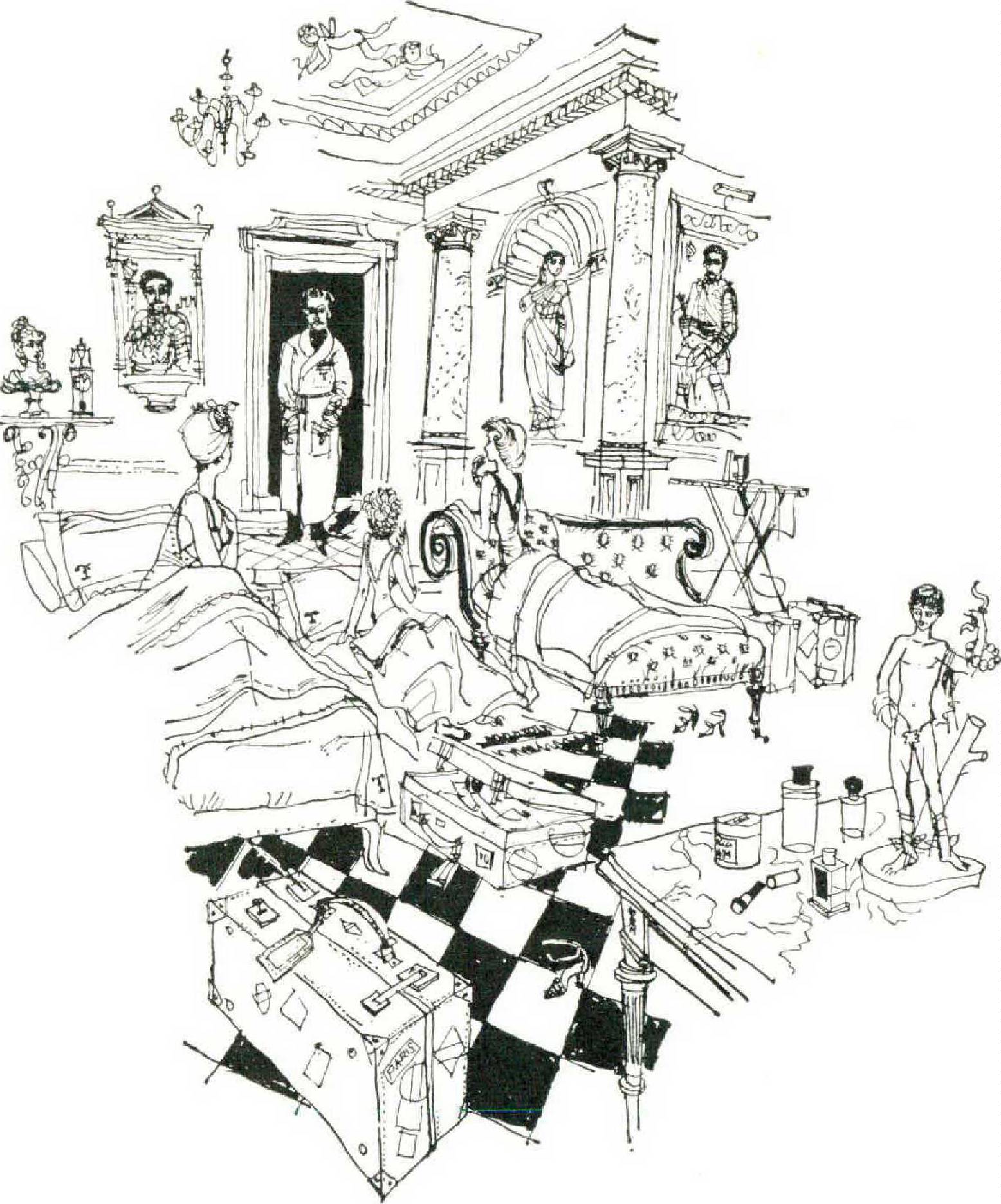
She inspected the premises on the Via Muratte, a small street not far from the Fontana di Trevi. She liked the location overlooking a small courtyard but found the accommodation small. She returned to say that there was definitely not room to sleep eight; only three could possibly be squeezed in. Pru and I were chosen. The Marche se was not eager for two chaperones, but Gillian remained stubborn, and we were graciously included in the invitation.
We were delighted at the prospect of living for nothing at the Marchese’s, but Gillian was dubious.
“I’m having enough trouble with Toni as it
Personally, I’d live in a lion’s cage to avoid paying a hotel bill,” Pru said.
“How am I going to fend him off twenty-four hours a day?” Gillian asked.
“Tommie and I will take turns guarding you.”
Pru was most reassuring. “Everything’ll be all right. Trust old Pru.”
Gillian’s description of the Casa Tetrazzini had been inadequate. On the ground floor was a magnificent dining room, lit by small chandeliers and silver candelabra and reflected in a great Florentine mirror with a carved gill frame. The kitchen was less splendid, with few conveniences more modern than those used by the Etruscans. On the floor above were the Marchese’s grand bedroom suite, a small dressing room, and the drawing room resplendent with tasseled velvet curtains and ornate, uncomfortable antique furniture.
“Seems awfully crowded in here somehow,” Gillian said.
“It’s all those characters looking over your shoulder,” Pru explained.
The walls were lined with pictures. Some were unmistakably the Marchese’s ancestors with the same heavy-lidded eyes. They had obviously found the seventeenth and eighteenth centuries as boring as the Marchese found the present.
“I don’t want to look a gift horse in the teeth, but it’s not frightfully cozy, is it?” Pru looked around the room.
“Just needs living in, that’s all,” Gillian said.
“We can soon put that right. Let’s have a real unpack.” T h e closets were filled with our clothes, some of which had not been aired for weeks.
“ We must wash everything,” I said. The marble bathroom soon looked like a laundry.
“ Rather like ironing in the National Gallery,” Pru remarked. We kept the ironing board in the drawing room for convenience. Piles of damp clothes were stacked on t h e marbletopped French Empire table; the recently pressed garments were draped over vases of classical design or hung from ormolu wall brackets.
Gillian, as house guest, slept in a single divan. The watchdogs shared a chaise longue so narrow that we had to hold on to each other to keep from falling off. Once we were asleep, our grip loosened, and inevitably one of us slipped over the edge.
The first night I was awakened by Pru leaning over the side of the chaise longue and hissing in my ear, “Tommie! The place’s haunted! Look!”
A figure in a flowing white garment was floating about the room. We clung together, speechless with terror, until we discovered it was not an astral body but the Marchese in his dressing gown.
“I don’t know why he can’t sleep.” Pru was bitter. “He’s got plenty of room.”
We soon became aware that insomnia was only a minor symptom of a deep-seated trouble which Gillian was not prepared to alleviate.
A few nights later we were disturbed by groans emerging from a large armchair. The ghost was seated with his head in his hands.
“What’s the matter, Toni?” we asked.
“Life.” He gave a long-drawn-out moan.
“You know what’s depressing you. You don’t get enough sleep.” Gillian was terse. We had not had an unbroken night since we had arrived and this, combined with a feeling of being hunted, was beginning to make her irritable. “If you aren’t careful, we’re all going to be depressed. Now go back to bed, Toni. There’s a dear.”
Toni drifted off like a lost soul to the lonely comfort of his canopied four-poster.
Gillian was so anxious to get some sleep that she would have sacrificed either of us, and Pru and I would gladly have sacrificed each other, if the Marchese had been willing, but he was not. The ghost continued to walk.
The fourth member of the harem, Anna the maid, slept soundly through the nightly alarums and excursions. Anna, like the Marchese, was always tired, but not from housework. She came from a small village north of Rome, but the city had nothing to teach her. Her features were irregular and a small black mustache did not add to her appearance, but this was offset by ripe contours and willingness. The first time we saw her smuggle a man into the house we thought he was her boy friend. But as we never saw the same face twice, we were forced to another conclusion. Large quantities of the Marchese’s best Chianti enabled her to keep going, but she never had strength to squander on scrubbing and polishing.
3
THE other girls thought that the Marchese would make a good match for Gillian. They did not know he was married. Nor did we until he casually mentioned one day that he was dining with his wife. We were alarmed, but he assured us that she would be delighted that we were taking care of him. She was apparently fond of him, but could not face living with him. We understood why. It was all the three of us could do to handle him. He was always under foot — following us about like a sad retriever. But relief was in sight.
One afternoon there was a ring at the door, and we heard Anna’s shrill voice raised in argument.
“Trouble with one of the customers,” Gillian said, looking up from her mending.
“Psst! Psst!” Anna rushed into the room talking in unintelligible stage whispers and pointing with terrified looks downstairs. We paid no attention. She was always agitated over something, but when she started to tug at Gillian’s skirt, it was impossible to ignore her.
“Suppose we’ll have to humor her.” Gillian was allowing herself to be pulled towards the bedroom when a handsome middle-aged woman, flamboyantly dressed, swept in belligerently swinging a long rope of pearls.
“The Marchese is not here,” Gillian said.
“Non qui. Nicht hier. Pas ici,” I added for good measure.
Pointing to us accusingly, she let forth a torrent of words which so frightened Anna that she crept hurriedly out of the room. Despite a voice of considerable volume, and expressive gestures, we could not understand a word.
“No italiano,” we cried in unison, shaking our heads, shrugging our shoulders, and holding out six empty hands. This only increased her irritation.
“Have a cup of tea. You’ll feel better,” Pru suggested.
As she poured out a cup of tea and the visitor paused for breath, Gillian edged up to me and asked in a horrified whisper, “Tommie! You don’t think she’s the Marchioness?”
“Good Lord!” I looked again at our visitor. She appeared too vital to be an aristocrat, and the belligerent pearls were too big to be true, but I felt we should lose no time finding out.
“ Parlez-vous français? ” I ventured.
“Mais oui.”
“Bon. Bon.” Gillian implied that our problems of communication were solved.
“Qui êtes-vous? ” I asked.
“Gina Ciardini.” Gillian and I breathed more easily. “ Chanteuse à la Teatro Kliseo.”
“Ah.” We smiled encouragingly, nodding to each other. “She is a singer at the Eliseo.”
“We aussi in teatro,” Gillian explained. Gina nodded. She seemed well informed about us. We struggled upstream with our rudimentary French, making little headway until we caught a line explaining that she was a chère amie of the Marchese’s and had been unable to see him during her present visit to Rome. Accurately translating chère amie, we saw the light. She had heard disquieting rumors of a ménage à quatre at the Casa Tetrazzini and had come to fight for her lover. She looked as if she might carry a pearl-handled revolver in her muff, and I decided that to avoid drama we had better be explicit. I led Gina Ciardini to the bedroom and pointed inside.
“Marchese toutes fois là. Toujours.”
“ Tout seul,” Gillian added.
I pointed to the dressing room and said, “Nous toutes fois ici. Toujours.”
“ Toutes ensemble,”Gillian added.
Gina looked surprised, but we managed to convince her that far from being prepared to fight for the Marchese, we would welcome anyone who would take him off our hands, if only for a few hours.
“We never get any sleep,” Pru said plaintively.
“It’s not possible àdormir a wink. Pas a wink,” Gillian translated.
Gina was touched, and promised to share our burden. As often as we could we sent the Marchese off to the Eliseo, and Gina occupied him until the following day. Seeing less of the Marchese, we found we liked him more.
Each morning, having breakfasted on one of Anna’s cups of coffee speckled with little white handkerchiefs of boiled milk, I left Gillian in Pru’s care and made for the American Express. There was nearly always a letter from Karl or my family. My father and Karl were both devoted to the Holy City, but for different reasons. My father was anxious that I should not miss St. Peter’s and the catacombs. Karl kept inquiring whether I had yet seen Michelangelo’s Pietà and the Sistine Chapel. My mother thought it would be a wonderful time for me to read Gibbon’s Decline and Fall.
Robert Graves’s I, Claudius seemed more easily digestible between shows. Once I was embarked on that, the whole rabbit warren of ancient Rome came alive for me. The streets became peopled with ghosts in togas. I could hear them splashing about in the Roman baths, and under the pillars I could see orgies in session: men lounging on long couches, eating fruit from gold dishes and shouting in impeccable Latin, “Bring on the dancing girls!”
Their twentieth-century equivalents were gaily bankrupting themselves in the smart shops on the Via Veneto. The materials in the tantalizing shop windows were not the drab grays and muddy browns we had seen in Germany. Italian women always wore black, but with it they combined fuchsia, cyclamen, crimson, and chartreuse. They did not wear hats to keep their heads warm. Their headgear was gay and frivolous.
The girls regarded Rome as a civilized city. It had an English chemist who stocked familiar cosmetics, where the girls laid in a supply of Cutex, Yardley’s, and Coty’s for the lean cities ahead. But the true sign of a higher civilization was an English tearoom on the Piazza di Spagna where you could get a decent pot of tea and buttered crumpets. Every afternoon the girls gathered in this haven to rub shoulders with expatriates—tourists, artists, students, and elderly ladies wintering in Rome — safe for the moment from the wolves that prowled in the Italian undergrowth.
4
MILAN, smart and gay with a wide range of entertainments, was a favorite with the girls. As soon as we arrived they were off in a whirl like that of Rome, but I stepped off the Milanese merry-goround. Karl was coming to see me. I cleared the decks of all male impedimenta and made plans. I drew up a list of the things he should see, starting with Leonardo’s The Last Supper. I was sure he would have no lire, and I had saved a couple of hundred to feed us during his stay. I found a small trattoria behind the Duomo where we could eat for practically nothing. He would be staying at the Cavour Hotel, so I had no worry about his bed and breakfast, and with careful handling I thought I could just manage to finance him for a week. We might even have an occasional treat — my budget allowed for two sandwiches and two glasses of Löwenbräu beer at Biffi’s in the Galleria Vittorio Emanuele. But I was not worried. Karl would not care where or what we ate.
I waited for Karl in the Albergo Moderno through the afternoon until I had to go to the theater. I described him to everybody in the hotel and left minute instructions for him to be taken care of in my absence. When he walked in the door he was to be handed a letter by the desk porter and led to the bar, where I had left some lire with the barman to ensure that he could have a brandy after his long, cold drive. The manager, who spoke German, had been alerted to act as interpreter. In spite of the advance organization I was worried for fear he might not find me and go away.
When I rushed back from the theater Karl still had not come. I sat in the empty bar with an empty glass, keeping my vigil. The barman gave me sympathetic looks. I could see that he thought Karl was never coming. He was in the midst of profuse apologies for having to close the bar when he suddenly pointed to the door.
“Eccolo! ” he cried.
Karl was proudly ushered in by the manager, the desk porter, and a waiter.
“Madam!” Karl held out both hands. “I am already late, but I am arriving slowly. The roads they arc like a — a Spiegel.”
“A looking glass.” I smiled happily and the staff, carried away by the romance, embraced each other in sympathy. The manager could not be restrained from kissing Karl on both cheeks when he revealed that he came from the hotelier world — an international brotherhood like the theater.
The Cavour and the Kaiserhof might be top-line hotels, but the manager was going to show Karl that in the matter of personal service the humble Moderno was not to be despised. He must have something to drink. A Strega possibly? He must have something to eat. An omelette deliziosa? It would be a pleasure.
I made hurried calculations as to how much a Strega and an omelet might cost, and decided that if we were to keep within my budget, I had better explain the situation at once.
“You can only have one Strega, Karl,” I said gently. “I’ve got it all planned.”
“But Strega I like.”
I did not want to intrude money into a blissful reunion, but I took the plunge.
“There’s nothing to worry about. We’ll be all right as long as we aren’t extravagant. You see, I don’t have much money.”
“But I do.” Karl brought out a wallet well padded with lire.
“I’ll have a Strega too,” I said with a sigh of relief.
The omelet arrived, and after a talk with the waiter, in fluent Italian, Karl outlined his plans for showing me the city, starting with The Last Supper.
“I didn’t know you knew Milan.”
“Oh, I am coming to Milano since I am small boy,” he explained. “The owner of the Cavour he is godfather for me.”
There were more surprises. I knew Karl the sculptor, but I had hardly met Karl the hotelier. One day he would have to take over the Kaiserhof. By an agreement with his father, certain months in the year were given over to sculpture and the balance to the family business. His father’s methods of training were thorough. He insisted on Karl’s learning every branch of the business at first hand. The official object of Karl’s visit was to work as a commis chef in the kitchens of the Cavour. Our time was precious and not a moment was wasted. I waited outside the Cavour at lunchtime until the last costoletta alla Milanese had been cooked and Karl appeared without his white coat and chef’s hat to spend the afternoon with me. In t he evening he waited impatiently at the stage door of the Teatro Odeon while I dressed with one hand and removed my make-up with the other.
“We go to see my old teacher, Professor Zeiss,” Karl said one Sunday after lunch. “The Herr Professor is anti-Nazi. He is warned by an old student he is to be arrested and he escapes with his wife to Italy. They are living quietly, you understand, in an old house near the Breher Gallery. We are bringing them a little somethings.” Karl loaded a bag of provisions in the back of the car. “They are not having too much.”
The professor, a burly man with thick spectacles and a shock of white hair, greeted Karl affectionately and led us into a room furnished chiefly with books. His wife, a thin little woman who looked much older than her husband, poured the coffee. Their embittering experience had not alienated them from their native land. It was pathetic to watch them grasping on to each bit of news from Germany.
When it was time to go, Karl said that he would see them again when he was next in Milan. The professor smiled sadly and explained that it would not be safe for them to stay in Italy much longer. He had been offered a post in Prague and another in Minnesota. He thought he would accept Prague. He had been there and it looked not unlike a German city. Karl advised him to accept the American offer. Ashamed of my German and depressed by their circumstances, I had not said a word, but suddenly I burst out, “Sie müssen zu Minnesota gehen.” In stumbling German I told them that they must go to the States at once, while there was yet time.
“Schnell! Schnell!” I cried earnestly.
The professor, a little startled at. my vehemence, explained that at their age it was hard to tear up their roots and go so far away.
“Tell them, Karl,” I pleaded, “that they’ll like it. The people are friendly, kind. Many come from German stock. They won’t feel strange. Tell them I know. I’ve lived in the Middle West.”
We did not leave until we had convinced them that they must accept the offer immediately.
As the Basil Beauties were on their way to San Remo, Karl was driving north over the Brenner Pass. I had tried to persuade him that a couple of weeks in a kitchen on the Italian Riviera would be beneficial, but he had to return to Munich.
I would have given up the theater for Karl, but I was not to be given the opportunity. On my return to England some months later, I received a rather strange note from him saying that there was no point in continuing to correspond. I wrote him saying that I did not see why there had to be a definite break. This brought no reply for several weeks until a letter arrived with a Zurich postmark. It had been smuggled out of Germany by a friend of Karl’s. It removed the fear that he might have fallen in love with somebody else, but it gave me an even more serious one. Karl was in danger. The Nazi Party owned most of the buildings in the block where the Kaiserhof was situated and they wanted the hotel. The problem of how to get it was simplified for them by the fact that Karl’s family were known to be unsympathetic to the Nazi cause. His father had been denounced by one of his employees and had been taken to Gestapo headquarters. Influential friends had obtained his release, but since then the family’s movements were being carefully watched — the telephones tapped and their letters opened. Karl explained that by writing I would only further compromise him and his family. He ended the letter by saying, “I have the statue to remind me of you, but I not need this. You are with me, Liebchen, wherever I go. And you are not to worry about these things. I am sure we keep a step away from the Gestapo.” In my worst moments I had visions of a black car drawing up to the rear entrance of the Kaiserhof, but I was sustained by a conviction that, whatever lay ahead, Karl would somehow pull through.