The Perfect Polyglot
by LOUIS MCINTOSH
A native of London who likes to spend his vacations on the Continent, LOUIS MCINTOSH IS an expert in linguistic camouflage.
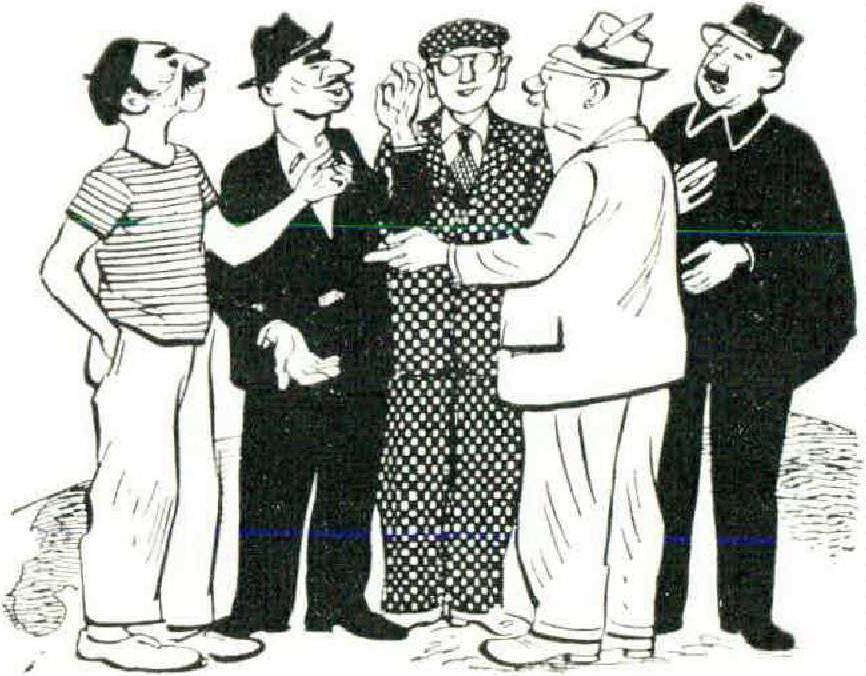
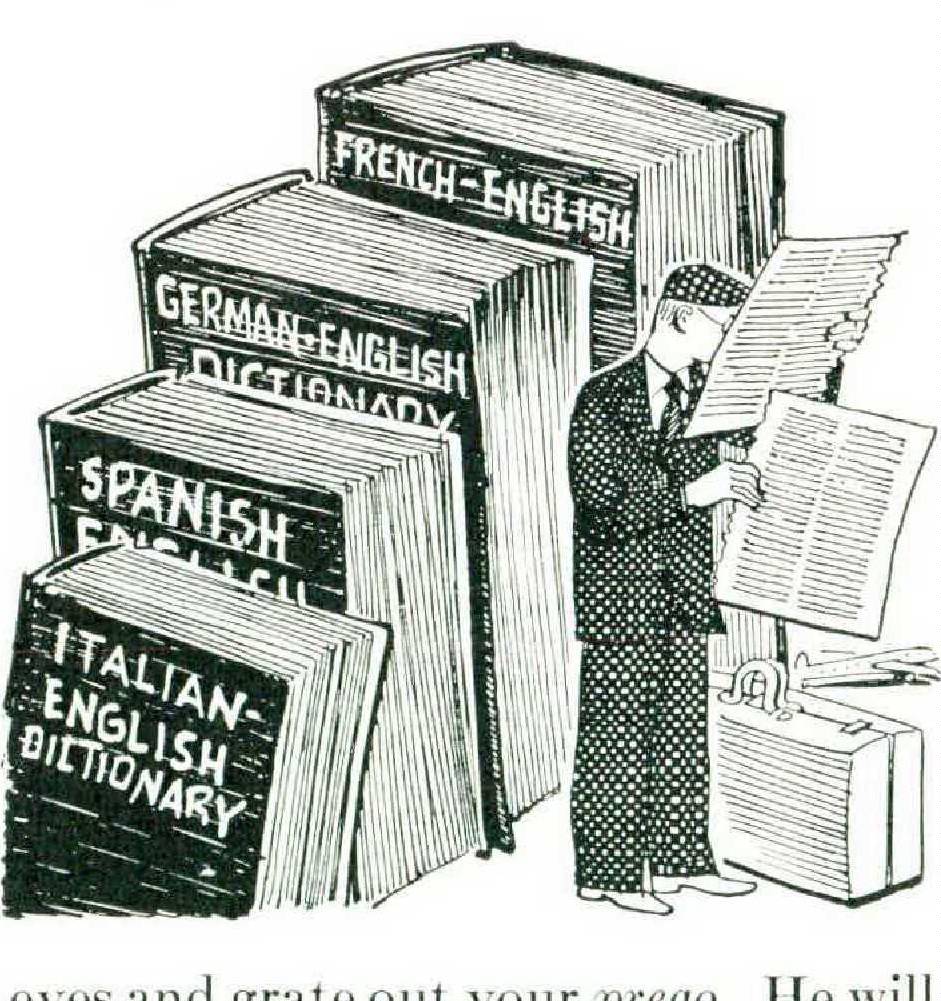
WHEN you visit a foreign country, do not try to learn the language. It is too difficult, and your failure to do so will only rub in the fact that you are a foreigner. What you can do is to pretend that you know the language. You need very little linguistic equipment, and a great deal of bluff, to pass yourself off as a native of the country. One or two strategically chosen words and phrases will give the impression that you know the rest of the language.
In Italian, for example, there is the word prego, which is a godsend to foreigners, as it can mean almost anything. Its basic meanings are “please,” “don’t thank me,” “you’re treading on my toe,” and “get the hell out of here,” but it is flexible enough to fit almost any situation, like “coexistence” in Russian diplomacy. It is just a question of waiting for the right moment, and then bringing it out with an idiomatic lilt. If you see an Italian beggar walking off with your luggage as you are looking for a taxi, go up to him, glare at him in silent wrath, and then — only then — look him between the eyes and grate out your prego. He will be far loo impressed ever to think of stealing your luggage again.
Another good word for a tight spot in Italy is permesso. This is a polite word, meaning “allow me,” which the Italians use, with delightful sarcasm, to accompany the most impolite behavior. When you are fighting your way through a crowd of Neapolitan housewives in order to get on to a bus, hiss permesso at them, and the vicious elbow shoves that you get will prove to you that you are accepted as one of them.
Do not be worried if this seems very little to go on. Even after weeks of study on a language there are many things you find you cannot say in it. So you must learn to make your feelings fit your vocabulary. If the only Italian word that you know is bellissima (and it is the only one that most people know) it is amazing how often you find yourself feeling the superlative admiration which it so exactly expresses — especially on sightseeing holidays in Italy.
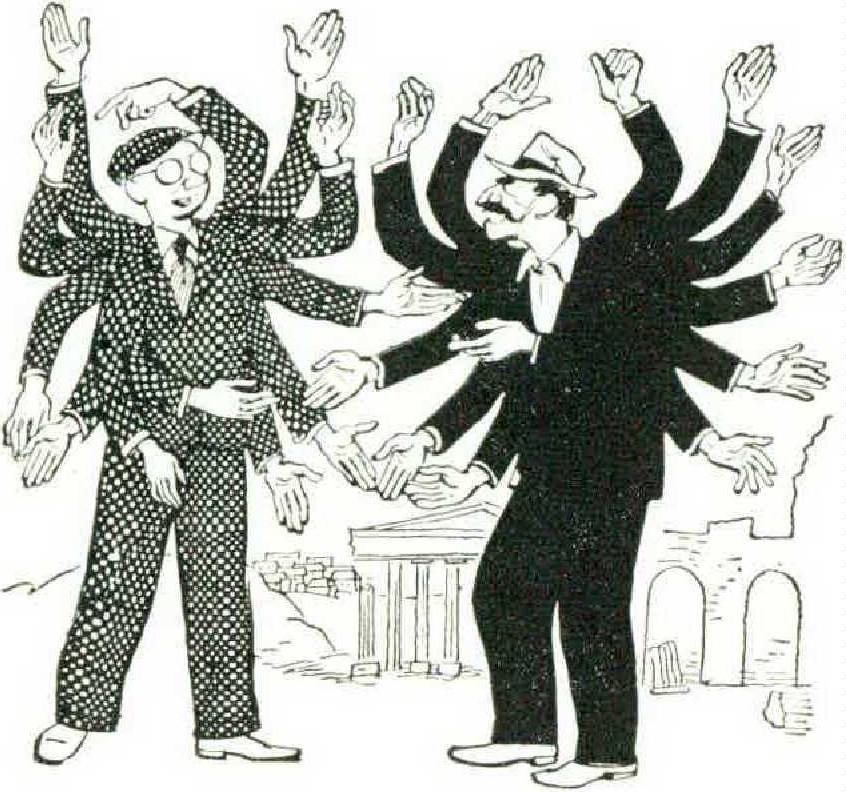
Italian is hardly a fair example, though, because it is so absurdly easy. Most of the time you need not talk at all, but can restrict yourself to gestures and ejaculations. But girls should beware of Italian men who offer to teach them the language, as words are soon liable to give way to gestures of unmistakable import, Gesture-language may be a restriction for foreigners, but for Italians it is quite the opposite.
In Spain more than anywhere else, it is important to pretend to know the language. To the Spaniards, anyone who doesn’t talk Spanish doesn’t talk at all, and is therefore uncommunicative and unfriendly. Sometimes they will address Americans in bad French, on the theory that, in speaking to foreigners, some foreign language, even the wrong one, is better than none. But their bad French is much harder to understand than iheir Spanish.
Whenever anyone says anything to you in Spain, a safe reply is según, meaning “it all depends.”This, as well as being good Spanish, indicates ineffable wisdom on any topic under the sun. Awkward gaps in the conversation can he filled by quoting Lorca. Although Lorca’s works still cannot he published (only sold) in Spain, they have changed from being revolutionary to being respectable. All Spaniards appreciate Lorca’s gypsy ballads, and they will be able to prompt you if need be. It doesn’t matter if you don’t understand them; anyway, it would take up far loo much time to look up the words besides learning them by heart.
Most things in Germany can be adequately described by sichön (beautiful) or gross (large). If you feel that these are inadequate, there is a refinement. You can add the prefix wunder to any adjective and thus supercharge it. So you can call Hildegardo Neff wunderschön (if you really want to) and Rhineland castles wundergross (though most of them are gross rather than wonderful).
As German word-order is rather complicated, it is risky to venture too many of your own sentences. Wait until the other person has spoken, nod your head in grave assent, and say, “Ack, so.”Or you can pluck up confidence and repeat what he has said after him. Not only will it be good German, but he will be delighted to find that you agree with him. I once motored around Germany in an old vintage ear of the 1920s. I was amazed to find that every German who came up to examine it made the same comment: “Das ist die Hauptsache, wenn es läuft.”first I would repeat this incantation, and in this way I made many good friends. After a while I became bolder, and when anybody came up to the ear I would forestall him by myself saying, “Das isl die Hauptsache, wenn es läuft.”Then he would repeat it after me. I would glow with pride at the progress I had made. It was only much later that I discovered that the sentence meant: “It may he an old crock, but anyway it moves.”
It is the adverbs which can be used to make the most convincing display in German, and the more syllables 1 he better. By the time you have worked your way to the end of unglücklichcrweise or selbstverständlich (unfortunately, obviously), your hearers should need no further persuading that you are a master of the German tongue. The great advantage of adverbs over the other long words in which German abounds is that they can be used much more frequently. To use Verantwortungslosigkeit (irresponsibility) on any and every occasion would be a trifle verantwortuvgslos. The longest current word in German used to be I Westeuropd ischeverteidigungsgemeinschaft (Europea n Defense Community). Linguists and federalists are united in lamenting its obsolescence.
In France you must take sides. You must be able to show violent approval or disapproval of the latest paintings, plays, public figures, and so forth. There arc enormous numbers of words expressing both pro and con altitudes, but be careful not to use those that have gone out of fashion. Thus formidable, which has got into all the phrase books, is thoroughly demode. More up-to-date expressions of partiality are sensationnel, crevant, and side raid, and the dernier cri is ravageant (at lime of writing). As might be expected, French is even richer in abuse. Ignoble, crapuleux, and minable are three choice adjectives of disgust to memorize. The nouns used for slanging people — for example, cuistre, ordure, goujat — should be used with care, as they can be, and often are, used to provoke si reel scenes for the entertainment of passers-by.
If you can bring out a few phrases of argot (slang), your popularity in France will be assured. For example, in the dictionary you will find the word argent, which is supposed to mean money. But it is never used outside the pages of economics textbooks. Frenchmen always use argot words for money, such as fric, grisbi, zozotte, and many others; you say your money, and you take your choice. Similarly, French currency is currently measured not in francs but in balles.
Do not be misled by Frenchmen saying, “ Vous parlez parfaitement fraçrais" (You speak French perfectly). This is meant as an encouragement, but is in fact an insult to your French. If you did speak perfectly, it would occur to nobody to remark on the fact. You only know that you are getting somewhere with the language when the French stop telling you so.
It is difficult to mimic the Parisian accent successfully. The solution is to put on some provincial accent. It doesn’t matter which, as long as it isn’t one of the recognizable foreign accents which foreigners assiduously acquire by imitating each other’s mispronunciations. A friend of mine used to adopt this technique in France, and claimed that he was an Alsatian, speaking in the thick Teutonic brogue of the Alsatian beerswiller. One day he was unwise enough to bring this device into play against a real Alsatian, who immediately switched to t he Alsatian patois (sub-language), a bastard mixture of French and German punctuated with hiccoughs. My friend saw what was up, and had the presence of mind to say, “Let us not speak in our native tongue. It brings back such painful memories.”It still does, when he thinks how nearly his bluff was called.