The Humans
by NEST A PAIN
NESTA PAIN has been a staff writer for the British Broadcasting Corporation since 1942, and much of her work has dealt with scientific subjects.
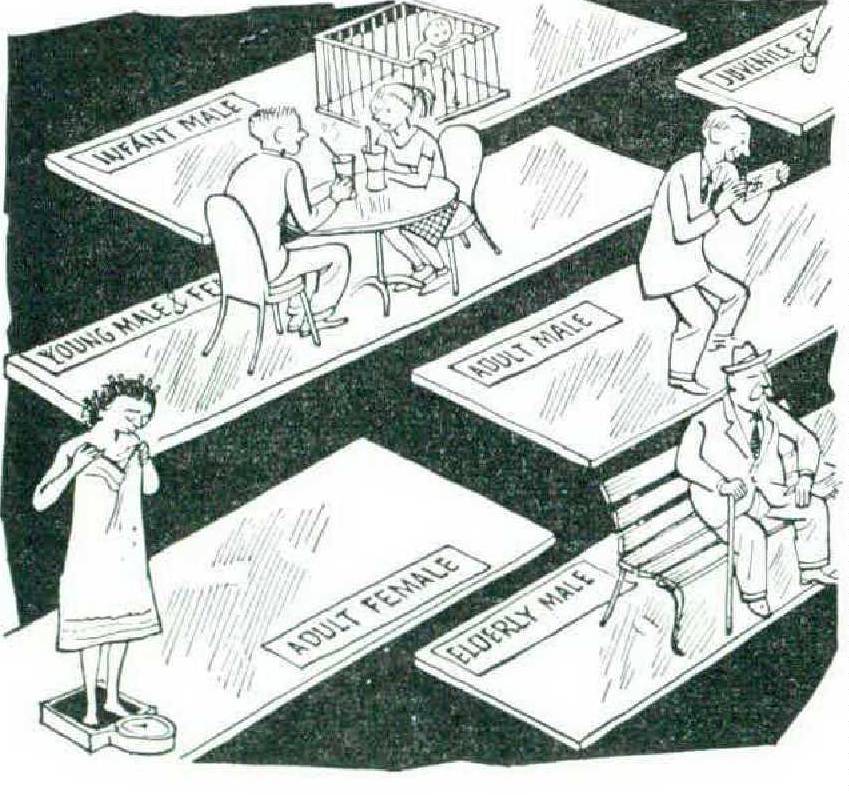
I HAVE continued to record my day-to-day observations of the human colony installed in my laboratory and I have seen nothing to make me reconsider my view that man is a semi-social animal, with a community life rather less highly developed than that of the ant but considerably further advanced than that, say, of the grasshopper. Man’s behavior, complicated as it sometimes is, can be quite satisfactorily explained in terms of reactions to stimuli, as I hope to show, and there seems no reason to invoke conscious purpose or feeling, as some workers have not hesitated to do.
I have made a number of experiments in order to test human reactions in a variety of situations. I have, for instance, several times exposed them to imminent danger by setting one of their nests on fire. (I refer to those communal nests occupied by a number of family groups, apparently brought together by some system of selection not yet fully explained.)
The pattern of events which follows is fairly consistent. At the first, awareness of danger, most of the inhabitants of the nest show a strongly marked escape drive, and there is a great deal of scurrying to and fro as they seek to find a way to safety. Soon, as the fire advances, the “fire teams" appear on the scene — those humans of characteristic coloration which appear to be specifically attracted to all conflagrations of any size.
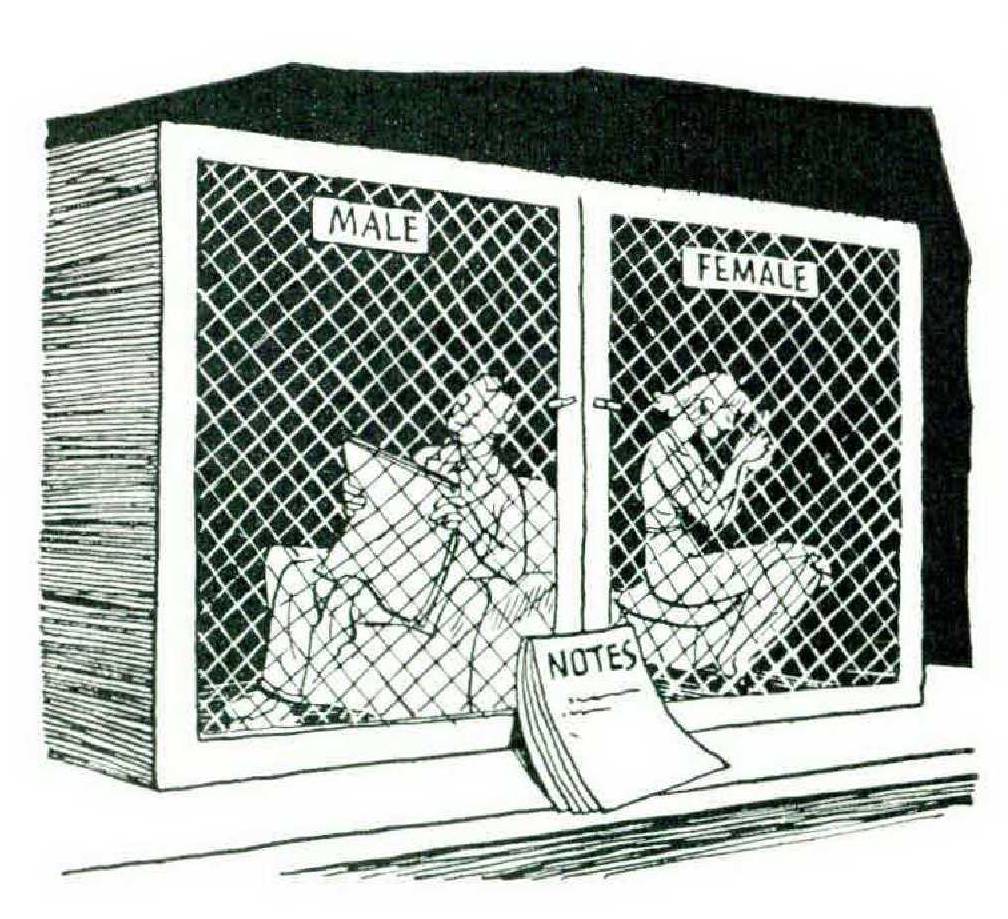
(Specialization in different kinds of “work” appears to be almost more highly developed among humans than among ants and termites.)
These fire teams might be thought to show courage in their efforts to put out the fire and rescue the victims, but a more careful examination of the facts indicates that such a concept would be quite out of place. If boiling water is poured on an ants’ nest, the ants, far from seeking to escape, may be seen pouring back into it — “at the risk of their lives,” as we might be tempted to say—in order to rescue their young. Yet nobody nowadays would maintain that they are performing an act of high courage. They act as they do because they are what they are.
Through long centuries of evolution they have developed an instinct to react to stimuli in the way most beneficial to the group. So it is not unreasonable to suppose that these human fire teams have evolved in such a way that they instinctively react to the stimulus of a fire by running toward it and attempting to put it out. Once the fire is out, the stimulus is gone and they show no further interest in the fellow creatures they have rescued with so much apparent sacrifice. Indeed, they make off with considerable haste and seem quite indifferent now to the whole affair.
So far as the maternal drive in humans is concerned, there seems to be a fairly high degree of care shown toward the young, although the mother has been observed at times to attack them with sublethal blows. In general, the family group tends to remain in association rather longer than is usual in the animal world, although the young are herded away for considerable periods into special enclosures where they are watched over by adults which appear to specialize in this task. One is reminded of the “nurses" which stand guard over the penguin nurseries.
Courlship behavior among humans offers points of particular interest, and there is evidence that some degree of choice is exercised in the selection of a mate. At the very least, one can say that some females appear to exercise a stronger attraction than others. Long before maturity comes, a change of coloring can be observed in these females. In particular a vivid shade of red appears on the mouth parts and the extremities of the forelimbs (the “talons”). Also in some cases a fairly strong scent can be detected. This appears to be intermittent; it varies from individual to individual, and may be derived from an externa] source. However that may be, I am inclined to think that it is a specific sexual recognition signal.
The early stages of courtship are frequently carried out at places where both sexes congregate in large numbers and perform elementary gyrations to the accompaniment of a grating, buzzing sound. (This sound is not produced by any special appendages of the. humans themselves, but by tools which they have devised for the purpose. Humans are comparatively well advanced in the use of tools.) When this music — if we may cull it that — begins, a clasping reflex is released in the males. They seize a female, holding her firmly grasped in the forelimbs, and rotate.
In most cases, they appear to lay hold of the female nearest at hand, but sometimes they seem to be exercising initiative in seeking out a particular partner. Certainly it appears indisputable that large numbers of males cluster round certain females (I have marked these females with a dab of white paint and have found their attraction to be quite consistent). Other females appear to have difficulty in securing a partner at all.
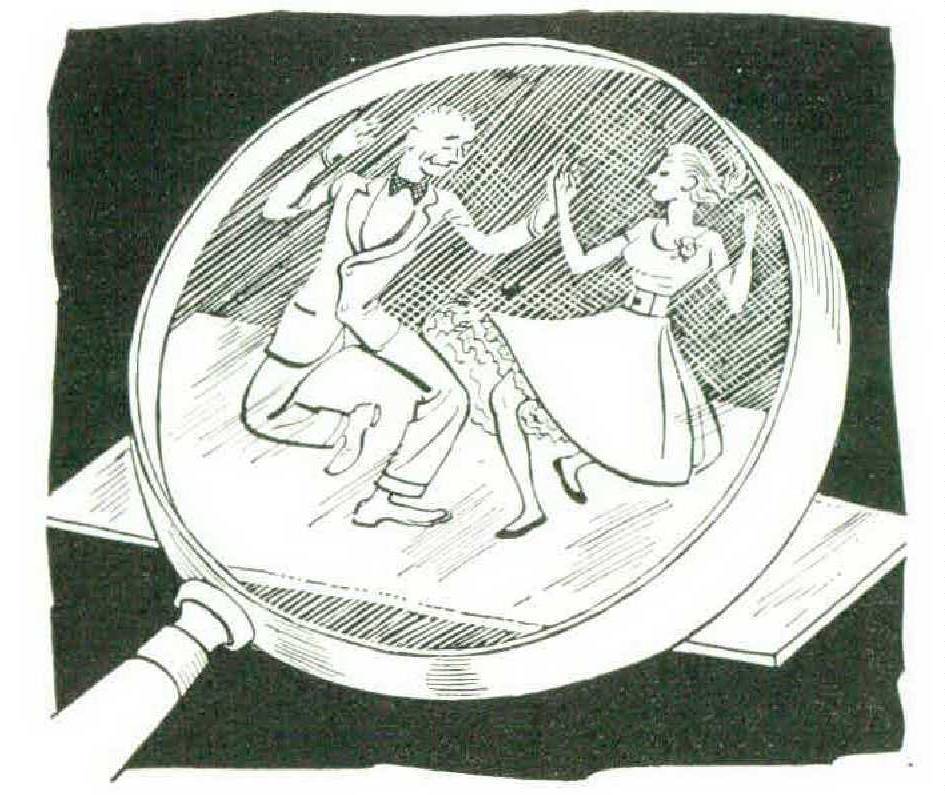
This dancing goes on for several hours but not always between identical couples. Occasionally a couple separates itself from the others and goes away alone. Courtship may then be carried a stage further. This whole phase of activity reminds one irresistibly of the courtship dances of the Empid flies.
Feeding is another aspect of courtship behavior which I have frequently observed. It happens almost invariably that at some stage of the courtship mutual feeding takes place, the male appearing to take the initiative in coaxing a female to share food with him. Courtship may still be broken off even at this stage, however, and it is by no means invariable that couples which feed together will also mate together.
The offering of gifts seems to be more decisive. Like those of certain Empid flies, these gifts appear to be chosen for aesthetic appeal rather than utility. Where the Empids offer florets or scraps of colored paper, humans too may offer flowers orrather more unusual—brightly colored baubles which the female contrives to attach to herself. Like the Empids, humans may conceal these gifts in wrappings (they use paper rather than the silk favored by the Empids); but so far as I have been able to observe, no humans have yet adopted the practice followed by certain species of Empid flies of offering elaborate wrappings with nothing at all inside. This practice may belong to a later stage of development not yet reached by humans.
A fair tolerance seems to be shown by humans toward the old and the sick, and these are frequently herded into special nests where they are fed and cleaned without being obliged to perform any work in return. Some authorities have taken this tolerance to be a sign of decadence, and prophesy that it will lead to the eventual extinction of those human colonies which practice it. They cite the example of ants and their extraordinary tolerance toward parasites, which sometimes brings about the destruction of the colony. I intend to study this aspect of human behavior and attempt to determine how far this care of useless lives may constitute a threat to a healthy colony.
I also hope, in a later communication, to make some contribution to the problem of specialization and work, which is far from fully explained. I have been observing in particular those humans for which paper appears to exercise some peculiar fascination. It has been maintained by some workers that they derive a special kind of nourishment from the paper which they are so assiduous in gathering round themselves, but I have never been able to find that it is actually consumed, although it is frequently picked up, held in front of the face parts, and put down again. What seems to be undoubted is that this group exercises some function which is deemed valuable to t he community, for they seem able to claim a share of food at least equal, if not superior, to that enjoyed by humans engaged in what would seem to us more obviously useful act ivities.
For the rest, I find my colony an unending source of entertainment as well as a rewarding object of study. I hope that other naturalists may be encouraged by these notes to add their observations to mine, for there is much in the behavior of these fascinating little humans which is far from being clearly understood.