The Wrong Weight
by R. G. G. PRICE
R. G. G. PRICE has contributed a great variety of light writing and criticism to Punch in recent years.
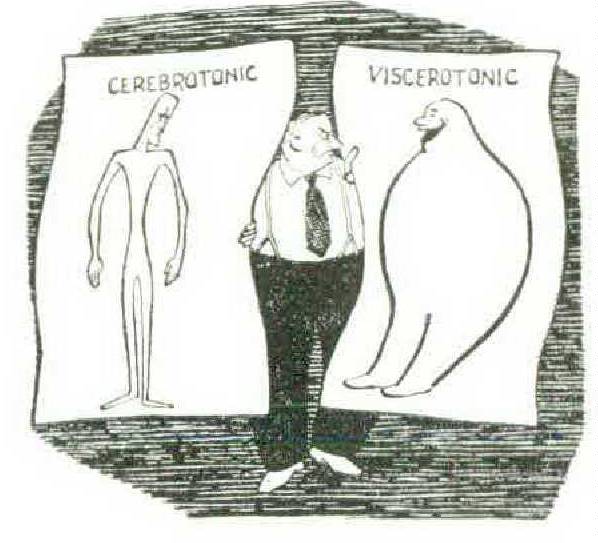
Two years ago I was a thin man with a fat man’s mind, and now I am a fat man with a thin man’s mind. One Sheldon, whose views I am pinching from an essay by Aldous Huxley, has argued that bodily shape and temperament are closely connected. When I was tall and gaunt, what he calls an Ectomorph — and I cannot imagine an apter name — I ought to have been nervous, shy, and moody. (In his classification of types of temperament this is the Cerebrotonic.) Unfortunately I was as gay as a Technicolor carnival. Nothing worried me but being short of cigarettes. I lived a happy, relaxed, beachcombing kind of life and as I wandered about town there was an invisible lei round my scrawny neck.
Then under medical threats I gave up smoking. After the first shock was over, I put on weight fast. I took an interest in my food, which I was delighted to find had different tastes, and very soon I became soft and rounded, what Sheldon calls an Endomorph, and should have had the kind of temperament he calls Viscerotonic. I should have had an intense delight in family life. I should have loved eating in common, ceremoniousness, and company. I should have become indiscriminately amiable. Instead, I became nervous, shy, and moody. My eyes stopped gleaming with fun and curdled and flickered towards the edges. I was always worrying.
There has been a further complication that Sheldon may not have considered: there is a time lag. I have spent so much of my life being teased for my thinness that I assume I am still thin. All those jokes about not having to open doors in order to go
through them have bitten into me. Now I never open doors far enough. In the old days my behavior was appropriate to my contours. Now there is a discrepancy. At parties there is usually a difference in the stances of thin and fat men. I used to be able to merge into the wallpaper, glass in hand, and get comfortably overlooked. Now when my fellow guests see me forcing my bulk against the wall they think either that I am drunk and overpropping myself or that I am furtively looking for a secret passage to make my getaway. An attempt at unobtrusiveness that fails may mean social disaster.
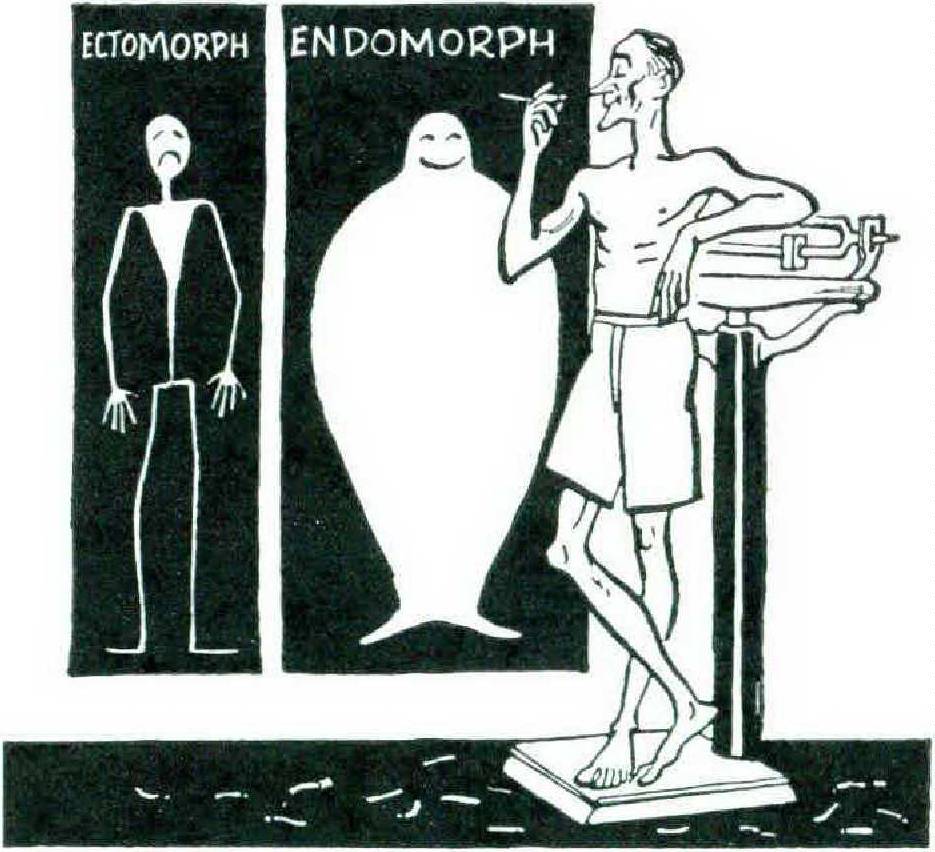
Obviously I have to get completely into one group or the other, and the jolly Viscerotonic sounds as if he got much more fun than the gloomy, introspective Cerebrotonic. I think the best way to do this is to take a hint from Sir Max Beerbohm’s fable, The Happy Hypocrite. Lord George Hell, whose face bore a case history of dissipation, wished to woo an innocent maid, so he bought a mask so pure and saintly that he easily won her love; but by dint of wearing it his face changed underneath and his nature with it. The best way to become a Viscerotonic is to act like one. However much I quake inside my fatty envelope, I must be cheerful and sociable in public. I must tell stories and slap backs and be infectiously gay. The trouble is that this might take so much out of me that I would thin down and by the time I was an Ectomorph again my temperament would still be out of step. If I am going to lose weight it would be pleasanter to do it by smoking.
I notice that in this system of classification only one kind of fat man is included, the indiscriminately amiable. What about the magisterialepiscopal? This would surely be a much better goal for me. I should enjoy standing rocklike in the middle of the room while small men squirmed round me apologetically. In measured tones I should throw the weight of my considerable authority into the scales against Youth or Modern Art. My voice, I think, would be ruminative and rumbly. When it became necessary to rebuke presumption my jowls would shake with stately disapproval. I should be paternally jocose to the daughters of the richer families. Unhappily, no amount of deliberate character-adoption will blot out the memory of the past. I should never forget that in my cheery, emaciated, sensible days I should have considered my new self an appalling old man, and I should recognize this view as right.
Sheldon has a third category, physically described as Mesomorphs and temperamentally as Somatonics. As these are large-boned, strong-muscled heroes, I do not think that anything I do about tobacco will get me into their class. It is not one I find attractive, Cerebrotonics, in Huxley’s words, “suffer acutely from the unrestrained bellowing and trampling of the Somatome;” So, I should imagine, do Viscerotonics, who must find bellowing and trampling very disturbing when they are ceremoniously eating in common.
It seems to me that neither the callous and competitive Somatonics nor the grim and self-searching Cerebrotonics would make nice friends for me, still less make good models. Unhappily, I am now coming to feel that even the merry Viscerotonics are not wholly admirable. Apparently they go in for telling everybody they meet exactly how they feel, and resemble — according to Huxley—liberal Protestant clergymen. If this be true, I am wrong in thinking that in the good old days I belonged to this group. Even when I was chainsmoking twenty hours a day there was nothing faintly clerical about me. I am much more likely to have categories of my own. I think that for many years I must have been a skinny and lighthearted Nicotonic and that probably my present condition can best be described as Megalomelancholic.