The New Mallarkey
by PEG BRACKEN
PEG BRACKEN is the pseudonym of Mrs. Roderick Lull of Portland, Oregon. Her verse, articles, and stories have appeared in many magazines.
THERE are more tricks to the glossy fiction trade than the casual reader probably thinks. One of the writer’s big problems, as he creates his beautiful, brave, lovable characters, is making them beautiful enough and brave enough, and still keeping them lovable.
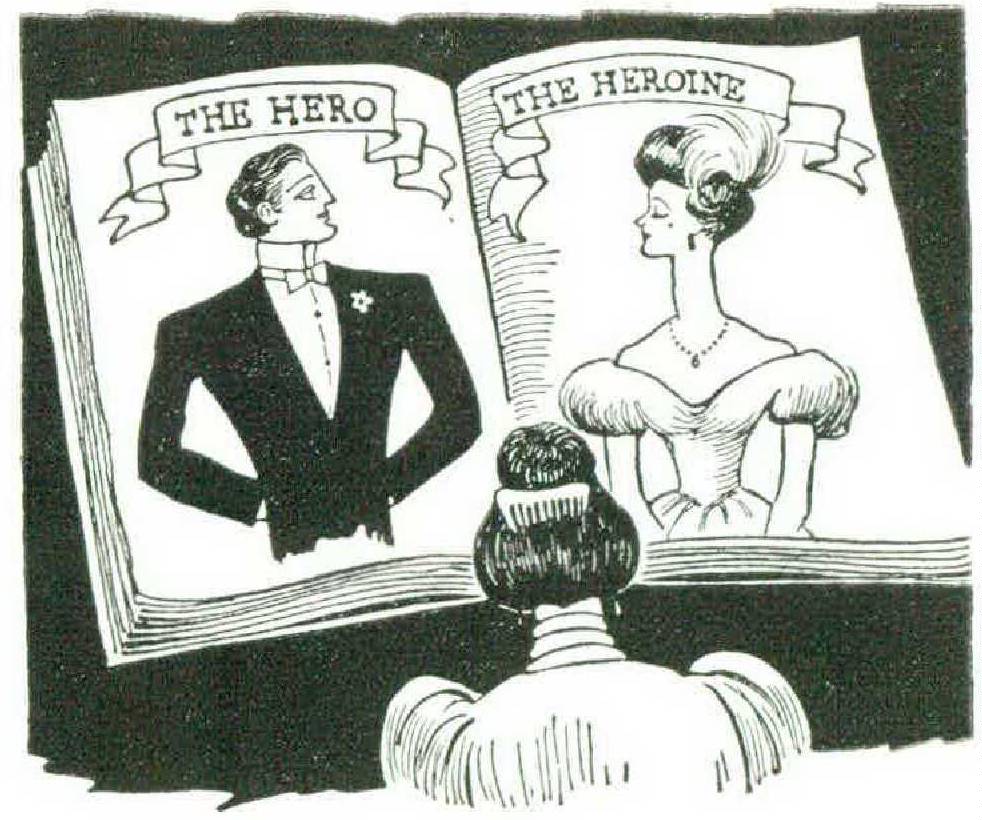
The fact is, times have changed. Today’s sophisticated reader will no longer buy yesterday’s heroine, who walked in virtue, her eyes blue as the sky over Naples, with cheeks that shamed the rose. He is equally unconvinced by yesterday’s hero, that big handsome broad-shouldered curlyhaired package of incorruptibility.
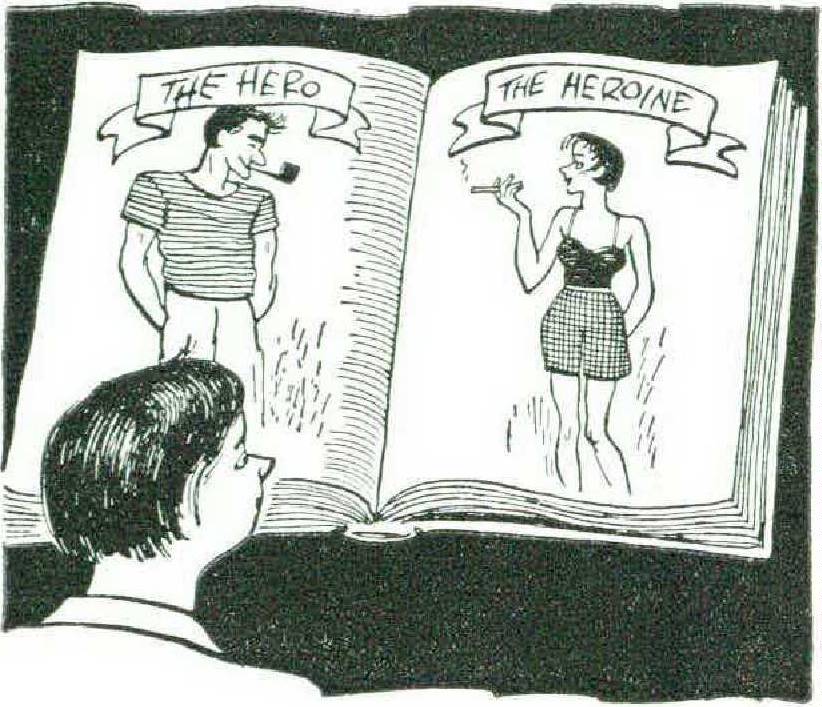
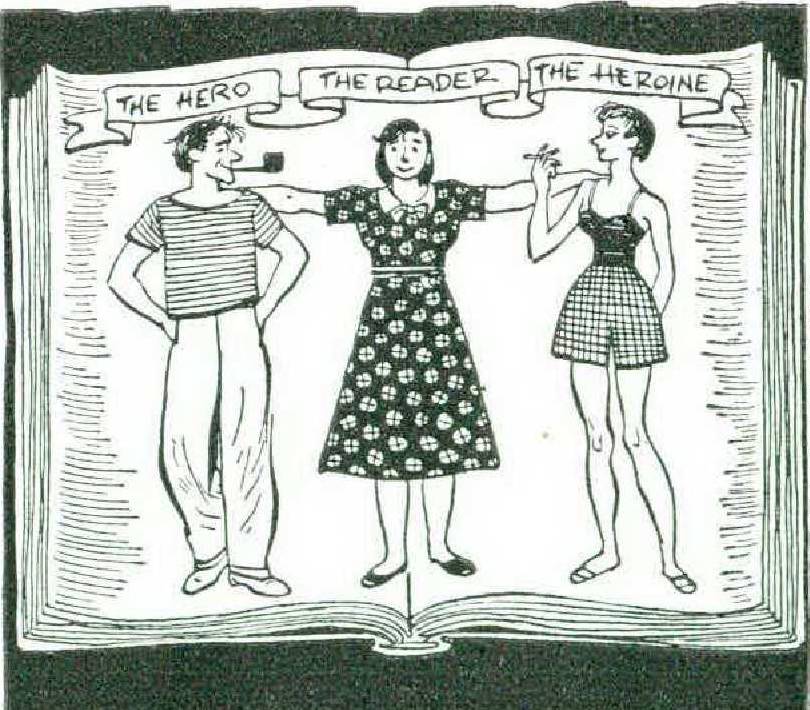
A thing called Reader Identification has set in. The reader knows, deep down, that he is not as beautiful or lovable as that, and furthermore he doubts whether anyone is.
Thus, the twin horns of the writer’s dilemma are distressingly clear. The writer must, to put it bluntly, lay off the mallarkey. But he knows, too, that his feminine readers will refuse just as flatly to identify themselves with a thick-waisted heroine or one who has a front tooth out; nor will his masculine readers stay long with a pothellied hero.
It is encouraging to be able to report that writers have solved the problem — not with the faint praise which damns, but with the faint damn which praises. For example: “Brad looked at Pam. She was too thin, her cheekbones too high, her eyes too wide apart. . . .”
Now, there is Reader Identification with a hey-nonnie. Every woman wants to be too thin. And love those high cheekbones, those wide-set eyes! But here she finds them brusquely dismissed as faults.
Well, the reader has faults too. She knows how it is. And while she privately imagines the heroine to be about as beautiful as any girl can be, she derives a certain feminine comfort from hearing that not everyone thinks so. The reader immediately joins the heroine’s team. She becomes her Secret Pal.
It is not easy, this matter of presenting virtues as faults; the writer must remember at all times that Pam’s legs may be too long, but not so her nose. Her eyes may be too large, but never, under any circumstances, her knuckles. “Pam’s toogenerous mobile mouth” is always acceptable to the reader, but “Pam’s big flapping mouth” would be rejected instantly. No, it isn’t easy. And the writer encounters the same problem when he describes the house or the room Pam lives in. Yet, here again, the same approach will ease the way to Reader Identification: —
“It wasn’t a smart room. Obviously no interior decorator had had a hand in assembling this casual collection of odd pieces; no decorator would have condoned the faded chintzes and the clutter of books. Even the kindly firelight burnishing the rocker and the old copper kettle couldn’t quite hide the shabbiness of the rug. Yet Brad liked the room, felt at home there. . . .”
Note the shrewd use of the “yet” instead of a “therefore.” Observe its magical effect in making the reader feel superior to the writer, as well as at home in the room. “Why, that’s my kind of place!” the reader thinks. “What does this silly writer want, a store window? My stuff doesn’t match either. And as for books, well, I always say a room just isn’t a room without books. . . .”So the reader is more than ever ready to share Pam’s problems and eventual joys.
The aspiring glossy fiction writer should know that his heroes will respond just as nicely to the faint damn as will his heroines and his settings. When a man reads that “Brad’s face was casually put together, the nose jutting, the lines deep — a face marked by the hard living of forty-one years,” he feels better about his own face, which was designed a bit haphazardly too. Also, the suggestion of manly dissipation enables him to write off his own extra rounds at the nineteenth hole. At the same time, he senses that none of these things is going to handicap Brad in the slightest. Brad is obviously a nice combination of valor and virility. He will go far, and the reader will follow him all the way.
It is true that there are pitfalls with heroes, as with heroines, and the alert writer will keep them in mind. For instance, a tight-lipped hero who grins an occasional crooked grin will be readily accepted by the reader, even though these traits, in real life, are usually an indication of bad bridgework. But the reader will quickly shy away from Brad should he have foot trouble. Foot trouble, for some reason, belongs to men named Harold Buebke, not Brad Reynolds; and heroes are never named Harold Buebke.
It is all a matter of knowing how and what to insult without insulting. It is for this reason that the writer so often seems preoccupied with the hero’s hair. Brad can have hair like old rope, and often does. Or he can have mussed-up hair, although the better adjective is “unruly,” or he can even have hair that’s growing thin on top — no matter, it will lower him not one whit in the reader’s estimation; moreover, it will provide a comfortable bond of Reader Identification.
No discussion of the praise-whiledamning method would be complete without mention of the flashback to adolescence — a technique which has been often and profitably used by writers who know their business. One of its many merits is that it permits the heroine to be an absolute dilly from the first moment she appears.
“Brad looked at Pam Harrison, slim, poised, perfect. There had been a little Pam Harrison once, years ago, before the war had torn and twisted so many things. . . . Pam Harrison, the little kid next door.
“ ‘Pam, are you the same girl that—’ Brad stopped, feeling like a fool. This girl, this copper-haired beauty with the exquisite legs, the warm ivory skin, the marvelous laughing mouth — she could never have been that skinny brat with the freckles, that kid with the braces on her teeth.
“ ‘You mean, was I the kid you used to chase home from school with snowballs?’ Pam wrinkled her nose, charmingly. ‘Yes. Wasn’t I awful?’
“Brad grinned.
“ ‘I was pretty awful myself,’ he said ruefully. ‘Remember how . . .’ ”
Now, this isn’t as easy as it looks. It’s quite all right for the child Pam to be remembered with braces on her teeth, a skinny freckled gamin. But the reader wall never make contact with Pam if she used to be doughfaced and overweight. Once in a long time a writer will fatten up a young heroine and get away with it, but the trick lies in the use of the word “pudgy,” which has a rollicking cherubic quality that’s rather fun.
However, once these problems have been met and mastered, the writer finds himself in a nice position, and can get on with his story; he has given his principals a reasonably repulsive adolescence, and the reader shouldn’t quibble over their distinct charm as adults. After all, fair’s fair.
This takes care of all the description the writer has to worry about, with one exception. If it is ever necessary to describe someone asleep in bed — and it is surprising how often this is necessary — there is only one way to do it: “Lying there asleep in the rumpled bedclothes, he looked defenseless.”
A querulous critic might object, Unless he is Lucky Luciano lying there asleep with his gat under his pillow and his finger on the trigger, how in the world else can he look? But that is mere carping, and it need not be considered here.