Unrecorded
by Angelos Sikelianos
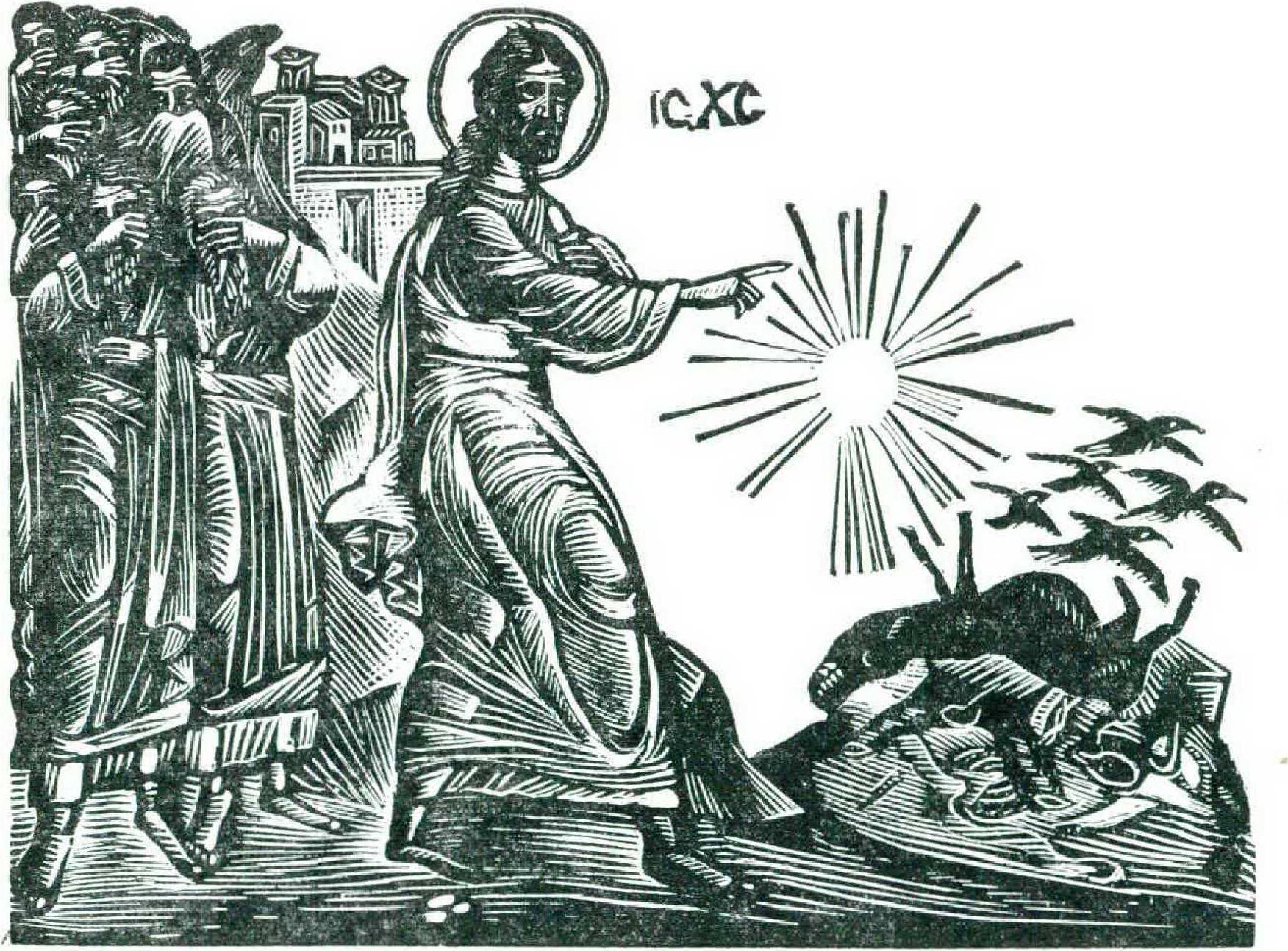
A little beyond the walls of Zion, walking
one day somewhat before the set of sun,
Jesus and his disciples came by chance
to that place where for years the town had cast
its rubbish: burnt mattresses of the diseased,
rags, broken crockery, refuse and filth.
one day somewhat before the set of sun,
Jesus and his disciples came by chance
to that place where for years the town had cast
its rubbish: burnt mattresses of the diseased,
rags, broken crockery, refuse and filth.
And there upon the highest mound of all,
bloated, its legs turned upward towards the sky,
the carcass of a dog lay stretched, from which
at once, as vultures thickly piled on it
took fright at steps approaching, so foul a stench
broke forth, that, the disciples as one man,
holding their breath within their hands, drew back.
bloated, its legs turned upward towards the sky,
the carcass of a dog lay stretched, from which
at once, as vultures thickly piled on it
took fright at steps approaching, so foul a stench
broke forth, that, the disciples as one man,
holding their breath within their hands, drew back.
But Jesus paced his way alone and paused
serenely before that mound of filth,
and gazed upon that carcass, until one
of the disciples, unable to restrain himself,
spoke from afar: “Rabbi, can you not smell
that stench? How can you stand so closely by?”
serenely before that mound of filth,
and gazed upon that carcass, until one
of the disciples, unable to restrain himself,
spoke from afar: “Rabbi, can you not smell
that stench? How can you stand so closely by?”
And he, his eyes not swerving from that sign
on which he gazed, replied: “This horrid stench
does he whose breath is pure breathe even in that
same town from which we came. . . . But now
with all my soul do I most marvel at that thing
which issues forth from this decay. . . . For see
how in the sun the teeth of this dog shine
now like the hailstone, now like the lily, far
beyond the decay, like a tremendous vow,
reflection of the Eternal, but still more
on which he gazed, replied: “This horrid stench
does he whose breath is pure breathe even in that
same town from which we came. . . . But now
with all my soul do I most marvel at that thing
which issues forth from this decay. . . . For see
how in the sun the teeth of this dog shine
now like the hailstone, now like the lily, far
beyond the decay, like a tremendous vow,
reflection of the Eternal, but still more
the lightning bolt and the harsh hope of Justice.”
Thus did he speak; and if they understood
these words or not, together the disciples
followed once more as he went on his silent way.
these words or not, together the disciples
followed once more as he went on his silent way.
And now, my Lord, the last of all indeed,
how I do turn my mind on these Thy words,
and wholly in one thought consumed, do stand
before Thee. O grant, even to me, my Lord,
that when I walk beyond the walls of Zion,
and all, from the one end to the other end
of earth are ruins, all are sweepings, all
unburied corpses that choke up the sacred spring
of breath, that in the city or beyond the city,
amid this horrible stench through which I pass,
grant me, my Lord, if only for a moment,
Thine own sublime serenity, that I may pause
unterrified within the midst of carrion
until I also may be given to see
some white spot, like the hailstone, like the lily,
something that suddenly may glow deep in me
out of decay, beyond the world’s decay,
as shone the teeth of that dog, O my Lord,
on which Thou gazed then in the setting sun
and stood and marveled, a tremendous vow,
reflection of the Eternal, but still more,
the lightning bolt and harsh hope of Justice.
how I do turn my mind on these Thy words,
and wholly in one thought consumed, do stand
before Thee. O grant, even to me, my Lord,
that when I walk beyond the walls of Zion,
and all, from the one end to the other end
of earth are ruins, all are sweepings, all
unburied corpses that choke up the sacred spring
of breath, that in the city or beyond the city,
amid this horrible stench through which I pass,
grant me, my Lord, if only for a moment,
Thine own sublime serenity, that I may pause
unterrified within the midst of carrion
until I also may be given to see
some white spot, like the hailstone, like the lily,
something that suddenly may glow deep in me
out of decay, beyond the world’s decay,
as shone the teeth of that dog, O my Lord,
on which Thou gazed then in the setting sun
and stood and marveled, a tremendous vow,
reflection of the Eternal, but still more,
the lightning bolt and harsh hope of Justice.
Translated by Kimon Friar (Written during the German and Italian Occupation, this poem takes on additional meaning when the carcass of the dog thrown on the dump heap is known to be a symbol of famine-stricken Greece.)