The Case for Third Base
A former city editor of the Omaha World Herald, B. F. SYLVESTER is a free-lance writer and news correspondent.
by H. F. SYLVESTER
THE authorities tend to look upon the structure of baseball as something finished long ago, a masterpiece that needs only a little touching up now and then. They can have no idea how timorous I feel at proposing what I am about to propose — which is that they correct, if they have nothing better to do, some basic errors made by the founding fathers of the game.
Despite the engineering which has produced the baseball diamond with its nice balance between offense and defense, the action is not well distributed. Compared with the goings on around first base, third is the dead spot of baseball.
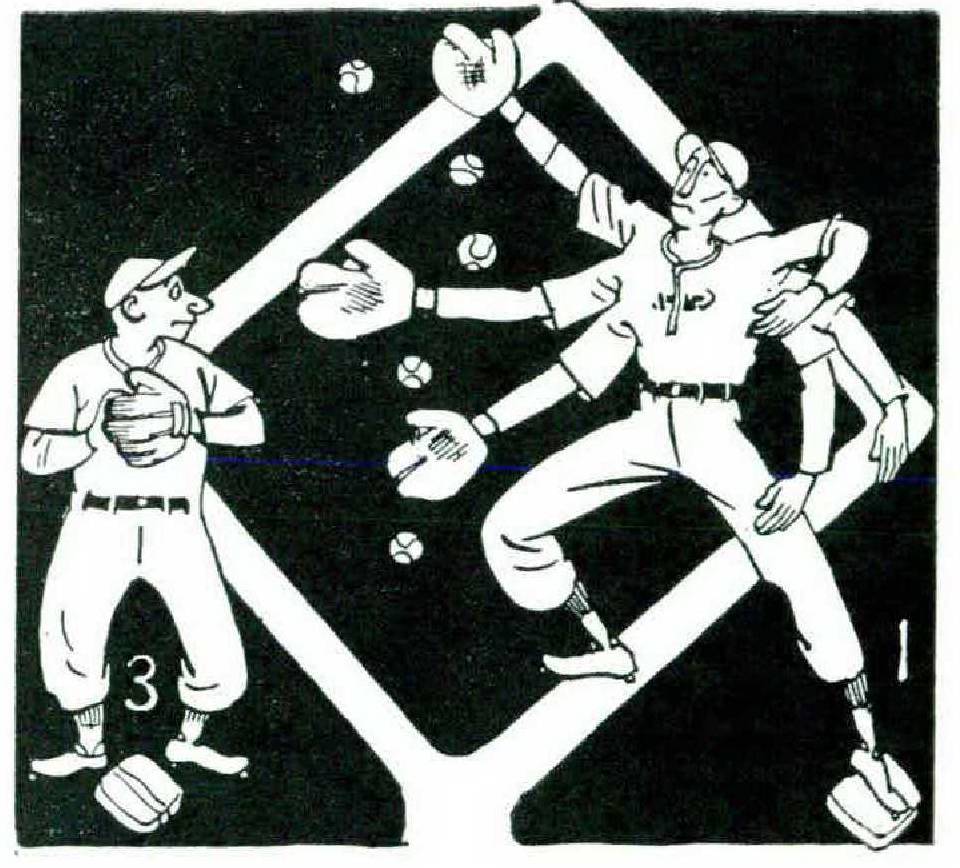
A box score, taken at random, of the New York Giants-St. Louis Cardinals eleven-inning game of July 17 last year shows that first baseman L’ckman (Lockman) of the Giants had thirteen pul-outs, one assist. First baseman C’ngham (Cunningham) of the Cardinals had fifteen put-outs, two assists. Besides all this defensive play, the fortunate customers on the first base side had a close view of fifteen of their heroes getting on base by hits, seven by walks, and one by error. For whatever pleasure or pain it gave them, they also saw fourteen Giants safe on hits, two by errors, and one hit by pitched ball. This adds up to around seventy separate bursts of action a that corner.
’This was only the beginning, being followed 1) by attempts of the base runner, in coöperation with the hitter behind him, the first base coach, and the manager in the dugout, to take second by stealing, the hit and run, and the sacrifice bunt; and 2) by the teamwork of first baseman, pitcher, and catcher to hold him close.
What was the third baseman doing while all this was in progress? T’mpson (Thompson) of the Giants had no put-outs, two assists. Jablonski of the Cardinals had no put-outs, one assist, ll’m’s (Hemus) of the Cardinals at short and third had no putouts, one assist. The hot corner, or that lonesome road? At that, the third base customers fared better than usual since the two teams made a total of nineteen runs. There are days when players of one team or the other don’t get to third.
The symmetry of the diamond is disturbed by a physical disparity among players which the conditions of play produce. The first baseman may be six feet five or six feet seven like Ron Jackson of the White Sox, who can scamper around his territory and stretch for wide throws. The third baseman may be a stubby live feet six — somet imes a converted outfielder who is thought to have some good years left in a less demanding position.
There is a suspicion that this lopsided arrangement was inaugurated by left-handers. For one thing, a left-handed pitcher has the edge in keeping a runner close to first base.
Another count in this indictment is that the left-handed batsman stands about two and one-half feet nearer first base than the right-handed swinger. Furthermore, his swing turns him into the base path, while the swing of the right-hander turns him away from it. These factors can be the difference in reaching first, or second, or third, or home. A fast left-handed hitter like Richie Ashhurn of the Phillies often makes it to first base on balls hit to the infield, while a fast right-handed hitter like Willie Mays of the Giants has to put the ball over the fence.
We hear someone saying that this inequity could be solved by two home plates and one batter’s box, the lefthander naturally taking the dish at the left and vice versa. The idea has to be discarded for several reasons. It would upset the geometry of the field, require the hard-pressed umpire to dust off two home plates where he dusted off only one before, and do nothing for third base.
There is a way out. Open up third base to settlement and make it blossom as the rose. Let the hitter head for first or third, whichever is more inviting. This presents the problem of men already on base from the other direction. One needs only to remember that with runners going only one way, Brooklyn once had three men on the same base. I am confident baseball can meet the challenge, and offer shyly some sample situations and suggested treatment.
1. Base runner has advanced from first to second. Hitter singles to left and starts for third. Man on second reverses direction and heads for home.
2. Base runner on first. Hitter pokes ball between first and second and heads for third. If it looks like extra bases, number one base runner turns around on reaching second and returns the way he came with the hitter behind him.
3. Bases loaded counterclockwise. If it seems advantageous to the hitter to go to third, the runners reverse themselves like a typewriter ribbon. At present, this is not a 100 per cent solution, since the runner who has legged it around to third probably would like to come in to score. In going the other way, he might be stranded and not score at all. It could be pointed out to this individual that the team score and welfare would not be affected, and over a season he probably would come out even.
4. Base runner has made it to third by way of first. In this situation, first base is indicated to the hitter — as it might be in situations 2, 3, and 4. A word of caution here about signals. The wrong sign at a time like this— !
The foregoing are interim devices while the people of baseball are adjusting themselves to more possibilities than Ted Williams could shake a stick at. Someday baseball may be played with both barrels, with runners flashing by each other in separate Janes, like streamliners on a double track. We may see the double squeeze, the quadruple steal, five runners tagging up after an outfield fly.