Where the Music Begins
JOHN M. CONLY is a former New York and Washington newspaperman, now editor of High Fidelity Magazine. “They Shall Have Music” is a quarterly feature in the Atlantic.

by JOHN M. CONLY
(This is the second of four articles being devoted to the shopping guidance of people interested in equipping their homes with custom music systems. An enormous variety of high-fidelity components — amplifiers, loudspeakers, FM-AM tuners, and so forth — now are manufactured for the homo market. They are easy to interconnect and operate, yet they are for the most part built to meet professional standards and are sold at professional “net” prices. They afford considerable flexibility of installation and respond well to care and ingenuity. Many an owner’s fond experimenting has been repaid in living-room music of astonishing realism. The first article in this series, published in the December Atlantic, dealt wit h loudspeakers. This one starts at the other end of the chain of sound reproduction, with a discussion of phono-pickups, tone arms, styli, record changers, and turntables.)
SOME home-music enthusiasts do a good deal of radio listening, especially in areas well served by highfidelity FM stations. And some buy prerecorded tape. For most, however, the basic staple of musical supply is the disk record — and the supply cannot be called a short one. It’s a dull day in the industry, latterly, when the studios produce fewer than three longplaying records; on a good day the total may run to a couple of dozen. There is tremendous treasure in the catalogues. Never has such musical diversity been available to us before, and never has the standard of reproduced sound been so consistently high. A bad-sounding record has become something of a rarity.
The music is in the grooves; the problem is to get it out. The disk must be rotated and its wriggling grooves tracked by a tiny jewel-tipped stylus whose motion can be translated into electrical modulations and thence into sound. If the disk is turned at the wrong speed, the pace and pitch of the music will be changed. If its speed varies as it turns, the sound will be deformed by those entertainingly named afflictions, “wow” and “flutter.” If the turntable is shaken by extraneous vibrations — motor rumble, for instance — this will be picked up by the stylus and reproduced in mixture with the music. Sometimes, if a record player is not adequately insulated against external vibrations, heavy bass notes from the loudspeaker will feed back into it — through its mounting — and be re-reproduced in thudding travesty. If either the turntable or the pickup head is not precisely level, the stylus will fight an uphill battle with the music, marked by much crunching and screeching.
If the stylus is worn out of its proper round shape, it will grate and gouge as it travels. If it is too stiff, insufficiently compliant, it will fight the grooves and fail to find their richest content; so will it if it tracks too lightly. If it tracks too heavily, it may lean sideways. If it is inadequately restrained by some damping medium, it may break into wild resonant vibrations of its own at certain critical frequencies.
Viewed together, these hazards may seem to form a fairly fearsome picture, but it hasn’t been fearsome enough to discourage the makers of pickups and turntables. The rather surprising fact is that the difficult mechanical refinement of these moving parts has almost kept pace with advances on the electronic front. Which is fortunate, because today’s near-perfect amplifiers would mercilessly expose bad performance at their sound source.
Particularly among people who are planning piecemeal modernizations of aging radio-phonographs, an early and burning question is which to buy: a record changer or a single-play precision turntable, with arm and cartridge separately chosen. The answer is really another question: What do you want it for?
If the record player is to be part of a final assembly, and is to be supplemented by other very high grade equipment, and is to be operated by the owner only, a precision turntable is indicated. It costs more and is harder to mount, but it allows you to select the arm you want, counterbalance it to match the pickup cartridge you want, do your own shock-insulating— with foam rubber and the like — and in general exercise your ingenuity.
A changer, in most cases, is cheaper. It does most of the work for you. It may never do it exactly as you would, but it probably does it much less roughly than Junior would, or your Martini-laden guests, and it will do it all evening while you read a book or play Scrabble. It may be wort h [jointing out that many an enthusiast of some years’ standing owns both a changer and a precision turntable — the former bought first and kept for lazy listening, the latter acquired after a new amplifier and loudspeaker had spurred the urge to more active participation in perfectionist musicmaking.
My experience with record changers is that their prices reflect pretty accurately what you may expect from them. The most expensive one I know is the Swiss Thorens CD-43 “Concert,” a truly deluxe changer that runs, when new, smoothly as a precision turntable. It will pause between records and, in fact, do almost anything short of choosing your music for you. It accommodates almost any pickup cart ridge — most changers will — and won’t mistreat it. Its motor is geared directly to its turntable; what happens when the gears wear I don’t know — but probably replacement fees are small enough not to worry anyone who can afford the machine in the first place. It costs $93.75.
Neck and neck for the next spot are two imported changers selling for about $68 — the Garrard RC-90 (British) and the Miracord XA-100 (West German). The Miracord is easier to install, and has a betweenrecords pause button. The Garrard has (like the Thorens alone) a finespeed control, operated by magnetic drag, which permits exact adjustment. Most changers run a little fast till loaded with about five records. I happen to own a Garrard, but I like both of these and would hate to have to choose between them.
Indeed, I might choose instead a more modest Garrard, the RC-80 ($49), which will do fewer tricks — it cannot even be operated manually, as a single-play—but which is driven by a rubber traction-belt assembly that minimizes transmission of motor vibration. Nearly all other changers are friction-gear driven. That is, the main shaft of the motor extends upward out of the casing and acts as a spindle, rotating against, a little rubber-tired idler-wheel which in turn rot ates against the inside of the turntable rim. Competitive with the RC80 is another British changer, the Collaro RC-54 ($49), a beautifully neat and extraordinarily sturdy machine, well worth consideration.
Also renowned for durability arc the American changers made by Webster-Chicago (Webcor). I have no firsthand acquaintance with their new Model 1126-27 ($40). I did have a 1948 model, which I subsequently sold but which I still look in on occasionally. At last visit, after more than five years’ service, it was still working smoothly. The V-M changers, even less expensive ($38 and $30), seem to have been designed as components for low-cost packaged phonographs, and I have met them only in tin’s guise, where they serve very well. People’ do use the $38 model (935-HF) with GK magnetic cartridges as part of economy-priced hi-fi rigs, and I have heard no complaints.
Thorens makes two smooth-running single-play assemblies; in one of them ($53) the arm is operated manually, in the other ($68) a mechanism sets it down and picks it up for you. Another Swiss-made manual player, the Lenco, is marketed here by the David Bogen Company at $40. Like other Swiss players, it is direct-gear driven. It also has fine-speed control. New, it behaves very well indeed, and seems a bargain.
The single-play assemblies listed above all come on mounting boards and equipped with tone arms. True custom turntables represent (or are supposed to) a step up in perfectionism. Some incorporate their own mount ing decks, but you arc supposed to supply your own tone arm.
The two least expensive custom turntables, I regret to say, are too new for me to have inspected them, but both come from firms a long, long time in the turntable business. Lowest price is the Rek-O-Kut Rondine Jr., a two-speed job (33 1/2 and 45 rpm; no 78) at $50. Next is the threespeed Presto T-15 at $54. Next is a veteran machine no longer advertised but still available, the Rek-O-Kut LP 743, which costs $59.50 and for some years has been standard equipment in high-fidelity homesof middling means. You must recondition the LP 743 every t wo years, but if you do, it will work. (This probably applies to all turntables which arc rim-driven by solid-tire idler-wheels. The tire rubber ages, hardens, develops gouges and “flats,” and inflicts a certain amount of wear on the motor-spindle that drives it — the wages of friction. Reconditioning costs from $3 to $20.) I don’t know how much it costs to recondition the $60 Thorens E53-PA, gear-driven, but I do know that its performance to begin with is impressively even and quiet. (A friend has had one a year; no trouble yet.)
The Rek-O-Kut model seemingly designed to supplant the old 743 is the Rondine, which costs $70; it is essentially a refined 743 and, thus, good news. I predict its success. I am equally certain of the success, on a different scale, of the turntable priced next above it, the Components Corporation Professional, at $85. It is a monster. Its cast-steel turntable weighs 25 pounds and is turned by a belt which girds it about and loops out to encircle the motor-spindle some distance away. To change speeds, it is necessary to lift off a plywood coping and shift the drive belt manually up or down the differential motorspindle — no job for sissies. It stands on four ugly spring-legs, which damp out extraneous vibration and can be twisted up or down for leveling. I bought one as quickly as I could, since I am a record reviewer, and I could see practically nothing that could possibly go wrong with it. So far, nothing has.
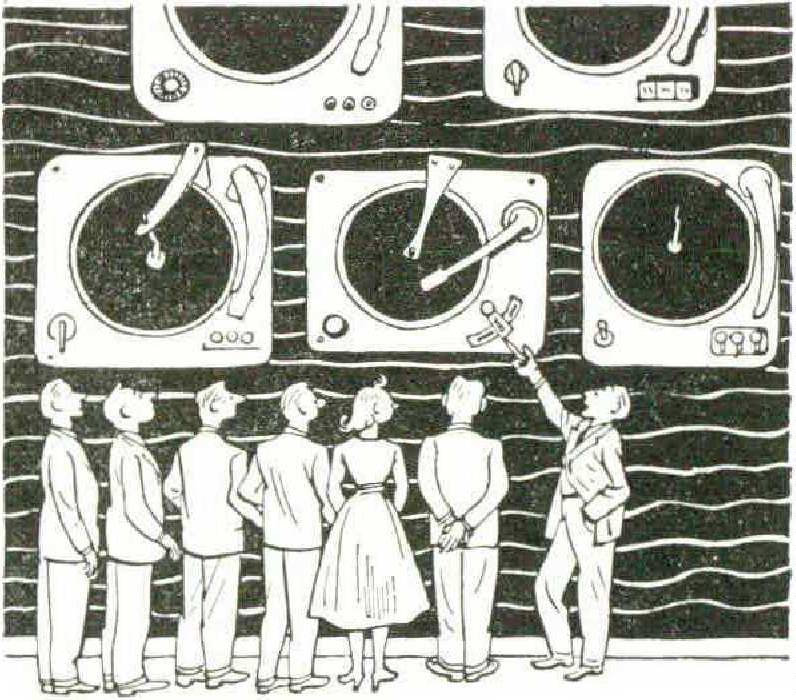
At $3 more comes a job that is more suave, the D & R, which features an outside-idler drive (no pinch effect on the rubber drive tire), extreme silence and smoothness, and very handsome box-mounting. And now come a pair of aristocrats I know only by repute, the Rek-O-Kut Rondine Deluxe, at $119, and the H. H. Scott 710-A, at $102. Central attraction of the Rondine Deluxe is a hysteresis synchronous motor, which runs so smoothly as to make precautions against motor shudder virtually superfluous. (All other commercial tables use conventional induction motors.) The Scott, on the other hand, has anti-vibration devices in almost supernatural abundance, apparently designed to screen out earthquakes. It also has a fine-speed regulator and, believe it or not, a stroboscopic speedindicator that works by mirrors. Both these are machines which must be seen to be appreciated, and both can be operated with the utmost case. It must be fun to be rich.
Phono-pickup cartridges are the small devices, tipped by groove-tracking styli, that fit in the end of tone arms and translate vibration into electrical impulses, to be built into sound by amplifier and loudspeaker. The high-fidelity variety are among t hemost precise and delicate electromechanical devices commercially produced today. I know of none that will withstand mistreatment and none that I cannot make sound very good. (The only treatise I know of on pickup and turntable care was written by I. M. Fried and appeared in the November issue of High Fidelity Magazine.) They range in price from $34, for a General Electric dual-point with twin diamond styli, to $125 for a British Ferranti two-head assembly. All prices I quote will include diamond styli, since nothing else will yield both lastingly good sound and peace of mind. Socalled “precious metal” tips deform almost at once, and sapphires (on most pickups) are good for only a couple of dozen plays before t hey begin to damage records. Get diamonds.
Beginning in 1948, when vinyl microgroove records appeared, magnetic pickup cartridges swept the high-fidelity field, nudging out the earlier general-purpose crystals. The magnet ics needed preamplifiers — as the crystals did not — to make their low-voltage output perceptible to amplifiers originally designed for radio. But I know of only one crystal pickup left now in the high-fidelity market, the Electro-Voice 80. It is comparable to the magnetics but — ironically — it must be sold with an adapter to reduce its output if it is to be used with current preamplifiers’ equalization circuits.
Not every pickup cartridge will work in most changers. The Elect ro-Voice crystal will. Among magnetics, two will do so reliably — the Audak Polyphase ($53) and the newly arrived British Tannoy ($65). Both are turnover types, with separately detachable styli, well sprung to prevent bending. Most commonly used with changers, however, are the GE’s, because of their low price. Of these, I prefer two single cartridges, used with separate plug-in heads, rather than the Triple-Play model. The latter has both jewel tips mounted on the same assembly — and if one wears out before the other, what do you do? Two singles cost only $6 more than the Triple-Play. GE stylusassemblies, of soft metal, tend to bend under rough changer-treatment and should be regularly inspected with magnifying glass, and with tweezers handy.
One model of the new Electro-Sonic cartridge purports to have been designed for use with changers, but I have doubts; the sample lent me would need a very gentle changer. The same applies to the Pickering dual model, though the more rugged single cartridges (Models 120 and 140) will serve reliably.
In a way, it is a shame to use good modern pickup cartridges in changers, since more of their manufacturers have lovingly contrived tone arms expressly for them. In some cases, but not all, the arms work equally well with other cartridges of kindred shape and size.
GE, for instance, has graduated its cartridge from the work-horse to the glamour class by furnishing it a very fine arm with an adjustable counterweight for the head, which also flips backward to afford a look at the cartridge’s nether workings. This comes (as do many) in 16-inch and 12-inch lengths, to accommodate the available space — $32 and $35. Audak has long made arms of similar length for its cartridge, the first, magnetic “turnover” model. Now it furnishes an adapter to receive other cartridges — an attraction, since Audak arms cost only $14 and $19. As yet no arm is made to hold the neat, plastic-cased Tannoy cartridge, but it fits nearly every other maker’s.
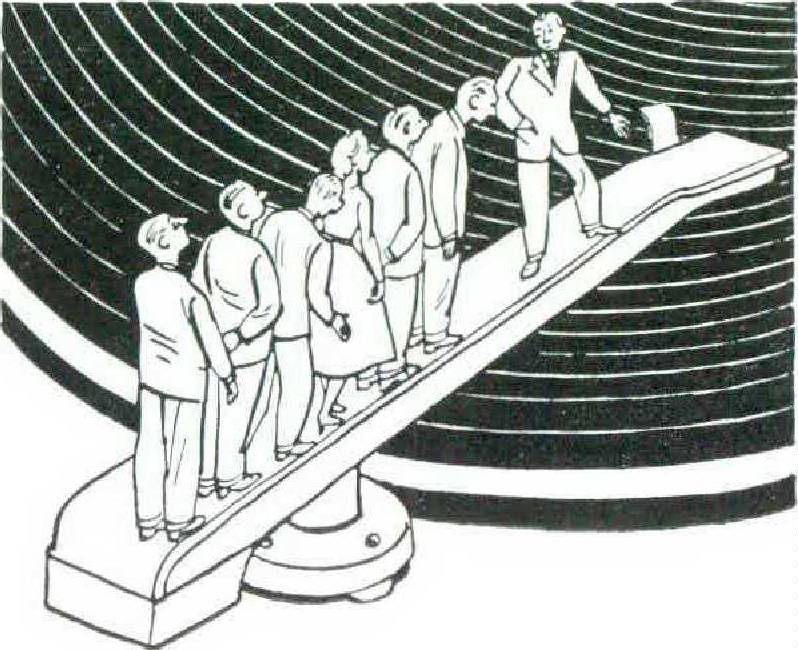
To fit its thumbnail-size new miniature cartridges, tiny in mass and high in compliance, Pickering offers its 190-D arm. Its main shank swerves only laterally, and is counterweighted in back to offset sidew ise shock or tilt; the cartridges are mounted on a small, lightweight tongue of metal hinged vertically at the business end. The cartridges in duo cost $60, the arm $31.50.
I own a Pickering, as well as an Audak and a GE, and have given them the kind of grueling use a record reviewer must — a total of perhaps 1500 hours a year. The Pickering, despite its minuscule mass and seeming delicacy, has stood up nobly. The factory, however, recommends conditioning at least once a year. The sturdier Audak and GE don’t need conditioning, but their styli should be taken out and sent for checkups annually.
Pickering, Tannoy, Audak, and GE all function on the principle of variable reluctance, the magnetic usage first employed in high-fidelity phonographic reproduction. Other aspects of electromagnetism have now become practical media, and the pickups using them have grown out of their early and fantastic fragility. In three makes now, a tiny coil vibrates instead of a pole piece. One, the British Leak, I have seen only in handmade shape. It sounded wonderful, but apparently is not yet in mass production. However, the American Fairchild is, and no careful owner will be unhappy with one of these splendid, beautifully balanced pickups, widely used professionally. Fairchild makes arms for them ($30) but they also will fit others. The output of movingcoil cartridges — and, in fact, of all types mentioned hereafter except the Weathers FM — is even smaller than that of variable-reluctance pickups. As a result, they yield best results when pre-preamp lifted. All their makers supply small transformers to effect this, adding about $10 to their prices.
The new Electro-Sonic cartridges use moving coils of a different movement — quasi-rotary, like miniature generators. The design — apparently Danish in inspiration — is ingenious and the results most impressive. The Electro-Sonics come in three series — the Standard ($30 per unit), prescribed for use with good changers; the Concert ($36), for use with good all-purpose tone arms, and the Professional ($49.50), which is fabricated in Denmark and requires its own tone arm ($57). The last two may have the highest stylus-to-groove compliance of any cartridges now in use. At least they need absolutely level turntables, and tone arms that traverse with the utmost case.
Close competitors in the compliance race are two very light weight pickups, the Weathers and the British Ferranti. The former is a powered frequencymodulation pickup which requires a power supply, an oscillator, and its own eountersprung wooden tone arm, and which plays microgroove records only. The whole assembly costs $79 with diamond stylus, $64 with sapphire (since the unit tracks at only one gram, its maker, Paul Weathers — though a confirmed audio-perfectionist — readily sells it with a sapphire tip). For $124 one can buy the arm, oscillator, and a Weathers preamplifier all ready-mounted in a turntable case. The Ferranti is designed by the Scots amplifier expert, D. T. N. Williamson, and so far as I know is the only pickup for which is claimed a frequency range of 100,000 cycles per second, or five times higher than the human ear’s. Source of its power output is an infinitesimal aluminum ribbon vibrated between the poles of a permanent magnet. With its necessary step-up transformer, sleek, slim, rather snakelike tone arm, and two plug-in heads, it costs $125. The Ferranti 78 rpm stylus is unusual, being elliptical rather than round at the tip — better inner-groove reproduction of highs.
Several manufacturers make tone arms only. Of these, the best known to me are the Livingston Universal ($19) and the Gray 108-B ($56). The latter is viscous-damped vertically; when dropped it “floats” harmlessly down to the turntable. But it won’t play warped records, especially 78s. The Livingston is an all-purpose arm, light and precise, initially built around . the GE Triple-Play cartridge but equally accommodating (with a little counterweight-shifting) to Pickering, Tannoy, or Fairchild. I have not yet seen the revolutionary new British arm, the Burne-Jones, which is really two jointed arms, in parallel, that keep the cartridge pointed straight along the groove as it traverses — no tangential error, it. says here.
It would be wrong to say that all turntables and pickups are of equal merit; they’re not. They don’t all cost the same, either. And they are not of equal durability or adaptability. But nowadays there is one for almost every purse and every purpose.
In a sense, the best pickup or turntable is the one best installed and best, cared for. All turntables and record changers need to be leveled to work best, and most need periodic lubrication. They should be shock-mounted, too. Their drive wheels should be inspected regularly for rough wear. The tracking weights of pickup arms should be checked (there are a number of inexpensive gauges made for this purpose) and adjusted. Caution: some cartridges are magnetically attracted to ferrous turntables, adding to their stylus pressure.

Cartridges should be installed so that their styli point straight down. They should be kept clean. Styli — even diamonds — should be I checked annually for wear. Some cartridges should be checked annually for stiffening of their damping materials. Any cartridge that begins to sound rackety should be sent to the maker for a checkup — most cartridges are handmade, and variations inevitably occur.
No such mechanical-electrical equipment as record-playing components should be accepted without a set of the manufacturer’s instructions; these should be read and kept for future reference if necessary.
And so — good spinning!
Record Reviews
Bach: Concertos No. 1 in A Minor, No. 2 in E Major (Jascha Heifetz, violin; Alfred Wallenstein conducting Los Angeles Philharmonic Orchestra; RCA Victor LM-1818: 12″). It is customary among reviewers to search Heifetz performances for virtuosic vagaries in defiance of tlie composer’s intent, but here there are none. These seem to me the best performances of these two concertos on microgroove, and the recording is highly adequate, too.The more I hear them, the better I like them.
Liadov:Baba-Yaga;Eight Russian Popular Songs;Kikimora with Balakireff:Thamar:Symphonic Poem (Ernest Ansermet conducting Orcheslre do la Suisse Romande; London LL-1068: 12″). Some of the season’s richest, most lustrous recorded orchestral sound ornaments Liadov’s two engaging little witchtales and Balakireff’s somewhat more ponderous one, all performed to perfection by a bearded Swiss magician.
Mahler: Symphony No. 1 in D (two versions: Bruno Walter conducting PJdlharmonic-Symphony Orchestra of New York; Columbia SL-218; Rafael Kubelik conducting Vienna Philharmonic Orchestra; London LL1107; each 12″). Each of these conductors plans to record all the Mahler symphonies. Kubelik has been given spectacular sonic reproduction, and he marshals Mahler’s forces in vast and rigid array; resplendently impressive. By contrast, Walter’s orchestra sounds slightly remote and romantically relaxed, and it takes Walter all of three bars to convince me, beyond any kind of argument, that this is the way it ought to sound. It is hard to describe the effect (and it is a completely subjective matter) except to say that the music becomes at once comprehensible, glowing with the kind of strange enchantment which is in the look of German forests and the feel of German fairy-tales.
Mozart: Fantasia in C Minor, K.475; Sonatas in A, K.331, and C Minor, K.457 (Paul Hadura-Skoda, piano; Westminster WL-5317: 12”). Angel Records has made the entire solo piano works of Mozart , played by Gicseking, and the Haydn Society is putting them out with Lili Kraus. I have heard samplings of each (the Angel collection will be released gradually on single disks). While fondly remembering earlier performances by Gicseking and Kraus, I think neither now plays in a manner so complementary to Mozart as young BaduraSkoda; indeed, I can call to mind no one who does, consistently. He even gives the illusion that he is playing on an eighteenth-century piano, though the jacket notes don’t say so. The sound is wonderfully realistic, too.
Mozart: Symphonies No. 35, “Haffner,” and No. 41, “Jupiter” (Erich Leinsdorf conducting Rochester Philharmonic Orchestra; Columbia-Entré RL-3103: 12″). Once again, an extraordinary bonanza on Columbia’s cut-rate label, Entré. You save a dollar and you get what seem to m« the most telling recorded performances of two of Mozart’s greatest symphonies. Leinsdorf Beet hovenizes them a little, as Richard Strauss used to do, but without loss of poignancy. The sound is strong and resonant, and the orchestral balance admirable.
Verdi: Otello (Renata Tebaldi, Mario del Monaco, Aldo Protti, Fernando Corona, Luisa Ribacchi, other soloists; Alberto Erode conducting Orchestra and Chorus of the Academy of Saint Cecilia, Rome; London LLA24: three 12″ in album with libretto). Confirmed opera-lovers are going 1o account this the best, or one ol the best, operatic productions on records. Confirmed Toscanini-worshipers may possibly account it an affront. The Toscanini version, made from a broadcast, has Toscanini, Ramon Vinay, and the NBC Orchestra. The London has everything else. RCA’s engineers did a fine job of refurbishing the NBC Sound, but it cannot compare with London’s. Neither can Yinay’s voice match del Monaco’s, though the latter, newer to the role, some!imes hams it up. Tebaldi is magnificent, though Herva Nelli plus Toscanini is not negligible either. Toscanini and the NBC arc likewise magnificent ; Erode and the Roman group likewise not negligible. London has the edge in supporting cast and in what may be called performance atmosphere. You take it from there; you can’t go wrong.