Style in the Congo
Traveler, writer, and amateur zoologist, ODEN MEEKER is the author of the recently published, book, Report on Africa.
by ODEN MEEKER
TOTAL nudism has been corrected,” says the official Traveler’s Guide to the Belgian Congo. The correction of this nudism keeps one factory in the Congo, Utexleo in Leopoldville, profitably employed turning out 23 million yards of splashy cotton prints annually, while the United Africa Company, which is a tropical tentacle of Lever Brothers, sells 100 million yards a year from the Congo up the West Coast. Japanese and Czechoslovakian drummers fly up and down the Coast peddling their own versions of savage African textiles. The best made and the most popular, since the African housewives appreciate quality, come from Britain, the Netherlands, and France.
These are the brilliantly colored batiks and tropical tartans, the handsome and semibarbaric designs which we are apt to think of as peculiarly African, and which were imported by Balmain and Dior and some American manufacturers in recent years to lend an exotic touch to their lines. As far as I know, they were all designed by Europeans in the first place. Still, the Africans have taken eagerly to the white traders’ idea of how they should dress, including imitation plush leopardskin. They also love movies about Tarzan and Jungle Jim.
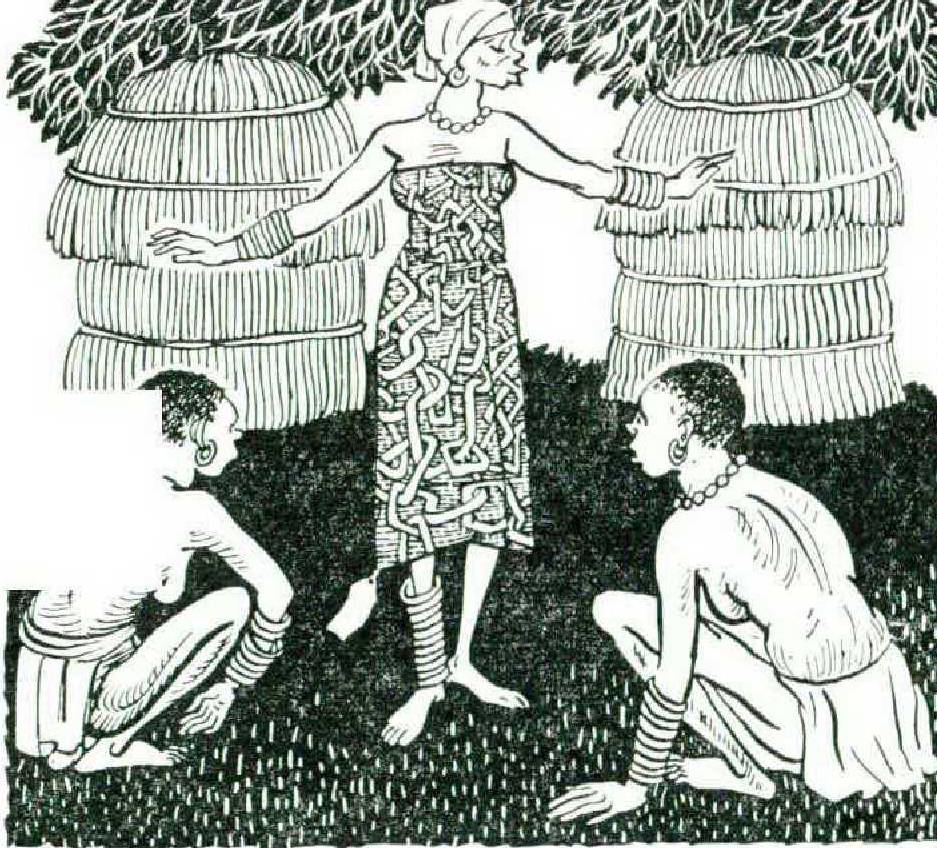
French West Africa imports about $35 million worth of textiles every year, and the shoppers in the Marche Indigene of the capital, Dakar, look as though they were wearing most of them. The Frenchwomen there, with their ankle-strap shoes, metallic red hair, and décolleté sun suits, are completely eclipsed by the Wolofs who sail into the market wearing an African version of the Parisian mode of the late eighteenth century: head-ties in purple, yellow, and emerald satin, gold coins strung across the dark finehead, and as many as ten layers of dress topped with the blindingly colorful African cottons, and an overveil of white tulle or organdy. Married Wolof women shave their heads and wear wigs of black darning wool sticking out at either side under the head-tie in crescent horns. Among them promenade the five African mannequins of M. Pierregrosse, a textile tycoon who listens carefully to the Dakaroises before having his factories in France turn out the new designs. Before Papa Pierregrosse began to stimulate the market, it took two to three years for the fashion to change; now he can do it in six months. And the models arc paid off in clothes rather than money.
The markets in the Gold Coast and Nigeria and the other colonies that are coastal enclaves in the sprawling immensity of French West Africa sell much the same sort of print, as in the French colonies or in the Belgian Congo to the south. African bobbysoxers in Accra, wearing super-poodle haircuts, little gold earrings, and tribal scars slashed diagonally across their cheekbones, sashay up and down decorated with pictures of Edward VII, brontosauri, elephants, all-seeing eyes, and jumbo alphabets, in chartreuse, black-brown, watermelon pink, and canary. Baby brolhers and sisters are carried slung at the back in another length of dress stuff. Here on the Gold Coast the traditional male dress is the toga, very handsome, and providing an additional market for the same materials.
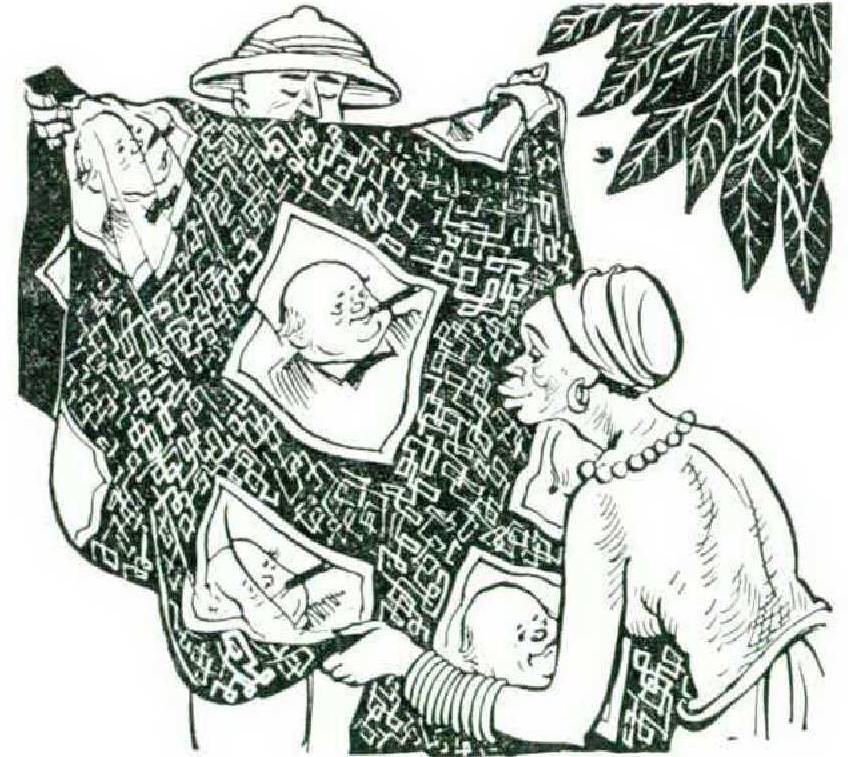
In Lagos, a little further along the West African shore, in a market, with an especially large magical section specializing in live chameleons, you can find Churchill giving his V sign on burgundy brocade, and cotton prints splashed with famous African disk jockeys and currently popular phrases: “So Long” — “Good Luck” — “Cheerio.” The trim, nautical BOAC stewardesses who come to shop for souvenirs here sometimes go off lugging the wild African prints, though what they do with them I am not sure — they certainly don’t appear as bathing costumes beside the English seaside.
The old-fashioned African approaches to beautification — scarification in elaborate geometrical patterns, knocking out teeth or filing them to a point, elongating the skull, or inserting saucers in the lips — arc giving way to the flashy, fascinating cottons. These in turn are being picked up by scouts for such American products as Everglaze Funwear, and for the mighty Paris couturiers who have been partial to jungly motifs during the past few seasons. They have not yet, however, imported the two most popular prints from the Belgian Congo — called the Deux Tonnes and Six Bougies, respectively, after the first appearance in those latitudes of the two-ton truck and the one with six spark plugs. The wearers are known as Two-Ton Women and Six-Spark-Plug Women.
In Léopoldville, the Congoese capital, the prints are sold by the market women, who also deal in plastic novelties, kitchenware, and toasted termites. Many of the most substantial venders — one in Nigeria, a Mrs. Mary Nzimiro in Port. Harcourt, grosses about a million dollars a year — are illiterate, but they can do lightning sums in their heads. Designs particularly popular in the Congo are Winston Churchill again (the African housewife seems to be an unflagging Churchill fan), George VI and the present Pope, Generals Leclerc and de Gaulle (Brazzaville, capital of French Equatorial Africa, is just t wenty minutes away across the river), and Elsie the Borden Cow. They are sold in dress lengths about forty-eight inches wide and just under five feet long, normally about seven dollars. Both the lengths of cloth and the wraparound dresses themselves are called pagnes.
“People who live in the forest have different taste than the desert and savanna people, who prefer brighter patterns,” said a pagne expert named Robert Peeters to whom I talked in Leopoldville. Mr. Peeters is a crisp, personable young Belgian in his midthirties who has picked up the African trading languages of Lingula, Swahili, and Kikongo, as well as Arabic, German, Dutch, and Greek, w hile working at trading posts all over the Congo Basin selling cloth. I found him at the headquarters of a prominent Greek firm named A. & B. Papadimitriou, surrounded by bolts spotted with monster polka dots, printed like crazy quilts, with subtle batik patterns in black and cinnamon, or veined with chartreuse, salmon, or ocher. Most popular in the French and Belgian capitals were those with provocative phrases in Lingula: “You Really Hurt Me,” or “Cold Heart — Warm Heart,” or just simply “Sentiments.” One worldly pattern proclaimed Bongo Mokonzi — “Money Is King.” Another said “ Why Not — Enjoy Ourselves? Dance? Drink? Laugh? Dress Well?” Presumably after absorbing this message, the reader went out and bought another pagne.
Mr. Peeters pointed out (he interdependence of pagnes and beer, gramophone records, and African sororities. When a mode is ready for launching, it is given to one of the African women’s clubs in town — La Delicatesse, L’Elegance, La Joie. The members are agreeable young doxies who hang out in the bars in Léopoldville’s Ville Indigène or frequent the Bal Dou-Dou over in Brazzaville, and they all dress alike. “When they launch a mode,” said Mr. Peeters, “it’s launched.”
The loudspeaker at Papadimitriou’s was shattering the Congoese calm with a recording of a syncopated African combo and a girl singer whose lyrics were disturbingly familiar; “Chérie, Oksom beta ngai bière.”;
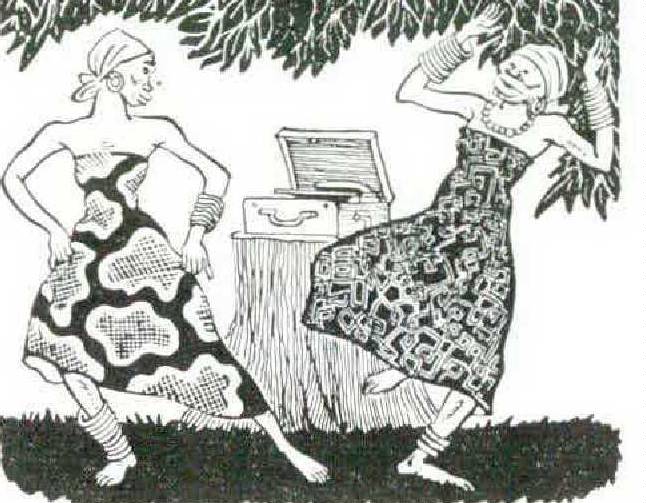
“Beer is indispensable to the Congoese concept of romantic love,”explained Peeters. Like the Portuguese firm of Nogueira in town, Papadimitriou makes and sells perhaps a quarter of a million gramophone records a year through its posts. Records are used to sell prints, and vice versa. I have seen a belle at the Bal Dou-Dou dance by with “Viva Nogueira!” across her eallipygian stern, and there is also one with a green parrot crying “Good Morning, Papadimitriou,” which may be had a little cheaper because of the advertising. But the one I liked best, I think, and the one which should draw squeaks of appreciation in America as well as Africa is Mr. Papadimitriou’s luxurious imitation lionskin number wit h the inscription: “When You Wear This, It Frightens Me.”