The Brown-Baggers
by DOALD MORRIS
DONALD Mounts is the author of a novel, China Stution. A lieutenant junior grade, he is note serving aboard a destroyer.
IN NO profession is the cleavage between the married man and the bachelor deeper than it is in (he Navy. Navy bachelors find on their ships a nucleus for their lives; the ship is their home and to it they return. They expect, to spend occasional evenings aboard, and they arc forever worrying about the drapes in the wardroom or the fact that Diesel oil is leaking from the shower.
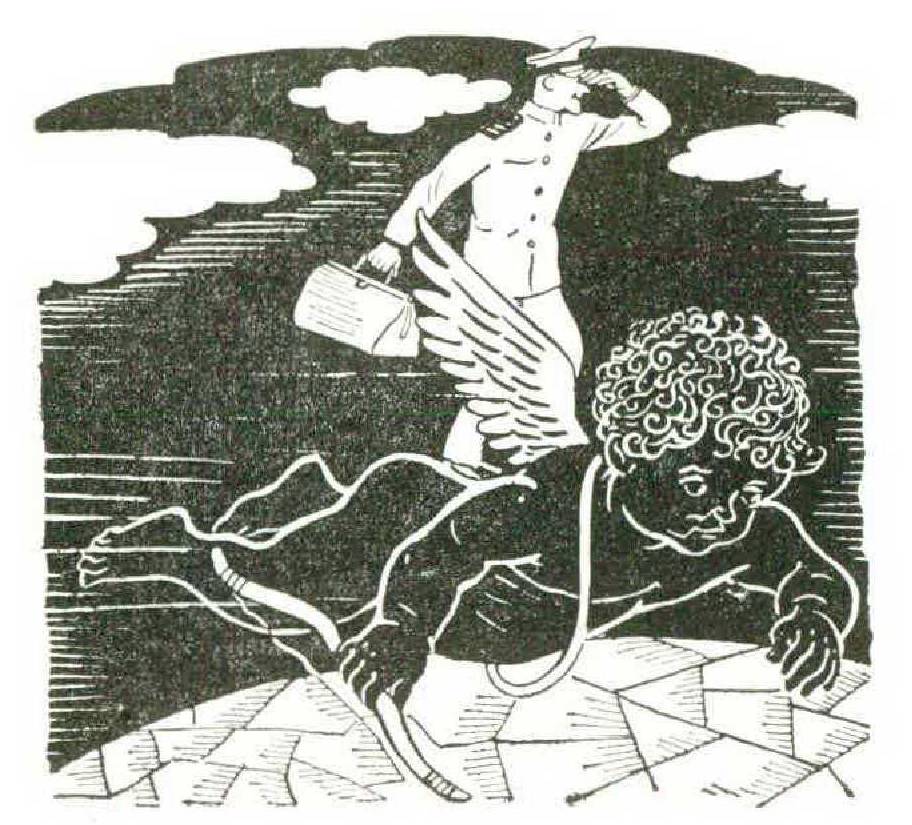
The married officers, on the other hand, look on their ships as a sort of office in which a certain amount of time must be passed before they are at liberty to return home. Since it is necessary to obtain the permission of the Executive Officer before leaving the ship, married officers are exceptionally industrious during working hours. The instant “Now hear this. Knock oil ship’s work” sounds through t he compartments, however, all the married officers on the ship who rate liberty appear like magic on the quarterdeck, each armed with a small brown suitcase in which toilet articles, laundry, and socks with holes are stuffed. On some ships, where the inspection of liberty parties is not oversiringebt, the rumble of theirpassage over the brow can be heard between “Knock off” and “ship’s work as they disappear up the piers.
I he married officers are known as “Brown-Baggers” and are regarded by the bachelors as victims of a deranging and incurable disease.
On overseas tours, these BrownBaggers form a pathetic group. Their little suitcases gather dust in the stateroom, and they themselves sit in small, depressed clusters in the wardroom. They Spend every spare minute in an exhausting analysis of the entire flow of Naval Communications, attempting to determine the exact date of their return. The fact that a single destroyer, operating in the Persian Gulf, has been transferred from Squadron Twenty-two to Squadron Twenty-four will be picked at for days, until every ramification of the transfer, and its possible effect on the duration of their own tour in the Caribbean, has been thoroughly explored. Their mail from home is filled with the same sort of information. They will spend hours comparing the relative worth of two rumors, one acquired at the Dental Clinic in Washington from the wife of a Yeoman 3/c who is working in the Pentagon, and the other culled from an almost illegible note forwarded to the ship’s barber from a friend who had been sitting behind a Rear Admiral in a movie. All in all, Brown-Baggers are a breed apart.
My own induction into their ranks was fairly sudden. I had reached the point where the word “confirmed" was apt to be coupled with “bachelor, and I went through my naval life with a high disdain for the Baggers. I was able to walk through the wardroom on my way to an evening in town and smile pleasantly at a Bagger stuck with the night’s duty; long ago I had rid myself of the slight twinge of pity that was all too apt to provoke a promise to return early and stand by for the unfortunate lout.
My conversion didn’t even start with a simple little question. In the ten days my courtship of Sylvia lasted (that being all the leave I was able to finagle, at the time), I was forced to repeat the question innumerable times, harping constantly on the fact that my ship’s home port had just been switched to Cannes, and an affirmative answer would result in an immediate two-year honeymoon on the Riviera. But the best 1 was able to obtain before I had to return to the ship was a judicious “Well, I’m not going to marry anybody else this month.”
From this stage I had to advance by mail, a process that placed a considerable strain on my vocabulary and on the Mail Orderly. For three weeks I was patronized by this individual, who, on returning from the Base Post Office, would gaily call out, “Hey, Mr. Morris! You made out fine today, two fat ones.” Once he entered the wardroom during dinner with a postcard, asking if ‘Je t’aime” was French or Italian. By this time a decision of sorts had been reached; I never did get a final answer, but since the letters had started to discuss the wording of the announcements, I felt it fairly safe to assume that a wedding was in the offing.
By this time my ship was in New York and Sylvia was back in Rabbit Shuffle, North Carolina. (Oh yes there is.) A strong warning should be issued (o grooms about the guests they invite. One of the two males I wanted on hand was an old high school chum, long since graduated from West Point and now an Air Force Captain. Me hadn t shot down seven Messerschmitts, but he had shot down a MIG, and on the Fourth of July at that. I hadn’t seen him for years, but I called him anyway. “Sure thing, old man. . . . Rabbit Shuffle, eh? . . . Got an airstrip? . . . Never mind, I ‘II find out. ... I’ll be in San Diego that morning, and I have to be in New Vork by midnight, but I think I can make it. Have someone meet me at the airport. I’ll change in the car.”
Now I had frankly looked forward to cutting a bit of a swathe at the wedding. After all, I was the groom, and I had a gorgeous new uniform. I even had a sword, borrowed from a retired Rear Admiral. Miss Sylvia’s Yankee, forsooth. This damyankee would stand on his own two feet.
Exactly eight minutes before the ceremony began, a station wagon dashed into the front yard. From it debouched my future parents-in-law, my future sister-in-law, my parents, and two guests. In the midst of this admiring cluster was a tall unshaven figure clad in a sweat-stained flying suit with pencils and slide rules and knives sticking out of little pockets. On his back was stenciled the outline of a MIG, with a large red cross splashed over it. It was a little hard to see the MIG, because my friend had a parachute slung over one shoulder. My father was carrying a clothes bag. My future mother-in-law was carrying a crash helmet. I think my mother had an oxygen mask.

“Sorry, old man. Couldn ‘t change in the car. Have I got time for a swim? Say, that’s a pretty small airport.” My friend had arrived.
Standing in front of the altar, until Sylvia actually appeared at the head of the stairs, all I could hear over the music was the excited muttering of the guests. “Right to the end of the runway . . . thought he was going to bring that old Sabre Jet right into the waiting room . . . look on the airport manager’s face . . . fourteen MIGs, wasn’t it?”
The ceremony itself was no strain for the groom. I’d read all about that, and now it didn’t matter it Sylvia hadn’t answered my questions before, she answered in the one way I wanted to hear. I said I will so firmly that the Reverend Mr. McCauley reared back, and 1 didn t drop the ring. And I did kiss the bride. A whole passed of people kissed the bride. A lot of them even kissed the groom. I even had some lipstick on my left elbow when it was all over. This was nothing, however, to my high school chum. He even got some lipstick on his MIG.
I didn’t really realize what it was to be married, however, until I got back to the ship. There the Captain gave me a wedding present. It was a little brown leather suitcase, just large enough to hold my shaving gear and pajamas and slippers and two pairs of socks with holes in them. And at four o’clock that afternoon, for the first time in my naval career, I didn’t hear the “ship’s work” follow the familiar “Knock off.” I was too far up Pier Seven.