Two Samurai Tales: Romance and Realism in Old Japan
by SAIKAKU IBARA
AN UNBALANCED ACCOUNT ON NEW YEAR’S EVE
AS NEW YEAR’S drew near, noisier and noisier became the cries of the vendors of holiday delicacies: kaya nuts, dried chestnuts, pine branches to put in the kitchen for good luck, and all festive things. Next door resounded the pounding of the New Year’s mochi-rice. But here in the Ronin’s house, not even the soot was yet swept away, not even his beard was shaved, though it was already the 28th of the month. And the dunning of the year-end bill collectors from the riceshops was such that he would swing his sword into position for action and shout: “ When I say, ‘ Wait till New Year’s!’ I mean, ‘Wait till New Year’s!’” Such was our hero, a haughty but unemployed Samurai named Naisuke Harada, who always tried to go crosswise through a straight and narrow world. Enable to live any longer in all of wide Edo, he had, for some four or five years, made his residence down here in Shinagawa, near the Fuji teashops. He had hardly enough firewood to warm the rice of a morning, or oil to light the lamp of an evening.
But with New Year’s fast approaching, his poverty was even less bearable than usual. So he wrote a request for a loan to his wife’s elder brother, one Seian Nakarai, a doctor practicing near the Great Shrine of Kanda. Though it was not the first such request, the good doctor did not feel able to abandon his relative, so he wrapped up ten gold coins, and on top wrote the directions: “Gold pills for that disease called poverty; good for all ills.” And he sent it to his sister.
Naisuke was overjoyed, and invited those fellow Ronin who were his boon companions to a New Year’s Eve drinking bout at his house.
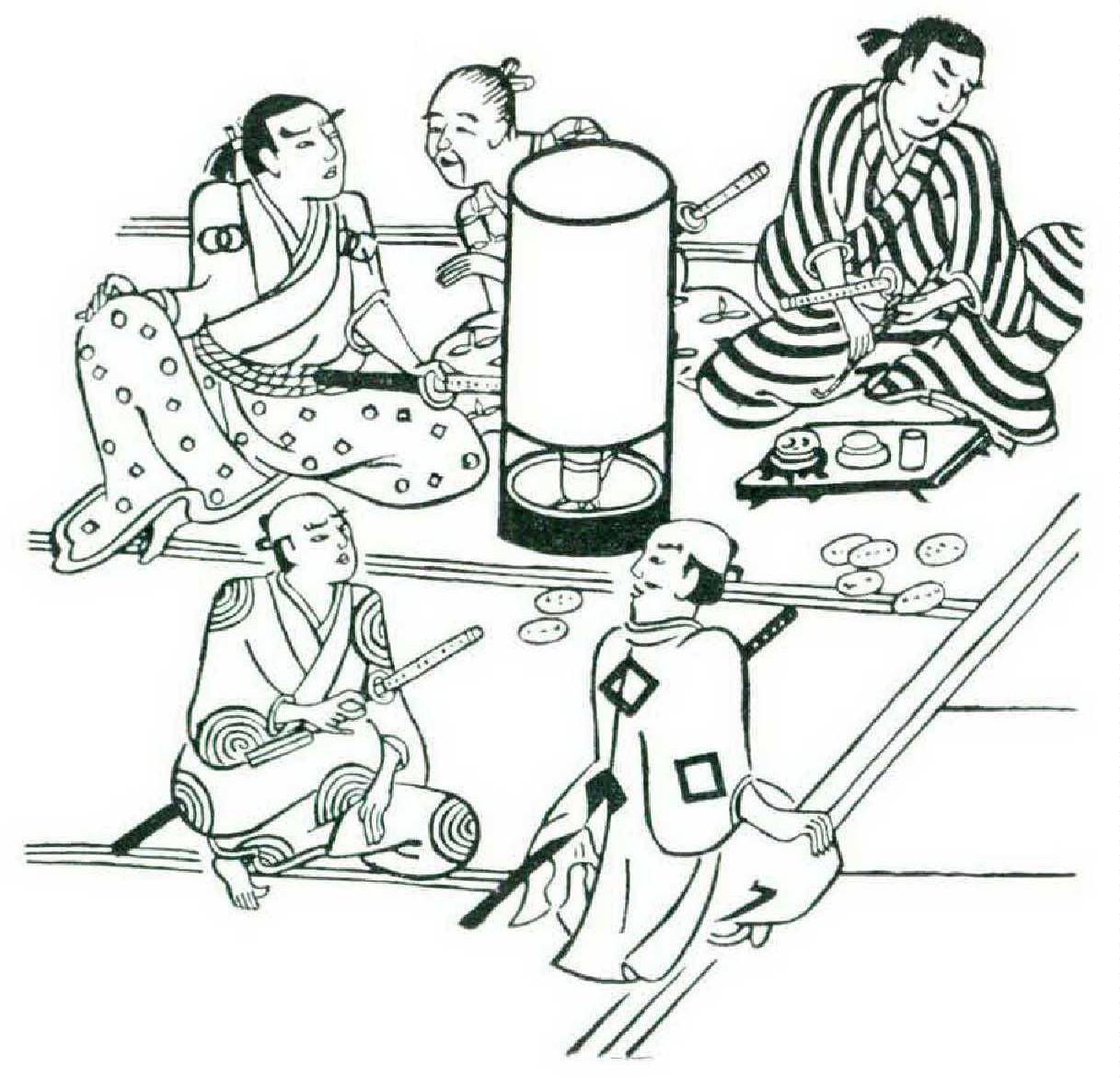
It was, by chance, a fine snowy evening, and, opening wide his decrepit gate, Naisuke greeted each friend as he appeared. His guests numbered seven, each clad in garments of cheap imitation silk, with thin capes entirely unsuited to the wintry weather. Yet there was about each something that somehow recalled their former days of glory.
After they had all made their formal salutations, their host came to the fore, saying: “Gentlemen, I am happy to inform you that, having been blessed by good fortune, I will be able to pay my debts and spend New Year’s Eve with you in just the way I might have wished.”
To which they all shouted, “O lucky man!”
“First of all,” be went on, “take a look at these masterly directions.” And, bringing out the packet of ten gold coins, he passed it around. All agreed it to be a most amusing prescription. Then followed round after round of wine. At last they sang the song of parting; all said that it had been a wonderful party, and apologized for staying so late. The guests then set about putting aright the disorder of the table; they gathered together the wine utensils and appetizer dishes, urging further that the gold coins be put away in safety. But when the coins were gathered up, one of the ten was missing. Everyone jumped up, shaking out the folds of his garment, and searched in every nook and cranny of the room. But nowhere was the coin to be found, and they had to conclude that it was lost.
But then Naisuke tactfully said, “Oh, I just remembered; I paid one of the coins for a longstanding debt.” But the others rejoined, “No, there were ten coins here a little while ago. It is very strange. Each must vindicate himself.” So, one by one, they rose and untied their sashes in order to be searched. But when the third man was reached, he made a wry face, and sat silent a moment. Then he drew himself up and said, “I am caught in an unfortunate situation. There is no need to search me: I do have one gold coin with me. I can only acquiesce in my fate; my life is yours.” Thus did he resign himself.
But the others in unison protested, “It is not impossible that even the poorest of Ronin should possess a coin of gold!”
And he answered them, “As for the provenance of the coin, I obtained it yesterday for the sale of my fine and long-cherished Tokujo Goto poignard to the dealer Juzaemon for an ounce of gold. But, the situation being what it is, I accept my fate. Only this I request, from the friendship you have all borne me, that after I am gone you will search for the lost coin, and cleanse this humiliation from my body. I beseech you!” And without further ado, he put his hand to his sword. But just then someone shouted, “The money is here!” and pulled a coin forth from the shadow of an oil lamp.
All present breathed a sigh of relief, and were commenting on the need of acting with care in such matters, when from the kitchen their host’s wife could be heard crying, “I’ve found the coin in here!” And indeed she then appeared with a lacquer tray, the gold coin stuck on it. The tray had contained wild potatoes boiled with soy sauce, and somehow the steam and heat had caused the coin to adhere to the lacquer. That was perfectly logical, but . . . there were now eleven gold coins. The guests then laughingly shouted that the steady augmentation of their host’s wealth was certainly an auspicious sign.
But Naisuke said, “The coins, which were but nine, I mistakenly thought were ten. But, while we were searching, they became eleven. Clearly one of you had a gold coin on him which he contributed to help clear up this very difficult situation. Now, I cannot keep this extra piece of gold; I must return it to its owner.”
But not one of his guests stepped forward. A curious stillness fell over the party. And though the night was nearly over and the cocks beginning to crow, no one would rise to leave.
Finally Naisuke spoke: “There being no other solution, let me handle this in my own way.” To this they all gave their consent. Whereupon Naisuke, placing the gold coin in a small wooden box, put the box on a large stone in his garden. Then, saying, “Whoever owns this coin, let him please take it with him,” he had his guests rise and leave, one by one, shutting the door behind each. Seven times he did this, till all the guests departed. Then Naisuke took up a candle and went out to examine the box, and he found the coin gone.
Whether it was for Naisuke’s adroit handling of the situation, or for his guests’ apt response, we cannot but consider it a denouement worthy of the spirit of the Samurai.
A LOVE POEM WRITTEN ON A FOLDING FAN
UNDER the cherry blossoms of Ueno Park even the troublesome restraints imposed upon ladies of high rank by life in a Daimyo-lord’s austere mansion could be forgotten, and these first flutterings of spring made their spirits light and gay. Secluded within an enclosure formed by hanging bright robes on ropes between the trees, the Daimyos ladies, with elegant songs embroidered on their kimonos, might well be judged a sight more attractive even than the cherry blossoms themselves.
Toward sundown, a lady who appeared to be the Daimyo’s consort set in motion first a vanguard bearing halberds and baggage, then a procession of highly decorated lacquer palanquins bearing the ladies. Among these could be seen, through an opening in the palanquin’s curtains, one more beautiful than all the rest. She was perhaps twenty years of age, and the like of her was not to be found even among all the far-famed fair ladies of Japan.
A young man, circling about her palanquin, had been staring at her as though transfixed. He seemed to be a manservant of middle rank, and did not appear the type which usually attracts women. But now by some strange fate he had lost his heart to a maiden of such high birth that he could never have any hope of success. Yet such was the attraction that he followed after the procession and, inquiring of one of the footmen, learned only that she was the exalted niece of a certain great Daimyo.
But he managed to find the mansion where she lived, and sought employment there. To his good fortune, he was given a position. Thus two years passed, he acting as her lackey wherever she went. And, fate being the strange thing it is, as he attended day by day the palanquin in which she rode, she came at last to be moved by his protestations of the love he bore her, and before long she had lost her heart to him.
At last, unable to rid her mind of thoughts of him, she instructed one of her maidservants to throw a black lacquered fan into the room where he and the other menservants were quartered. The pages and footmen gathered round, teasing him about a supposed affair with the maidservant; but he stopped their mouths with gifts of wine. That evening, alone, he opened up the fan, and saw immediately handwriting which was not that of any maidservant. The poem on the fan was the maiden’s admission of her love, and reading it over carefully several times, he saw that the meaning was: “If you really love me, this very night you must take me away with you. I will dress as a boy and go secretly to the garden gate. Treat this as you would your life.” He was overwhelmed with gratitude, and determined that even though they should tear him to pieces . . .
Waiting for her as appointed, he saw her appear just as she had written, disguised as a page-boy. Together they slipped out the gate and went secretly to the house of a friend on Kawarake Street. And he sheltered them. Later they rented a secluded little house on a back street, and there, unknown to any, lived together as man and wife.
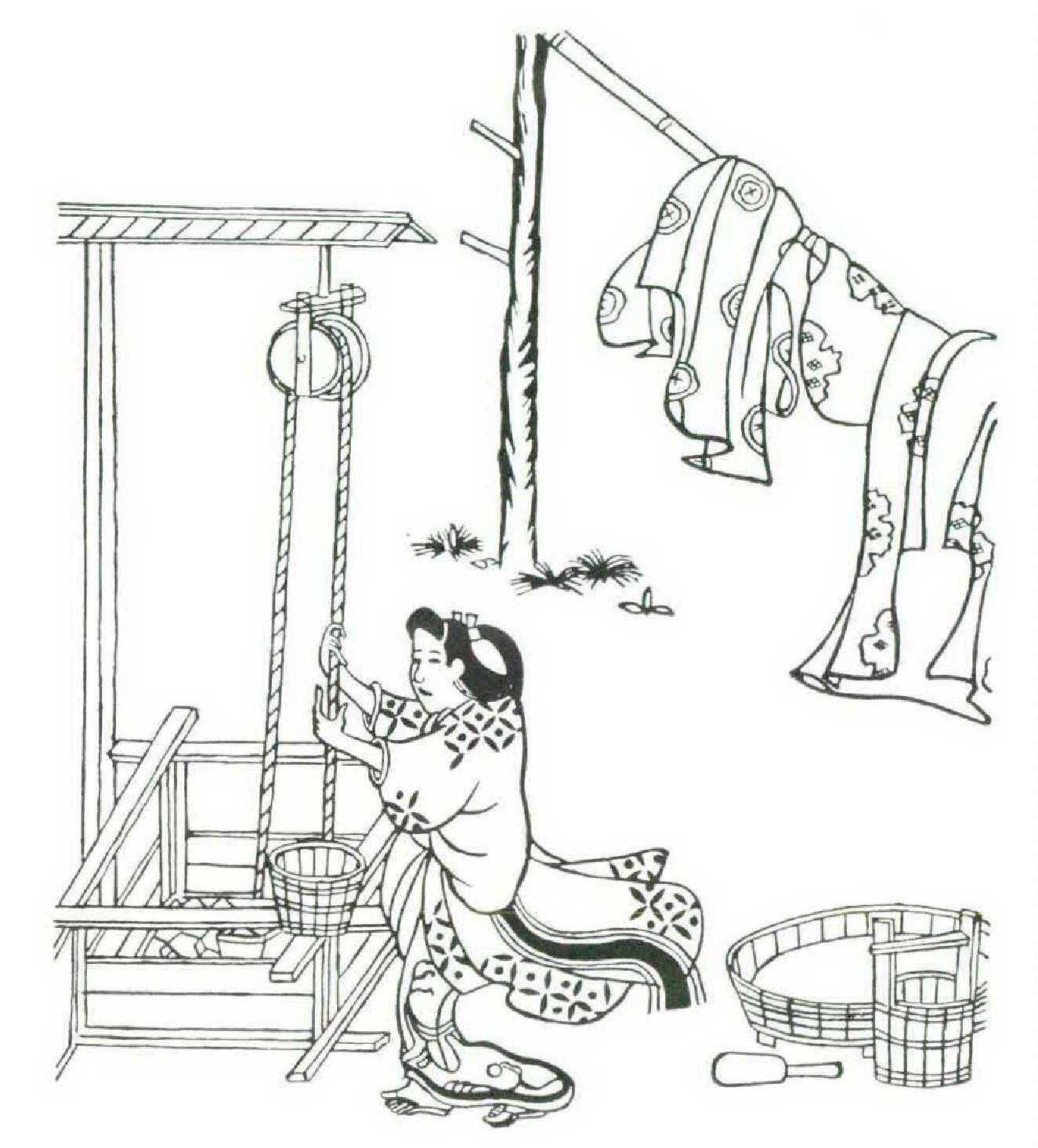
But they had made their flight without any preparation, and, finding no way to make a livelihood, they pawned the small sword which she had carried, and lived awhile on the proceeds therefrom. But soon there was no money left. So every night the man would go out selling medicines, but with little profit. At last, there being no other alternative, the girl began to take in laundry — work to which she was so little accustomed that it was pitiful to see. Indeed, the people in the neighborhood began to think that there was something strange about these two.
Meanwhile, fifty men were daily sent from the Daimyo’s mansion to search out his niece’s whereabouts. More than six months passed, but they finally found her. The two were surrounded by a large group of Samurai, and the man tied strongly with a rope.
That very night he was executed. The girl was shut up in a room. And she was let know that, as the child of a Samurai, the only path left her was self dispatch. But she showed no such intention.
Finally came word from the Daimyo himself, that there could be no more delay in her fate, however much, as a weak woman, she might fear death. And he sent a messenger to tell her: “It is the law. And although I sympathize with you, you have been unchaste and you must die.”
But she answered him, saying: “I was born with the rights of a human being. That a woman should have but a single husband, that is only proper; that I should have loved a man of such low birth is but the inscrutable working of fate. Know you not the real meaning of unchastity? That a woman possessed of a husband should love another man, or that, having been separated by death, she should seek another husband — these are unchastity. But for a woman without a husband to spend her life with one man cannot be called unchastity. And for a person of lowly birth to be taken in marriage, there are many precedents. You have murdered a man who was without guilt.” And she wept bitter tears.
Then, in order to devote her life to prayer for the soul of her mate, with her own hand she cut off her hair, and entered a nunnery.
Translated by Richard Lane