Two-Sword Hombers
HUGH A. BURR was first employed as a young stenographer for the FBI, served in the Army from 1944 to 1947, and teas graduated from Harvard in 1950. Recalled as a reserve officer, he was stationed in Korea and Japan, and is now freelancing in upper New York State.
by HUGH A. BURR
IN the new, democratic Japan, developments in any field that suggest a return to unenlightened preMacArthur practices bring forth hot volleys from the nation’s editorial writers. Indeed, these gentlemen sometimes leave an outsider with the feeling that they would like the world to forget all Japanese history previous to the first P.T.A. meeting.
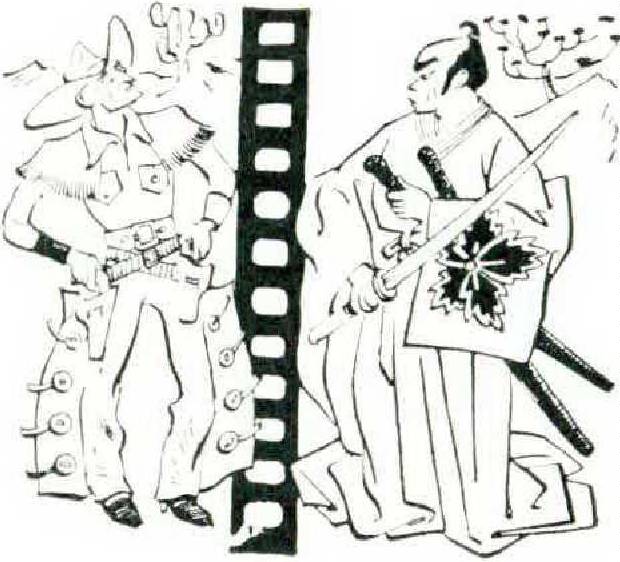
It took my discovery of the samurai movie to show me that most Japanese are still enchanted by their past, and particularly by their several centuries of warriors — even to the point of paying good prices to see films about them. I myself became a steady patron of samurai movies during a recent year in Japan, finding that they satisfied nicely a recurrent appetite for carnage normally filled by the American western — with which they are often compared.
I was aware that a certain minority of the foreign colony in Japan sat (when they had the rare luck of locating seats) through Japanese films occasionally as a cultural duty or in pursuit of the language. But these shows I write of will never impress Venice the way Rashomon did; nor is it likely that auditing one would avail the student of Japanese as much as would five minutes with a good grammar, unless he had uses for the unlovely monosyllables supposedly uttered by members of high society in feudal Japan upon taking a blade in the giblets. No, these are simpleminded exercises in violence, and they can be enjoyed by anyone, regardless of ear for the language.
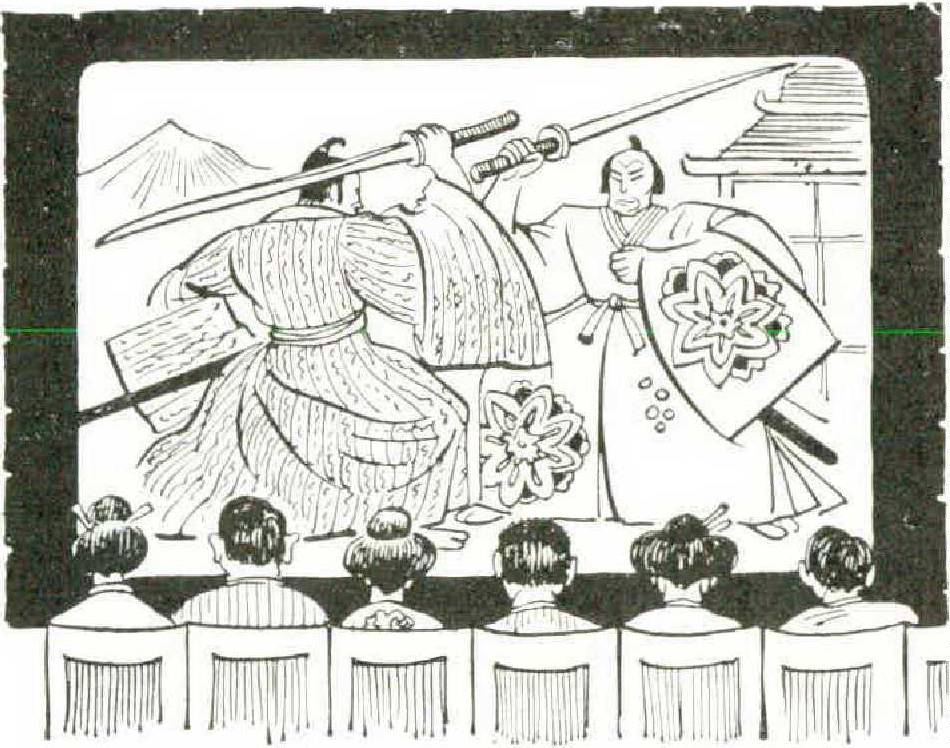
Studios making samurai movies often go for their plots to the extensive literature of the kakubi theater, which itself reflects eight centuries of feuding and civil war and is full of wickedness, revenge, passion, and self-sacrifice. But here, as with those sagas from the stables of Southern California, story really doesn’t matter as long as it renders decently plausible the several sustained Donnybrooks that fans of the genre expect for their money.
Like the western, the samurai movie has been stylized to a certain extent. For instance, you can be sure that at least once per movie the hero will find himself trapped up a dead end by a platoon of swordsmen which he proceeds to decimate in the course of a ballet-like demonstration of poor offensive tactics, the opposition attacking only one at a time like perfect gentlemen and then rebounding mortally wounded by blows that didn’t come within two feet of them. (Our next cultural mission to Tokyo might well include a couple of stunt men from Republic.)
The advent of reinforcements is handled in two ways, both as stirring as the sight of the Seventh Cavalry Regiment heaving into view over a rise. A posse of good samurai, long sword in hand and short sword in the belt, comes pouring down the alleys, sailing over the shrubbery with kimonos clutched high, and often taking to the rooftops with a stirring clatter of wooden shoes on the tiles. When — better yet — they come by night, their approach is first indicated by a file of bobbing lanterns like a writhing, incandescent snake in the distance. What a sight to quicken the blood!
As might be expected in a country where every arable inch is rice field, action in the samurai movie remains in town and indoors more than that of the cowboy movie. When the ambush is of a daimyo in a sedan chair rather than of a bank courier in a stagecoach, not quite so much room is needed, anyway.
The photography in these films is usually first-rate. It would please me still more if the cameramen could just steel themselves not to linger so lovingly over their pet shots. Japanese domestic interiors are beautiful and surely beckon the lens; but I came to dread the inevitable moment when two characters had been maneuvered into conversation between retracted rice-paper doors against a background of trees and sky, because I knew then the action was going to languish while my aesthetic side was appealed to with balance, perspective, and lighting.
Swordplay resumes, however, and sometimes abruptly, the quiet chat cut short by the arrival of the bad samurai.
Geisha squeal, men curse, sliding doors are whipped open and shut with sounds like shots, and then the rapid footsteps and the whisper of naked steel through the air. Now, whereas Hollywood must manufacture special frangible furniture and fixtures for its brawls, the normal Japanese household of wood and paper disintegrates into kindling very satisfactorily without tampering. I came to cherish the sight of a combatant going through a wall with a great splintering crash or thrashing his way out of the paper door he hadn’t had time to open.
Ladies figure in samurai movies much as they did in westerns before Hollywood let the kids down and started the cowpokes akissin’. They fill in between rounds with soft, talk and samisen music, and sometimes rile up the junior samurai, but before long scramble belowstairs, out of range of the cultery, to prepare hot water and towels.
One last word of commendation. I have seen several dozen of these films and can report that I have yet to hear a samurai sing.