Ameaningful Experience
CHARLES BOEWE grew up in West Salem, Illinois, took his A.B. and M.A. at Syracuse University, and is now working for his doctorate at the University of Wisconsin.
by CHARLES BOEWE
NOBODY in his right mind ever asks someone else’s child what he learned in school today — for one thing, he might tell you. Nevertheless, the schoolroom still seems a likely meeting ground where one can approach a child without feeling at a terrible disadvantage for not knowing the niceties of intergalactic law or who gives way to whom when two space ships meet outside the orbit of the planet Pluto. So one hedges around the central question, hoping to elicit remembered agonies of long division or common fractions. At least I expected something like that when I recently hinted to my nephew, a fifth-grader, that I might be interested in the arcane goings-on that afternoon in the scholastic thicket.
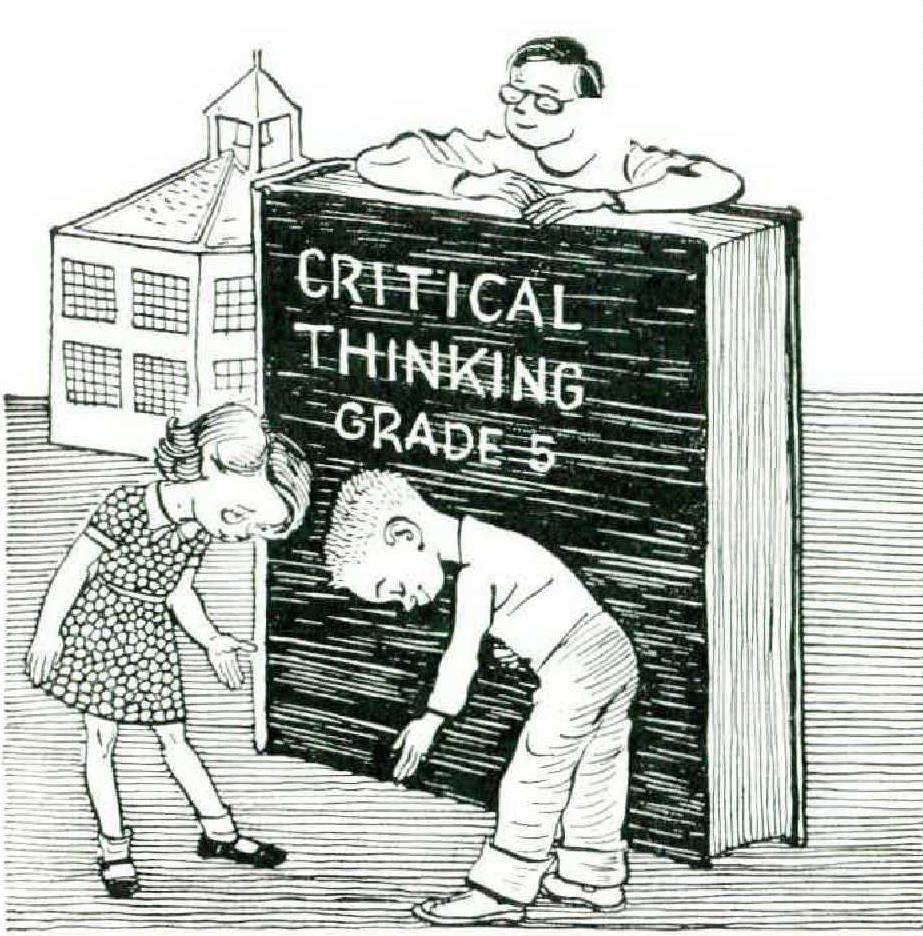
“Nothing very exciting,” he said. “We had Critical Thinking.”
Critical Thinking! How grand it sounded! I remembered that in my day we did pretty well to read through a book and get the nub of the plot.
“What sort of criticism do you carry out?” I asked him. “Are you historical critics.”Do you practice impressionistic erit ieism? Perhaps you follow some school. Are you Neohumanists? Perhaps New Critics?”
“We are oow-structive,” he said flatly. “We are never de-stmotive, because de-structive thought is negative thought.”
“ Is that bad?”
“Of course. Negative thinking is always bad. Thinking has to be pos- itive. We have Critical Thinking three afternoons a week — days when we don’t have Interpretive Body Rhythms.”
Interpretive Body Rhythms! Dear me, what impressive subjects! But one thing at a time.
“ What sort of works do you criticize?” I asked.
“Works? We do critical thinking on things that have happened in the room. We each have a chance to talk about the meaningful experiences we have had during the past day.
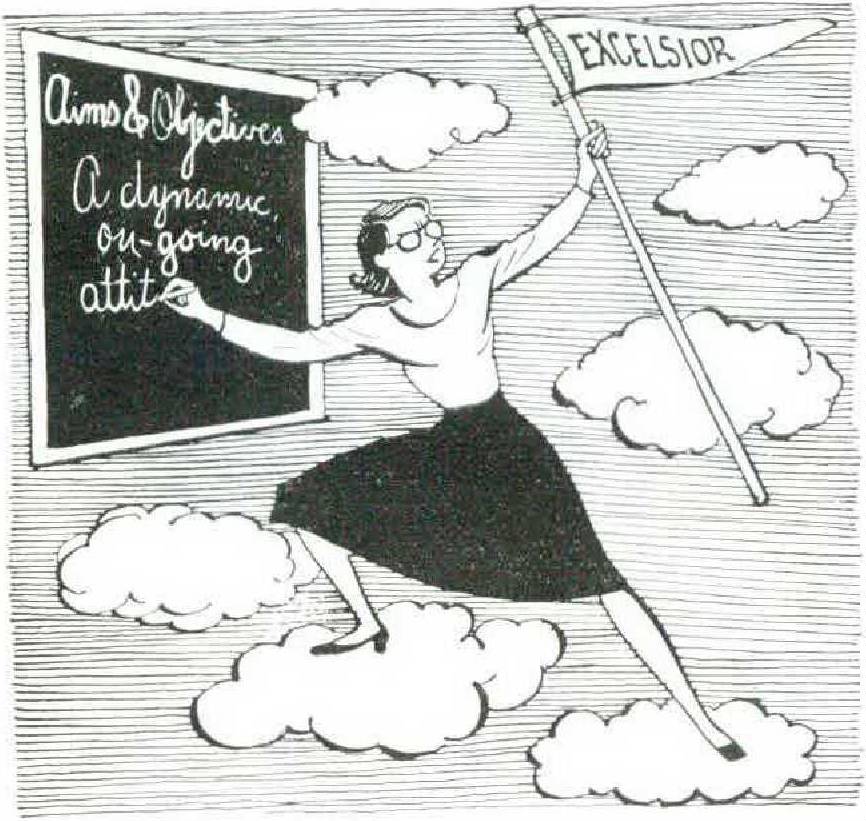
“Suppose somebody bumps into me and says, ‘Excuse me. Well, during Critical Thinking I say that so-and-so was polite to me, and then we talk about the effect of politeness on the group. It s a snap. You just say, ‘Politeness helps group coöperation.’ Then the teacher writes on the blackboard, ‘Politeness helps group coöperation.’ Maybe, if she likes it real well, she’ll say, ‘Shall we make this one of our aims and objectives of the week?’ Then we change it to say, ‘We must all be polite,’ and it stays on the blackboard all week.”
“Now about Interpretive Body Rhythms,” I said. “What is that?
“Oh, we just interpret things. We get the ideas from Social Studies units or Current Events, and we make up plays about them. I did a whiz of a pantomime on the Hanging Gardens of Babylon — all by myself. I stretched out on a table and imagined I was a hanging garden. Sometimes we do things like the North Allantic Treaty Organization. That’s a lot of fun; we dress up in foreign costumes and run around in every direction, symbolizing a muddle.”
Probably it was less an avuncular interest in the lad’s intellectual welfare than shameless curiosity that prompted me to seek an interview with his teacher a few days later. It was an experience I shall not soon forget.
“I wish you could come to one of our little Sharing Parties, “ the good lady urged as soon as I was settled comfortably in her file-cabinet-lined office adjoining the classroom. “I do so like to have the boys and girls share their educational experiences with their parents and relatives.”
“Such as Critical Thinking?” I asked. “Thank you, I’ve had my share — a share, that is.
“That’s only part of it. We like to have them share all their educational experiences. Sharing is a part of the school’s group-determined aims and objectives. Perhaps I could tell you about our curriculum best if I began with these.”
I Complimented her and the school on the very subtle point of having both aims and objectives. It must have been so discouraging for the poorer students when schools had only objectives. This way, I could see, there was something for everybody; for, while you can’t expect all the students to reach the school’s objectives, you can at least aim their faces in the right direction. For a moment I entertained the pleasant image of hundreds of little scholars, each an intellectual weather vane, each little nose pointed into the invigorating breeze of learning.
“No,” she went on thoughtfully, “I think first I should explain my personal philosophy of education.”
A philosophy of education guiding the fifth grade! And not just any old hand-me-down philosophy o! education from Plato, or Bacon, or even Pestalozzi, but a personal one.
“I believe, you see, in the nondirective approach. I don’t force. I don’t lead. I let the child be his own guide. It is only by thinking critically about himself or herself that the child is able to make his or her significant and meaningful contribution to group activity.”
“Is that desirable?” I asked with some hesitation, perhaps momentarily confused by her delicate distinctions of gender.
“Desirable? Of course. Why else do we plan and work together with emphasis upon increasing self-direction (individual and group) in organizing and carrying forward our activities but that the individual may contribute his best talents, skills, and concepts to the group?” She had me there, and I think she knew it.
“Why critical thinking, except that we help each other to help the group?”
“Now that you’ve mentioned it,”
I said, “I have been wondering about critical thinking. That’s a subject that seems to have slipped up on me.”
She smiled — rather compassionately, I thought. “Oh, we don’t teach subjects; we teach children.
Another hit. I tried to roll with the blow.
“Critical thinking is part of our program of aims and objectives,” she continued, letting each word drop separately, like a pebble into a pool. “Critical thinking makes it possible for us to evaluate our own behavior so that we may gain competence in the sort of behavior that is needful to implement our social attitudes. Our social attitudes, implemented by our social skills, enable us, in the light of our social concepts, to deal effectively with social processes such as persistent life situations. But we must coöperate; none of us can reach as valid conclusions alone as we can as contributing members of a group.”
“ Everybody is smarter than anybody. Something like that ?”
“Well, not quite. The teacher,” she continued in her nondirective way, “tries to encourage the boys’ and girls’ favorable attitudes toward positive social situations. From the focal points of the learning situation, around which cluster meaningful experiences, the teacher endeavors to develop dynamic, on-going attittides.
The word “on-going” did it. All at once the keystone dropped into place, the sirup jelled, the precipitate came down. I picked up my hat, thanked her, and left the school in a meditative mood.
It isn’t long division or common fractions that puts you in touch with a schoolboy today. As well try to stir up an argument among your friends over Freud or Darwin as expect him to get excited about 3/8 divided by 1/6. All that mathematical stuff is elementary in this age of Planck’s constant and I 235. Instead, share your critical thinking with him, ask him about his meaningful experiences.