The Music of India: And Its Role in Indian Dance
by NARAYANA MENON
1
INDIAN music is a very ancient art and has a three-thousand-year-old tradition behind it. This represents perhaps the longest unbroken record of any cultural tradition we know. Countries like China and Egypt have longer records of history and culture. The Catalogue Général des Antiquités Égyptiennes du Musée du Caire published recently by the Egyptian Government gives accurate descriptions and pictures of musical instruments 4000 years old, and indications of a musical notation which point to an art at a high stage of development. But somewhere in the history of Egypt, the link with this historic past is lost, and contemporary Egyptian music cannot be related to its past.
It is this continuity of growth that is the most remarkable thing about Indian music. Long before the Christian era it had developed not only definite laws of theory and practice, but even comprehensive theories of appreciation. The ancient pandits studied carefully the physical stimulants to aesthetic enjoyment. They analyzed the nature of emotion (Bhava); the conditions and the themes which produce the emotions (Vibhava); the visible signs and results of such emotion (Anubhava); and even the nature of the subconscious mind, the involuntary emotions (Satvabhava). Their methods were rational and, what is more, they put their conclusions to good practical use. The Greeks did this on a small scale. They realized, for instance, that the Doric mode was dignified and manly, and taught the Spartan boys nothing else. They were careful of the use of the Lydian mode which they thought voluptuous, licentious, and orgiastic. Strabo, the Greek philosopher, may have been thinking of this when he acknowledged the debt of Greek music to India.
The beginnings of Indian music are shrouded in mythology. We are told in the old legends that the seven notes of the scale and the primary rhythms were revealed by the god Vishnu himself, and it was believed that singing, playing, and dancing exemplified his various forms. Thus it was only natural that music should have grown and developed as an adjunct of religious worship and that India’s temples should have been her great conservatories. To this day the orthodox Hindu musician thinks of his music as devotional.
From the study of ancient treatises on music which have come down to us, such as Bharata’s fourth-century Natya Sastra and Sarangadeva’s thirteenth-century Sangita-Ratnakara, we know how little Indian classical music has changed since early times. To be sure, when the Muslims came down into India about the twelfth century they brought with them the subtle and highly developed melodic scales of the Persians, but this influence never became more than a superstructure on the robust body of Hindu music, and in South India, where the penetration of Islam was least, the traditional Dravidian forms retained their purity almost untouched.
Perhaps the most distinctive characteristic of Indian music — the quality that makes it at first sound so strange to the Western ear — is that it is purely melodic. By pure melody I mean melody that neither needs nor implies harmony. Harmony affects the structure of melody itself, and it has become almost impossible for the Westerner to conceive of melody without the implications, tacit or explicit, of a harmonic system.
In Western music, a melodic line is really the top or surface line of a carefully constructed harmonic structure. Thus in the building up of melody, the harmonic implications of substantive and passing notes, and the relationship of these, play an important part. Beyond this, Western melody has a tendency to develop round notes which are harmonically related to the tonic.
Indian melody, on the other hand, is made up of notes which are related purely by their continuity. If melody of this kind sounds exotic to the Western ear, it is probably because the West has lost the sense of pure melody and cannot take in melody neat, as it were. The Indian use of quarter tones is also relevant here. There is no such thing in Indian music as an exact quarter tone, such as those used by Alois Haba or Bloch. But Indian musicians do use in certain ragas sharps which are sharper than those of the diatonic scale and flats which are flatter. It is not the number of notes we use that is important. The important thing is how small an interval we can successfully employ.
The bases of Indian music are raga and tala. Perhaps the nearest English equivalent for raga is the term “ mode.” The Persian maqam is much the same thing. But our raga is a far more definite concept. In a raga not only are the notes used within the octave important but even the sequence in which they arc used. The result is great strictness within great variety. According to a classification which dates from the seventeenth century there are seventy-two fully septatonic ragas. In all these the fifth is constant. Thirty-six have true fourths, thirty-six augmented fourths.
Then there are a number of derivative ragas, some pentatonic, some hexatonic. Some of these use five notes going up, but six or seven coming down the scale and vice versa. Consider now that this music is seldom written. Indian musicians, handing down the tradition from generation to generation, have developed such extraordinary powers of memory that they carry several hundreds of these ragas in their heads.
Tala is the rhythm of Indian music. And like the raga it obeys strict laws of pattern. Tala is asymmetric as well as symmetric. Often a bar is made up of 4-2-2, as in the southern Adi Tala. Variations of talas can be in either geometric or arithmetic progression. A variation of the tala given above might be 5—2-2 or 3-2—2. There are accented and unaccented parts of a bar. Thus in the Adi Tala, the first, the fifth, and the seventh beats are strongly accented. All this is possible in Indian music because it is not forced to accept symmetries of rhythm which harmonic planning necessitates.
Within this well-defined framework, this fitting together of pitch and beat according to rigid laws, the Indian musician improvises. And it is the brilliance of his improvisation — what he can do by sheer virtuosity in spite of the restricting rules of the game — which is the glory of our great artists.
Is not the highest art extemporaneous? The art of improvising was current in Western music until recently and all the great masters such as Bach, Handel, and Beethoven, up to and including Liszt, were famous for their improvisations. The only corresponding musical activity in the West today is the improvisation of jazz. But here the improvisation develops along certain chord sequences, while in Indian music it is confined to the melodic line. Variations in rhythm, of course, are common to both.
Another of the key elements in Indian music is the dominant role of the voice. Indian music is sung music, even when played by instruments, because the music is basically vocal in conception. It is not that we lack instruments — in variety India probably has more than the West, and the best of them are capable of subtleties of intention and nuance beyond any I have heard anywhere in the world — but simply that the human voice is still the finest instrument there is for the kind of music we have.
2
IN THE pattern of Indian culture, music and the dance, the visual arts and poetry are all governed by the same attitudes. Indian music bears the same relationship to Western music as Indian dancing does to Western ballet, and for that matter much the same sort of relationship as Indian literature does to that of Europe or traditional Indian art to European art. In all these, the insistence, in India, is on emotional sincerity as against intellectual sincerity in the West; on the lyrical impulse rather than on the dramatic impulse; on intuition rather than on reason; on contemplation more than on action. The result is a subjectivism which is opposed to Western objectivism.
Many factors are at the root of such a development and it is perhaps beyond the scope of a short essay such as this to go into any detailed analysis of the reasons. But let me illustrate it from the dance. The fundamental difference between Indian dancing and Western ballet consists in the way in which a given idea is realized. In Indian dancing, the dancer (like the musician in Indian music) is the center, the figurehead of the idea, and the dance emanates from him. In European ballet the idea of the dance is projected on the dancers. It is an objective realization of the idea by the creator of the dance, the choreographer, who uses the dancers as a vehicle for the expression of his ideas.
This makes the Indian dancer, within a strictly traditional code, a creative artist in the fullest sense of the word; whereas in European ballet the dancer’s role is an interpretive one, to infuse and bring life to the choreographer’s conception. This also makes Indian dancing essentially a solo affair. Even when there is a group of dancers, as in the more dramatic forms of Indian dancing, like the Kathakali of Malabar, the dancing takes the form of a series of solo performances. Groupings are unimportant. There is no plastic relationship in the lines, which are related purely by their continuity. The wide, sweeping lines of the ballet are absent. Minute gestural effects become important.
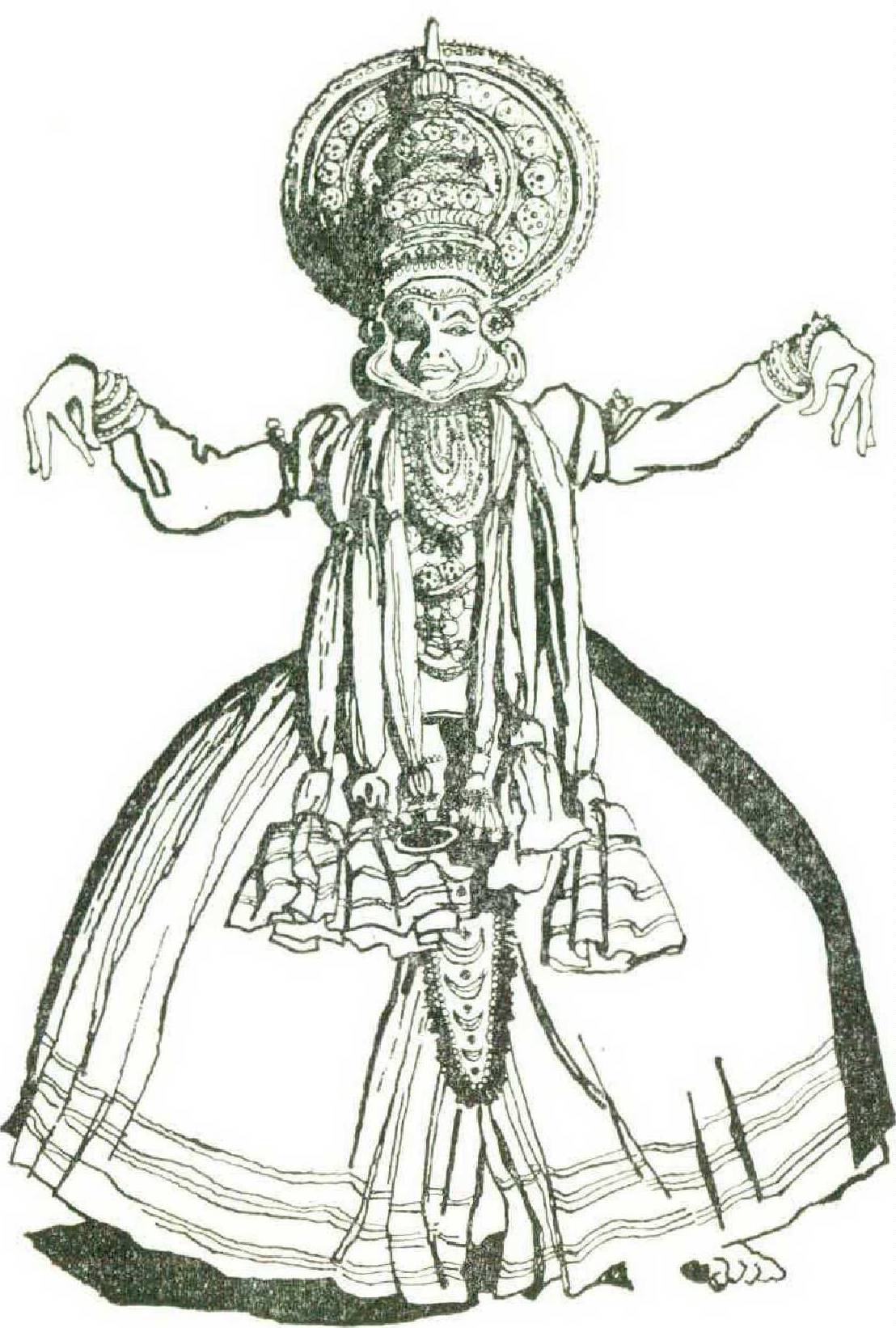
Kathakali, the traditional dance-drama of South India, goes back two thousand years to the great religious epics which are the basis of Hindu culture. Dancers mime the stories of the ancient myths while singers chant the tale in verse, accompanied by gongs, bells, and drums.
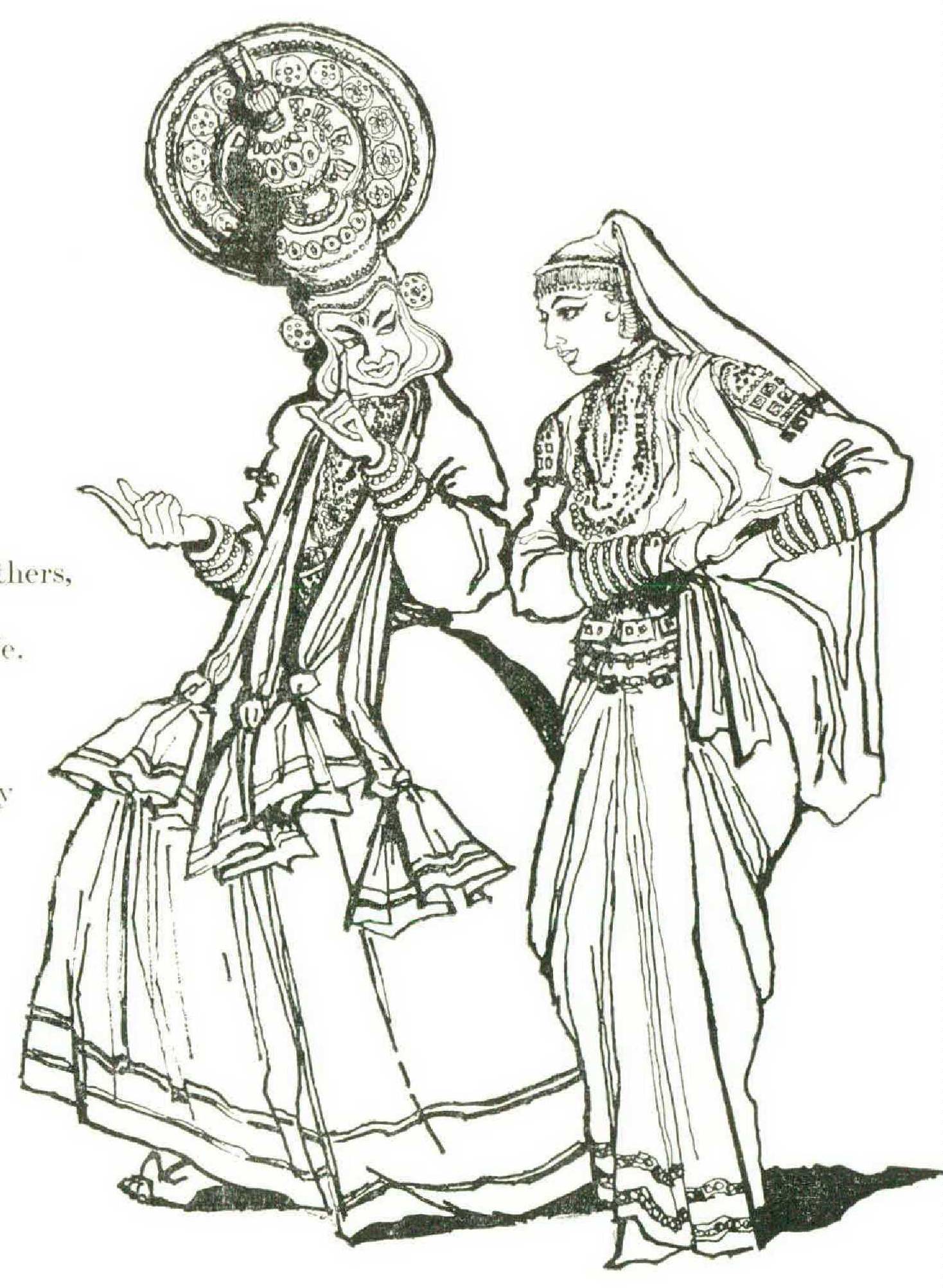
Here a “good man” (perhaps one of the Pandava brothers, heroes in the Mahabharata) is conversing with his wife. Kathakali actors never speak, but use mudras, a sign language of the hands with a gesture for every Sanskrit word. Female roles are taken by boys.
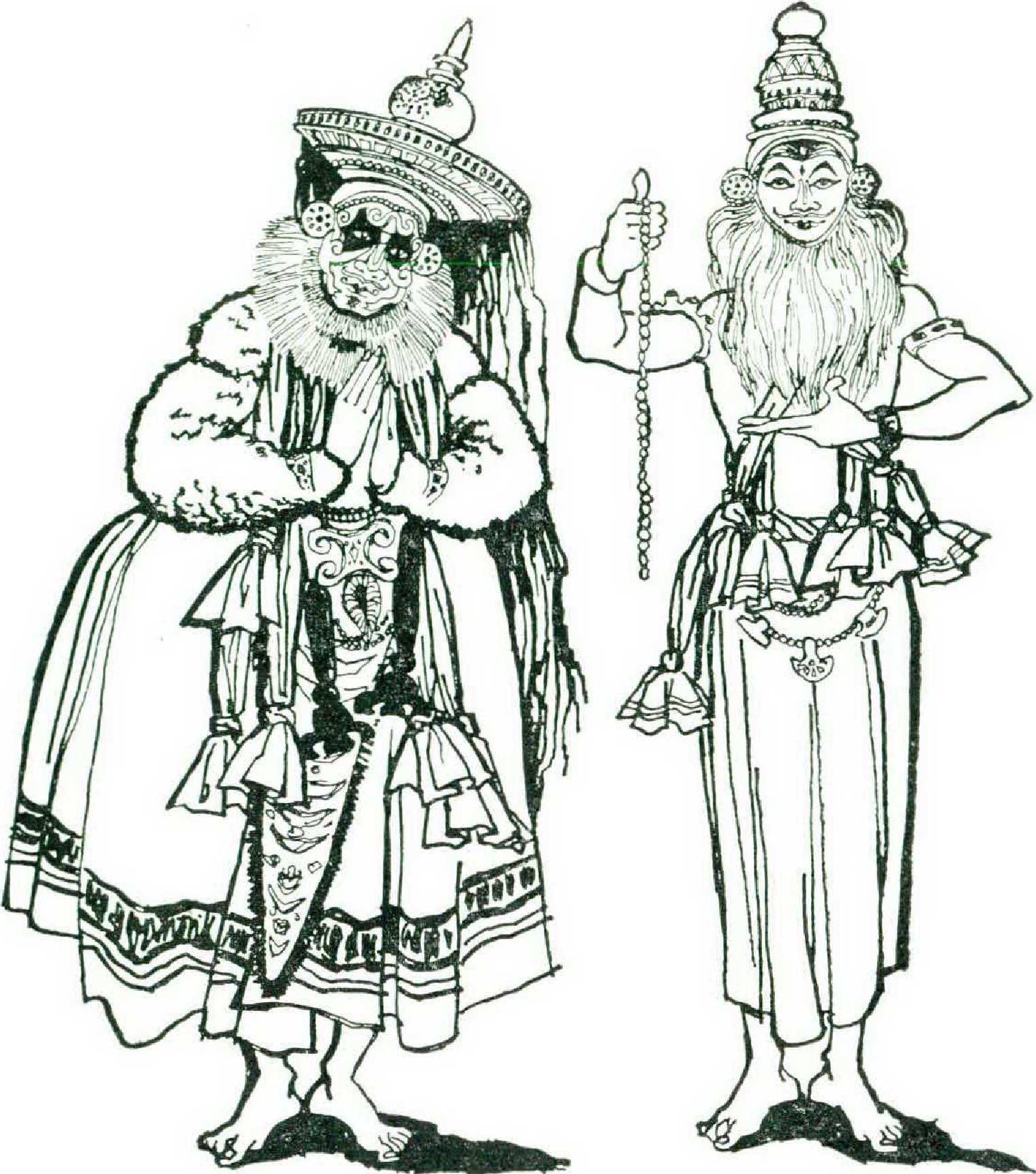
On the left is Hanuman, the heroic “monkey god ” of the Ramayana epic, making obeisance to a Brahmin priest who is giving his benediction. The dancers’ startling make-ups of green, yellow, black, and browns take many hours to put on.
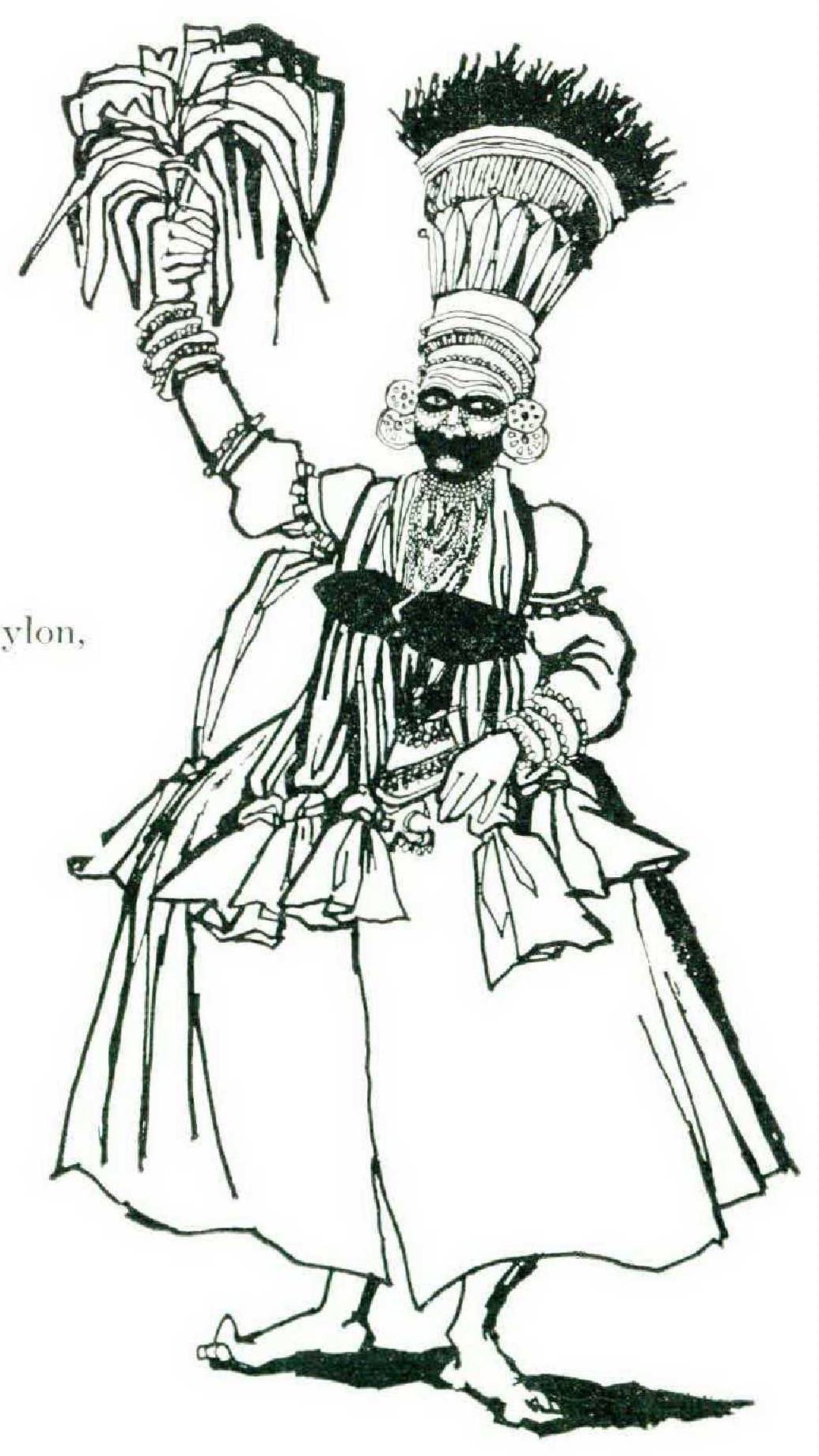
The sister of Ravana, the mythological demon-king of Ceylon, is shown here in all her grotesque horror. Kathakali is usually performed at night, often in the open with flaming torchlamps for illumination. Sometimes the performances go on until dawn.
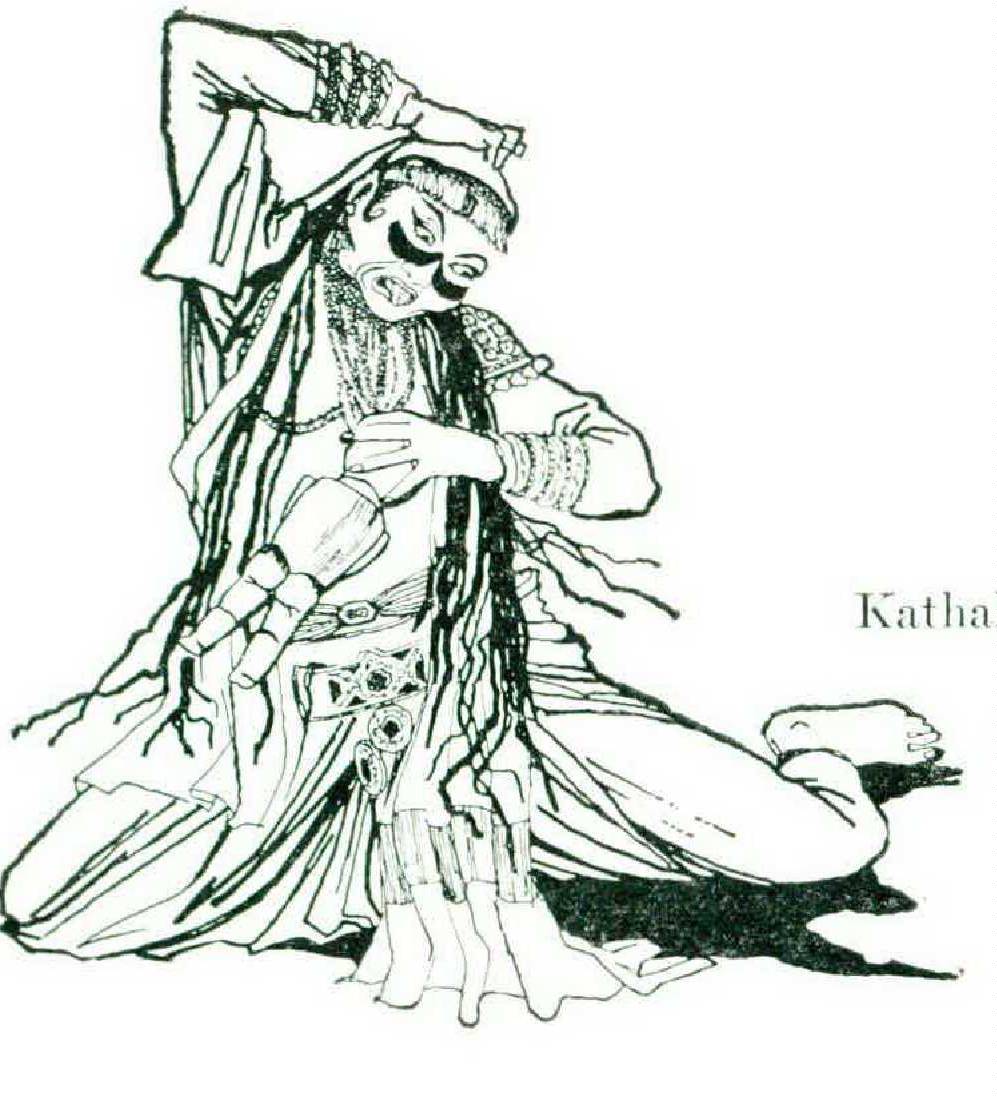
Kathakali is at once sophisticated and barbaric, poetic yet violent. Here an evil mother drives herself to kill her own child. As the stories unfold the emotions of the audience rise to fever pitch.
These gestures, or mudras as they are called, are the essence of Indian dancing. They are a very comprehensive language and any story or incident or any shade of emotion can be satisfactorily expressed through them. Two well-trained dancers can carry on a conversation on any topic in everyday life by using these gestures. The eloquence of the mudras is the eloquence of poetry, not the realistic eloquence of prose. They suggest, but never imitate. They evoke a mood, but never state it.
In Western ballet conventional movements such as an arabesque or entrechat or pirouette are freely used by a choreographer to express certain ideas or types, not to mention the clever and dramatic use of the mime. Bnt does not convention often become an embarrassment, even an impediment ? Even in such a poetic ballet as Les Sylphides the male dancer looks slightly ridiculous. It is this hidebound convention which has led to new growths in the dance styles of the West—movements led by such dancers as Mary Wigman, Martha Graham, Kurt Jooss, who go completely outside the conventions of classical ballet to revitalize the new dance.
Since India is not simply one country but a whole subcontinent, it is only natural that her main tradition of the dance should have developed unevenly and become divided into distinct schools of varying individuality in different regions. The most important schools are: the Bharata-natyam of South India, the Kathak dances of Upper India, and the Kathakali of Malabar. Less famous perhaps, but significant, are the Manipuri school of the Northeast, of which Mr. Bowers writes in these pages, and the masked dances of Siraikela and the States of Orissa.
Bharata-natyam probably represents the purest and oldest form of the Indian tradition. It descends, of course, from temple dancing, but nowadays it is presented as a recital, with a program usually lasting about three hours. Bharata-natyam is always executed by one single dancer, usually a woman, and there is hardly any décor or change of costume. The music for it consists of a singer, or singers, and a group of drummers. The sung music functions like a commentary on the dance except when the nattuvanar, who directs the performance, calls out the bols of the rhythm which the dancer’s feet execute.
If the intricacies of rhythm in Indian music escape the uninitiated, the rhythms of Indian dance are even more subtle and difficult. In the Kathak school the role of the percussion is especially important. The drummer anticipates every step of the dancer and the result is like two musicians playing in unison, the bells on the dancer’s feet synchronizing with the beat of the drums. Facial expression — abhinaya — is also a highly developed element in the dance. The Kathak school shows strong Muslim influences. Its elegance and its sophistry were derived from the Mogul Court, but its complicated rhythms are of indigenous origin.
Kathakali, which literally means “story-play,” is the most dramatic form of Indian dancing. Here the gestures and technique of Bharata-natyam have taken on a more masculine vitality. Kathakali employs many dancers and many types, acting out themes drawn from the old Sanskrit epics. It is usually performed out of doors and the dancing is likely to last the whole night through. Kathakali is as violent and exciting as Bharata-natyam is subtle and lyrical.
3
THE relationship between music and dancing is nowhere closer than in the Indian tradition. This tradition must be understood in the context of Indian life and thought. Its present theory and practice are the logical development of a consistent process, a process which has been distinctive and which is an integral part of Indian history and culture. To listen to Indian music and judge it in terms of Western music or some other system will mean missing the point and reaching absurd conclusions. It will be like judging Beethoven or Brahms in terms of raga and tala. Questions of style, of interpretation, of finer and subtler points of execution cannot be discussed in any recognizable international terms. Aesthetics and attitudes can. Music is not an international language. All this talk of music being an international language is a myth. Of course it may be true of limited areas such as Europe or Southern India or the Middle East — areas which have a common musical system but different spoken languages. But I have heard too much of Egyptian, Javanese, and Chinese music — not to mention the various national styles of Europe — to believe that cosmopolitanism in music is possible.
And values differ so widely. Take the voice for instance. Most Europeans think that Indian voices sound artificial, harsh, strained, and nasal. Yet that is precisely what most Indians think of Western voices — artificially produced, strained, and nasal. What either of them will think of a Chinese operatic singer, I dare not say. Of course there are voices which can be appreciated the world over — Paul Robeson’s, for instance, or the late Ustad Faiyaz Khan’s. But the attributes of a voice will be determined by what the voice is expected to do. Only a fully trained Western soprano can sing the aria of the Queen of the Night from The Magic Flute and only an Indian musician can do the Viriboni Varna. Stress on particular values, too, is important.
The quality of the voice as such is comparatively unimportant in Indian music. In India the voice is no more an asset to a singer than, say, good handwriting is to a poet. What a musician sings is far more important than how he sings it. Every singer is a creative artist in the fullest sense of the word. In the West, a singer is a vehicle for the expression of the composer’s ideas, and very often — as in many operas — a voice is used just like any other instrument. In the course of a BBC discussion with Sir Steuart Wilson I said: “In Europe a young man decides to become a singer if he has a good voice; in India a young man decides to become a singer if he is musical.” Sir Steuart admitted it was perhaps an exaggeration, but only the exaggeration of a vital truth. How can one apply the same tests for such widely differing conceptions?
Music is the most abstract of all the arts. And it has the least verisimilitude to nature. Poetry has words which can be understood or translated, at least partly. Painting and sculpture (except in the most abstract modern works) have recognizable forms which approximate our visual experiences. But in music we have no such aid to apprehension. The knowledge of (or at least an awareness of) the system of which the music is a part is the only guide. One can come to grips with it only through constant hearing. One must listen and listen a great deal — with discrimination and with intelligence. Only then will subtleties of nuance and style begin to take shape in one’s mind.
If I lay stress on the necessity for what amounts to a total immersion in our music it is certainly not in an attempt to discourage Western music lovers from approaching it. There is much in our ragas which can give pleasure at first hearing, especially when the hearer is prepared to listen with his emotions — even to listen from his subconscious, if he must, forgetting for the moment all that he has been conditioned by Western music to expect. I have an American friend who could not hear enough of our music when he visited India and who told me that a Kathakali performance on the Malabar Coast moved him as profoundly as any dance he had experienced in the West. No, if I urge long listening, it is only because I know that the time will be well spent and the effort rewarded. Within its limits, Indian music is limitless. It offers riches to the ear, the mind, and the heart which are no less fabulous than the other storied treasures of the East.