The Thief of Asswan
Atlantic readers will remember ALLEN JACKSON as the University of Michigan football player whose extraordinary article “Too Much Football,” appeared in our October, 1951, issue.
by ALLEN JACKSON
THE city of Asswan, near the first cataract of the Nile, is about eight hundred miles south of the Mediterranean Sea. In the summertime it is very hot in Asswan; the valley of the Nile at this point is narrow and the desert comes down close to the water. In the afternoon it is quiet in the town, and conversation in the cafés makes a meandering buzzing sound like sedentary flies on a veranda.
One afternoon I was sitting in a café sipping tea with an Egyptian named Azziz whom I had met on the train coming into Asswan two days before. Mr. Azziz was an official in a government office and he had taken it upon himself to make sure that I saw everything there was to see in Asswan. His zeal, however, was greater than his material; we had already gone to the dam two miles upstream, we had seen the unfinished obelisk of Queen Hatshepsut, and that morning we had climbed up the high bluffs on ihe other side of the river to see the tombs. Now Mr. Azziz was fretting.
“Perhaps you find our town a dull place, eh?” said Mr. Azziz. “A fine dam, yes. And some monuments and the cataract. But in order to see these things one requires less than two days, and then we are sitting in this eafé. But I wish you could know it as I know it. Asswan is my home.”
“Didn’t you say you were born in a mud village?” I said.
“Oh yes. Near here. But Asswan is really my home.”
“Why don’t we take a ride out to your village?”
“Oh, but what interest is that? Mud houses, that’s all. One store, one café. It is very dull.”
“They’ve got a café? All right, let’s go there just to change cafés.”
When we arrived Mr. Azziz showed me around the village, pointed out the house in which he was born, observed a number of times that the village was a dull place, and then, after asking me if I still wanted to sit in the village café, led me to it.
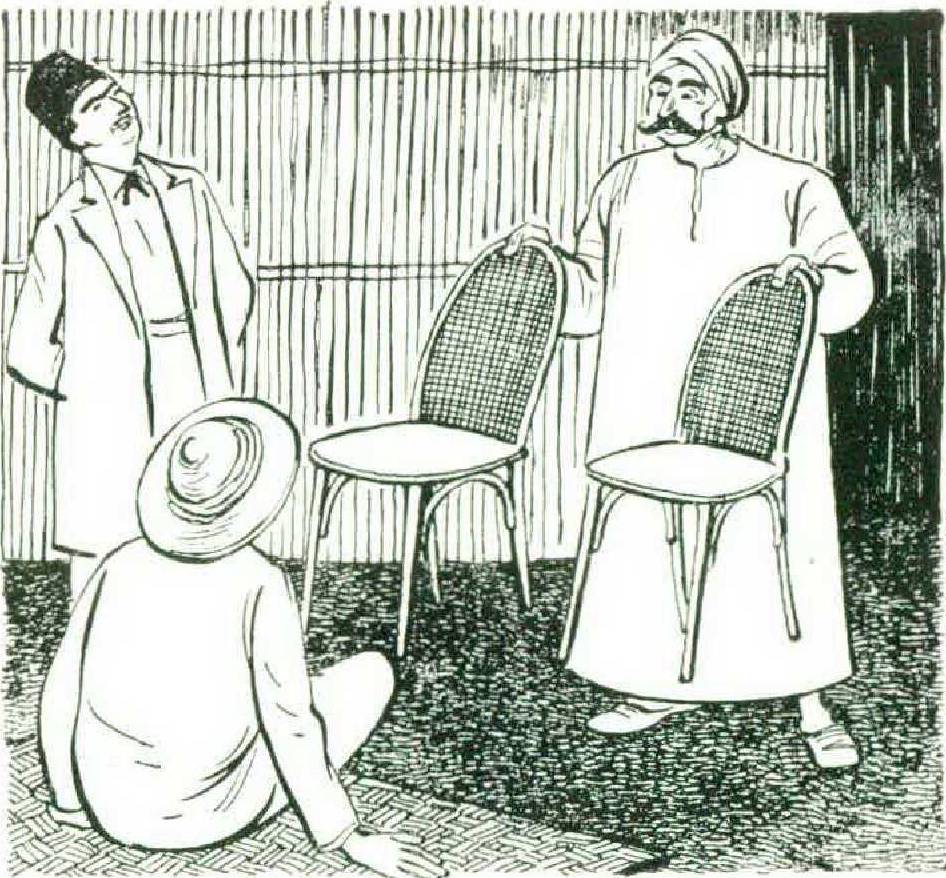
The café was made entirely of mud. A few idlers sat on the “terrace,” a small area adjoining the café which was enclosed by light walls made of cornstalks and roofed over with reed matting. There were no chairs, but it was a cozy place and I stooped through the entrance and sat down on one of the mats which covered the dirt floor. The proprietor, a big burly man with a long scar on one cheek and a bright flashing smile, leaped to his feet as I entered, and dashed around into the mud part of the café.
“He goes to bring chairs for us,”said Mr. Azziz. “It is all right for you to sit on the floor, but I must wait for the chair. He will bring two chairs. He is a good man and it will make him happy if you should sit on the chair.”
The proprietor came back after a few seconds, all smiles, with the two chairs. Mr. Azziz and I sat on them, and the proprietor and the other idlers sat around us on the mats.
“Buon giorno,” said the proprietor to me in a deep bass voice. “Lei parla italiano?”
“No.” I said, somewhat taken aback at hearing the Italian, “sorry.”
“He speaks some Italian and some Geek and some of the language of Yugoslavia,” said Mr. Azziz. “He learned t hese languages when he w as a thief. He used to be a great thief in Alexandria.”
I asked Mr. Azziz how the man had come to be a thief and how he had learned the languages. Mr. Azziz spoke to him. The man was eager to talk and Mr. Azziz translated for me.
“He was born here in Asswan, but there was no work when he was a young man, so he went to Cairo. He is very energetic. He says he had enough food in Asswan, but he wanted to make an interesting life, and there was nothing to interest him in Asswan. He has a good head, I think. I think he left Asswan because he has a good head, but he had no education, and he did not know what to do. He says he stayed in Cairo for some time and then he went to Alexandria because he wanted to look at the sea.
“He had never seen a sea, and it was a great miracle for him. When he saw the sea for the first time there were high green waves which broke themselves against the rocks; there was a strong wind and the white part of the sea was thrown high into the air; there was a great noise which filled up his mind so that nothing could enter, and he thought that God was speaking to him. He says he came to the sea in the afternoon and he stayed there in one place until late in the night. He could not go away because the noise of the sea stayed in his head, and so he slept there.
“When he woke the next morning the high green waves were gone and the noise was gone and God did not speak to him any longer; but he says he felt peace in his body and he wanted very much to go upon a great boat and to discover that which was on the other side of the sea.
He had no food and no money and he knew nothing of working on the great boats of the sea. He went to the port and found some work by unloading the great boats. In this work he was paid very little money and he saw only the dark places of the boats and never the green waves. He worked for a year like this and he began to be afraid that all his life should pass in the dark places of the boats. It was then that he became a thief.
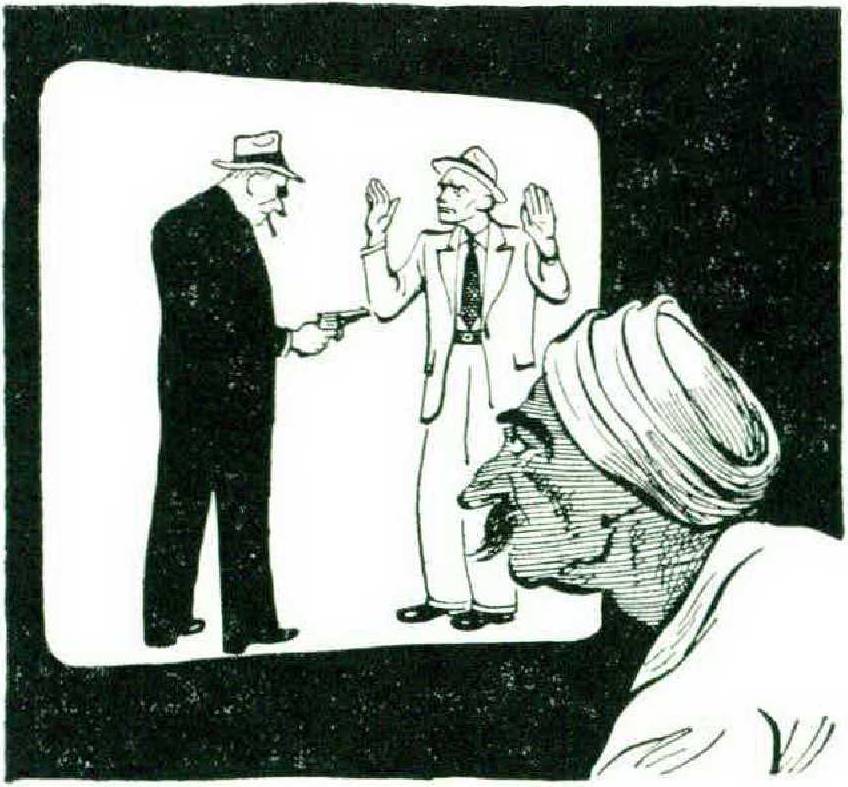
“He says he became a thief after he went to the American cinema. He did not know how to be a thief at first but he learned much from the American cinema, especially about putting some things in the road to make the automobiles stop. After he became a thief he went to the cinema twice each week, just as a student goes to school, and he learned the most from George Raft and John Dillinger and Billy the Kid. He also likes Popeye and Mickey Mouse, but he did not learn much from them.
“He says he was a thief for a year and he saved all his money to buy a ticket for a voyage upon the sea; but one day, just before he was prepared to buy his ticket, he was arrested by the police. He was in prison for three years, and each day in the prison he dreamed of the green waves of the sea. When he was finished with the prison he had no money again, but his desire for the sea was still very strong. He says he went immediately to a great boat and hid himself in a dark place, and the boat took him away from Egypt.
“He stayed in the dark place for three days without food, and when the boat stopped he jumped into the water at night and swam to the shore. The boat was in Naples. He stayed in Naples for a year. He say s at first he was very disappointed with his voyage upon the sea. He wanted to see the green waves and he saw only the dark place of the ship. In Naples it was very difficult for him because he was not able to speak Italian, and he began to be a thief again. He learned to speak Italian. He says he was beginning to have a happy life and he had enough money in order to make a voyage upon the sea. Then he was arrested by the police, and they put him in the bottom of a dark boat and sent him back to Egypt.
“In Egypt he was in the prison again, but he dreamed still about the green waves, and when the prison was finished he went again and hid himself in the dark place of a boat. This boat stopped in Yugoslavia. He says in Yugoslavia it was more difficult than in Naples, and after five months he was arrested by the police, and they sent him back to Egy pt. He was very discouraged, but he remembered still the first time he saw the sea and how the white part of the sea went high into the air and how the voice of God came from the sea; and after his prison was finished he went again to hide himself in a boat. This boat went to Greece.
“He says Greece was a happy place for him because he worked with two old men who caught fish with a small boat, and each day ho went upon the blue sea. One day the two old men went to fish without him, and there was a storm and the two old men did not come back from the sea. He says this was the most sad day of his life. Then it was very difficult for him. He was arrested by the police and they sent him back to Egypt.
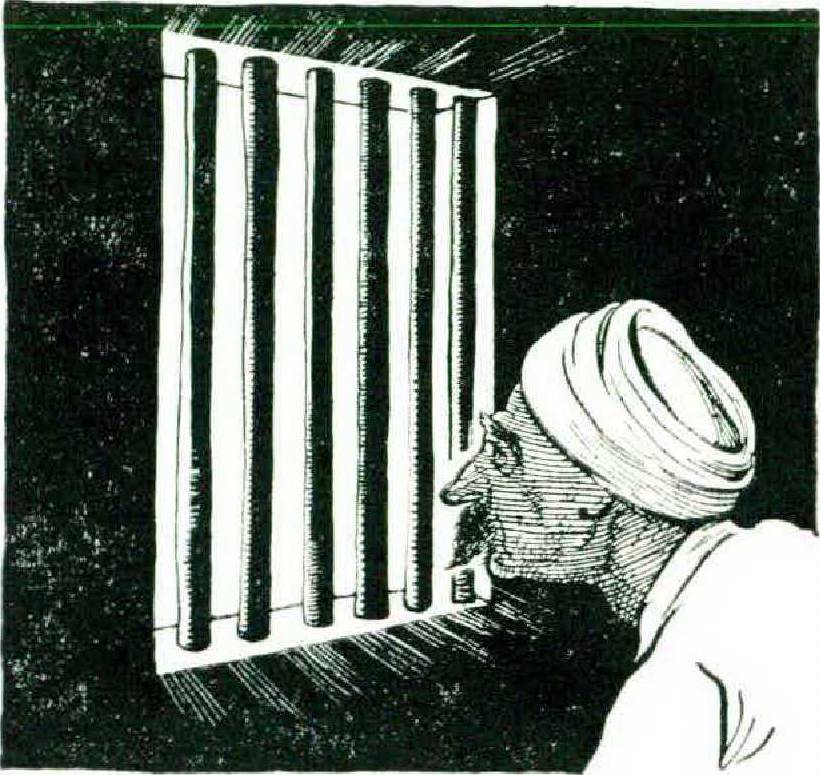
“He says that altogether he passed fifteen years in the prisons of Egypt because he wanted to discover that which was on t he other side of t he sea. Then he came back to Asswan. He says it is peaceful here, but there are no waves in the river Nile and the color of the water is brown. He goes to Asswan each time there is an American cinema about gangsters, but only to amuse himself. He says he should like to go to America very much. The other men here should also like to go to America. They should like to go to America by flying upon an airplane, but he should like to go by making a voyage upon a great boat — the top of a great boat.”
A little later Mr. Azziz and I got into our carriage and went back to Asswan.
“He tells us he is no longer a thief,” said Mr. Azziz as we rode along, “but that is not entirely the truth. He does not steal things himself, but he makes the plans so that others may steal. The things which are stolen are always small, but the plans which this man makes are ornamental. When something is stolen in Asswan the chief of police always knows if this man has made the plan, because his plans are very ornamental. This man has a good head, and it is something to give exercise to his head when he makes an ornamental plan in order to steal a chicken. Also it makes amusement for the chief of police, and he is happy that this man has come home to Asswan.”