The Other Foot
As the most peripatetic of the Atlantic’s staff, EDWARD WEEKS has long hud an occupational interest in feet and footwear.
by EDWARD WEEKS
DURING the war I was in London when the first detachment of American WACS arrived, and I well remember what an impression they made on the British populace as they marched down the Strand. London was used to uniforms but this was something new. People stopped and stared. Our girls did look trim and attractive, and for all that mannish uniform their curves showed. But what really slaved the spectators was their legs. “Oh, I say,”said the English woman standing next to me, “look at those legs, those long, beautiful legs!" And she spoke as much in envy as in admiration.
Now there is, of course, a fundamental difference between the British and the American build. The English woman with her nobbish little fell hat and rough tweed to set off her squareness suggests the rectangle; whereas the American, who is more rangy and longer-limbed, suggests the triangle. As a rule the English woman wears a skirt to conceal her legs, and the American to reveal hers. And that day in London, as I saw both types in motion, I was struck by the fact that a good shoe is essential in show ing off a good leg.
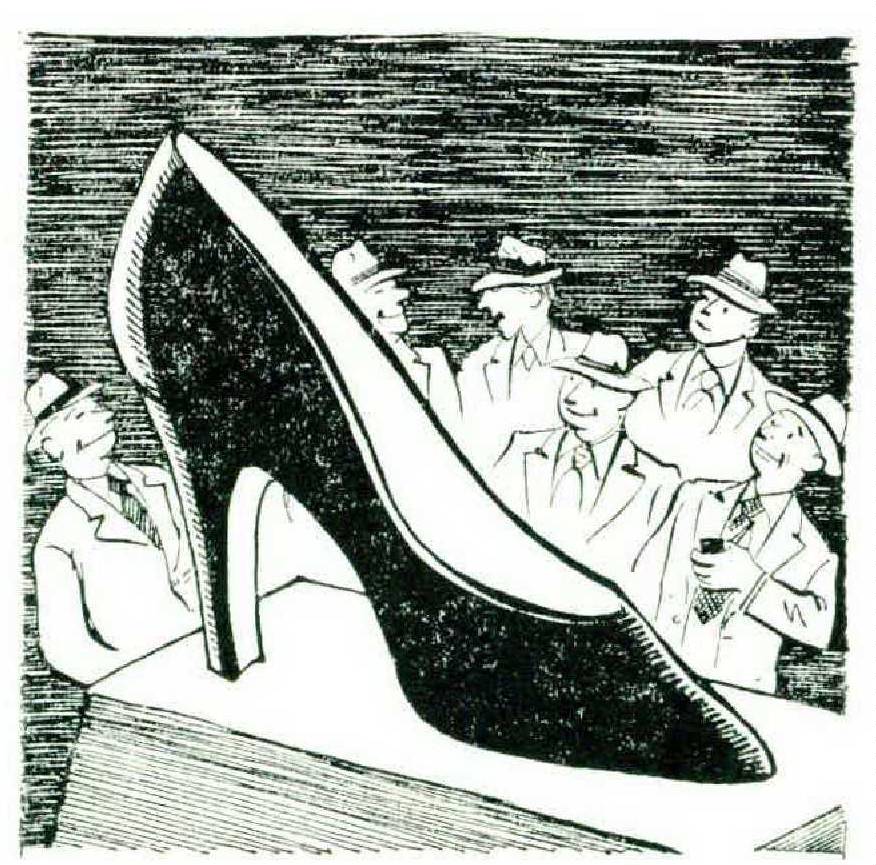
Whoever designed the shoes and slippers for our WACS and WAXES did a neat and superlative job: they wore easy to look at; they were practical; they lutd just enough heel and just enough point to please the male eye.
But what a job was perpetrated on American women not in uniform! I mean both during the war and after. Here was a lime of shortage; silk and nylon stockings were mighty scarce. So what did your anonymous fashion designers do? They gave you the Open Toe. This was certainly no thing of beauty. A woman has Several more attractive features than her lag toe, especially if the toe is glimpsed through a semi-soiled stocking. To paraphrase my friend Ogden Nash:
Quickly loses its savoir faire,
It does indeed. And a toe when it is exposed to the subway does not bloom as a rose. It gets stepped on, the toenail cracked, and grimy.
In the Open Toe women mooched along, collecting pebbles, cinders, grime, in their shoes. Their stockings never looked quite clean; and thanks to the How of raw materials, their nylons wore out much faster than if they’d been decently clad. This, as Eve said, in a time of shortage.
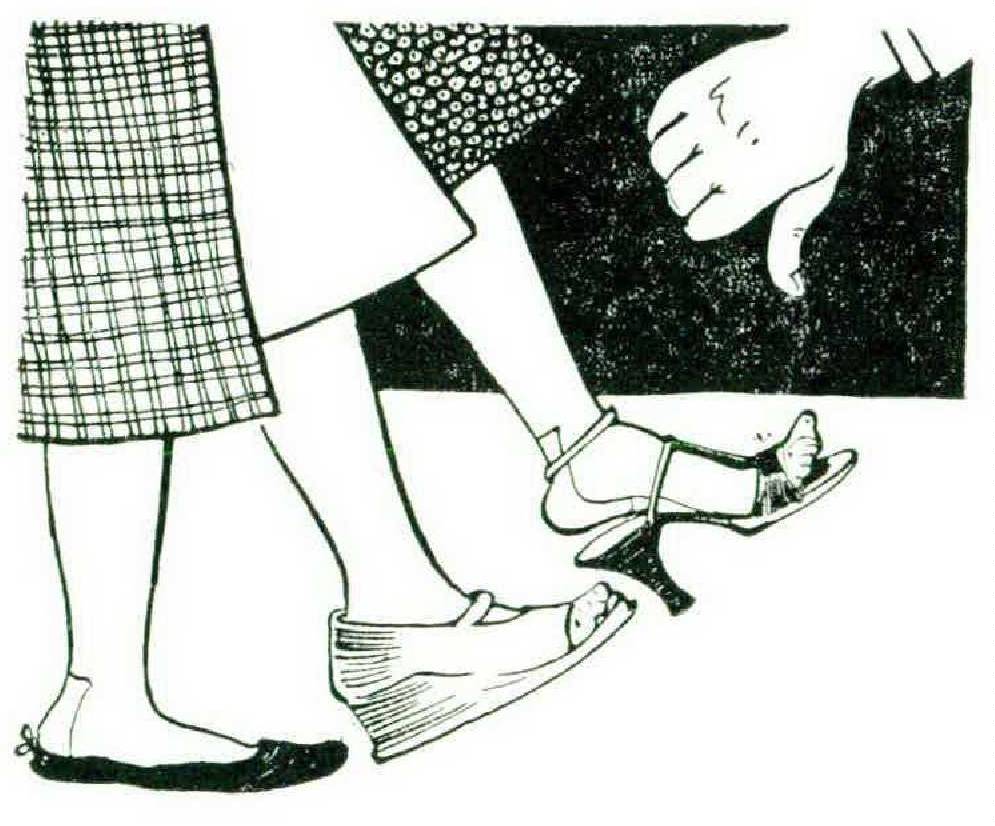
The man who designed the Open Toe probably intended it as a hoax. Being taken seriously, he went a step further. Open up the heel too! So now you had an Open Toe and an Open Heel with a thin bracelet of leather to keep the contraption on the foot.
Happy day! This paid off in two new models. There was the lowheel, no-heel sandal type which went flap, flap, flap as the flapper — or her aunt —trod on parquet, the club porch, or the ballroom floor, there being no possible way of keeping the heel and the sole of the shoe intact. That this is the noisiest shoe yet invented sounds clear when you hear your charmer descending a wooden staircase.
The second model was the wedgie. The designer of the wedgie discarded ihe notion that a woman’s foot could be dainty and her ankle trim; he thought it more natural that they should clump about as if they had been born with hooves. All the graceful part of the shoe was filled in solid. You get the same effect if you root around in the hall closet and find some worn-o.ut rubbers, lash these in a black mass to the rear of an old shoe, and what have you; Well, you haic a heavy, awkward stilted object which looks as if the wearer needed crutches. To get along, that is.
These assaults on women’s feet have gone on and on. And at last the young girls themselves have risen in rebellion. Since it is the secret ambition of most of them to be ballet dancers, what was more natural than that they should take refuge in the simplicity of ballet slippers. Now the ballet slipper may be the perfect mount for the perfect leg but, brother, what it does to those that aren’t! Women look different when you see them flat-Hooted, Not till I saw Bostonians in ballet slippers did I realize how many of them were how legged.
There are a number of girls’ schools in the neighborhood of my office, and as I watch the students from my window it occurs to me that they are having to adopt a new kind of walk. Ihe ballet slippers very evidently stretch to the point where they won’t stay on at the heel, so the wearer goes shuffling along, shuffle, shuffle, shuffle, with the toes pointed straight up in the air to hold the flimsy things, looking for all the world like a medieval court jester. The ballet slipper, of course, is not a very hardy protection against, winter, and the leaping that goes on over our slushy, snowy Boston curbs is a sight to see.
I am old enough not to expect to have my advice about clothes taken seriously by the women in my family. But as a taxpayer and bill payer, as a husband and father, I should like to know, Who is responsible for women’s shoest
Author’s note: The shoe men really like has a high, thin heel, a sleek (closed) pointed toe; it fits tightly enough to arch the foot, and is of any good leather.