Farewell, Burnt Sienna
by W. F. MIKSCH
W. F. MIKSCH is a former newspaperman now free-lancing in New York. He was born in Bethlehem, Pennsylvania, and attended Moravian College.
IT MAY take the art world a little while to get over the shock, but I am retiring from the field of Sunday painters. Actually, I don’t suppose I ever was what you could really call a “Sunday painter" because Sundays I mostly sat around and wondered what to paint. Monday nights after work, if I thought of something, I’d paint it, and that left me the rest of the week to go about with a turpentine rag wiping cerulean blue or yellow ocher off the wallpaper.
Anyway, I am now looking for an abandoned art gallery where I can hold a one-man show of my canvases. I want to get rid of them, my wife wants to get rid of them, and the man who hauls away our old newspapers doesn’t want to be bothered.
When I took up art two months ago, I scarcely expected such quick recognition as came to Grandma Moses and Prime Minister Churchill, but I did think maybe I might nose out a few other Sunday painters like Mrs. Vincent Astor and President Eisenhower — especially the President, because you know how busy he’s been with other things this year. I might have, too, had I stuck at it longer, but two months is about as long as I can ride any hobby.
The trouble with a hobby is that either it becomes so relaxing I fall asleep over it (button collecting, basket weaving), or it makes me nervous (model building, soap sculpture). Or it makes people around me nervous (Swiss bell ringing, pyrography, and now — painting in oils). For it is chiefly at the urging of others that I am closing down and offering the following canvases for sale or for free:—
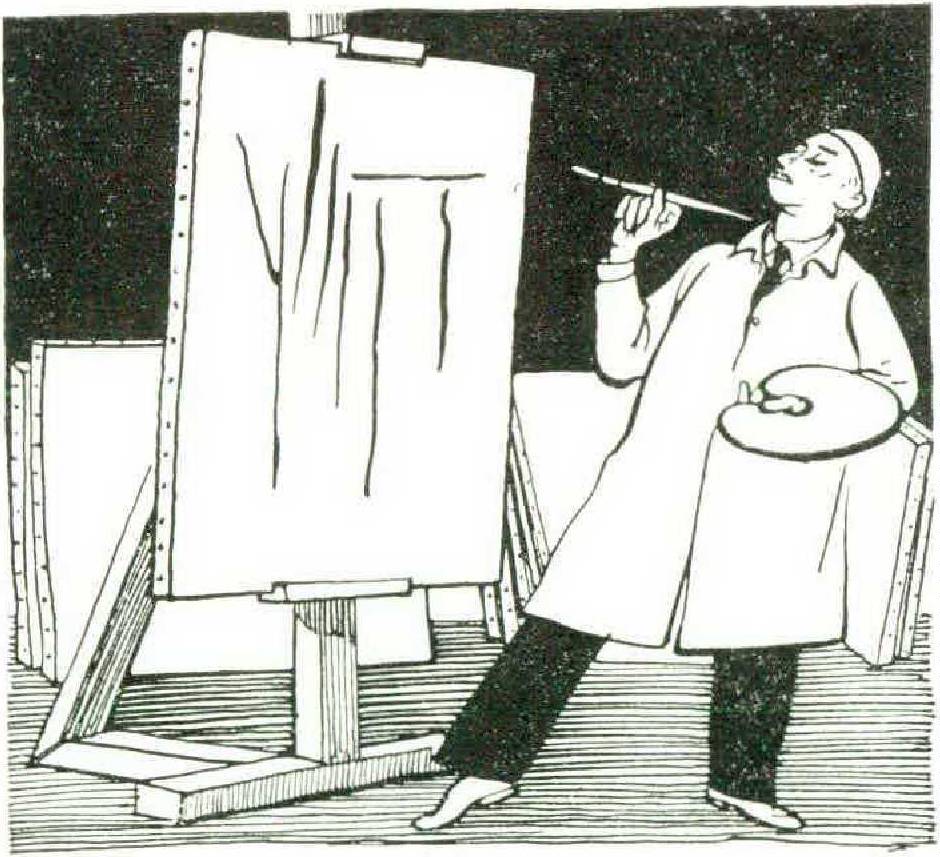
“Self-portrait of the Artist.” His first effort, painted while enthusiasm still ran high, and with a realization that if he ever became a success like Van Gogh he would need a selfportrait for posterity. What appears to be purple hair is really a beret put on as an afterthought. It isn’t a bad beret either, considering the artist never owned one and had to paint it from memory.
“Pretty Straight Lines.” Although suggestive of possible influence by the Futurist school, this study of eight horizontal brushmarks is simply the result of some spirited badinage between the artist and his wife. She had taken him unfairly to task for fooling away his time when he should be putting a new washer in the bathroom faucet, and even went so far as to cast doubt on his talents. Whereupon the artist, in a fine burst of temperament, cried: “Whaddaya mean, I can’t draw a straight line!” and he promptly drew eight of them. The last one is very nearly straight.
“May in the Garden.” A delightfully coherent landscape in the Sir Edwin Landseer tradition showing the artist’s back yard. Despite its pastoral serenity, this canvas stirred up considerable discussion among the artist’s relatives owing to a misunderstanding of the title. The May referred to is the month of May and the seated figure on the cellar door is not the artist’s Cousin May (as was charged), but a Saint Bernard from across the street. Any resemblance is purely coincidental.
“What’s the Use?” This interesting melange of Classical, Cubist, and ; Modern technique points up a phase of development through which the artist was passing. His picture started out to be a hula-hula girl, but halfway through he remembered that Gauguin had covered South Pacific pulchritude pretty thoroughly, so he started to change it to an odalisk and then recalled that Matisse had specialized in them. Finally, he added wings — only to remember that Michelangelo had excelled in the angel department. Thus the canvas might be called symbolic of the artist’s frustration that came from an awareness that no matter what he wanted to paint, somebody else had already painted it twice as well.
“Side Street.” A piquant bit of “ash-can art” depicting the artist’s front porch and part of the street. The squalor is not exaggerated. However, the gray cloud in the upper right corner is not actually a gray cloud at all. It is bubble gum that got on when a neighbor’s boy stopped to inspect the artist at work and stood too close to the canvas.
“Unfinished Symphony.” A still life (still incomplete) showing the lower half of an apple. Painting the apple made the artist hungry, so he laid down his palette on the liv ingroom sofa and went out to the kitchen to make himself a sandwich. Meanwhile the artist’s wife, wearing a chartreuse housecoat, entered the living room and sat down on the wet palette. Naturally some of the color pigments adhered to her housecoat, creating a baroque, rainbow effect as well as a big row when the artist returned with his sandwich. “Unfinished Symphony” is the artist’s final work. It is a little damaged from being thrown hard, but it is still a great buy because with it go all the artist’s brushes, a pint of linseed oil, palette, easel, palette knife, and his tubes — which are “twisted and dried,” as Kipling once said.
Alone in an attic, I might have become an Old Master. But at home with the Philistines, I never had a chance.