Pleasures and Places: French Boat
After living in California and Connecticut, JOSEPH WECHSBERG is traveling once again in Europe, whence he sends us this account of what makes a crossing in a Ereach ship different from all other modes of travel.
by JOSEPH WECHSBERG
THIS is the age of advertising and people’s notions of gracious living are often reflected by the ads of their steamship companies. The Italian Line, publicizing its new ship, Andrea Doria, puts emphasis on “the skill and pride of the greatest artisans of Italy. . . . Every mural, every tapestry, every rug and chair, each exquisite bit of glassware is the work of craftsmen. This is the tradition of Italy.”
The Cunard Line shows smartly dressed people walking briskly around deck or enjoying themselves strenuously on the dance floor. (“Getting there is half the fun. . . . Thu brilliant round of activities, the highspirited companionship, the spacious luxury, the glorious tonic effect of the clean salt air. . . .”)
The United States Lines feature the streamlined silhouette of the new superliner United States, and endorsements by prominent bankers, corporation presidents, and film stars attracted by the slogan that “Europe’s Only a Long Weekend Away.”
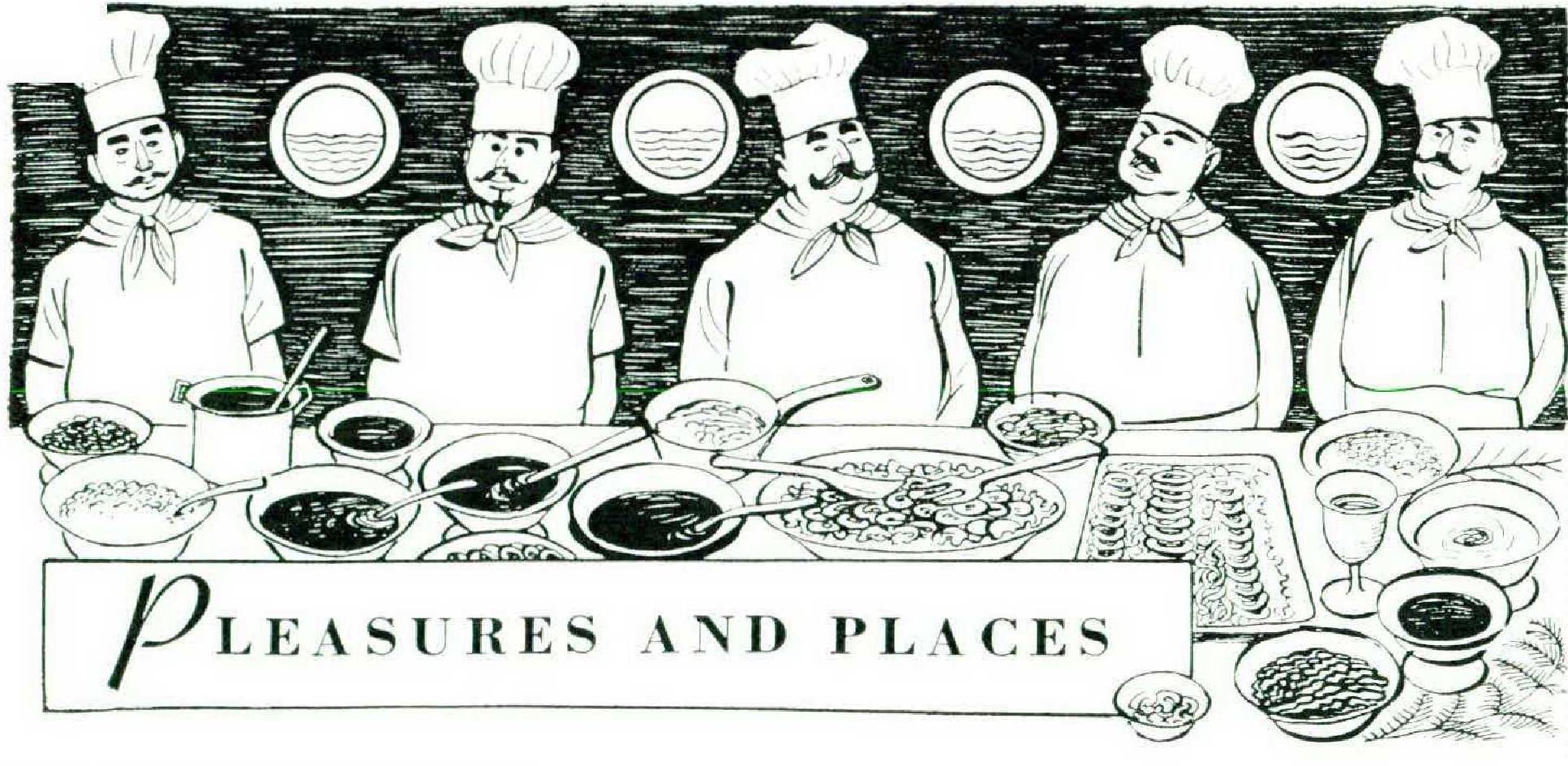
Of an entirely different kind is the pitch of the French Line. The accent is strictly on cuisine. The ads show a glass of champagne and a homard à Varmoricaine, and the hell with murals, salt air, and long weekends (“. . . French Line chefs, with their matchless artistry, make everv serving a delectable adventure”). The Rabelaisian invitation, “Fais ce que vouldras,” still holds good.
It has always been that way on French boats, where the most respected individual is the chef de cuisine, not the commandant. Old Atlantic hands, before boarding a French boat, would inquire “Who’s cooking ?” as opera lovers might inquire “Who’s singing tonight?” For decades. Gaston Magrin, the former chef of the Normandie and Île de France, was the most celebrated practitioner of the haute cuisine on the Atlantic, and also the most feared. His outbursts were epical. Ship’s captains and company presidents would tremble before Magrin’s angry stare. On the Île, Magrin commanded a hundred and twenty-two assistant chefs and a battalion of helpers and dishwashers.
Magrin was able to fulfill a passenger’s most uninhibited gastronomic desires, provided the passenger traveled in first class, was punctual, and showed proper appreciation. Once he flew into a violent rage because a couple of people were still having cocktails in the bar at the moment their biruf saignant à la ficelle was ready to be served. “Rare beef with a string" is a piece of filet tightly wrapped around with string, roasted quickly in a very hot oven, and dipped for sixty seconds in boiling consommé just before it is served. It’s a tricky dish and hopelessly spoiled if it is allowed to wait just a few minutes, He had a fit when a gentleman from Ohio ordered braised pork loin with tomatoes, spread with tuna fish, served with macaroni. Last year, when he retired, French newspapers noted with satisfaction that he had been decorated with the Légion d’Honneur, Croix de Guerre, and Mérite Maritime. Vive la France!
Food has always been the concern of the Compagnie Générale Transatlantique and its predecessor, the Compagnie Générale Maritime, founded in 1861 by a decree of Emperor Napoleon III. When the Touraine captured the blue ribbon in 1891, crossing the Atlantic in seven days and four hours, the creations of her chefs caused more sensation than her speed.
In the verv gay twenties, I spent the best years of my youth playing the violin on the boats of the Messageries Maritimes between Marseille and the Far East, and on French Line boats between Europe and New York. I’ll always remember with great fondness La Bourdonnais, a dilapidated one-funnel vessel with no serviceable lifeboats to speak of. Rumors persisted that her machinery was held together by adhesive tape, but after the second glass of champagne no one cared. The crossing from Bordeaux to New York by way of Spain and Nova Scotia look eleven days. (The old Champagne, a two-funneled, clipperrigged four-master, had made it a little faster back in 1885.)
During the lirst three days of the trip, the Spanish passengers would keep away from the Anglo-Saxons and vice versa, but the Frenchified atmosphere soon leveled off differences of language, morals, bank account, and politics. Everybody, including the crew, had a fine time of it. There were always prelly women hanging around our quarters, presumably music lovers. Our chef d’orchestre, a pinkcheeked, vintage-conscious Alsatian named Maurice, issued orders that the wine cellar under his bed must at all times be well stocked. We would comply by robbing the passengers’ tables of their bottles. The surplus was sold in New York, that wonderful citadel of prohibition, to American connoisseurs who didn’t seem to care about vintages as long as there was anything liquid in the bottles.
I have other lighthearted memories of French Line boats. On the Rochambeau there was a red-haired lady passenger who came aboard straight from a good-by party. She was wearing her evening dress and for luggage had only her tiny evening bag, but that didn’t bother anybody — not on the Rochambeau. The lady purchased a toothbrush and a pair of pajamas in the ship’s store and adjusted her life to the circumstances, dancing at night in her evening dress and sleeping by day in her pajamas. Once the machines broke down and we were immobilized for ten hours in the middle of the ocean, but the redhead never knew it.
When I worked on the De Grasse, we musicians kept whimsical hours. Rarely were the five members of the orchestra in a sober state of mind. Each crossing was a continuous Cognac picnic. Other French Line boats went down during the war — the La-fayette, Champlain, and Far is, to name only a few — but the De Grasse survived shells, submarine attacks, and fourteen months of submersion up to her main deck in the Gironde.
She is still popular for her light moods and sturdy movements. Fewer people got seasick on her and more were pleasantly intoxicated than on any other ship of comparable size. Lasl year she was sent into semiret irement, being assigned to the boring West Indies run, but popular demand has recalled her to active duty, and a few months ago the charming old lady was sold to the Canadian Pacific and has resumed her leisurely rounds.
Another French boat, the Île de France, seems to have evoked more sentiment than any other ship afloat, and was decorated for her wartime gallantry by the French government with the Croix de Guerre with Palms. In the embarkation hall is an engraved plaque with the citation, “ Glorieux batîment qui na cessé de faire flutter les couleurs francaises sur toutes les mers du monde. . .”
There is an unfortunate trend toward speed and getting it over with, as though crossing an ocean were an unpleasant duty, such as sitting in a dentist’s chair. The Germans started it with the Bremen and Europa; the French got into the act with their Normandie; the British topped her speed with the Queens; and the Americans now hold the world’s speed record with the United States. People in a hurry should take a plane.
The fastest French boat, the Liberté, which was once the German Euro pa, is also the least popular. Last year, when traveling abroad as a passenger, I became infected by the restlessness of my fellow passengers, and 1 started to worry whether we should arrive in time — as though it mattered. There were no mechanical breakdowns. The elevators were running. Hot water came out of the hotwater faucets. Life held no more surprises. The musicians had regular hours and strict rules of behavior. They were not permitted to enter a passenger’s stateroom “even if they should be invited.” I hale to think how such a rule would have affected us in the old days.
Thus I was pleased to read the accounts of the maiden voyage in July, 1952, of the newest French boat, the Flandre. Everything went wrong. (As far as I am concerned, everything went just right.) The lights didn’t work, the accumulators went on strike, the winch was powerless to raise the anchor. It sounded wonderful almost like old times. Three weeks earlier, the United States had broken all transatlantic records, making the trip from Ambrose Lightship, New York, to Bishop’s Rock, Land’s End, England, in three days, ten hours, forty minutes, at an average speed of 35.95 knots. People arrived in Europe practically before they had time to say hello to each other.
The Flandre took six days, at the end of which she had to be towed into New York Harbor. Some New York papers muttered about her “ignominious debut.” That seems to me a mistaken evaluation of the facts. The papers noted that the Flandre’s foghorn ran out of breath; they failed to note that the Flandre’s wine cellar never ran out of vintages.
Personally I can think of nothing more pleasant than to be marooned indefinitely on a French boat, eating fine food, drinking fine wines, getting fine service, at no additional cost whatsoever. The Flandre had simply behaved in the best Gallic tradition, whimsical and unpredictable, as any pretty girl in France would.
The ship has been completely overhauled, but people won’t care about her schedule after tasting the gratia de langoustines. She is equipped with “two groups of Rateau Bretagne double reduction geared turbines developing a normal horsepower of 36,000, with a maximum of 44,000 horsepower, driven under 64 kgs. of steam pressure per square centimeter,” and also with some excellent Leoville LasCases 1945 and CortonCharlemagne 1947.
There is cool French logic behind the madness of outfitting ships with unsalted caviar ralher than with oversalted accumulators. Sensible travelers going abroad are more concerned with the position of their dining-room table than with that of the watertight compartments. Of the total cost of a ship’s trip, service and cuisine amount only to 8 per cent. The rest is fuel, salaries, insurance, and so forth. The Flandre travels at a comfortable 22 knots. Raising her speed by only a couple of knots would cost more than double servings of Malossol caviar with every meal. Moreover, she is conveniently sized — 20,500 tons, with rooms for 363 people in first class and 283 in tourist class.
The Flandre pays proper respect to the increased importance of middleclass travel. A considerable part of the ship is given to the tourist-class passengers. Should the times get worse, some of the first-class staterooms can easily be converted into tourist-class accommodations. Passengers have the choice of fourteen versions of eggs for breakfast; and that’s just breakfast. I understand that the bridge is equipped with the latest inventions in navigation technique.
And for those who don’t care for eggs or navigation technique, there are other attractions. It reminds me of the pretty woman I watched on the bridge where she was shown the gyrocompass, radar, decca, loran naviphone, magnetic compass, and other paraphernalia of safe ocean travel. She was properly uninterested until a slim, dark, and handsome officer with a gold-braided cap went by.
The prelty woman perked up. Who was that attractive man? The chief purser, she was told.
She glanced after him wistfully. “Is he going to be at the dance tonight?” she asked.
Of course he was at the dance. Vive la France!