The Women
by MICHAEL HALBERSTAM
“MICHAEL HALBERSTAM IS now in his senior year as a Harvard College undergraduate, and. experts to go to medical school. He has worked summers as a news reporter for the Hartford Count ut.
TIME was when the inquiring photographer and the sidewalk reporter were essential parts of many American newspapers. Today these strange beings appear more often in the comic strips than they do in the less gaudy sections of a newspaper. Editors art a hit wary of using a device which has become a cliche in newspaper practice, yet occasions do arise when an editor must find out. what The People think about an event, and for these times nothing is more useful than the sidewalk interview.
Thus it was that one sticky afternoon last summer I found myself stationed at the most congested corner in Hartford, Connecticut, desperately trying to impress myself and my questions upon unwary passers-by. The Republicans had made their nomination for President in the morning, and our city editor had sent a photographer and me to find out what people thought of the choice.
I am not a shy man, but neither am I an open hearted lover of all people at all times. I am not a timid man, but neither do I walk in where angels fear to trend. Considerable newspaper experience has accustomed me to interviewing people—but only those who are used to being interviewed or who want to he interviewed. There is a great, difference between questioning a visiting statesman and trying to question the man in the street. This was my first assignment of the latter variety, and I approached it with some queasiness.
The photographer reassured me. Like most of his kind, he was used to intruding, complete with dazzling flash bulbs, at public ceremonies of all sorts. Having disrupted openingnight concerts, solemn conventions, and crucial speeches, he had become inured to arousing the wrath of large groups of sensitive people. Men and women to him were but possible opportunities for “good shots.”
“Don’t worry a bit about it,” he said. “ We’ll just go out there and stop people. I’ve done it lots of times before. After a while you’ll get to like it.”
So we made our way to the traditional “busy corner on Main Street ” and set up shop. We needed the photographs and reactions of eight men and women. To do this we decided to take twice as many pictures as necessary, thereby ensuring ourselves of enough good shots and interesting statements.
A carefully dressed middle-aged man was the first to come by. He had been eying us while the photographer assembled his equipment, and I decided he would make a likely subject.
“Excuse me, sir, I’m a reporter and my paper would like to know what you think about the Republican nomination,” I blurted. The man expanded before our eyes, pleased that he, of all the people on the street, had been singled out to give his opinion on an event of national importance.
“Well,” he rumbled, “Eisenhower’s a good man. Better than those other guys who were trying to get it. I think it’s a damn good thing.” I thanked him and wrote down his reply, along with his name and address, on my pad of paper.
The next three interviews came out excellently. A man we had spotted as a “workingman type” gave us a fine statement about foreign policy, and a short man in a T shirt shrilled excitedly that Taft had been robbed. He gave the kind of pithy, virile quotes that we needed. As the photographer had predicted, I was getting to like the idea of stopping strangers and demanding to know what they thought of something.
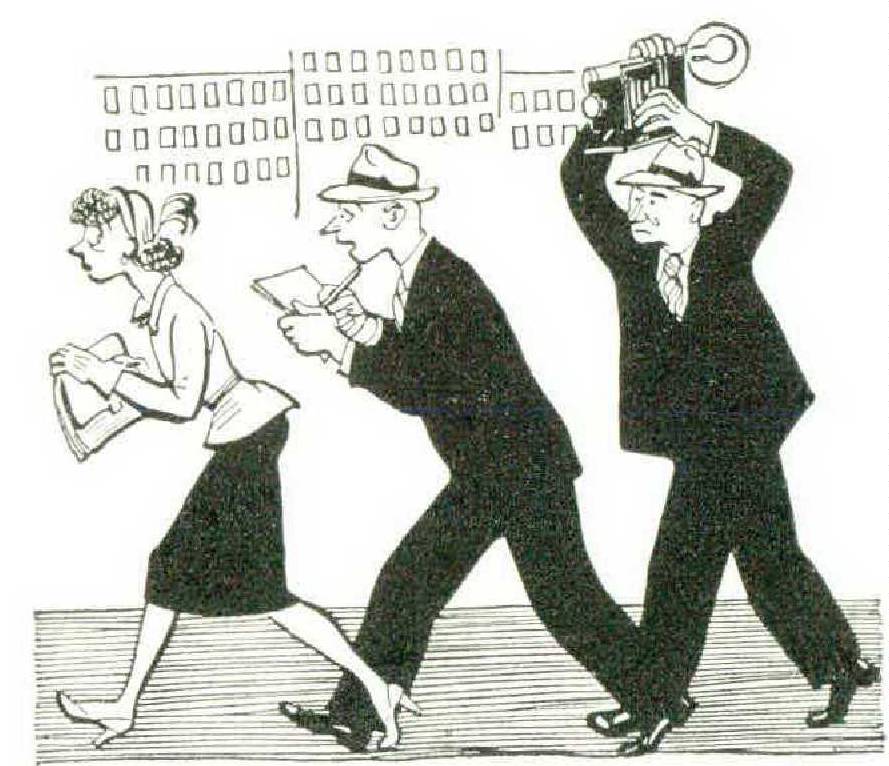
When we were about half finished with our interviews, we realized that we had not yet stopped any women. Accordingly we began a special effort to pick women out of the crowds that eddied around us. We discovered quickly that whereas men had been willing subjects and had even hovered about us in hopes of being questioned, women were almost impossible to catch. We proceeded, as we had with the men, by picking out a woman walking toward us, rapidly debating whether she was the particular type we needed, and then letting me sidle up to her while the photographer snapped us together.
As the women passed before us, I would walk over to them and begin, “ I’m a news reporter, ma’am, and my paper would like to know . . .”The Women ducked their heads and hurried on. I rushed alongside them, waving my reporter’s pad and explaining, “I’m not selling anything, I’m from a newspaper and . . .” Putting on short bursts of speed, the women would shake their heads and scurry away.
If you have ever watched a man trying to pick up a girl on a busy street you have an idea of what I looked like. There I was, trotting alongside these strange women, frantically talking to them from the corner of my mouth while they blindly shook their heads. Perhaps they thought that I was trying to pick them up. So I concentrated on old women, unattractive women, women with children in tow. The results were no better.

Flushed and perspiring, I returned to the photographer, who had been watching things with a malicious smile. “Let’s forget about the women,” I suggested.
“No, we’ve got to be representative,” he said.
I thought and then proposed that he plant himself directly in the path of the women as I approached them from the side, thus forcing them to listen to me.
This plan of cornering the women worked, but a new difficulty appeared. The first woman we trapped said, “I’m sorry, I don’t know anything about it.”
“But don’t you have any opinion about it?” I countered.
“No,” she said, and dashed away.
The next woman said, “I’ve been too busy to follow all that.” A young matron replied, “I let my husband worry about that sort of thing,” before disappearing in the crowd.
The photographer was no longer amused. He virtually dragged unwilling subjects within range of the camera. We finally found a woman who made intelligent — or at least quotable — comments. When the interview was over I asked for her name and address. “Oh, no, you can’t use my name,” she bleated, and pulled away. The next woman pleaded, “Oh, I wouldn’t want my husband to find out what I said.” We let her go.
It was the photograph that upset the next one. “You can’t take my picture now, I’m just a mess,” she said. We were inclined to agree. We parried with a few more publicity-shy women and then gave up. For some reason they all felt that their particular views must remain concealed.
On the way back to the city room the photographer turned to me. “ Well, how about it?” he asked.
“They never should have got the vote,” I said.