Chinchillas
ALEX FAULKNER is the Sew York correspondent of the London Daily Telegraph. This is his second, appearance in the Atlantic.
by ALEX FAULKNER
IN the cellar of a small roadside establishment in New Jersey, not far from New York, is the equivalent of a fortune in live chinchillas. Wire cages are stacked high along the walls and wedged into the corners of the cellar, and in each cage chinchillas disport themselves.
The day I visited the place, babies had arrived in several of the cages only a few minutes before I got there, and were being dried out with heat lamps. Chinchillas are born with their eyes open and a substantial covering of fur, and within an hour they are exploring their quarters.
It felt rather cold in the cellar, in contrast with the mild weather outside. There was scarcely a trace of smell from the cages. A woman in a white uniform was looking after the chinchillas, and iT was obvious that she enjoyed her work. She described with enthusiasm their attractive traits.
Chinchillas are lively little animals, full of fun, and have the closest thing to a sense of humor that I have ever seen in a nonhuman. One of their most fascinating features is their long whiskers, which keep moving in a most expressive manner. Their fur is one and a half inches long and is very soft, fine, and silky. IT is grayon the surface and a deep bluish gray nearer the body. They eat grains, greens, dried fruits, and an occasional twig, all in small quantities.
Many of the animals at the place I visited, it turned out, were tle property of people who had succumbed to the “buy chinchilla” urge. At $1200 a pair one does not take a purchase of (his kind home and give it to the children. It is more like a stock certificate, which one locks up in the safe deposit at the bank. For a fee of $5 a month the place provides bed and board for the valuable couple, and does everything else calculated to promote healthy “dividends” in the form of baby chinchillas. And, like a good broker, it helps to find purchasers for the young ones as they come along.
Like any investment, a chinchilla purchase is a calculated risk, and on the day of my visit I was told that a statistician on the staff of a business magazine had just bought three pairs after spending a few days working out the probable yield.
At first glance it looks like a good thing. In theory there is a reasonable chance that within eight months of making your initial investment of $1200 you increase your holdings by one or two chinchillas (one to three young are produced in each litter). Chinchillas will breed two or three times a year under ideal circumstances, but the careful investor will not bank on obtaining half a dozen young a year. According to the Department of Agricultlure, which has issued a very useful leaflet on chinchilla raising, a general average of two young a year for all females kept is considered good production.
It was formerly believed that these animals could only be mated in pairs, but in recent years polygamous mating has been tried with increasing success on some large ranches, and it has the advantage of reducing the number of males needed. Inexperienced breeders, however, are advised to stick to the more usual practice of relying exclusively on monogamous unions.
Taking two young a year as the safe average for chinchillas, within twelve months one may expect to increase one’s holdings to four. Within two years the number should be increased to eight, and within three years to sixteen, with a value, if they all reach maturity, of $9600. The original pair may continue to breed for fifteen years and more.
If the litters are larger, and if whelping takes place every eight months, the herd will be considerably larger than this at the end of the three years. If an abnormal number of deaths occur, it may be smaller. These are speculative elements which for many people make the whole undertaking much more exciting.
Among the adverse factors is the average rate of chinchilla mortality; it has now been brought down to only 8 per cent, but as recently as 1933 it was 50 per cent. Another is the tendency to sterility. In spite of these and other risks, many hardheaded businessmen have decided that chinchilla stock is a buy.
One of the reasons may be that some investors like seeing and even caring for what they buy. It is the peculiarity of this rodent from South America that it fares best when it is looked after by someone who gives individual attention to his charges. Although there are a number of ranches with a chinchilla population running into the hundreds, chinchillas are owned to an astonishing degree in small lots by people who like being personally responsible for them, both because the prospects of financial gain seem good and because chinchillas are extraordinarily attractive. For many people they are as much a hobby as a source of income.
As one of them put it: “If you like animals, it’s a good business that leads to peace of mind.” At his wife’s urging, this investor gave up a contracting and decorating business in 1943 and spent $7200 for six pairs of chinchillas. Now he has 300 of them.
The chinchilla population of the United States has grown from some 10,000 ten years ago, and some 75,000 last year, to more than 100,000. There are believed to be about 5000 in Canada, and perhaps another 20,000 in other countries. It has been estimated that as many as 6000 or 7000 people are engaged in raising them, some in city cellars or suburban back yards.
The most remarkable thing about all this is that chinchillas, despite the value of skins, are at present worth considerably more alive than dead. The people who are breeding them would not think, at this stage, of killing them for their pelts. For perhaps another five years they will be produced mainly as breeding stock.
This situation is the result of the almost complete extinction of chinchillas a few decades ago. In the early part of the century the skins were being shipped to the United States by the bale, and coats and wraps made from those old skins are sometimes found, in excellent condition, stowed away in family attics. Chinchillas had been trapped for centuries by Indians, and later by Spanish conquistadores; and still later they had been hunted by foxes exported to South America by British sportsmen. But by 1920 the number of wild specimens had been reduced to such an extent that chinchilla skins were bringing as much as $400 apiece.
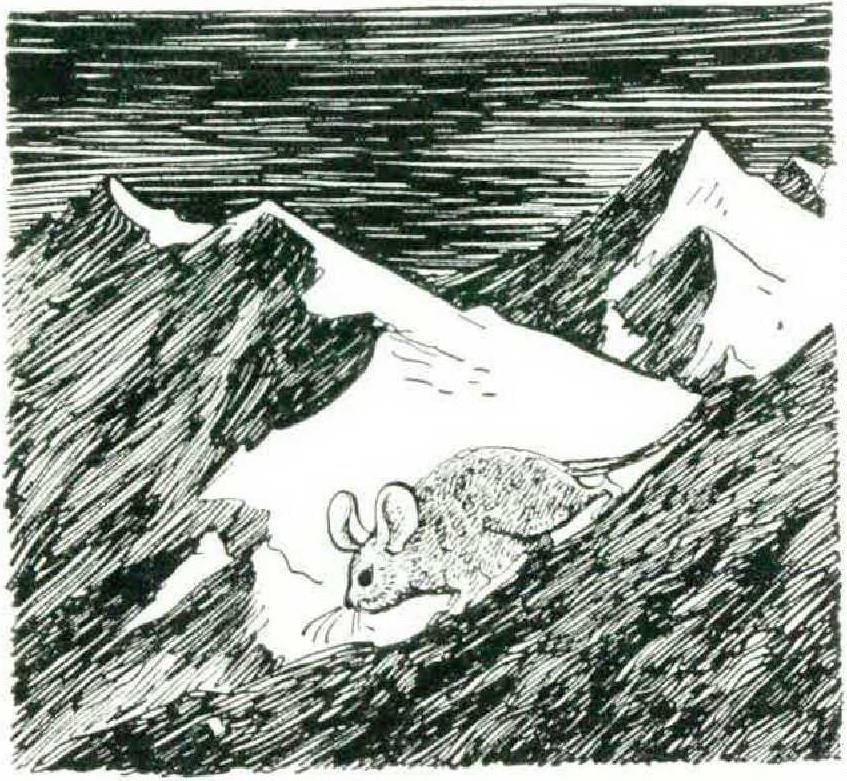
It was at this stage that an American engineer, M. F. Chapman, who had been working in the Andes mines, decided to search for some of the remaining chinchillas and, if possible, rescue them. Aided by Indians he found eighteen, all at heights of over 10,000 feet, and he then undertook the long and difficult task of bringing them down to sea level and entirely different climatic conditions. Over a period of nearly four years they were moved down from the mountains by easy stages and then started on the journey to the United States.
Only seven males and four females survived the crossing of the equator and the long trip to Chapman’s home in California. Subsequently such South American countries as Chile and Peru passed laws prohibiting the exportation of live chinchillas or chinchilla pelts, although later on permission was obtained to make some additional shipments. Most of the chinchillas in the United States, however, are descendants of those brought north by Chapman.
As there is not yet a large and steady market for pelts, their value is rather uncertain, but today they are worth perhaps $50 each, and it takes about 250 of them to make a full-length coat, which may cost anything from $25,000 to $100,000. Chinchilla skills are considered more satisfactory for loose wraps, capes, jackets, neckpieces, and muffs than for fitted coats.
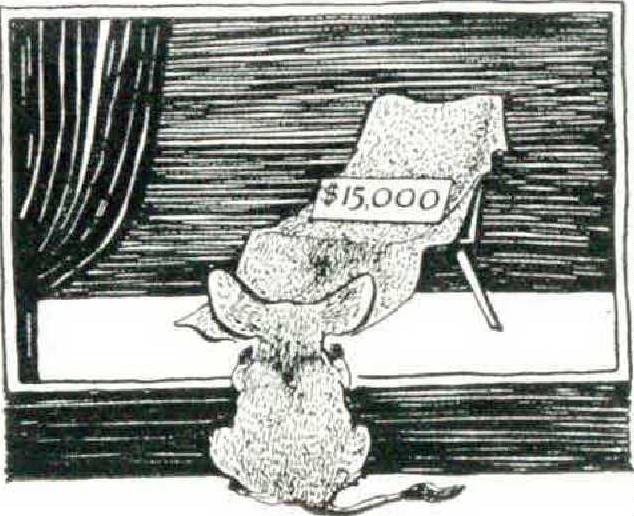
Only two chinchilla shawls were known to be for sale in New York last winter, and the prices asked for them were $5000 in one case and $15,000 in the other.
There are not yet enough chinchillas to ensure the regular yearly supply of pelts the fur trade would need before it could start using these skins as it uses those of other animals. Chinchilla for the time being is a luxury and a rarity. Chinchilla breeders and such organizations as the National Chinchilla Breeders of America, Inc. (P.O. Box 1806, Salt Lake City, Utah), are preparing for the time, five years hence or more, when production is raised to the point where a steady market can be established and kept supplied. It is not expected that this will happen before the chinchilla population passes the half-million mark. Until then chinchilla on the paw is worth more than on the ladies’ backs.