Provence Without Garlic
by JOSEPH WECHSBERG
JOSEPH WECHSBEBO has been traveling in Africa and in Europe. This latest of his travel articles comes to us from the South of France.
I AM always skeptical when one of my gourmet friends tells me of a “sensational” restaurant which he has discovered. Too often the place appears to be sensational only because of the amount of garlic the chef gets away with in something whimsically called Provencal, or because the lights are turned off or on — I don’t remember which — while Crêpes Suzette are being served. I like good food (ungarlicked), and occasionally I write about people who make good food because I’ve found them to be interesting and wise in many ways, but I’ve never thought of myself as a gourmet. I was more dubious than ever early this spring when a gourmet friend from Boston told me of a “wonderful” restaurant in Les-Bauxen-Provenee, France, called L’Oustau de Baumanière. Epicureanism, I’ve come to learn, is rare among the Bostonians’ many virtues. I put the address down in my book and gave no tbought to it.
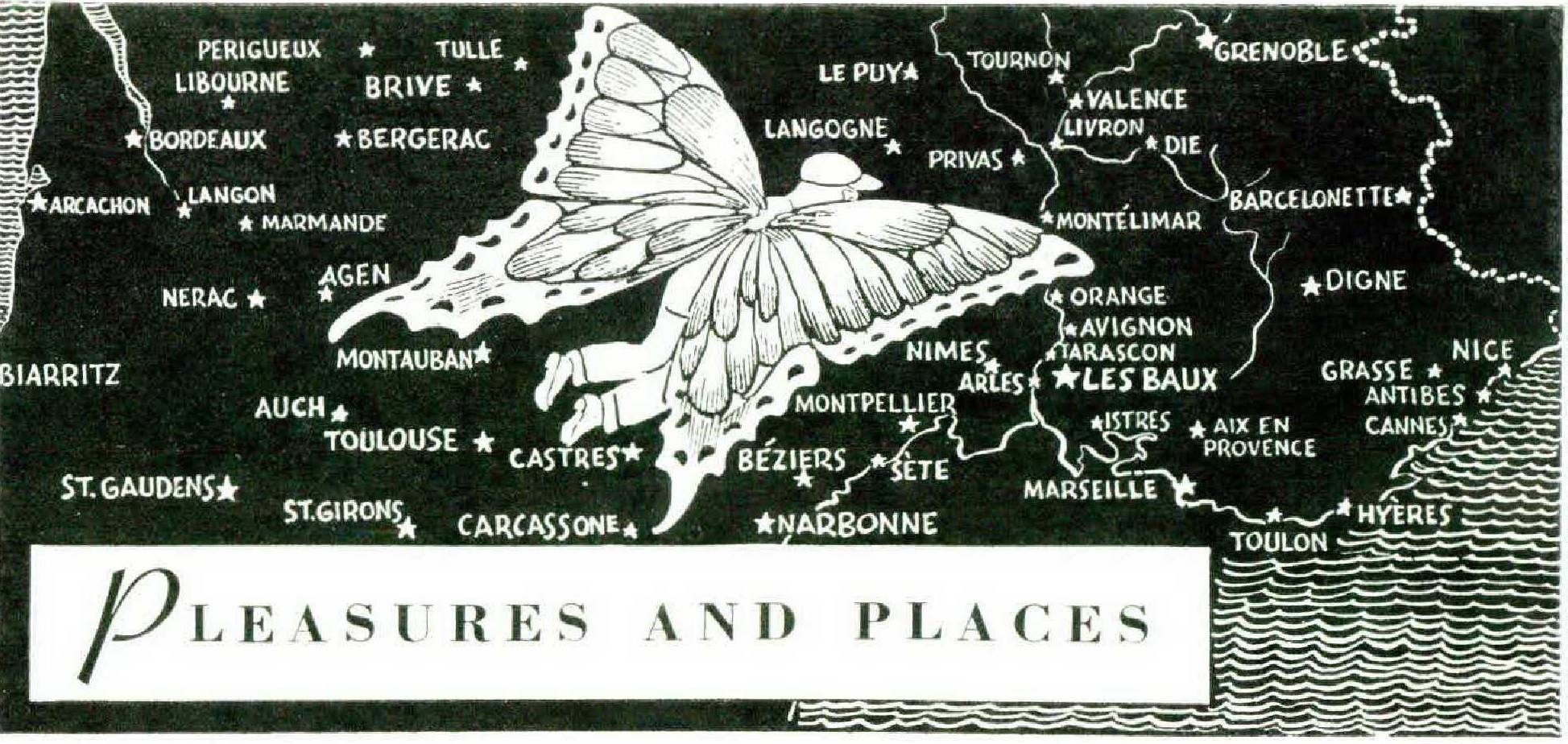
Then, one morning a few weeks ago, I found myself in the Provence, after a long and arduous trip through North Africa on which I had subsisted on 40-cent in-flight luncheons prepared by United States Air Force mess sergeants, and on some awful couscous which my gourmet friends would doubtless consider exotic — spiced and thus sensational. Hot as red pepper. I began to think wistfully of a good French table. Then I remembered the address. As I happened to be traveling northbound on the Marseille-Paris Express, I asked the conductor where to get off for Les Baux. He didn’t know and suggested that I get off at Arles. “Nothing is very far from Arles,” he said, with commendable Gallic serenity. The Guide Michelin, however, put Les Baux, department Bouchesdu-Rhône, at 18 kilometers from Tarascon, awarding the Baumanière, tel: No. 7, two stars — which is pretty good — and adding, in red print. “Bel interieur provençal et patio fleuri.” I would get off there.
Tarascon is a sleepy old Roman town with many ruins. I went into the post office and called No. 7 in Les Baux. In due time M. Thuilier, the patron (proprietor) of the Baumanière, came to the phone. He would be glad to pick me up in half an hour, he said. No bother, no bother at all. He was going there anyway to look at a saddle of lamb and the early asparagus.
Half an hour later a Talbot stopped in front of the Syndicat d’Initiative. M. Raymond Thuilier was a jovial, mustachioed Frenchman who looked as pleased as if he’d just heard some good news about himself. He would have been fat for a middleweight champion but he was rather trim for a chef. He wore a topcoat over his while chef’s outfit and explained apologetically that he’d been about to prepare déjeuner and that there had been no time to dress. M. Thuilier, it seemed, was that rara avis, the owner of a well-known restaurant who actually did the cooking himself.
As soon as we left the old ramparts of Tarascon behind us M. Thuilier started to step down on the gas. “Life begins at eighty kilometers an hour,” he said. “I used to go much faster. Must be getting old. Fiftyfour. you know.”
We went through the Provence at suicidal speed. I’ve always liked the Provençal landscape with its soft colors, deep shadows, the permanent warm glow in the air, and the omniscient memory of bold warriors and romantic troubadours, but there was no time for appreciation. We stopped briefly in the small village of Maillane where Frédéric Mistral, last of the great troubadours, lived and is buried.
ACCENT ON LIVING
“ Pablo Casals came here last year to play Bach at Mistral’s grave,” said M. Thuilier. “I suppose it was Mistral’s poetry that made me come here. I’m from Chambéry, in the Savoie, where my parents and my grandparents were hotelkeepers.
The road began to ascend and the fertile lovely countryside became rocky and wild. The rocks grew into rocky hills and the hills became jagged mountains with grotesque patterns, like the eerie moonscapes in Arizona and New Mexico. M. Thuilier said that many of his American friends had noted the resemblance. “Lots of fennel and thyme here,” he said. “The air is very dry, too dry to keep our Camembert. They bring it up all mûr and within twenty-four hours it’s as dry as bread crust.”
We reached the pass. The mountains were called Les Alpilles — “the little Alps” — and below us the valley with its bizarre formations was Val d’Enfer, the Valley of Hell, where according to legend Dante had found the inspiration for Ins Inferno. Way up on the hilltop, built into the rocks so that it was hard to distinguish the houses from the rocks, was the centuries-old village of Les Baux. Baux is a Ligurian word which means “steep”; the mineral which was later called bauxite was first found here in 1822. Back in the thirteenth century the township of Les Baux had boasted of three thousand six hundred people but now there are only fifty-five or fifty-six.
M. Thuilier turned the car off the road. Suddenly, as if the scenery had been switched on a revolving stage, I found myself back in the twentieth century with its more advanced comforts. There was a swimming pool, a stately stone house, the patio fleuri that the Guide Michelin had noted in red letters, and a wide terrace with comfortable chairs, from which you could look out over the mysterious Camargue country, the plains of the Provence in the rear, and the bluish haze indicating the faraway Mediterranean.
I was enchanted. There were drama and contrast and beauty in this picture. “I fell in love with the place,” M. Thuilier said, with the quiet satisfaction of an artist showing his life’s work. “There wasn’t much when I came here in ‘46. A dilapidated, abandoned farmhouse. We had to rebuild the whole thing but we stuck to the Provençal style and to the old name. Oustau means ‘house’ in Provençal. We are not sure about the origin of the word Baumanière.It may be the name of the family that built the house, in 1634. Or it may mean The House of the Black Cave, or The House Near the Rock with Easy Access. There was a mill here, and a sheep farm. The family of Mistral lived here for some time. You remember Mistral’s words, ‘Di Baus farien ma capitado — in Baux I’ll make my capital.’”
An affectionate young police dog rushed up to M. Thuilier and was introduced as Ajax. “When we bought the place with M. Moscoloni, my partner,” said M. Thuilier, “we had trouble to find water. We drilled and found enough to fill the pool.”
A few people were sitting in the patio and on the terrace, and from the kitchen came the nervous sounds that always mount before mealtime like the tide, but M. Thuilier said there was no hurry; he was a civilized man and didn’t like to hurry, and he was going to show me the house. There are only ten guestrooms but M. Thuilier, unlike most French innkeepers, knows the importance of showers, bathrooms, fireplaces, telephones, of good beds and rough towels. There were even screens on the windows. The floor had Renaissance tiles and above the entrance was a sun clock with an inscription: —
A la Teulisso lou Teule
Au Toulissaire lou Souleu.
The vaulted dining room was cool and comfortable, suggesting a home rather than a restaurant with its big fireplace, gobelin-covered chairs, and flowers everywhere. Most people were eating outside but I thought I would rather have lunch here. M. Thuilier agreed. “It’s all right to have a picnic on the terrace, cold meat and cheese and salad, but you can’t really appreciate the food outside, with the wind blowing dust on your plate and blossoms falling down. I’m going to prepare your lunch. What do you like?”
I never tell a good chef what I like to eat; I eat what, he likes to make for me. M. Thuilier was delighted. “So many people come here and order,” he said. “They don’t give me a chance to show what I can do.”
The headwaiter, Rodolphe, was a relaxed young fellow who had worked in Paris and London and wanted to go to America. Did I think it was difficult to get to America and find a job if you really knew your métier? As we talked, a couple sat down at the table next to me, and Rodolphe turned toward them. The man was stiff and unsmiling and wore a small Swiss flag in his lapel, and his wife was heavy-set and needed a shampoo. Rodolphe started to make suggestions. They have a printed menu — without prices — but rarely bother to show it. There are always three or four specialties — not that weird list of seventeen dishes, all as unpersonal as cans of peaches.
How about some warm hors d’oeuvres to start with, said Rodolphe, perhaps cervelas truffé en brioche or a parfait de foie gras en croûte? Afterwards he would recommend either the gratin, de langoustes or the filets de soles, both specialties of the house. Then, perhaps, a poulet or some red meat, an entrecôte. The fat woman started to swallow in happy anticipation.
“Filets de soles for me and an entrecôte,” she said. You could hear her mouth watering.
“Wait!” her husband commanded. ‘Waiter, how much are the soles?”
Rodolphe kept smiling. “Five hundred fifty francs, monsieur. A very fine dish, served with sauce crevettes and quenelles which were flambées à l’Armagnac.”
“Too much money. We’ll have an entrecôte only.”
“Very well, monsieur. A nice entrecôte, with a béarnaise . . . It was evident that Rodolphe knew his métier.
Three red-faced, hungry-looking Dutchmen came in, shook hands with Rodolphe and with René, the sommelier, and ordered even before they sat down. They ordered everything that Rodolphe suggested, and would have ordered more. René brought a flat-bellied bottle, uncorked it with a quick turn of his wrist, and filled their glasses. He is a blond, easygoing fellow and told me that he was half Alsatian, half Savoyard. René judged his clients by their faces. If he liked a client, he would do everything for him.
“M. Thuilier is going to make you his soles,” he said, with amiable authority. “Try this Muscat blanc des Alpilles with it.” He brought the bottle, tasted a little in his silver cup, and filled my glass, looking at me expectantly. The wine was light and agreeable and aromatic, like the spirit of the landscape outside from which it came.
René laughed. “Quite amusing, hein? One wouldn’t think that such a wine could come from the country here. You must try the red Gigondas later. It comes from a place a. few kilometers east of the Châteauneufdu-Pape. A little lighter and less brûlant.”
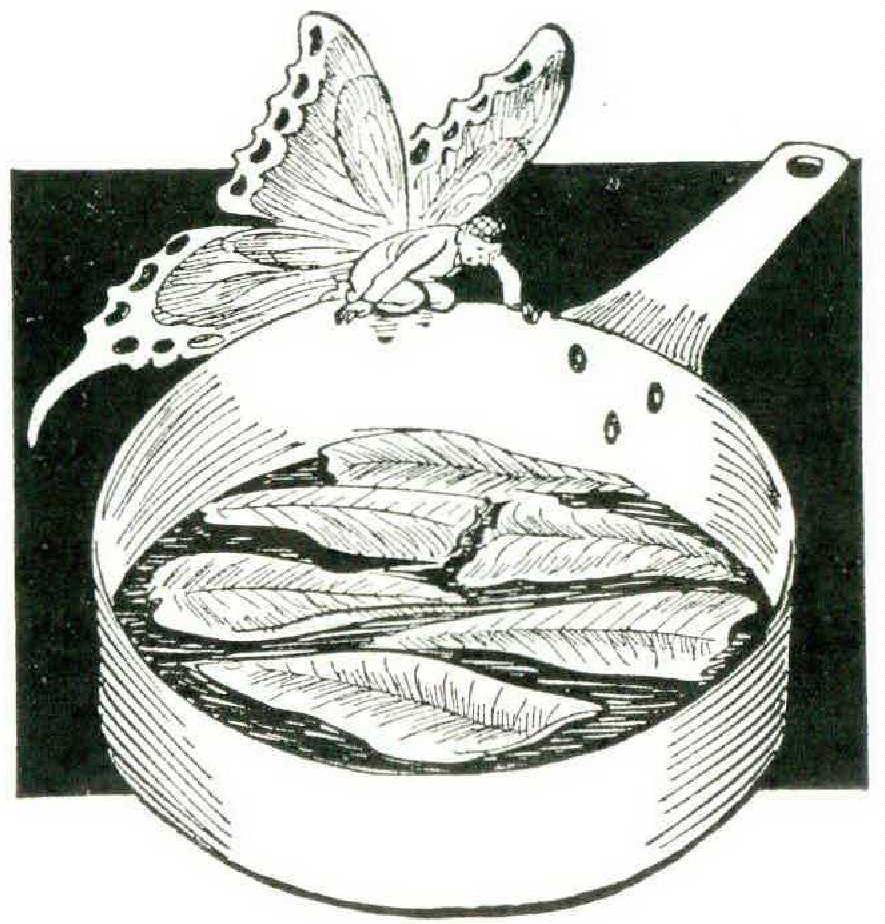
It was a wonderful lunch. The filets de soles were poached in dry Cinzano and served with a delicious sauce crevettes. Any cookbook tells you how to make shrimp butter, which is the important ingredient of sauce crevettes — “pound shrimp remains, add their weight of butter,
strain through a fine sieve” — but no book could possibly explain how M. Thuilier made his sauce. The quenelles (fish cakes) were flambées in Armagnac, for the benefit of impressionable tourists. Afterwards I had a pintadeau an porto, with a sauce that was made of the juice of the Guinea cock, with port wine and Madeira added. The mixture had been simmering on a low flame for hours. I began to have a guilty conscience about the way I had reacted when my Bostonian friend had given me the address of the Baumanière. In fact, I wished he were there with me. I won’t be surprised if some day the Guide Michelin should award M. Thuilier the supreme accolade of a third star, which only seven restaurants in France received in the 1951 edition. M. Thuilier isn’t sure whether this would help the restaurant. Three-star places are the ones where “money doesn’t matter” and some people might be afraid to come. Actually the Baumanière is not an expensive place.
M. Thuilier had his lunch at mv table, a little cold meat and salad. He said he rarely ate a big meal; sometimes he didn’t eat the whole day. After tasting every dish in the kitchen he wasn’t hungry. “I have a small staff,” he said. “An assistant, a commis, a charcutier who prepares the cold hors d’oeuvres, and a patissier. Good boys, all of them, but the trouble with the help is that they remember the difficult things and are apt to forget the simple ones. I keep telling the boys that they must never roast a chicken in a very hot oven, and always only in its own fat. So first thing they turn on the fire and cover the paulet with butter. Wrong. The skin gets blisters and even the finest paulet from Bresse dries out inside. I put the chicken in, sprinkle it with its own juice, and when it gets gold-brown, I put a little butter on the legs. Thus the juice is kept inside and gently bloats up the chicken.”
M. Thuilier asked for a bottle of Vichy water and said, “A cook shows how good he is when something goes wrong and he’s got to show presence of mind. One of my friends in Morocco has a good Arab cook who can copy anything from a recipe but is not able to think for himself. He will lose his head when his sauce béarnaise curdles. Silly, what? Easiest thing in the world to make a good béarnaise.”
Sure, I said. As easy as it is for Jascha Heifetz to perform the Walton Concerto.
“He added hot water to the warm sauce. Of course, it got even worse.” M. Thuilier laughed, genuinely amused. “The trick is to add tepid water when the béarnaise is cold, and to add cold water when the sauce is tepid. A simple chemical reaction. Suppose I make you an entrecôte tonight with my béarnaise?”
He had another glass of Vichy water. He drinks little wine, not more than half a bottle of champagne a month, and never hard liquor. He never smokes. “Can’t afford to hurt my palate. A chef is good only as long as his palate is reliable.”
Being isolated in the mountains, M. Thuilier has a problem of logistics and supply. Everything has to be ordered and brought up. The chicken comes from Bresse, the langouste from Cap Finistere, the fish from the Mediterranean and from Lac d’Annecy in the Haute-Savoie. “The train leaves there at eight in the evening and gets here at eight in the morning,” said M. Thuilier. “Of course you’ve got to trust your fishmonger. I buy only the best and I must be sure that I get what I want. I had an argument last week. The fellow knows that I don’t want my rouget (red mullet) larger than 180 or 200 grams. No rouget is worth anything when it’s over 300 grams, hein?”
I couldn’t help wondering what my gourmet friends would say to that. They always talk of spices and sauces and soufflés and forget the basic things — the size of the red mullet, for instance.
“I had the mullets packed in ice and sent them back,”said M. Thuilier. “The next time I’ll throw them away and look for another dealer. You can’t compromise on quality.”
A petite brunette and her husband came to our table. They were Madame and Monsieur Moseoloni, M. Thuilier’s partner. “Léon is from Lyon,” said M. Thuilier. “You know what we in France say about the Lyonnais? The richer they are, the shabbier they look. When I meet a fellow with frayed shirt sleeves on the golf course, I know he’s a silk millionaire from Lyon.”
“A Lyonnais never shirks out of an obligation,” said M. Moseoloni with some asperity. “In my city the biggest business deals are confirmed by a simple handshake.”
“Oh, la, la, the Lyonnais,”M. Thuilier said, winking at me.
Madame Moscoloni said the refrigerator would be out of order for four days. They were enlarging the kitchen for the second time since the end of the war. The Baumanière serves sixty luncheons and thirtyfive dinners on weekdays; on Sundays there are as many as a hundred and twenty people. During the winter most guests are French, but in summertime there is a higher percentage of foreigners — Americans, British, Dutch, Swiss, Spaniards.
“Some Americans know about food,” M. Thuilier said. “I know — I was with them in the war as liaison officer with the Twelfth Army Group. But many do not. They haven’t learned yet that the best dishes are simple dishes. My mother used to say, ‘Il faut manger simplement et sainemenf,; simple food is healthy food. My American friends didn’t believe me when I told them that I rarely use garlic in my Provençal dishes; they like everything overspiced. The simple dishes are also the most difficult. The other day my assistant prepared a gratin de langoustes. The sauce was too ‘short’ — too thick and not clear enough. I wasn’t satisfied, but the client was. But to make a perfect purée de pommes de terre (mashed
potatoes) — ah, that’s difficult. The slightest mistake shows up. The potatoes must be steamed, not boiled. The dish must not be too liquid and not too firm and it must not be allowed to wait. Another simple and difficult dish is pot-au-feu. The secret of ‘boiled’ beef is that the soup must never boil, only simmer. To make a fine omelet is one of the most difficult feats of the grande cuisine. But the clients would stop coming if we served them omelets. They want things that sound complicated, rougets pupillottes au beurre d’anchois, mullet grilled and wrapped in a paper bag, or caneton à l’orange, which has never been my favorite. In cooking, as in music, there should be harmony, and duck just doesn’t harmonize with oranges. And you must never hurry. A few weeks ago a client told me he was in a hurry, could I serve him in twenty minutes? I said to him, “Of course I realize that you’re in a hurry, monsieur, and I will serve you — a sandwich.’ ”
“We work too hard here,” said M. Moscolini. “ We should close one day of the week.”
“Difficult,” said M. Thuilier. “Restaurants like Pic in Valence and Point in Vienne can afford to close once a week. There is always some other place near Route 7. But people make a detour to come up here and they would be stuck. Have you been at Point’s Pyramide in Vienne lately? Ah, the great Fernand Point! We are old friends. We come from the same region and were both born in the same year, 1897. They are wonderful people, Fernand and Mado Point. Last year we both got the Légion d’honneur and Point gave a special dinner. Served us a whole pheasant, with head and feathers, but the body was made of pâté de faisan. Ah!”
There was a minute of reverent silence, then we walked over to the cave to look at some vintages of Châleau-Lafite. Château Gruaud-Larose, a 1928 Chambolle-Musigny, a. 1929 Charmes-Chamberlin. It is a small cellar but has a fine assortment of Côtes du Rhône wines, Hermitage La Chapelle, and a '29 Châteauneufdu-Pape. M. Thuilier compared the Bordeaux to a “grande dame” and the Burgundy to an “exciting mistress.” René, the sommelier, remembered a Clos de Vougeot '29 which
I tiptoed away. The sun was getting low and I walked up to the high plateau past a Roman chapel where, an old man told me, “even the unbelieving ones feel the urge to kneel down.” I walked through a dead city of broken walls, scattered rocks, and troglodyte dwellings, past the tenthcentury castle which Louis XIII had demolished in 1632, two years before the Baumanière was built.
When I came back, the lights were burning in the patio and there were candles on the dining-room tables. M. Thuilier was working again. I had a “simple” dinner, a marvelous gratin de langoustes (“nothing to it,”said M. Thuilier, “once you have the feel of the sauce”) and a steak which M. Thuilier rubs with butter lightly before broiling it over a hot fire, and butters once more later so that the juice will stay in. He is doubtless one of the great chefs of France. When I walked up to my room, the moon was bright and the rocks seemed to be strangely alive. I thought I was hearing the old battle cry of the Lords of Les Baux, “A l’Hasard, Bauthésard!” but it was only the voice of Rene, downstairs in the patio, telling a guest of the wonderful bottle of Moët & Chandon 1906 which had still been in perfect condition when he opened it, forty-five years later, although it was older than himself.