Une Petite Piqûre
This is the latest adventure of our pseudonymous correspondent in France whose reports are a frequent feature of these pages.
by RAOUL SIMPKINS
THE pain in my ear was intense; indeed it had reached a point at which I was unable to work. A French newspaperman gave me the doctor’s address. “A man of impeccable technique,” he assured me.
The doctor turned out to be a pleasant, graying chap. “An English patient,” he observed with easy punctilio as he rose to greet me in his inner sanctum. “What a pleasure. We of the Resistance —”
“Doctor,”I broke in, grimacing, “this ear —”
“— have myself seen the Gestapo drag a man out from the house next door to this. I have stood at this very window and watched the executioners’ rifles raised —”
“— prevents my sleeping. There is the most violent throbbing —”
“— the Oberleutnant turned away, abashed. ‘I am forced to salute France,’ he said. Next moment we heard the fraternal roar of RAF propellers. All eyes were turned skywards and there—”
“—worse, oh, far worse, than toothache. It resembles a gimlet —”
“But, come now,” interrupted the doctor, with genial insistence, “enough of idle gossip, enjoyable though it be. Let us now permit ourselves a glimpse of this stupefying ear of yours.”
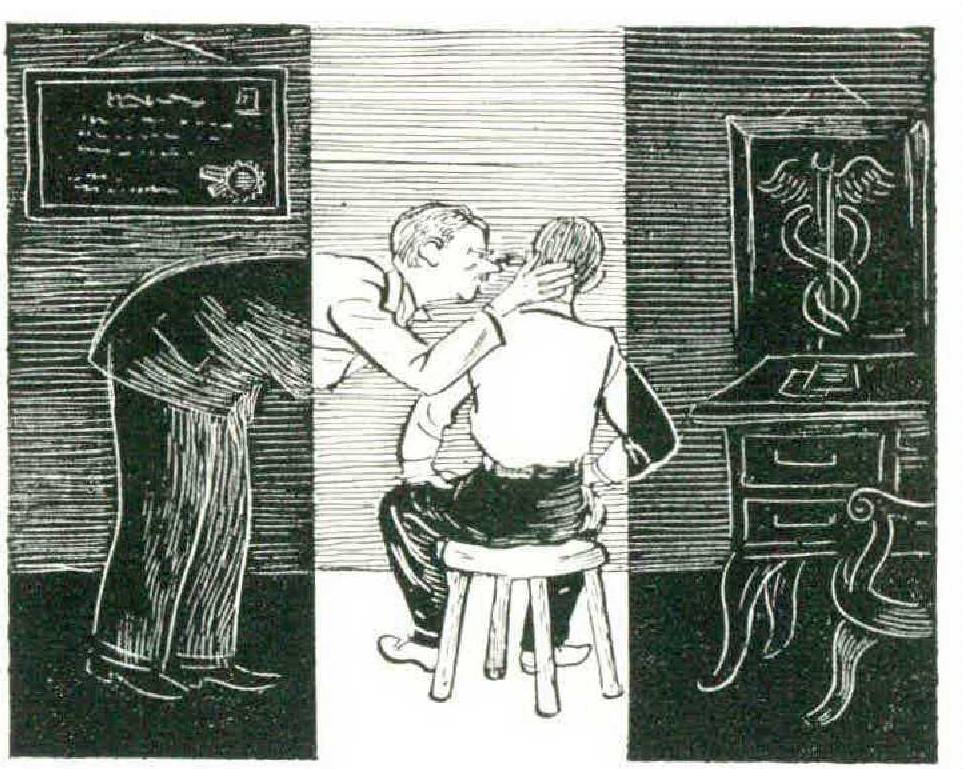
There was a swift and grateful surrender to the impeccable technique. The doctor introduced something that resembled a stunted stethoscope into my ear and switched on a light. “ Tiens!” he observed with gratification, and — a few moments later — “ Tiens! ”
He slipped the contraption out again, folded it, and sat regarding me with gentle chuckling reproof, every inch the indulgent father who has caught out his son in some inconsequential peccadillo.
“So,” he remarked, “Monsieur finds himself tormented by a pimple.”
The pain, temporarily in abeyance while the examination was in progress, came roaring back inexorably. I clasped the side of my head and said as evenly as possible, “Doctor, for the pimple — what treatment?”
“Highly interesting, the impact of so tiny an excrescence,” said the doctor, with an evenness outmatching mine. “Were it but possible for you to see inside your own middle ear, you would find it highly rigolo that so minute an outcropping — a veritable pin point, Monsieur, I can assure you — could cause you even a moment’s inconvenience.”
“But for this pin point, Doctor,” I pursued, with what I can only suppose was a ghastly smile, “what would you suggest ?”
“Ah, that!” He was all reassurance. “Twenty years ago — ten even — you would undoubtedly have faced a tedious period of combat. Today, thanks to your own splendid Sir Fleming, the answer lies at hand. Vive penicillin! Une petite piqûre . . .”
I had my coat off and was rolling up my shirt sleeve when he gently stopped me. “Not so fast, Monsieur. It does not lie in my province to administer la petite piqûre in person, much as I should appreciate the privilege for one of our British allies. I can only give you a prescription which, as you perceive, I am even now writing out. Just take it to a pharmacie and all will be well. . . . A check? If that is really to your convenience, Monsieur. Although we impecunious French, bedeviled as we are by anachronistic fiscal tyrants — Ah, thank you; cash is always perhaps the simpler solution.”
At the pharmacie, in the Paris suburb where I live, they studied the prescription, gave me a covert glance which seemed to indicate that in their experience there was only one kind of indisposition requiring penicillin, and grudgingly handed over a box of the stuff.
Once again I had reached the shirtsleeve stage, eager lingers fumbling at the cuff links, when I was stopped. “No, no, Monsieur; a pharmacie possesses no authority permitting the administration of piqûres. For that Monsieur must arrange to wait upon Madame l’Infirmière.“
Monsieur groaned (most genuinely), inquired the infirmière’s address, and set off, clutching his box of penicillin. Down one of those long, dusty French roads which seem to go on forever (villa after ugly villa guarded by high rococo walls and privet hedges tortured by demon gardeners into the most improbable topiary) I came at last on the infirmière’s hide-out.
There was a plate at the gate saying: “Madame Ulrique Destaing. Diploma of the University of Paris. Registered Nurse. Masseuse. Midwife.”Pain-maddened, I paid little attention to the strong white teeth of the police dog which sprang at me snarling as I made my way through the front yard. My steady gait and near-sleepwalker’s certainty — for by this time I had just got to have that petite piqure, and very soon too — must have thrown the beast out of stride, for it slunk away, evidently nonplused.
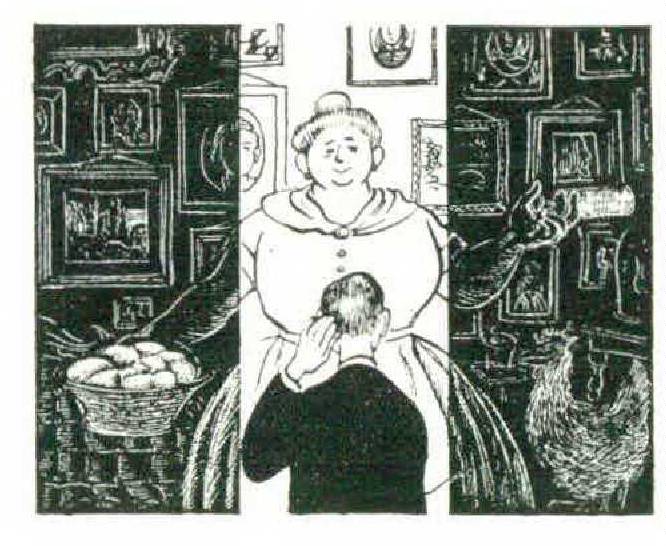
The front door stood open, revealing a narrow passage crammed with a perambulator, umbrella stands, discarded sweaters, empty wooden boxes, the top part of a rusty stove, a shovel, a deflated football, a bicycle, and a large pile of plums. I rang, and after a seemly pause Madame l’Infirmière appeared. She was formidably mustachioed and had on a garment which had long since eschewed any nonsense about pretending to be white. It was plucked in, arbitrarily enough, at the waist, but immediately above and below this unlooked-for restraint it flowed outwards, irresistibly rebellious.
“Monsieur desires?” she inquired, blank-eyed.
I held out the box and pointed, piteously enough, at my ear.
Totally disregarding the secondary gesture, she looked at the penicillin. “Aha!" she said. “In here, please.”
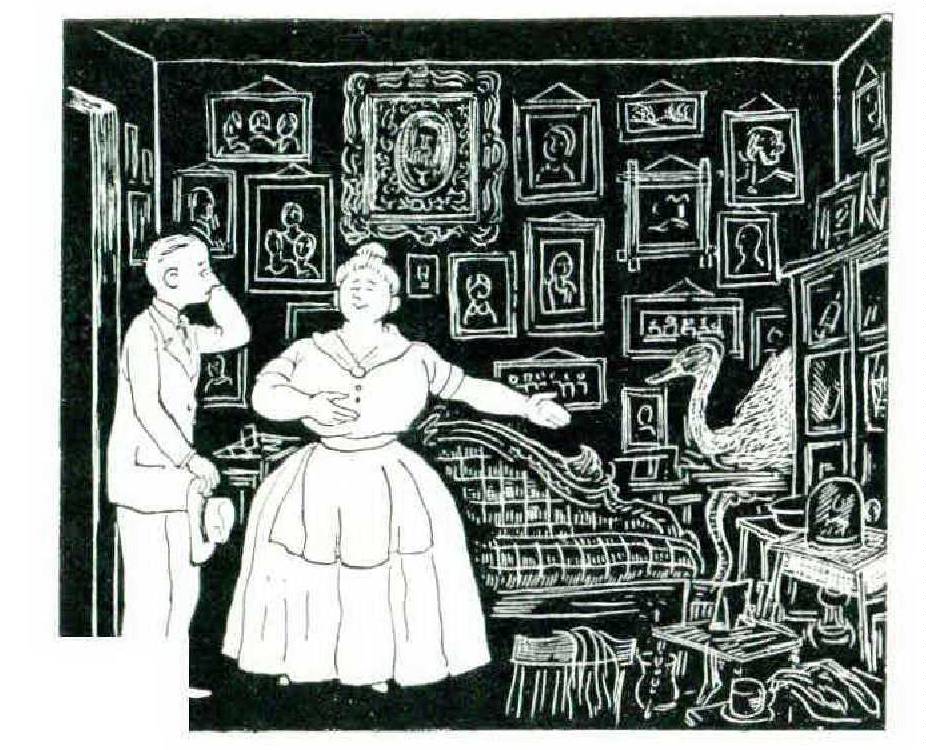
Feeling oddly furtive, I walked into what I took to be an infirmière’s equivalent of a doctor’s consulting room. It was small, dark, and exceedingly crowded. Fight opposite me was a stuffed swan, beginning to go a little at the base of the neck. Next to it was a glass case containing World War I medals — a row of about six, the ribbon colors faded. Then there came an engraving, something like the Last Stand of the Spahis at Sedan (War of 1870), done in great detail and with all hands at their noblest. Next door was a massed battery of yellowing parchment diplomas, including, doubtless, the one from the University of Paris. There was a set of chessmen, elaborately carved — the knights on tiny horses — and so little meant for use that they were irretrievably under glass. There were various tables, all of them covered with objects, from dog’seared copies of L’Illustration to a child’s mackintosh, toys, a cucumber, some knitting, a piece of oilcloth (which looked as though it had strayed up from the floor), a tin of DDT, an empty bottle of Suze, a double-barreled gun, and a quantity of family photographs, their subjects posed to the last centimeter.
In one corner, shouldering aside the tables, stood an unpleasant-looking glass cabinet. It contained, I supposed, the main stock in trade of an infirmière: huge, blunt hypodermic syringes (looking, at a casual glance, like something discarded by a veterinarian as being too cruel on the horses); little piles of swabs and bandages; a spirit lamp; needles of all sorts; sutures on a wooden spool; one rubber glove, thumbless; various bottles and tubes of ointment; and a vast, evilly glittering pair of forceps. Barely discernible through the dust cloaking the outside of this case was a faint Red Cross, unaccountably askew.
Near it was the centerpiece, around which the whole cluttered, mangy room seemed instinctively to group itself: a sofa. In other surroundings, perhaps, this sofa might have escaped unnoticed. In the parlor of furnished rooms at the seaside, for example, one might conceivably have consumed tea and toast quite happily upon it. But in my particular circumstances its dark and dingy tapestry, its slightly knowing lurch, its general air of nameless experience, struck a chill into my heart as my gaze, flickering from the swan and the medals, came to rest — by way of the glass case — upon it.
But Madame was at my heels, massively efficient. “Allons!” she remarked briskly. “To the task.” She opened the glass cabinet, selected one of the swollen hypodermic syringes lying within, and extricated it. Next she half filled it with water from a nondescript vessel which I had assumed to be an unoccupied flower vase. Then, using the sort of plunging motion with which brawny section hands are wont to set off dynamite charges in quarrying operations, she tested it ceilingwards. A great jet of water duly shot across the threadbare carpet. “Admirable,” she muttered. “It works.”
She slapped open my box and began to draw its contents into the syringe. “Good,” she remarked casually over her shoulder. “And now if Monsieur will kindly lower his trousers.”
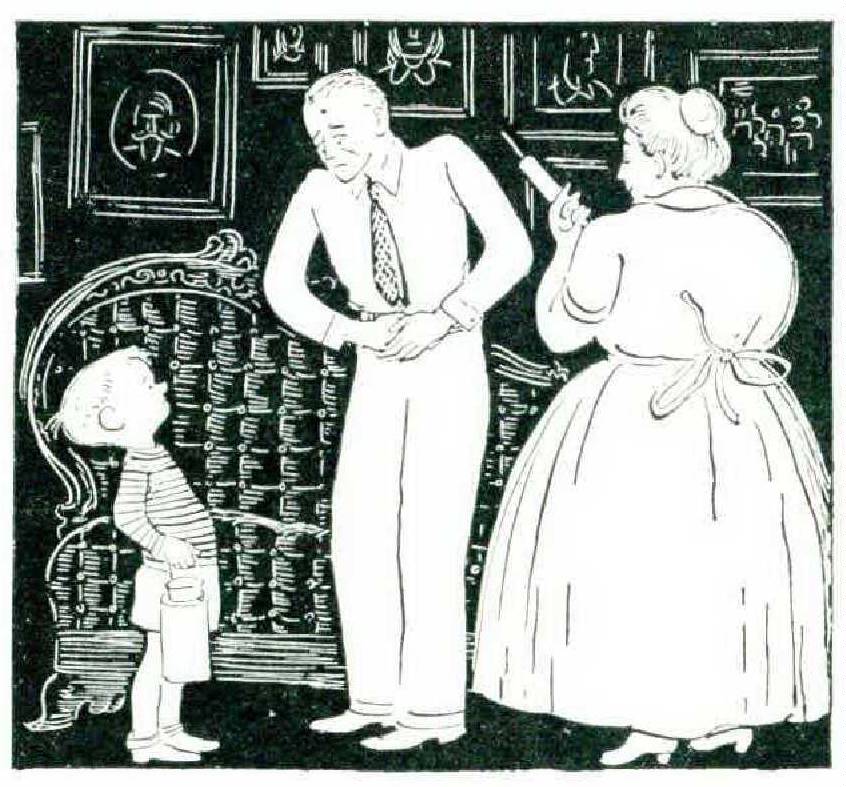
Pain or no pain, the ingrained coyness of the Anglo-Saxon abruptly asserted itself. The swan seemed, all of a sudden, to be watching me with an ugly leer. I plucked feebly at my belt. The door opened and a child wandered in. He was, I suppose, some six years old and might indeed have been the owner of the mackintosh which draped one of the tables. I paused, belt in hand.
“Shall I fetch the milk now, Maman?” he inquired.
“Yes, my little one,” responded Maman, still busy with her impedimenta. The little fellow, who I now perceived was carrying a tin can of the type in which the suburban French collect their milk, transferred his gaze to me.
“Maman has a client?” Clearly a rhetorical question.
“But yes. Monsieur is a client,” replied his parent, indulgently enough. Madame turned to me, syringe at the ready. “Come now, Monsieur, all is alerted,” she said. “Remove the trousers, if you please, and place yourself, prone, upon the sofa.”
Yes, that was it. Like the executioner’s block at the Tower of London, redolent of the blood of its victims through the ages—Lady Jane Grey, Essex— this evil old sofa possessed its own register of clients who had placed themselves upon it to await the blow.
There was just one more gesture before I inclined myself with what grace I could muster. It was not so much the spoken word as the mute glance; and the glance was directed at Madame’s son, who still stood his ground, milk can in hand. Madame seemed to understand. Perhaps she had had earlier dealings with the ludicrous English, with their false modesty, their pudeur. “Oh, it’s all right,” she said, advancing on me. “ He is used to it.”
I sank, face downwards, on the sofa. Its evil old bosom received me with the malignant vibration of a broken spring. Madame after all was quite deft. Indeed I have experienced far more unpleasant inoculations. While still face downwards, waiting for the process to be concluded and congratulating myself that the little pimple would soon be meeting its match, I thought I heard the clucking of a hen.
This wouldn’t do. Clearly the pain and the tension had affected my nerves more than I had realized. The clucking was repeated.
“Kindly resume your normal attire,”commanded Madame. With a kind of sheepish defiance I assumed a sitting position, dragging my trousers into place as I did so. A wave of relief overcame me as I now observed that there was indeed a hen — a large brown bird — in the room with us all. It was pecking, not without resentment, at the carpet.
“Well now, Henri, it is high time that you put yourself in train for the dairy,” observed Madame. She replaced the hypodermic in the glass case with the kind of offhand yet affectionate care with which a squire might put his gun back in the gunroom racks after a good day with the pheasants. The child obediently left the room, milk can a-clank.
Again Madame followed my gaze, directed this time to the fowl. “Ah,” she said as she counted the cash I had handed her. “Perhaps Monsieur would be interested in some new-laid eggs? My hen’s product is well spoken of by all.”