This Month
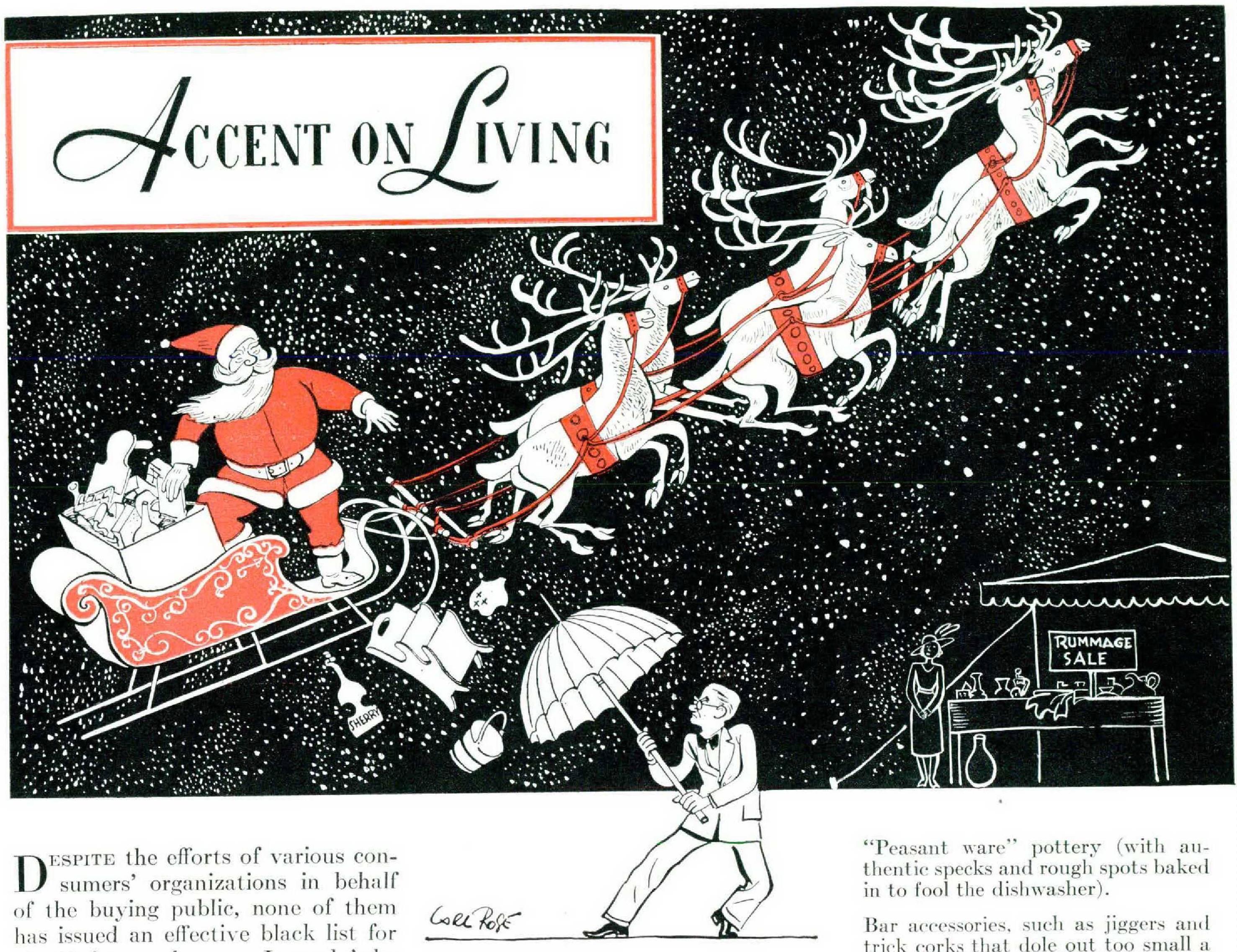
DESPITE the efforts of various consumers’ organizations in behalf of the buying public, none of them has issued an effective black list for the Christmas shopper, It needn’t be a long list — just the basic nightmare items of the tea-shoppee genre, rummage sale candidates for the year 1960.
There was a time, to judge from rummage sales that I have attended, when every family possessed a silver or brass opium layout, of Oriental workmanship, and usually with a few essential parts missing. Customs change; the American householder is no longer a slave of the poppy; but he is still exposed to a good deal of merchandise which will inevitably wind up on the tables of the annual Parents’ Day White Elephant Sale at the Nirvana Heights Country Day School.
Let us make a beginning of a list, therefore, to be headed “Not Acceptable.” It will help not only him who gives, but also those who receive. A voluntary display of such a list by tea shoppees would be in the best interests of all concerned. (Far better to take such action independently, now, rather than to be driven to it later on by Federal legislation.) It would be understood, of course, that the caveat applies only to the articles as gifts for others, and none of it inhibits the right of an individual to buy “Not Acceptable” goods for himself, if such a thing were imaginable.
A tentative list: —
Gift package of chemicals to make firewood burn in eerie colors.
Sherry decanter in the shape of a violin.
Any other kind of decanter. (It’s more comfortable to know exactly what you’re drinking.)
Imitation cobbler’s bench.
Miniature imitation cobbler’s bench.
Match packets stamped with “merry sayings.”
Gifts for dogs and cats.
Magazine and newspaper rack (for outdated periodicals).
Wall brackets for pots of ivy.
“Peasant ware” pottery (with authentic specks and rough spots baked in to fool the dishwasher).
Bar accessories, such as jiggers and trick corks that dole out too small a drink.
Corkscrews. (Anyone who hasn’t a corkscrew by this time wouldn’t want one anyhow.)
Gay but unidentifiable cloth object. Pot holder? Egg warmer? Inner sole?
Imitation sap buckets.
Miniature imitation sap buckets.
Miniature anythings.
Experienced rummage sale organizers will doubtless have other candidates for the list, and in any case lengthy hearings must be held before protective legislation — probably under the Commerce Clause can be enacted. Meanwhile, the gift trade might usefully take thought of a quarterly publication of the Institute of Contemporary Art, Boston, entitled Current Design. I assume it is intended mainly for manufacturers and dealers.
Current Design is a loose-leaf catalogue of industrial products which the Institute regards as well designed: accessories, appliances, china and pottery, fabrics, floor coverings, furniture, glass, kitchenware, lighting equipment, metal tableware, plastics, and wallpaper. In each case, with a photograph, price, and basic specifications of the product, the names of the designer, manufacturer, and distributor are provided.
The Institute will undertake to refer a manufacturer to capable designers in his field, and it will also collaborate with his own staff of designers. Some rather sizable enterprises have already put into production items thus newly designed to replace various old-time eyesores which they had been piously turning out over the years.
Organizations like the Institute could enlarge their services handsomely, it seems to me, by getting after some of the homecrafts in rural parts of this country and Canada, especially in the Maritime Provinces. Jarring colors and banal design too often nullify even the most exquisite handwork, as any country “exposition hall” will demonstrate. An ugly hooked rug is ugly, if that’s the way it works out, however naive or painstaking its creator; and there comes a point at which local pride and suspicion of outside advice are more of a luxury than the craft can afford. At several fairs in New England and Canada last summer it was saddening— and irritating — to see how fine weaving and needlework could achieve so many repulsive offerings — effects that not even “summer people” would buy.
If improved design should eventually bring an end to the rummage sale, perhaps some less cumbersome form of fund raising could follow. Granted that the sale is a financial pillar of private education in this country, a glance at the statistics will show the need of newer methods: —
AVERAGE PRIVATE SCHOOL RUMMAGE SALE — 1950
Original cost of merchandise donated for sale $1,003,728.15
Man-hours contributed by parents (@ $1,25 an hour) $24,000.00
Gasoline and damage to finish and upholstery of parents’ cars (no charge)
$7,853.00
Income and expenditures (Cash)
Sales $861.33
Catering 800.00
Net Profit $ 61.331416
Mrs. Himmelfarber, treasurer of the sale, is still trying to find out how π got in there.
CHARLES W. MORTON