Stuffing the Turkey
“Even to the children, a Christmas turkey without stuffing is unthinkable.”
EVEN to the children, a Christmas turkey without stuffing is unthinkable. But I suspect that the character and quality of what cooks inside assume major importance at about the time the drumstick becomes just another part of the big bird. When there are more applicants for a bit of the oyster — that juicy morsel of dark meat on either side of the third vertebra — than there is oyster meat to go round, the time has come to remember that there are two ends to a turkey and that one end can be used for a new departure in stuffing while the other retains the old family stand-by.
Perhaps our family has been unusually fortunate in that when the children were old enough to be discriminating and wanted to try things they had tasted or heard about outside the family circle, one of my uncles began to specialize in raising small plump turkeys for market. Since one of his turkeys would not serve our minimum of fifteen at Christmas dinner, we always had two to roast, and thereby four avenues for experimentation. There were times when we thought, nothing of whipping up the maximum number of stuffings—wild rice with mushrooms for one, chestnuts for another, oysters for a third; but always Mother’s fresh homemade noodle stuffing was reserved for the biggest cavity in the biggest bird.
This is a subtly mild stuffing, with only the turkey giblets, turkey broth, bits of butter, and salt and pepper to flavor it, aside from the turkey juices that seep through it during the long, slow roasting. And that may be a reason it always remained a favorite. With no onions, sage, or other high seasoning with which to compete, the goodness of the turkey was all there.
Homemade noodles alone are such a delicacy, and so easy to make, compared with many other staples made with flour, that it is surprising so few have ever even tasted them. But the recipes sound formidable, and both time and space are necessary for the drying — requirements often difficult for present-day cooks to meet.
MOTHER’S NOODLE RECIPE
2 egg yolks
1 whole egg
3 tablespoons water
2 cups flour
1 teaspoon salt
Beat egg yolks and whole egg together lightly with a fork or whisk, add the water, and mix together. (Old recipes used whole eggs entirely and no water, but using water in place of egg white gives a lighter, more tender noodle.) Sift the flour and add one cup of it, plus the salt, to the egg mixture. Work in more flour until the dough leaves the side of the bowl. Knead in whatever additional amount is required to make a dough firm enough to roll out.
Divide the dough into three pieces and roll out each separately, as thin as possible and in as near a square or oblong as possible, on a floured board or pastry cloth. This is the part that frightens off inexperienced cooks, but the egg and flour mixture presents little difficulty compared with pastry or pie dough; the stickiness of the egg keeps it from breaking or stretching apart.
Set aside on cloths to dry for an hour or so, depending on the humidity and how much flour has been worked in. Mother’s test is whether or not the sheets feel satiny to the touch. They must not feel sticky, nor yet crisp and brittle. Roll up each sheet in a flat roll and slice off at the desired thickness: for stuffings, ¼ to 3/8 inch is about right.
Unroll each noodle — or toss into the air to unroll—and again spread out to dry until it is brittle; the time required is about two hours. The noodles, after becoming brittle, may be stored in covered jars until needed, but are at their peak if boiled and used immediately. Use 3 quarts of boiling water with 1 tablespoon of salt. Drop the noodles in and boil about ten minutes.
MOTHER’S NOODLE STUFFING
Noodle recipe
Chopped, cooked turkey giblets
¼ pound butter broken into bits
Turkey stock from cooking giblets — about ½ cup
Salt and pepper to taste
Mix the noodles, giblets, and butter in a large bowl. Add stock bit by bit, stirring and turning over the noodles. When stock begins to collect in the bottom of the bowl, you have used enough. Taste; if the stock is quite salty you may need no more salt. Taste again when you have added the pepper. If the stuffing is as good as it ought to be, even at this stage, you may end up with less than you expected when you come to put it in the turkey.
How big a turkey will this recipe stuff? That depends. Turkeys are not standardized, and some have bigger cavities per pound than others. But the recipe should fill a mediumsized turkey. More important, it will make about 5 cups of stuffing, which, allowing ½ cup per portion, will take care of 10 servings. Fill the breast end first if you are using the stuffing for both ends. If the main cavity isn’t quite filled, it will not matter. However, if all the stuffing won’t go in the bird, the rest of it can be baked in a covered casserole with some turkey drippings added after the bird has left the oven.
Cooked separately, it becomes dressing, of course, not stuffing; for while the two terms are often used interchangeably, a dressing is properly something cooked outside the bird.
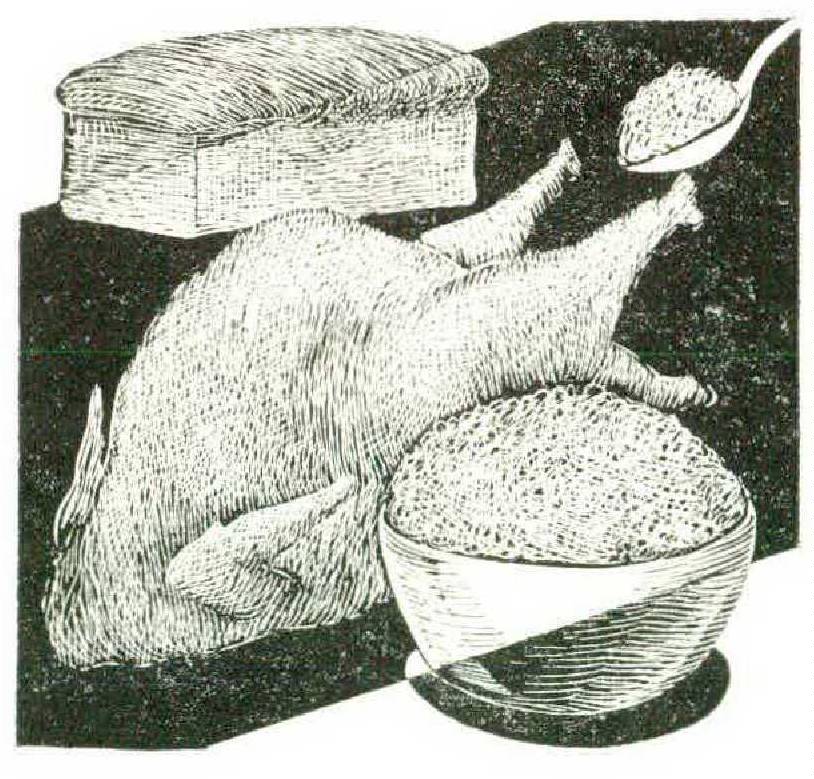
For those who prefer a richer stuffing with a dash of onion, one cup of fine bread crumbs sautéed in butter, a small, finely diced onion, and a half cup of mushrooms, also sautéed in butter, may be added. This gives a Viennese touch to the stuffing.
For a stuffing that counts on the flavor of the bird to bring it to perfection, care in cleaning the turkey is important, and here is where I take issue with the exponents of the wipe-with-a-damp-cloth school.
In my mother’s kitchen every speck of lung or liver was removed from the inside of the turkey anti clear, cold water run through it in a brisk stream. Then the inside was well dried, so that no lingering bits of inedible or off-taste matter could remain. As for the outside, two of us have spent as much as three hours on one turkey, seeing that every pinfeather was removed and every bit of yellowed dead skin peeled off, so that those who thought the crisp, golden crackling skin the best part of all would really have something to talk about.
Our second favorite stuffing is made with wild rice and mushrooms — a good flavor contrast, especially with turkeys that have not been overdomesticated.
WILD RICE STUFFING
1 pound uncooked wild rice
¼ pound butter
1 onion
1/2 pound mushrooms
Salt.
Chicken bouillon or turkey stock
Boil and drain the rice. Sauté the onion, finely chopped, and the mushrooms, sliced, in butter. (Use the stems, too.) Mix together and salt to taste, adding as much bouillon or stock as the rice will take up. Any giblets, especially the liver, that aren’t pledged to some other dressing, or to the gravy, may be added as well. This makes 6 or 7 cups of stuffing. During the war, when wild rice was hard to get, I discovered that it could be stretched with an equal amount of brown rice without appreciable difference in flavor or texture.
Our most exotic stuffing, as contrasted with the noodle recipe, was never used in turkey, but rather in large roasting chickens or, best of all, in duck. This is it:
CHINESE FRIED RICE STUFFING
3 cups boiled rice
1 egg
3 or 4 scallions, or 1 small yellow onion chopped fine
½ pound giblets or uncooked beef, pork, or chicken
½ cup celery or mushrooms, bean sprouts, or other uncooked vegetable
½ cup toasted almonds
1 to 2 tablespoons soy sauce diluted in an equal quantity of water
Fry the egg flat and hard in butter, piercing the yolk and turning. Remove from the pan and cut into thin strips. Place in a large bowl. Cut the scallions into thin slivers, slantwise, or use the chopped onion, and fry quickly over a high flame for about two minutes. Add to the egg strips. Cut the meat into paper-thin slices and then into strips. Fry in butter over a high flame, sprinkling with half the soy sauce and water, and stirring rapidly to keep from browning. Cook about two minutes and add to the other cooked ingredients. Finally, fry the thinly sliced celery, mushrooms, or whatever vegetable you have selected, the same way, sprinkling with the rest of the soy sauce and water. Mix everything together with the rice and chopped toasted almonds, and add about a half cup of chicken consommé or stock — not enough to make the mixture runny. Taste, and add salt or more soy sauce if you prefer.
That good old stand-by, bread stuffing, was first choice with only a few of us, even when dominated by oysters or chestnuts, until Mother started adding sizable quantities of finely chopped sautéed celery to it.
