How Football Died--Continued
by SAMUEL YELLEN
SAMUEL YELLEN is Associate Professor of English at Indiana University, His verse has appeared in the Atlantic and other magazines.
LAST year, in the November issue of the Atlantic, I reported how the two-platoon system, introduced fourteen years ago (that is, in 1947), led inevitably, step by step, to the death of football. An autopsy undertaken during this past year, however, has revealed that still another disease, operating almost simultaneously, helped do football in. That disease was the self-imposed handicap. The original blame, in so far as any human agency can be held responsible, rests squarely with Notre Dame and Head Coach Frank Leahy.
Looking back from the present vantage point of 1961, we can set the exact time and place. The self-imposed handicap first manifested itself on Saturday afternoon, October 29, 1949, in the Babe Ruth Stadium at Baltimore, when Notre Dame, to use the staid and sober language of the New York Times, “inflicted the most humiliating defeat upon Navy in the 23-year history of their football rivalry, winning by 40-0 before a full house of 62.413”
Yet the item of greatest significance in the Times account was buried near the bottom of a column: “The Fighting Irish, obeying instructions, did not launch a pass in the second half.” (Emphasis mine.) What is astonishing is that not one of the sports experts and commentators in those remote days noted the implications of the fact that for two full quarters Notre Dame had deliberately denied itself the forward pass.
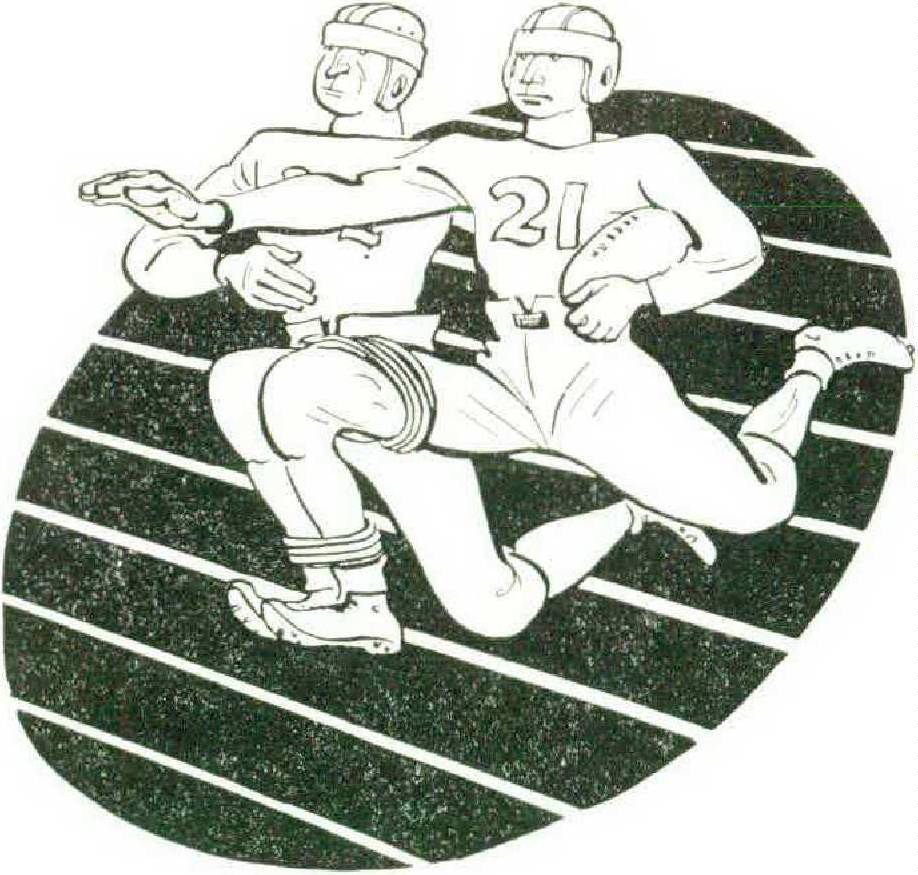
Today it is not hard to understand what drove Frank Leahy to make use of the self-imposed handicap. Out of the 38 games played during the four seasons 1946-1949, Notre Dame won 36, most of them by overwhelming scores, and tied the other two (with Army and Southern California). The dilemma that faced Leahy is clear enough. He was finding it increasingly difficult to schedule games with the better-known teams, which were understandably reluctant to submit themselves to such utter carnage and humiliation.
Somehow Leahy had to reassure his opponents by discovering a way to keep the score down and make the game less one-sided. Nothing he did seemed to stop Notre Dame from rolling up a score.
Consider, for example, that Navy game back in 1949. Four of the six Notre Dame touchdowns came in the first half. During the third quarter, with the regulars on the bench and with the secondand third-stringers under instructions not to pass, Notre Dame still scored two touchdowns. Only in the fourth quarter, when Leahy had scraped the bottom of the barrel for a sixth-string backtick! and had, moreover, forbidden it to pass, could Notre Dame manage not to score.
The prospects must have disturbed Leahy. No wonder that at the close of the 1949 season he announced that Notre Dame would not have a good team the following year. There was, of course, nothing as definite as an agreement. Nor even an understanding. Nevertheless, there can be no doubt that the opposing teams took the hint.
By 1951 they assumed that Notre Dame could be counted on to use the forward pass only during the first half of each game. Actually, after it saw the score of the opening game, Notre Dame limited itself to passing during only the first quarter of the next game, and later restricted even the number of passes. By the end of the season it was using no forward passes at all. But still the scores — all too lopsided—rolled up.
By 1952 the self-imposed handicap was no longer a mere assumption. It had become a definite agreement, sometimes informal, more often written into the contract. In desperation, Notre Dame gave up not only the forward pass but also the lateral. In fact, before certain schools like Princeton would schedule a game at all, Notre Dame had to restrict the number of end runs too, until by a gradual limitation that play also disappeared from its repertoire.
Nevertheless, trouble arose. The self-imposed handicap proved to be self-defeating. For as Notre Dame gave up in turn the forward pass, the lateral, and the end run, and finally confined itself to line plunges, it developed greater and greater line plungers. What it was up against was the sheer adaptability of man. Or perhaps Emerson’s law of compensation was at work. Thus SixYard Sitko of 1949 gave way to Nine-Yard Hrvbovczak in 1952 and Twelve-Yard Antonini in 1953. Despite the diminishing variety of plays and the exercise of self-restraint, Notre Dame continued to run up its usual scores of 40 and 50.
As football lost its variety, it also lost its spice. The spectators began to complain about the monotony of a game all line bucks. Nor was Notre Dame the sole offender. Other titans, such as Michigan and Southern California, had likewise adopted the selfimposed handicap and written it into contracts with weaker opponents. By 1954 the dissatisfaction of the fans showed itself in the’ steadily falling attendance figures. When only 18,000 turned out for the Notre Dame-Navy game that year, anyone could see that strong measures were called for.
At the close of the 1954 season, Leahy himself issued the invitation for a conference of the leading schools.
The problem was simple. Somehow the former variety of plays—the forward pass, the lateral, and the end run — had to be restored to football. At the same time, some means had to be devised to curb the virtuosity and skill of the individual players.
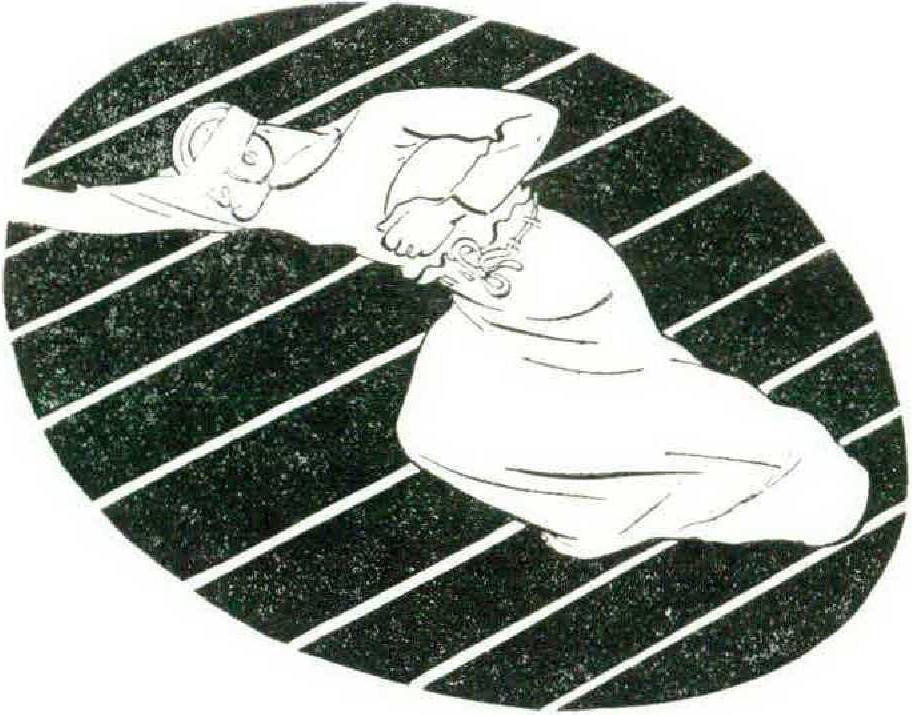
The solution, when found, had the simplicity of any great fundamental discovery. Why not tie the right and left halfbacks together as in a threelegged race?
With his customary resolution and daring, Leahy tried out this idea in the opening game of the 1955 season. It was a triumph, True, again the handicap proved inadequate. For, given the kind of interference provided by the Notre Dame blockers, the three-legged right-left-halfback swept down the field 90 yards for one touchdown, and 73 yards for another. However, the crowd went wild. New thrills and color had been added to fool ball.
As the season progressed, other tricks were introduced to weaken the Notre Dame scoring punch. Thus the safety man receiving a punt took it with one hand tied behind his back. Whenever Notre Dame crossed into enemy territory, further modifications went into effect; inside the 10-yard line, the entire backfield was put in sacks, and took off for an off-tackle slice or an end run as if in an oldfashioned sack race.
But probably the most impressive play the season, an adaptation of the egg-and-spoon race, came in the Pittsburgh game, when left end O’Grady grabbed a pass with his free hand and ran for an 80-yard egg-andspoon touchdown.
Of course, difficulties could not be avoided. The players grew more and more adept at overcoming handicaps; the fans became more engrossed in the incidental performances than in the game itself. Players had to be selected not so much for their ability to run, pass, and kick as for the handicap stunts they could do. The gridiron took on the appearance of a three-ring circus. This development had been foreshadowed long before in the complicated formations and ads put on between halves during the 1940s by marching bands, baton twirlers, acrobatic cheerleaders, and beauty queens. However, those primitive interludes were like amateur night compared with the new spectacle.
It is not surprising that even those on the inside were slow to see the disaster at hand. Somehow there were always new and urgent problems to be met immediately and solved, leaving no time for the long view. Thus, during the 1957 season, friction developed with the Variety and vaudeo Artists Guild, when it stepped in and demanded a contract covering all the stunt players.
A further complication arose when Actors’ Equity claimed jurisdiction over the quarterback calling signals because of the “speaking part” involved. However, all these minor hindrances were smoothed out, as if, ironically, to permit the ultimate catastrophe to gain full momentum. What had happened was that football had been transformed into theater. The backfield came to outdo the best talent available on television. This eventuality was first put into words by Variety in a story headed “Grideo Heaves vaudeo.” In fact, so important did the theatrics become, and so intricate, that in 1958 Southern California hired Billy Rose to help the coaches in planning and directing its games. Other schools, too, began to lure directors from Broadway and Holly wood. Perplexed coaches were let go as unnecessary, although some schools kept them on, either because of sentiment or of what sociologists call a cultural lag.
The virus spread with fatal speed, and with it came disintegration. Television began to focus only on the spectacular stunts, so that the rest of the game became vestigial. MCA scouts showed up in the locker rooms to dangle contracts before the players. Even the alumni organizations, loyal and generous as they were, could not compete with such an outfit as CBS. There was a constant exodus of players, most of whom quit as early as their sophomore year to go into television or the movies.
By I960 the game was running out of players, at the very time that the two-platoon system and the specialized unit were requiring ever bigger squads. It was more than football could survive. The coup de grâce came late in the 1960 season when CBS moved Grideo out of the stadium into its studio, and put on the highlights of the Minnesota-Michigan Little Brown Jug game there. One of the props was a football.