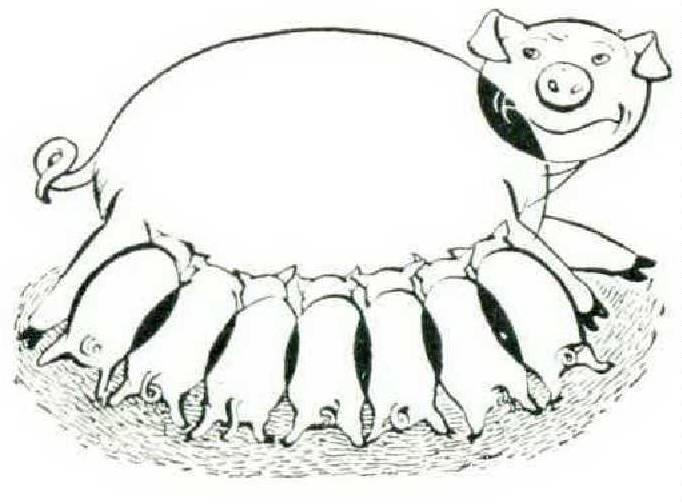
Pigs
Readers will remember RIXFORD KNIGHT for other findings about barnyard animals. He is a farmer in Jamaica, Vermont.
by RIXFORD KNIGHT
THE best way to build a pigpen is to use two-by-six planks with four-inch spaces between them so that children and guests will have room to rest their feet on the lowest plank and lean over the top one while watching the pig. The top plank should be as high as a person’s armpits. Not to keep the pig in — you can’t keep him in anyway — but to serve as a support from which the children and guests can suspend themselves when the pig approaches so close as to threaten their toes.
There is more to be learned from watching the pig than any of the other farm animals. Kittens are cute and colts or calves are appealing, but the frame of mind of the person watching them is quite different from that of the person watching a pig. It may be that there is the possibility of character differentiation here, so that we might say: “The character of the person who watches pigs is superior to the character of one who prefers to watch kittens or calves or puppies.”
If this is so, the explanation probably is in the character of the pig himself since the pig resembles human beings more closely than any other farm animal, having an intestinal tract approximately the length of our own.
It is commonly supposed that the pig is a nasty animal who by nature prefers to wallow in his own filth. This is not so. The pig is one of the very few animals, wild or domestic, who habitually choose a particular spot to do their chores in and who rigidly adhere to their choice. In this not trivial respect he resembles the more cultured of the human race.
It is true that a pig who is reared in a slum tends to take on the character and appearance of a slum dweller. But it is also true that one who has had advantages will benefit from them. His skin will be smooth and pink, and his clean white hairs will show a precise and meticulous part down the ridge of his back. Cynics say he keeps clean because he is continually rubbing himself against a post to alleviate the irritation caused by lice. The answer to this is that pigs, at least, do not like to have lice and try to get rid of them.
But it is in respects more fundamental even than cleanliness that the pig rewards study. After watching a pig for an hour or two, one is bound to appreciate that in the pursuance of his ends the pig possesses the same wary but confident indifference to forces irrelevant to those ends that characterizes the most successful of our business, political, and military leaders. And he too likes to have his back scratched.
Of course the ends that motivate a pig are not, except in a general way, the ends that motivate us; and his methods of attaining his ends are not, except in respect of perseverance, methods we should care to emulate. It is a harrowing experience for one of my own dental frailty to listen to a pig cracking the pits from two bushels of canning peaches in order to get the meats within. He will also crunch, Fletcherize, and swallow the heads, beaks, eyes, brains, and feathers of eight large canning roosters. And if not properly dieted a sow will do the same with her newborn young. Her husband will anyway, if he happens around.
This is due to the fact that pigs are not inhibited. It is practically impossible to inhibit a pig. I would rather undertake almost any other farm task than to try to inhibit a pig from sticking his nose into the skim-milk pail before I get it poured into the trough.
Many of our troubles as humans come from our being inhibited against doing things we want to do. The pig does not operate under that disadvantage. He is what he is, and Miss Stein would surely say that he is not needing to be changing. He gets along very well. It is hard to see how he could do better for himself.
You are thinking to say: “Ah, but what happens to him in the end?” In the end he will be dispatched fairly painlessly and be eaten by people who in the end will succumb fairly painfully and be eaten by worms; though this last distressing probabilily can be got around by incarceration in a solid gold or lead casket, so that we can look forward to a happier life after death than a pig can.
In a way it is true that a pig is not a free agent, and that he has to do what man tells him not to do and feels a compulsion not to do everything his master tells him to do. But even in this perverse way he is exercising his individual initiative, a trait which enables an individual to do others before they do him. Our largest and most successful industries have been built up through the exercise of individual initiative.
But the pig’s most enviable virtue is his practicality. A practical person is one who knows what he wants and refuses to be distracted from getting it by contemplation of scenery, sonatas, or poetry. I have yet to meet an impractical pig.
I would not want to say definitely that the virtues I have mentioned are the ones that attract people who like to watch pigs. Under the headings Beef, Pork, and Lamb, in Miss Farmer’s cookbook, thirty-three recipes are devoted to beef, forty-five to pork, and thirty to lamb, and the possibility cannot be excluded that considerations associated with these recipes may influence the reflections of persons who like to watch pigs. But I dislike to believe this.
Instead I prefer to think that these people are actuated by admiration for the pig’s perseverance, for his independent spirit, his wary but confident indifference to forces not serving his ends, and for ihe practical nature of these ends. I like to think that children and guests are learning these things from the pig. Because it is characteristics like these that assure success in the world. Impractical reflections about poetry, philosophy, or the nature of the physical universe don’t serve any ends that a welladjusted pig would think worth a moment’s consideration. It is, for example, the great tragedy of Mr. Einstein’s career that he has never been able to make himself think, look, or act like a pig.