At Home Offshore
CARLETON MITCHELL is a Rear Commodore of the Cruising Club of America and makes his home, when he is not afloat, at Annapolis, Maryland. He is the author of Islands to Windward, the account of a cruise from Trinidad to the Bahamas, and his new book, Yachtsman’s Camera, will be published this fall.
by CARLETON MITCHELL
IT WAS blowing hard when we left Havana. It had been blowing hard for several days. The flags over Morro Castle stood out rigid, bright rectangles against a bright sky. We had moved Carib over under the lee of the northern shore of the harbor to case a nasty chop. There was no sign the wind would drop.
‟Hell,” ‘said Hod, “it′ s never going to let up.”
“No,” I answered, “I guess not.” So we took my wife Zib ashore to Zaragozana’s for a last lunch of more crabs, and stopped by to pick up clearance papers for Nassau, and bought a baked ham and a case of Mexican Carta Blanca beer, and got out through the entrance just at sunset. The fortress looked massive and impregnable, typifying the solidity of the land.
Outside there was quite a slop of a sea, but it was worse close in than farther out. By the time we were a mile off the beach there were no lops on the seas. They looked big in the strange light of dusk hut there was no weight in them, (drib rose easily to each, hardly wetting her deck. As the lights ashore winked on, we saw that we were getting a set from the Gulf Stream.
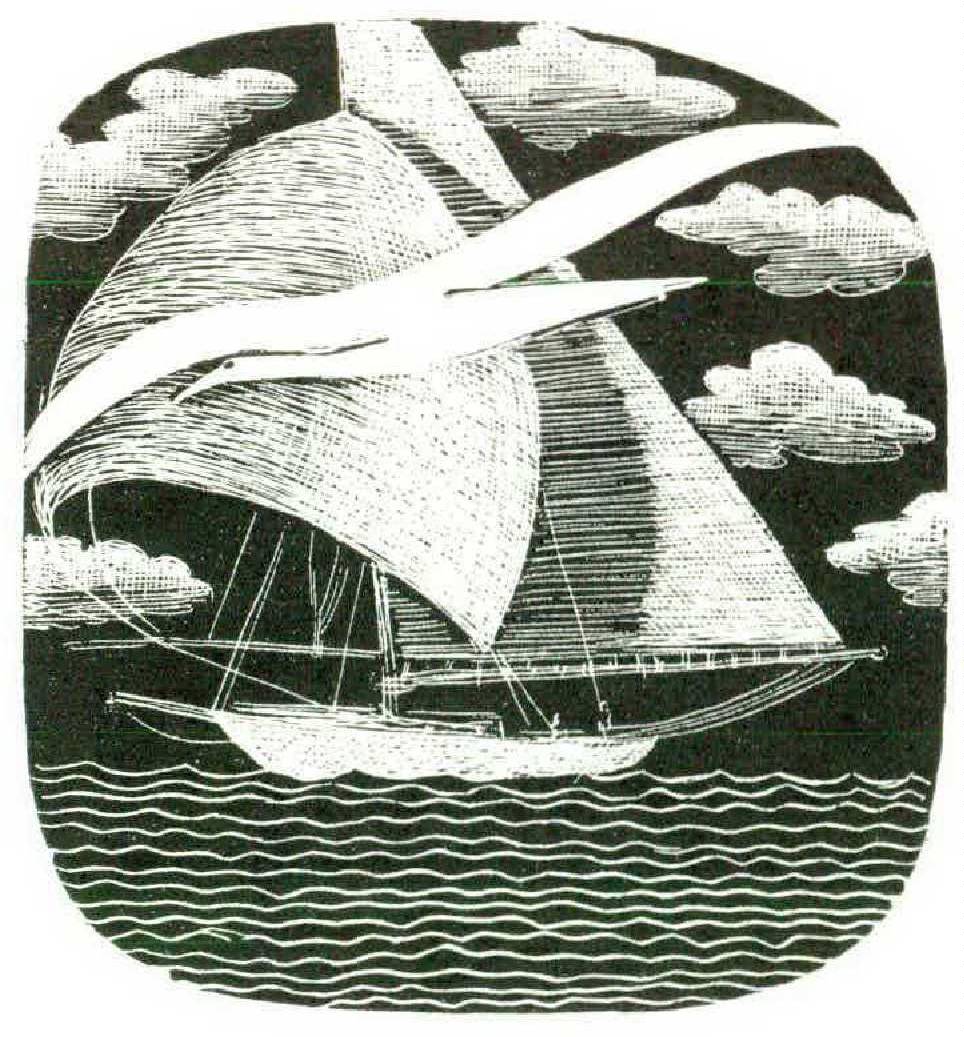
At first we were steering about north, which would take us to Key West. That wasn’t our destination. Our idea was to get east along the Cuban coast to the resort town of Varadero. We hadn’t seen a good swimming beach since leaving Grand Cayman. Varadero sounded fine. But it looked as if the wind had other ideas. We came about and did no better than east-southeast.
About an hour later the wind gave one last gasp and died. There was a sudden squall and then no wind. Not a breath. We expected it to come back, but after a while started the engine. It stayed calm all night. The sea dropped off entirely. Ashore towns and lights with musical names slid steadily astern: Rio Jaruco, Santa Cruz del Norte, Puerto Escondido, Matanzas.
At dawn Hod called me. Just ahead a light dominated a cay. “Piedras,” said Hod. He had turned off the engine. Carib had bare steerageway. Below, perhaps six or seven fathoms, the bottom was plain: hard sand dotted with occasional humps of coral.
We turned in and picked up some buoys. Nothing cheeked with the Pilot Book. The water became murky. Finally we discovered that Bahia Cardenas is a big place. We worked in behind a long low point called Icacos; it had begun to blow hard again, this time from almost due north, so we decided that Varadero could wait for another cruise and beat up into the lee of Icacos. Close under the land the water was flat but wind howled through the rigging. In the worst puffs the whole boat trembled.
It blew the whole day. Two men sculled by in a dinghy and we bought a pargo, still flapping. We were content. We swam over the side and ate fish for lunch, slept through the afternoon, ale fish for dinner, and went right back to sleep.
That dawn was like the last, all the colors any painter ever dreamed but no wind. A wonderful tropic smell came off the land. We sat on top of the deckhouse, waiting for enough light to see our way out. When things began to resume their shapes we got in the anchor.
After dropping the Cuban coast the horizon was empty. We were sailing waters that had known the whole incredible streaming of life from the Old World to the New. Before us had passed explorers, colonists, traders, soldiers, priests, and buccaneers, a ghostly procession inspired by greed, by lust, by power, by religion, and by all the other motives and dreams that can send men forth into the unknown.
To the east stretched the Old Bahama Channel, a shimmering chasm of blue lying between the pale-green water of the Great Bahama Bank and the dark-green mountains of Cuba; to the west, beyond the Gulf Stream, extended the peninsula of Florida. Ahead, except for a tangle of reefs and uninhabited low cays forming the Cay Sal Bank, our way was clear.
Observations of the sun during the afternoon put us east of the estimated reckoning. Cay Sal is no place to approach after dark. Since the days of sailing ships ended, the light on Double Head Shot Cay has not been lighted. Hod climbed the mast, He waved and pointed; as he signaled I swung the bow until it headed towards the abandoned tower, and read the bearing from the compass. It was somehow an unreal procedure. I never saw the cay from the deek. But I pictured it from an earlier visit: the sun baking down on the rocks and thousands of screaming sea birds rising ahead as we walked among the nests, the tracks of turtles across the beaches, the grave of a lightkeeper desecrated by seekers after treasure.
A strange thing was the calm. The rising sun had not brought wind. We ran the engine during periods when no air was stirring, turned it off as soon as there was enough breeze for steerageway. For hours at a time the Gulf Stream lay unruffled. No ripples, no underlying swell. Nothing. The sun went down and the stars cameout. They reflected in the water.
We kept on through the night and the next day, paralleling the unseen coast of Florida. Nothing came over the sharp bright ring of the horizon. Then before sunset we angled towards the east and small humps appeared, and when it became dark twin flashes glowed ahead. We had reached Great Isaac Cay, guardian of Northwest Providence Channel. Here we swung sharply to the east for Nassau.
A moderate breeze struck in from the west — most unusual in tradewind latitude, consequently doubly acceptable. Off to starboard in the darkness were the rock forms of the Brothers, East and West, and the Isaacs, Little, Middle, and East; and farther along the hidden teeth of Gingerbread Ground Reef; and still farther the wondrous sand plateau of the Great Bahama Bank.
Early in the morning we rounded Great Stirrup, a final turn. The breeze was still in the west, lighter with the sun. We held in close along the fringe of cays, following the line of soundings. Between small islands the pale green of the Banks shone with unreal brilliance.
During the afternoon the breeze gradually faded. Before it trailed off entirely, a tiny hump broke the flat line of the sea: the top of the water tower above Fort Fincastle, the highest point on New Providence.
We could have been at anchor within three hours. There was gas in the tanks. Instead we drifted. Ahead was the land, the sheltered harbor and fine town of Nassau. Still we drifted. Being out on the water was best. There was no hurry. It was too good to end. . . .
That, like all accounts of passages, is a relation of conditions and progress. We left Havana, we covered four hundred miles — painlessly, in this case, because of a freak of weather —and we fetched Nassau. But that is only part of the story: the rest is what makes sailing a way of life.
Carib lying a few miles offshore was more than a boat becalmed. To the four of us aboard, she was home: man’s portable castle. We happened to be in the Providence Channel. Under similar conditions, we would have been just as content off Montauk Point or the Golden Gate or Land’s End. Life aboard would have been about the same, and we would have bad the same feeling of completeness.
During our passage every moment of every day had been filled. There is always something to do for a small boat on the open sea. Giant steamers are likened to cities: so many kilowatts of electric power, so many loaves of bread baked, so many gallons of water consumed. But no one has attempted to find a comparison for cruising boats poking about the lonely places.
Aboard we had the goods and services taken for granted by civilized man. We pressed a button and bad electric light; we turned a valve and had drinking water; we ate hot food and slept on spring mattresses and drank our fruit juice chilled. If we had a headache there was aspirin in the medicine chest. If we felt like reading there were shelves of books. Rotating a knob brought us the noises and doings of all mankind. Torn pants could be mended, shoes shined, cocktails mixed. Into an object some forty-live feet long and twelve wide were compressed all the items of a well-stocked house: food, beverages, linens, clothes; pots, dishes, glasses, silver; medicine, cosmetics; books, writing paper, pictures — everything. And in quantities to last several people for days or weeks — no running to the corner drugstore for castor oil or to the grocery for mustard!
But few houses have to manufacture their own electricity, or carry fresh water in the basement. Even if they do, they are hardly called upon to furnish and accommodate their own means of propulsion. Or to lake along the equipment to find where they are. So in that same space, a space of considerably less cubic footage than the most modest of cottages, were also placed an engine, a generator, batteries, tanks for fuel and water, and an intricate maze of pipes and wires. Plus a few other items not generally found in houses: sheets and sails and halyards; squares of canvas and bags of blocks; awnings and covers; and such things—required by the Coast Guard and common sense—as life jackets, fenders, fire extinguishers, and code flags. . . .
So as we made our way along we were a complete unit. A part of our pleasure came from our knowledge of independence. Part came from having the skills that kept everything functioning. Part came from pride in our boat, and our relation to her. We tended her needs and she kept us safe and comfortable. Our time was filled. We lived four happy days, days of peace and content. We saw the dawn lighten the eastern sky, we saw the sun shafting deep into the blue water, we saw the day fade and the night begin. We did our daily tasks and lazed in the shadow of the sails; we finished our night tricks at the wheel and slept deeply. We trailed fishing lines astern and watched bos’n birds wheel overhead. There were bucket baths under the bowsprit and long involved discussions in the cockpit. We sat alone with our thoughts when we wanted to be alone, we gathered by the helmsman when we wanted companionship. The day and ils events were sufficient in themselves.
To desire nothing beyond what you have is surely happiness. Aboard a boat it is often possible to achieve just that: that is why sailing is a way of life, one of the finest of lives.