Pickwick Lives Forever
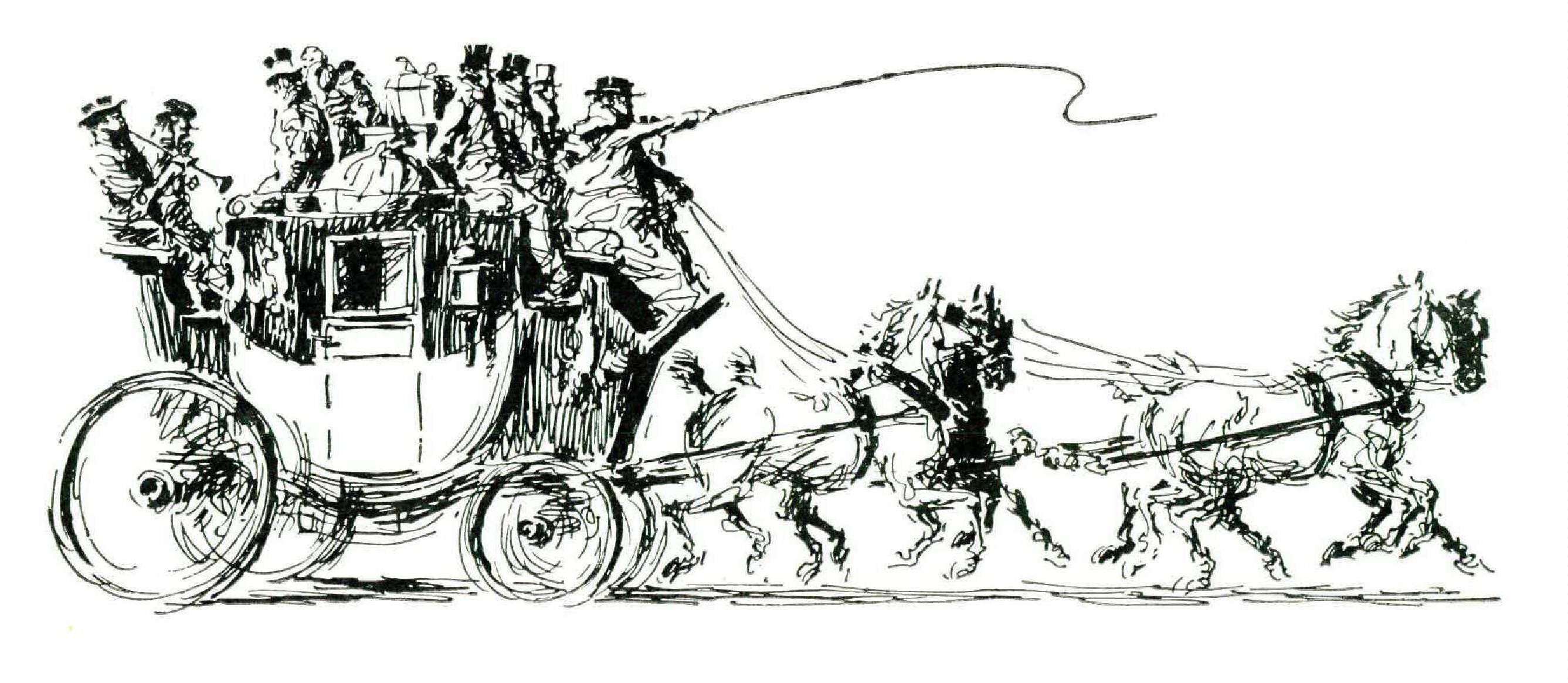
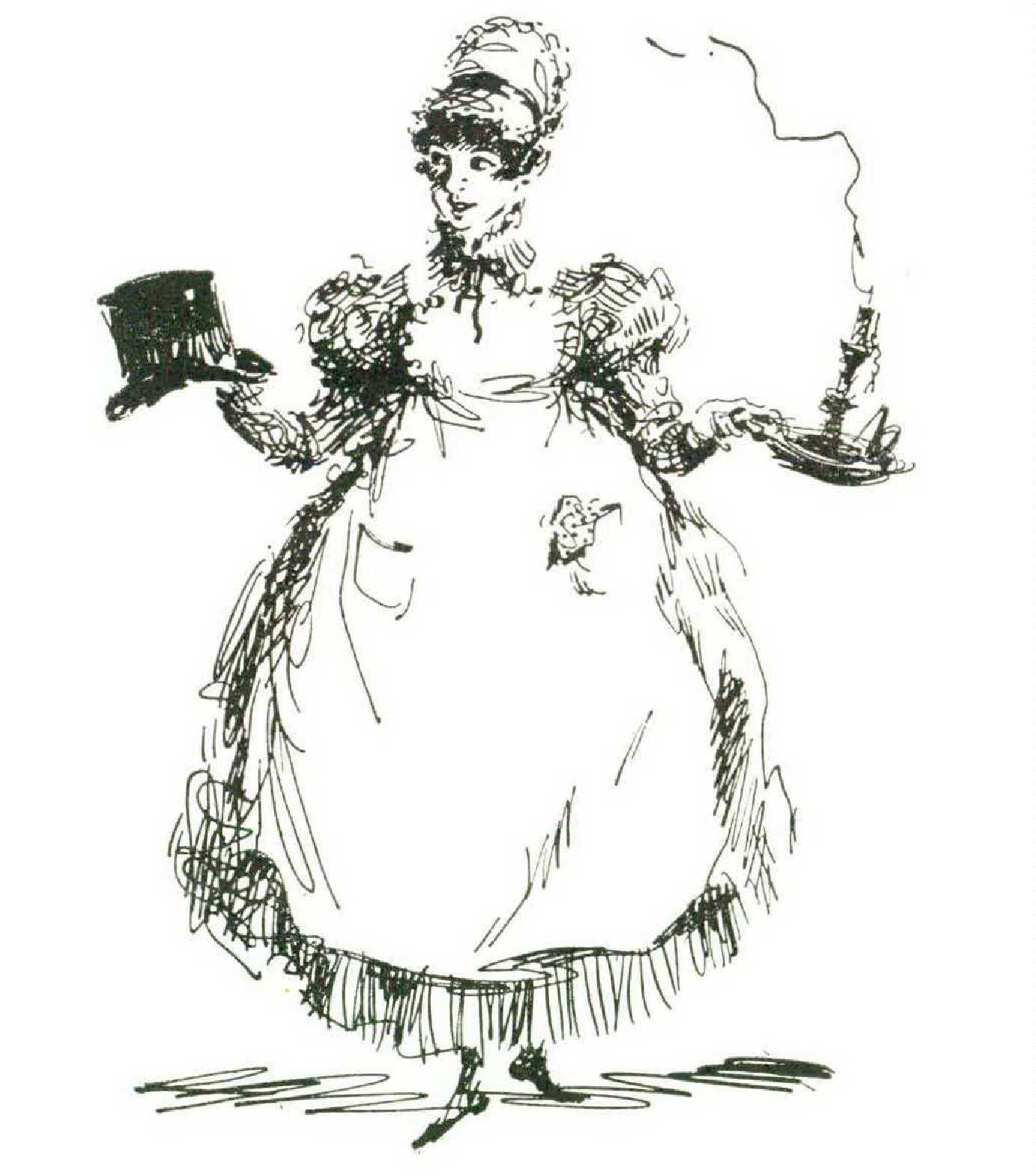
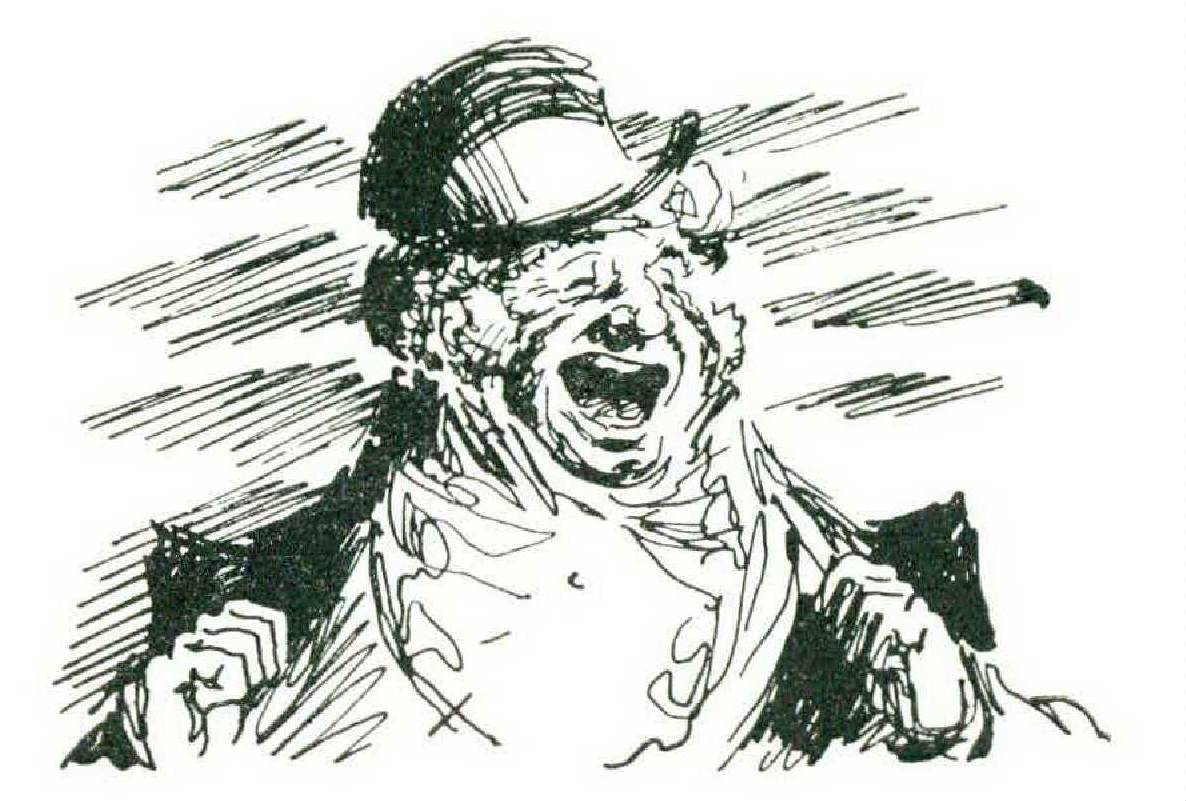
The Pickwick Papers, that book of perennial Christmas laughter, has been reissued this autumn in a handsome new edition by Simon and Schuster. For the volume, CLIFTON FADIMAN, for many years the literary critic of the New Yorker, has written a foreword from which we have drawn the following essay. The characters in Pickwick have come down to us in the famous drawings by Phiz; now they reappear in the creative interpretation of a British artist. Frederick Banbery, who has contributed the black and whites and the cover panel for this issue.
by CLIFTON FADIMAN
SOON after Christmas, in 1835, the perfect project fell into the young Charles Dickens’s lap. To his door in Furnival’s Inn came Mr. Hall, the managing partner of Chapman and Hall, a new publishing firm with which Dickens’s fortunes, and a few misfortunes, were to be linked for some years to come. He came with this proposal: that Dickens furnish some not very important serial letterpress to accompany the humorous sporting plates of Robert Seymour, then fairly well known as a comic draftsman. The idea was to set up a “Nimrod Club” of amateur sportsmen who would become embroiled in a succession of difficulties, all laughable and all suited to the genius of Seymour.
Dickens, to whom publisher-fighting was to become as natural as breathing, bristled, and at once produced four reasons for handling the notion his way. His way involved dropping the Nimrod Club (Dickens knew nothing of sport) and subordinating the illustrations to the text. A fifth reason he did not voice, though he must have been aware of it: he was a genius, and Seymour wasn’t.
In the quaint little bow-windowed office at 186, Strand, Dickens and the publishers worked out their arrangements. From a letter of February 10, 1836, to Catherine Hogarth, soon to become his wife, we learn that Chapman and Hall “have made me an offer of £14 a month to write and edit a new publication they contemplate, entirely by myself; to be edited monthly and each number to contain four woodcuts. I am to make my estimate and calculation, and to give them a decisive answer on Friday morning. The work will be no joke, but the emolument is too tempting to resist.”
The “work” has turned out to be the merriest of jokes, and the “emolument” more tempting than the recipient was ever to know, for it is the love and laughter of untellable generations.
However, the mind of the businesslike Dickens was fixed less on fame than on the £14. By February 12 Chapman and Hall had drawn up a letter of agreement for the monthly publication of The Pickwick Papers. Six days later their young author was able to write them, “Pickwick is at length begun in all his might and glory.” On February 21 Dickens, who at no time found it any trouble to indite novels with one hand and reams of correspondence with the other, wrote his Catherine: “I have at this moment, got Pickwick, and his friends, on the Rochester coach, and they are going on swimmingly, in company with a very different character from any I have yet described, who I flatter myself will make a decided hit.” (The different character was Alfred Jingle, the “rather tall thin young man, in a green coat” who saved the Piekwiekians from the onslaught of the pugnacious cabman.)
Of the first number of The Pickwick Papers, the cautious publishers printed only 1000 copies. Of the 400 ordered bound up, perhaps fifty were sold. Apparently Mr. Pickwick set forth on his perambulations at a sluggish pace, for one month later the print order for the second number was reduced by 50 per cent, only 500 copies being issued.
Copyright 1949, by The Atlantic Monthly Company, Boston 16, Mass. All rights reserved.
The first notices were what publishers call “mixed” — that is, not very good. One reviewer found “some few instances of profanity which we could readily dispense with; and some jokes, incidents, and allusions, which could hardly be read by a modest woman without blushing.” In general one might call the book’s reception successful only in a Pickwickian sense.
Things hardly improved when on April 20, two days after he and Dickens had met for the first and only time, the artist Seymour committed suicide, He died, quite in character for a maker of sporting sketches, by pulling a string attached to a loaded fowling piece. A pathetic claim was later made by his distracted widow thill her husband had been the “originator” of Mr. Pickwick. In 1927 a letter of Dickens dealing with this claim sold for $2800 — a crass commentary on the relative importance of Dickens and his first illustrator. It is true, however, that in a book which Seymour had illustrated previous to Pickwick — it was called Maxims and Hints for an Angler — you will find a character who looks vaguely like Mr. Pickwick, one who slightly resembles Jingle, one even more remotely recalling Sam Weller.
As a direct result of Seymour’s suicide there occurred one of the most interesting and unclimactic encounters in literary history. An enormously tall, gangling young man, hearing that a job as Dickens’s illustrator was open, made his way to Furnival’s Inn and offered his services. In the world of practical affairs Dickens always knew what he wanted. He did not care for the samples submitted. The tall young artist who moodily retired from Dickens’s chambers was William Makepeace Thackeray, later to become friend, enemy, and then again friend to Dickens, and to share with him the affection of the British novel-reading public.
A new illustrator, R. W. Buss, did three plates for the third number of Pickwick, but he was a poor draftsman; and Hablôt k. Browne (“Phiz”) was subsequently engaged. It is the Phizical conceptions of the Pickwick characters, of course (as well as of many later Dickensian creations), that have become traditional. That they did not exhaust the possibility of further creative interpretation is proved by the remarkable drawings of Frederick Banbery.
Pickwick progressed rather slowly until the fifth number (August, 1886). At this point Sam Weller sauntered in and stole the show. From here on it was nothing but, as Dickens upper-cased it in a letter to a friend, PICKWICK TRIUMPHANT. Sales leaped from the hundreds to the tens of thousands (the printing order was 1000 for Part One and 40,000 for Part Fifteen). Disregarding the reviewers, the British people as a body discovered a masterpiece. Dickens awoke to find himself Dickens. For the first time since 1066, England was conquered— by a fat man in gaiters, attended by a cockney.
Nor did Pickwick’s popularity diminish as the century wore on. During his second American tour, in 1867, Dickens met the Secretary for War, Edwin Stanton, who told him that during the Civil War, when he had served in Lincoln’s administration, he had never gone to bed without reading a few pages from Pickwick. Perhaps the simplest and best of tributes is that of George Sainlsbury: “There is no book like Pickwick anywhere.”
One might add that its fame has been somewhat meaninglessly enhanced by the circumstance that a complete set of the numbers in their original parts has become one of the great prizes of book-collectors. In 1837 one could have bought the twenty Parts for £5. At the moment a perfect Part One is worth about $1000; a perfect Part Two about $2000. In 1929, at the famous Jerome Kern sale, a complete Pickwick was knocked down for $28,000.
A final minor note: Dickens himself made perhaps £3000 in all out of Pickwick. The publisher’s profit came to about £14,000.
2
THE best way to read Pickwick is for fun. It is one of the few great books that do not call upon the reader for reflection. The laughing confounder of commentators, almost everything it has to offer lies on its sparkling surface.
It even defies classification. “ Pickwick,” said George Gissing, “cannot be classed as a novel; it is merely a great book.”If it has any at all, the structure is that of a dance, rather than that of a properly plotted narrative. Certain patterns recur: the appearances of Mr. Jingle, the visits to Dingley Dell. It may also be said to boast a comic climax in the Bardell-Pickwick trial and a serious one in Mr. Pickwick’s incarceration in the Fleet. After his release, despite a few great scenes, such as the arrangement of the business affairs of the elder Weller, the story runs downhill rapidly. The whole Winkle-Allen marriage imbroglio is feeble stuff, and reflects a Dickens anxious to be off upon a new project.
No, it is not constructed at all merely created. There never was a book in which such perpetual fun is made of the mere notion of a plot. The only “ plot ” in Pickwick is a conspiracy, a conspiracy on the part of the characters to take over the socalled story at every turn, bind it, gag it, toss it out the window. Progression in Pickwick? On the contrary, there is retardation. Everybody is hard at work, or at play, raising obstacles to the free flow of the narrative. When Sam Weller attends the “swarry,” he does so not to advance the story but to detain it. He is there to afford Mr. John Smauker and Mr. “Blazes” Tuckle an opportunity to delay everything with their aimless, immortal conversation.
It is apparent that Pickwick is not a “deep” book. But, disconcertingly, it is not a shallow one either. Still more oddly, it is not something in between. What it is is simple, like a fairy tale or a ballad. At bottom the charm of Pickwick resembles that of primitive works of folk art, those evolved in a period before human life began to be analytically observed. It has far more in common with the story of Jason than with the modern novel. Written by one of the most complexly organized of individuals, somehow it seems also to have emerged out of the popular imagination. Once Dickens met an old charwoman who, astonished to learn that he was the sole author of Dombey and Son, cried, ” Lawks! I thought that three or four men must have put together Dombey!” This is even truer of Pickwick. It has a quality of anonymous composition, like a legend.
Dickens was an uncommon man not because he was ahead of his time, but because he was unconsciously in touch with certain simplicities that underlie all times. Here is André Maurois on Pickwick:“A whole picture of rural England rose up, a very eighteenth century and rural England, alive with that sort of childlike delight which the English take in simple pleasures, the enjoyment of roaring fires on the hearth, sliding in snowy weather, a good dinner, and simple, rather absurd love-affairs.” Note that even our urbane Frenchman responds to these “simple pleasures” otherwise he could not write about them so fresh and pleasant a sentence. As for these pleasures, what are they if not what men for thousands of years have been spontaneously responding to: fire, weather, food, and a woman? Add to this brief list laughter, friendship, and movement — particularly movement —and you hold in your hand the true subject-matter of Pickwick and the secret of its appeal.
If for the moment we omit from consideration some of the dismal (and dull) interpolated stories and virtually all of the prison chapters, we may say that the tone of this vast legend is set by a sentence directed by Mr. Wardle at the Pickwickians on their first meeting: “And now you all know each other, let’s be comfortable and happy, and see what’s going forward; that’s what I say.” This is the tone of a merry yarn of the commonplace. If we define the commonplace as something that commonly takes place and also something that takes place in common, we begin to feet what Pickwick is.
3
WHEN Dickens was first approached to do the sporting novel Seymour had in mind, he refused on the ground that he “was no great sportsman, except in regards of all kinds of locomotion.” Many years later, in 1845, recalling the early newspaper training that preceded Pickwick, he wrote John Forster, his biographer:
There never was anybody connected with newspapers who. in the same space of time, had so much express and post-chaise experience as I. And what gentlemen they were to serve, in such things, at the old Morning Chronicle! Great or small, it did not matter. I have had to charge for half a dozen breakdowns in half a dozen times as many miles. I have had to charge for the damage of a great-coat from the drippings of a blazing wax-candle, in writing through the smallest hours of the night in a swiftflying carriage and pair. I have had to charge for all sorts of breakages fifty times in a journey without question, such being the ordinary results of the pace which we went at. I have charged for broken hats, broken luggage, broken chaises, broken harness — everything but a broken head, which is the only thing they would have grumbled to pay for.
This, surely, is the spirit of Pickwick, expressed in old Wardle’s high exultant shout during the epic pursuit of Rachael and Jingle: “Ah! we are moving now!” — expressed again in Mr. Pickwick’s first statement after the trial: “And now the only question is, Where shall we go next?“
In Pickwick two years of peregrination form the foundation of a narrative in which the author exploits an extraordinary variety of travel aids, from shying horses to wheelbarrows. Of these the greatest is the post-chaise. Nowhere else in Dickens (except perhaps in the wondrous description of Tom Pinch’s journey to London) is the poetry of the post-chaise so rich, Gissing thought the best coach drive ever put into words was that of the Muggleton Coach. Another admirer has said, “You can’t hold a copy of the ‘Pickwick Papers’ to your ear without hearing the coach-horns in it.”
The Road and what happens on it have supplied a staple of narrative from the Odyssey almost up to our own day. With the advent of the railroad and particularly the airplane, however, this symbol has lost some of its emotional charge. We have not “abolished space” — the phrase mirrors our paranoia — but we have, by the pointless, dehumanized acceleration of movement, abolished a part of ourselves. A man moving about on the surface of his home, the earth, is a man. A man in a jet plane is simply so much transportable material. Antaeus, detached from the soil under his feet, grew feeble and was easily overcome.
Dickens lived well into the Railway Age, but never took to it. (See Tony Weller’s wry remarks on the “rail” in Master Humphrey’s Clock.) He felt the immense chasm — no more and no less than the gap between the organic and the inorganic — that separates travel from transportation. But in 1832 his imagination was still happily anchored in the pre-paleotechnic period. As Mr. Pickwick remarks in his speech to the Club, “Traveling was in a troubled state, and the minds of coachmen were unsettled,” assuring us in this delightful sentence that travel was still far from its present state of dehumanization. The Road was all before the Pickwickians, where to choose their place of rest, and Providence their guide.
The warm Cave and the open Road — to these primal symbols the simplest and deepest parts of us respond. And co-primal with the Cave and the Road is Food-and-Drink. Take the Cave (for at the end of every Pickwickian journey beckons the farmhouse kitchen or the tavern snuggery) and the Road out of Pickwick and you remove its heart and arteries. Take out Food-and-Drink and you remove its very guts.
“Now, Sam,”said Mr. Pickwick, “the first thing to be done is to — ”
“Order dinner, sir,”interposed Mr. Weller.
Dickens, like Mr. Weller, knew what the First Things were; Pickwick is made of them. Me knew that on the whole the lot of man is gaunt and uncomfortable; therefore he smothers the reader with comfort, stuffs him with food, fills him with drink. (He mentions twenty-two separate and distinct inns and taverns.) Pickwick is one long harvest-ritual of abundance. It is filled with a primitive delight in the earth’s replenishing and consolatory generosity.
The mottled-faced gentleman rose, as did the other gentlemen. The mottled-faced gentleman reviewed the company, and slowly raised his hand, upon which every man (including he of the mottled countenance) drew a long breath, and lifted his tumbler to his lips. In an instant the mottled-faced gentleman depressed his hand again, and every glass was set down empty. It is impossible to describe the thrilling effect produced by this striking ceremony; at once dignified, solemn, and impressive, it combined every element of grandeur.
Dickens is half in earnest: it is a ceremony. Food and drink for him are the serious, which is to say, the joyful, matters that they would be for all of us were we able to approach them freshly and innocently, instead of taking them for granted.
Hot punch is a pleasant thing, gentlemen — an extremely pleasant thing under any circumstances - but in that snug old parlour, before the roaring fire, with the wind blowing outside till every timber in the old house creaked again, Tom Smart found it perfectly delightful.
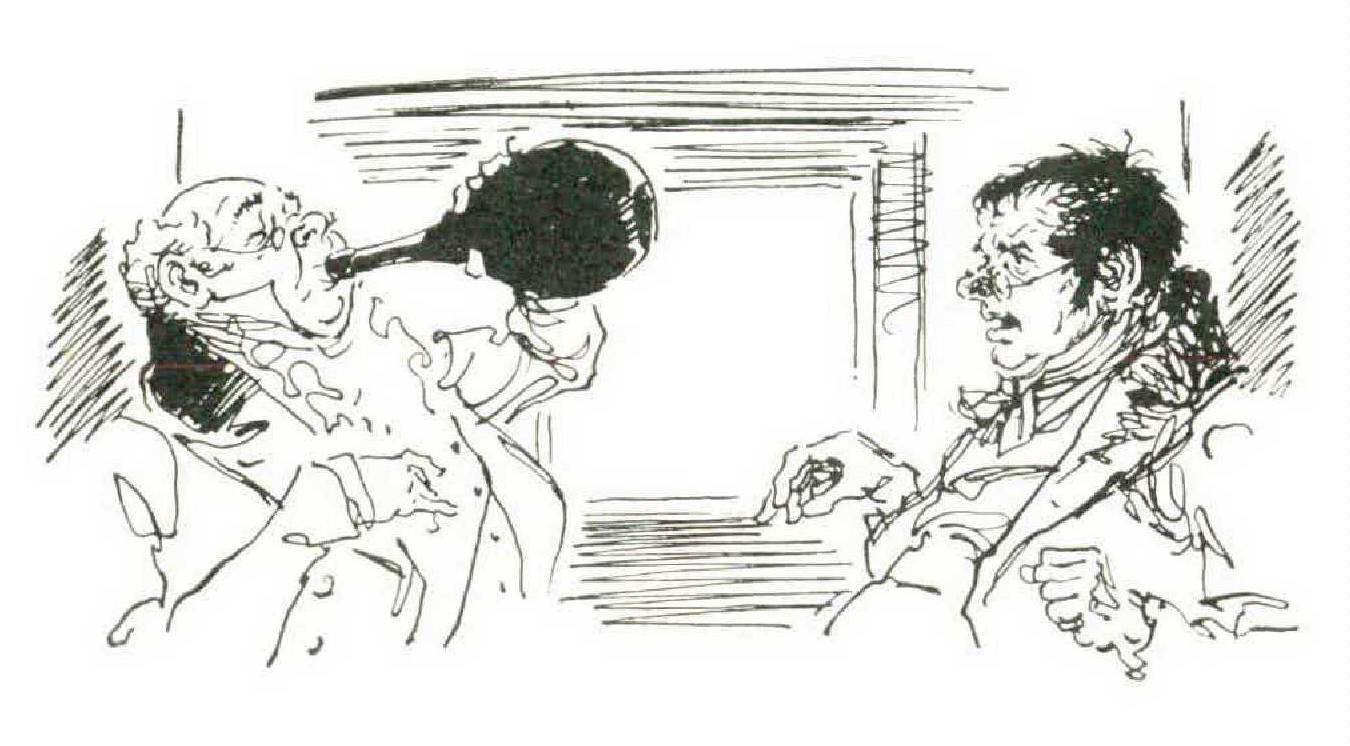
All the Pickwickians are heavy drinkers (indeed, the bland Mr. Pickwick occasionally verges on the sot) but they drink out of conviviality, which can be a profound emotion. Nothing more aptly measures the distance between Pickwick’s world and ours than the difference between that book and Charles Jackson’s remarkable and symptomatic The Lost Weekend. All too often we eat and drink because we are unhappy. In Pickwick they eat and drink because they are happy.
4
UNTIL we come to the Fleet the satire of Pickwick has a certain airiness, an amoral commedia dell’ arte quality. The characters are more like great clowns than carefully observed types. The business of the clown is to make fun not of a specific local or temporal institution but of those absurdities which reside in the very circumstance of our being human, of having ridiculous appendages like legs and arms, of acting oddly when we eat or drink too much, of losing our dignity, our temper, our balance.
For the most part, the Pickwickians are such clowns. This is not to say they are untrue to human nature, but only that they are true to human nature seen in the very large and often very crude. Mr. Tupman embodies the howling ridiculousness involved in the mere spectacle of the male vis-à-vis ihe female. Mr. Winkle is the clown as predatory hunter, Mr. Snodgrass the clown as poet and visionary. His “wash-up,” the majestic Mr. Nupkins, does not arouse resentment of bureaucracy; he merely stimulates delight in Nupkinsism. We say to ourselves, Wouldn’t it be fun if military maneuvers were as absurd as those at the Rochester field day; if visiting celebrities were as great geese as Count Smorltork. Those strange animals, Dodson and Fogg and Perker and Buzfuz, constitute about as cogent a criticism of the law as the Fat Boy constitutes of greediness.
Are Jack Hopkins and Bob Sawyer intended as satire on the medical students of the period? One supposes so: as knowing an authority as Logan Clendening calls these grotesque portraits the best of their kind in literature, and goes on to say that their dialogues have “the spirit of practice . . . only Dickens divined that patients are bores.” True; but they are also buoyant with a helium-life of their own, soaring at once to (hose upper airs where live their greater clown-brothers, Falstaff and Lncle Toby.
Opening it almost at random, one sinks back into Pickwick as into a dream; indeed the book has a dreamlike quality, as though it were partially exempt from the restrictions of space, time, and conventional behavior. In this dream, as in most dreams, nothing really comes to a head. Forever shall the villainous Captain FilzMarshall be unmasked and forever shall the Pickwickians tetaken in by him, for neither the deceptions nor the unmaskings are meant seriously, being but feints and lunges in a harmless comic duel. Mr. Pickwick says to the temporarily crestfallen Jingle, “I might have taken a greater revenge, but I content myself with exposing you, which I consider a duty I owe to society.” That is the point: it is Mr. Pickwick’s duty to “expose” Mr. Jingle — that is, to exhibit him in the clearest possible comic light.
One is tempted to apply to Pickwick Charles Lamb’s seductive theory expounded in On the. Artificial Coinedj) of the Last Century and to think of the book as containing neither true heroes nor true villains, as retaining only the simulacrum of moral values.
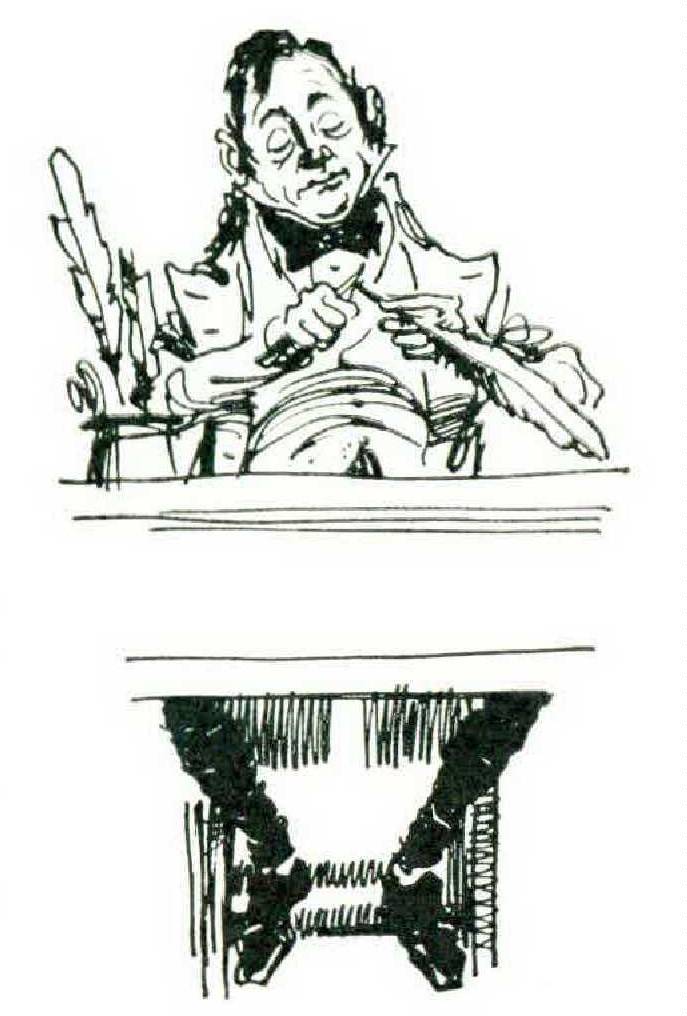
Take Buzfuz. He is an unfair, hypocritical, prevaricating shyster. Logic tells us he should be disbarred. But Buzfuz laughs at logic, He reminds us that his disbarment would be an irreparable loss to the human race. It were almost better that the legal profession should remain a mass of futility than that we should not possess Buzfuz. He may behave like an idiot, in a kind of eternity, but, if so, he is an indispensable idiot, and his eternity gives greater savor to our mortality.
The relation of these people to the real world, though far from nonexistent, is joyfully tenuous, like the antics of the Marx Brothers or, to descend to a lower, perhaps the lowest, level, like the moron absurdities of our national reading, the comics. They should be judged not as satire, but as jokes.
Of these jokes the best is the relation between the two Sams, Pickwick and Weller, who transform into gleeful absurdity the notion that a human being is a dignified animal. Mr. Pickwick is the Eternal Innocent disguised as the Eternal Respectable; Mr. Weller is the folk philosopher who protects the innocence and sees through the respectability. They form an alliance—Don QuixoteSancho Panza is the classic example — over which men have always smiled with pleasure.
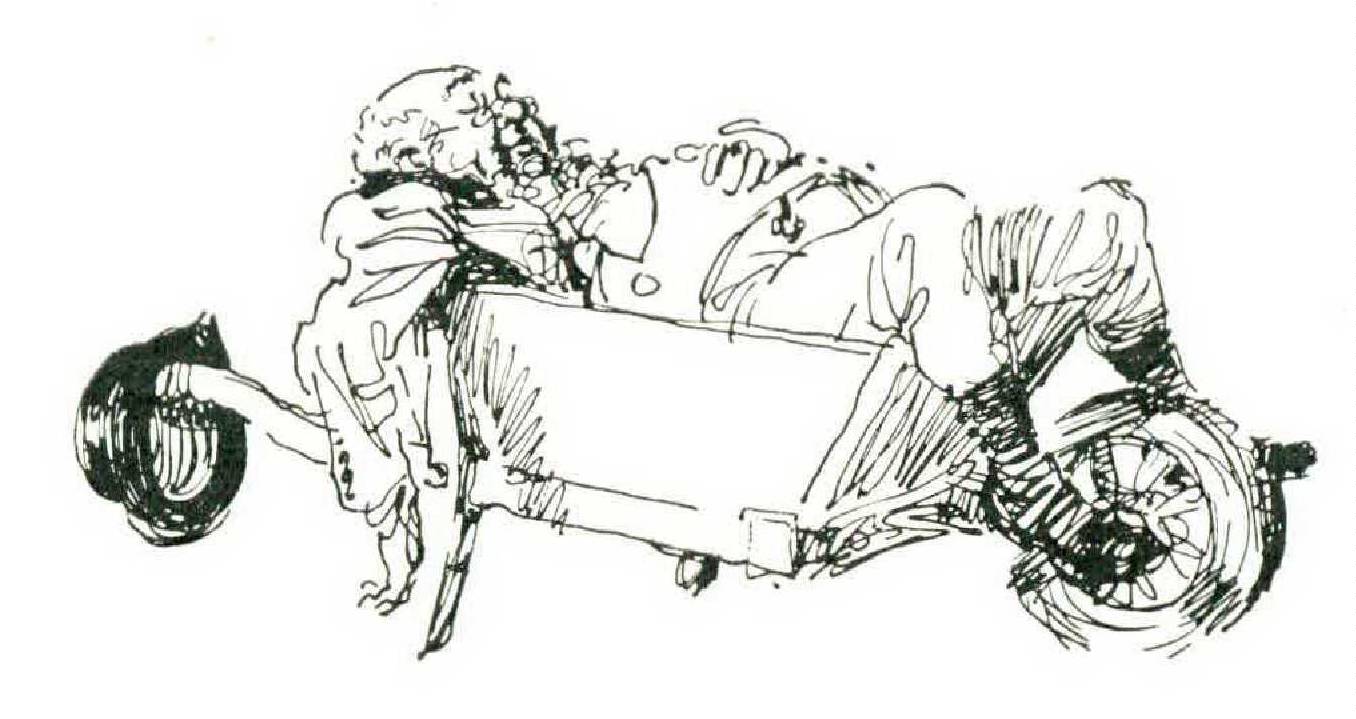
It is exquisitely right and humorous that the benevolent Mr. Pickwick should call himself “an observer of human nature” — and that Mr. Weller should do all the observing. It is quite proper that Mr. Pickwick should suppose he is attaching Mr. Weller to his person, when in truth Mr. Weller proceeds at once to attach Mr. Pickwick and everyone else to his person. It is true that when Mr. Pickwick enters the Fleet he becomes a different man; but the Fleet Pickwick is not the one we remember. The Pickwick we remember is the one who falls asleep drunk in the wheelbarrow; or slides on the ice; or dashes his spectacles insanely on the floor; or listens with blessed gullibility to the extraordinary medical narratives of Jack Hopkins. The real Pickwick is just what the strong-minded Mrs. Pott calls him: “a delightful old dear.”
And what shall we say of his good fairy, Sam Weller? He represents that best-beloved of human types: the clown, the hind, the peasant, the cockney, who turns out wiser and wittier than his betters. It is he who sees in Mr. Pickwick the lovable man beneath the ridiculous gentleman. His mind is keener than that of anyone else in the story (except perhaps his begetter, Mr. Tony Weller). His wit is more searching, his energy more tireless, his worldly wisdom more applicable. It is he who infuses the warm, popular life of the streel into almost every page. He democratizes the book but in a spacious, imaginative manner that confounds the critic who would make of him a hero of the proletariat. He tells tales of the street, but they are mythical tales. He issues moral quips, but they are odds and ends from a gigantic underground system of folk wisdom. He has that most uncommon of talents, the common touch.
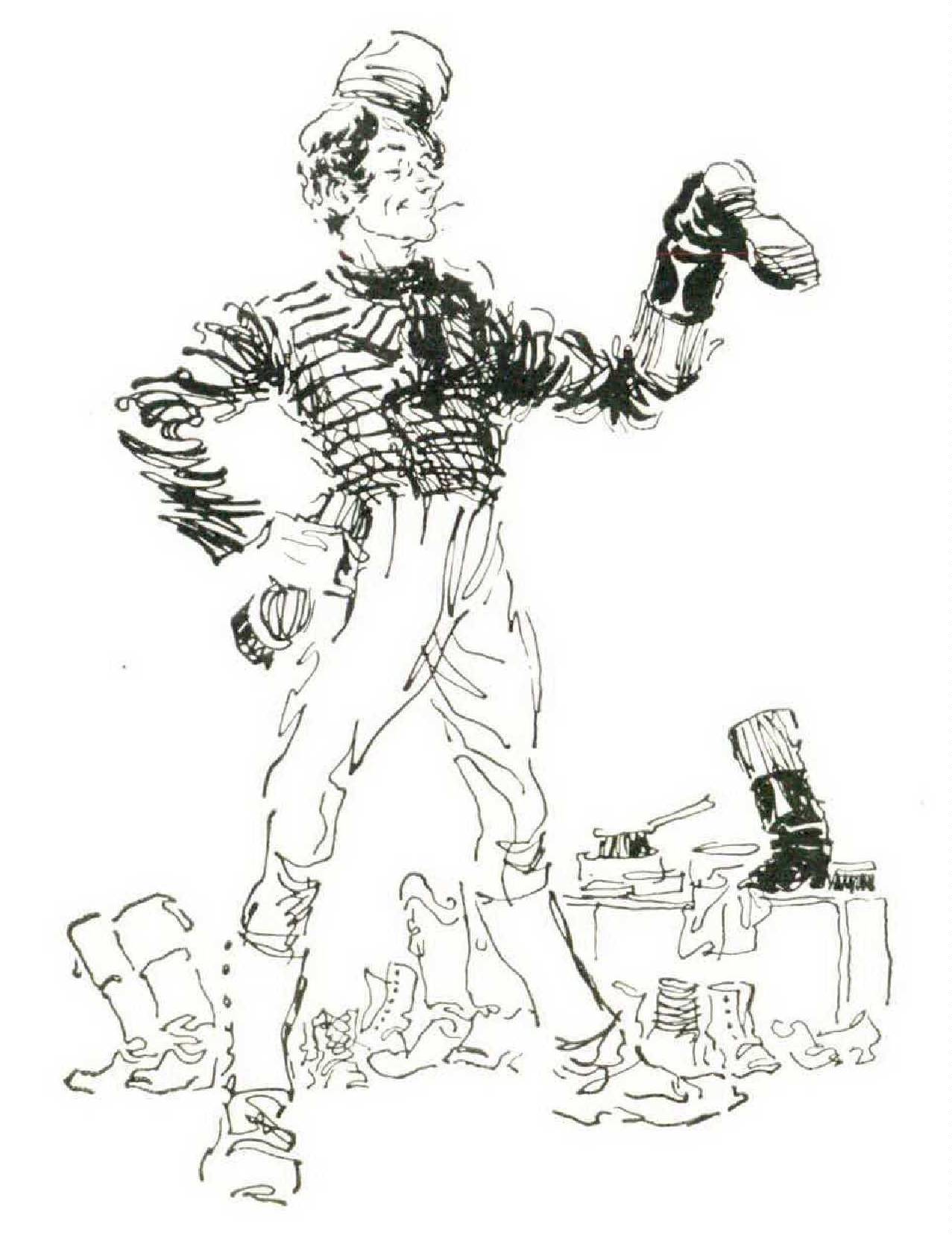
Incomparably the greatest character in Pickwick, Sam Weller is among the greatest in literature. Perhaps the secret of his hold on us lies in the simple fact that he is a poet, a lord of language, one for whom the word is quite literally life. Mr. Weller stands with Falstalf, Panurge, Pantagruel, Huck Finn, Hotspur all vast and poetical talkers. His trade, of course, is not that of a boots, or a gentleman’s gentleman, or anything so minor and transitory. What he is is a professional conversationalist, like Socrates. He lives in anecdote and dialogue. Take his story of the crumpet-eater “as killed hisself on principle.” It is pure dramatic legend, perfect in form, alive in every word, loaded with nuance. For him humorous, detached observation is a way of life, as for Hamlet tragic, subjective observation is a way of life: complementing each other, they represent the two poles of the English imagination working at high speed.
Here is Mr. Pickwick explaining Sam Weller to Mr. Peter Magnus: “The fact is, he is my servant, but I allow him to take a good many liberties; for, between ourselves, I flatter myself he is an original, and I am rather proud of him.” To which Mr. Magnus replies: “Ah, that, you see, is a matter of taste. I am not fond of anything original; I don’t like it; don’t see the necessity for it.” Mr. Weller is an “original” in the sense that he is a poet, a pure creative imagination; just as Mr. Magnus, who doesn’t see the necessity for originals, prefigures, however mildly, the Gestapos of our time.
5
NEVER again was Dickens to write anything so purely comic as Pickwick, so free of bitterness and indignation. Yet even Pickwick foreshadows the novels of the future, with their increasing somberness and ferocity. Pickwick contains the farce which later on is to darken into satire. Mr. Nupkins faintly indicates the bureaucrats to come, as Lord Mutanhead indicates Dickens’s view of the upper classes. Stiggins is a freehand sketch preliminary to the full-dress portraits of Chadband and Pecksniff. The Fat Boy (a perfect observation, by the way, of a hyperpituitary case) is the first and one of the greatest of a long series of Dickensian halfwits and flutter-minds.
Dickens’s contempt for politics and Parliament was to explode in novel after novel; we note it first at Eatanswill. As for his great enemy, the law perhaps it is the great enemy of all imaginative men he sounds his preliminary battle-cry with the Bardwell-Pickwick trial. In Alfred Jingle’s rather callous view of the female sex we catch more than a hint of Dickens’s own mature attitude toward women — or, rather, a component of that altitude.
There is, moreover, a large and important section of Pickwick which we cannot properly call comic or farcical. Many readers have felt this section, describing Mr. Pickwick’s incarceration in the Fleet Prison, to be badly out of key with the rest of the book. It seems odd that a young man of twentyfour, cocky as the very devil, with a best-seller on his hands, apparently bursting with energy and optimism, could have conceived it. The Fleet scenes might have been drawn by Hogarth: they are at once ferocious and sorrowful.
In them the character of Mr. Pickwick undergoes a change many have found unconvincing. The corpulent innocent in tights and gaiters is transformed into a thoughtful spectator of man’s inhumanity to man, and finally into an indignant reformer. With Sam Weller as his Virgil, Mr. Pickwick enters the hellish gates of the nineteenth century.
A similar transformation is undergone by some of the lesser characters, in particular the extraordinary Mr. Jingle, the glandular polar opposite of the Fat Boy. Mr. Jingle, who up to now has been merely a great grotesque, a grimacing Punchinello, suddenly reveals unsuspected capacities for suffering. There is real imaginative power in his broken ejaculations as he contemplates what he conceives to be his inevitable death in the darkness and dankness of the Fleet: —
“Lie in bed — starve die — Inquest — little bone-house — poor prisoner — common necessaries hush it up — gentlemen of the jury — warden’s tradesmen — keep it snug — natural death — coroner’s order — workhouse funeral — serve him right — all over — drop the curtain.”
These chapters seem almost to comprise another book. It is as if during the rollicking high jinks of the pre-Fleet Pickwick Dickens had unconsciously been repressing a part of him that now suddenly rises and clamors for attention. There is a tone, difficult to define, in these chapters that makes one feel they are the involuntary translation of some actual episode of Dickens’s life.
We can point to this crucial episode: it took place in Dickens’s boyhood during the short period when his father was confined in the Marshalsea Prison for non-payment of debt. In the Fleet Mr. Pickwick hears the pathetic cry: “Pray, remember the poor debtors.” Dickens remembered them.
But the harsh, wild tone of this section springs from something in Dickens that lay deeper than the effect of any single episode in his early life. The Fleet is in part a re-creation of the Marshalsea. But it is more than that. The Prison is one of the central symbols that recur in Dickens’s novels almost to the very end. It is his Moby Dick: it has a terrible special agonizing meaning for him.
This has been pointed out with superlative brilliance by Edmund Wilson in Dickens: The Two Scrooges, a profound study from which all future serious interpretations of England’s second greatest creative imagination must take their lead. Wilson demonstrates, within the compass of a relatively brief exposition, that Dickens, probably from childhood, was a sorely divided human being, and that as he grew older the chasm in his soul grew wider. Part of him was a Victorian gentleman; part of him was a guilty outcast. His sense of guilt expressed itself, among other ways, in an obsession with crime and criminals. All his life this good Victorian, the prose-laureate of the family, the celebrant of Christmas, the lover of little children, writhed in painful and only half-conscious rebellion against the institutions that had blighted his boyhood and whose hollowness he had systematically observed during his novitiate as parliamentary shorthand reporter and traveling newspaper correspondent.
For Wilson, therefore, even the great comedy of the Bardell trial represents, “like the laughter of Aristophanes, a real escape from institutions.” For Wilson, “Pickwick, from the moment it gets really under way, heads by instinct and, as it were, unconsciously, straight for the Fleet Prison.”
I cannot feel as Wilson does about the Bardell trial; but with respect to the Fleet he seems to me essentially right. Dickens did not know that his epic of laughter was to rise to its climax there; but something in him forced that climax upon him. The underground Dickens rose to the surface, to remain there for the rest of his life. The Fleet episode is at variance with the rest of the book; but it is not at variance with the complex and unhappy temper of the man who, to our doubtless limited twentieth-century eyes, is the real Charles Dickens.