My First Millionairies
LORNA SLOCOMBE runs her own business, a taping agency, in Harrard Square, Cambridge. This is her third appearance in the Atlantic.
by LORNA SLOCOMBE
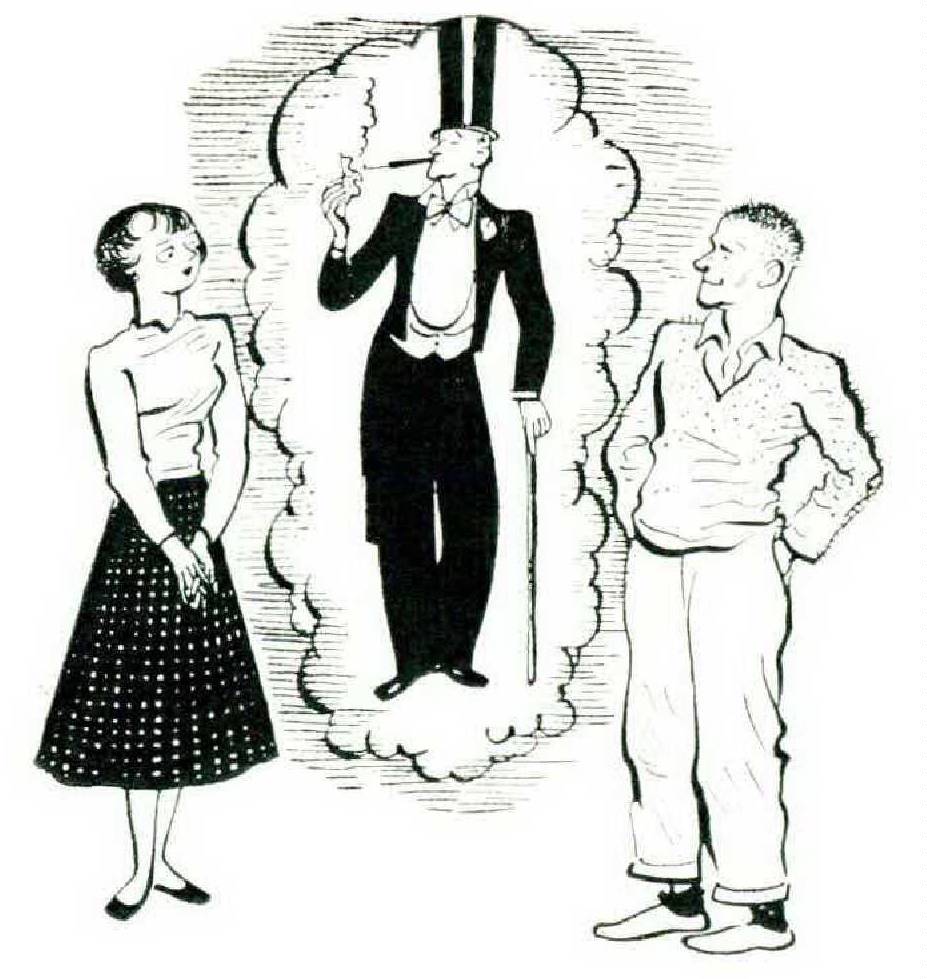
LIKE any other girl brought up in a middle-class suburb, I knew just what a millionaire would be like. I had learned all about it from the movies. He would look like Tyrone Power, drive a convertible, and live in a mansion. His name would be Brad or Rod. He would be full of aplomb and escort me to a little restaurant where the headwaiter knew him. He would order wonderful food, get the best service, and leave a large tip. I was looking forward eagerly to my first millionaire.
Because of the Hollywood visions of sugarplums that danced in my head, I went out with a millionaire all summer before I noticed it. I was taking a short-story course, and seated beside me was a nice guy named Joe, tall and handsome, his brown hair in a crew cut. He wore old blue sneakers with a hole in them, and his trousers were held up by a piece of rope. By now I know that holey sneakers are practically a hallmark of the Boston Social Register, and one glance at such footgear should have alerted me.
He invited me out for a coke one day after class, and we had a fine time discussing our fellow students, The next day Joe said wistfully that he’d like to invite me to the drugstore, but he didn’t have any money. I tactfully said it would be on me today since he’d treated yesterday. And so the summer progressed: one day he’d buy the cokes, the next day I would.
Finally Joe invited me to go dancing. As we set forth in his old sedan, he said he was worried about it. So was I. Fortunately we weren’t going far — just to the worst section of town. “Now I haven’t got much money, Joe said. “You’ll have to get along on two drinks.”Conversation was difficult, because of the noise of the car, but he finally shouted an apology that he hadn’t sent flowers. “We don’t have as much as we used to,” he said, looking so distressed that I hastily assured him it was quite all right.
The night club was small and dreary, with rhinestone signs to right and left of the orchestra saying LADIES and GENTS. The dance floor was so tiny you could only clutch your partner, and sway or hug, as the case might be. But we had a. fine time. The Negro singer was a great friend of Joe’s, a wonderful woman full of laughter and profanity. When she sang of love, you knew all about it.
The short-story course ended, and that fall Joe went into the army. It was then that I read in the papers about how much money he had. “The Millionaire Selectee,” they called him, and there was a picture of him looking aristocratic and gloomy as he learned how to make a bed. I was furious. The next time I met a millionaire, I would do better.
I was much quicker about spotting my second one. We were rehearsing in a dramatic club show together, and he invited me to go out for a beer, if I had a dollar. This time I wasn’t thrown off by the faded khaki pants or the patches on the elbow of his jacket. Out of Charlie’s toughlooking face came an expensive accent. It was spring, and almost every evening (that I had a dollar) we sat in grubby restaurants while he told me all about everything in his life. I was content — but I felt I shouldn’t be. My Hollywood dreams still haunted me.
Not that life was all grubby. I ran into a waiter I know one morning at. the public library. Jake didn’t have to be at the Bugle N Beagle till three, so he invited me out to lunch. He took me in a taxi to a little restaurant where the headwaiter knew him. He ordered wonderful food, got superb service, and left a large tip.
That afternoon I ran into Charlie, who was just going to the tailor’s to call for a new suit. His grandmother had sent him a check for $150 — wisely made out to the tailor. The new suit was becoming, and there was fifteen dollars in change. Charlie looked in happy surprise at the cash. I said I was hungry. Gamely, he invited me to dinner.
“This time,” I said, “let’s go somewhere nice.”
“Why sure!” he said, surprised.
At last I felt I was living right. I made Charlie take me home while I changed into a suitably smart outfit, and we set off. “Where are we going?” I asked.
“To the Bugle & Beagle,”he said.
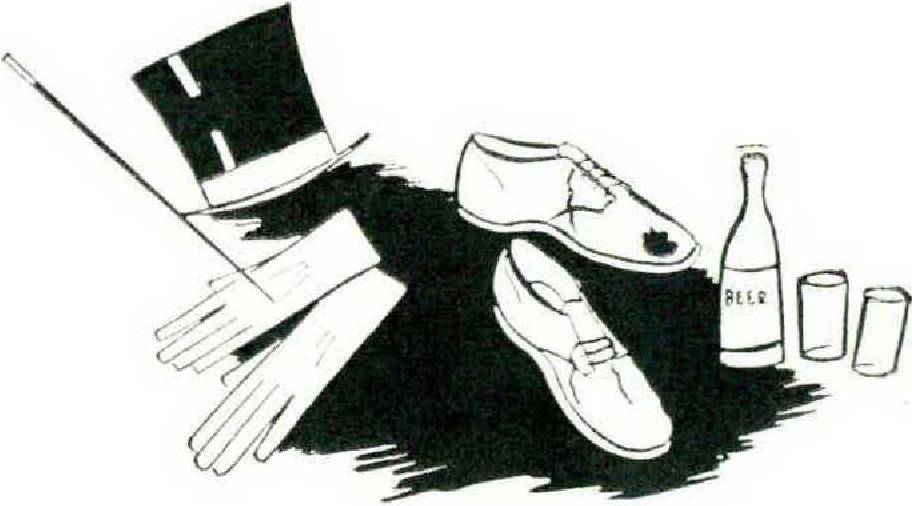
It was inevitable: the headwaiter seated us at Jake’s table. Now Emily Post tells what to do when someone you know stops at your table, and when the gentleman rises and the lady proffers her hand, and all that, but she doesn’t tell how to operate when you’ve had lunch with your waiter. I introduced Charlie and Jake, and Jake brought up one of the waitresses whose sister wanted to be a writer, and there were more introductions all round. Then Jake, with all the aplomb in the world, served us a terrific dinner. There must have been a pound of roast beef on my plate, and when I bogged down halfway through, Jake asked, “Would you like the rest in a dog box?”
“A what?” Charlie inquired.
“A dog box,” said Jake firmly, and he went and got a cardboard box that said: “FOR FIDO. Compliments of the Management.”
“But she hasn’t got a dog,” Charlie said, bewildered.
“Oh, she can always use a good meal,” Jake explained, stowing away the beef.
“Thank you, Jake,” I said weakly.
We left the club, carrying the little cardboard box, and Charlie said I knew the most interesting people. He left for the summer soon after and got engaged to somebody else.
I’m hoping to be resigned by my next millionaire. I’ll buy him beer peacefully and expect to dine at the motormen’s café. And when I really feel the need of a bit of high living, I shall look up my friend Jake.