Cruising Cook
A yachtsman who served as a naval officer in both world wars, ALEXANDER W. MOFFAT is the author of Galley Guide. Since it was first published in this handbook on cruising cookery has run through eighteen printings and its sales have increased each year.
by ALEXANDER W. MOFFAT
FOR thirty-five years my wife and I have cruised together happily in small boats. As grandparents, pushing sixty, we are more than ever drawn to our life afloat, which we find a challenge to good living.
Whether it is a vacation cruise or a long week-end plucked from the routine of orthodox life ashore, there is a surcease in life aboard a small cruising boat that is unequaled — no telephone, no newspaper, no adjustment to other people’s timetables, in fact no timetable of your own. You have freedom to put to sea or to stay in port as the spirit moves you, freedom to sleep when you please and wake when you please, time to savor simplicities, and opportunity to regain the capacity to appreciate nature. Few environments can offer all these in such measure.
There is an idea all loo prevalent that living aboard a 35-foot auxiliary cutter is roughing it. Not the way we do it; we like creature comforts and we like good food. We have a Shipmate coal stove, with an oven, which keeps the cabin dried out. A two-burner gravity feed alcohol stove fits on top of the Shipmate when the weather is too hot for a coal fire. We are thoroughly screened against insects. There is always an oversize kettle of hot water available for washing. We have comfortable berths with electric reading lights and plenty of lounging space in the cockpit. The little ship is dry and cozy, and has all the room we need.
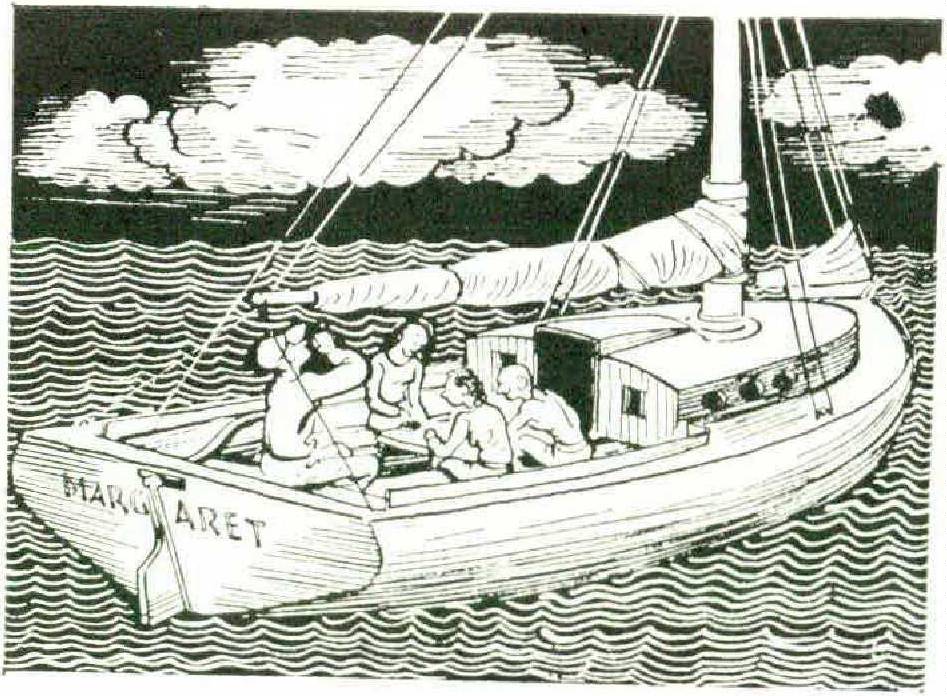
Let me introduce you to the end of a day’s sail aboard Tide Over. Perhaps the routine adopted by a couple experienced in living afloat will hearten you as to the degree of civilized living that can be attained and that we now take for granted.
It may be three o’clock or seven o’clock of a summer’s afternoon when we round up offshore of an attractive port of destination to take in sail where there is plenty of sea room. No Vikings, we. After sails are secured we chug our leisurely way under power to an anchorage. Thus, no unforeseen physical demands are made of the Old Man.
After the anchor is down and safoly set, over goes the boat ladder. This is a hinged contrivance which unfolds so that four steps are under water for coming aboard after a swim with no strain. Then the awning is set. If the weather is wet, a forward curtain keeps the cockpit comfortably protected. While we are having a swim the drafts of the stove are drawing so that water will be boiling for tea, with or without rum. Relaxing after the swim, dried by warm salt air, we judiciously discuss the menu for ihe evening meal.
This determined, the ingredients are laid out for preliminary preparation while the Old Man completes his deck and engine-room chores. He is then ready to engage in his real avocation, the sensitive admixture of the components which create the Martini. We like ours 4-1 with just a drop of Italian. In the final stages of preparing the meal, which require the cook’s devoted presence below decks, barkeeping activities follow her from cockpit to cabin.
What is this meal in preparation? It will certainly include hot soup, even though we have had sou]) with our sandwiches for lunch under way. Hot soup, with us, consists in mixing different kinds of canned soups and adding cream and usually teaspoon onions. A favorite is cream of celery with cream of chicken. Another is pea soup and cream of tomato. Vegetable soup and consommé combine to advantage. Ingenuity in adding bottled or packaged flavorings is a challenge to any cook, as is the variety of combinations that improve palatability.
This meal is going to include Eggs Benedict: a slice of buttered toast, a slice of Hormel precooked ham from a can, lightly grilled in a frying pan, a slow-cooked dropped egg, Hollundaise sauce, and a canned mushroom to garnish the top. Lest you are fearful of Hollandaise as a difficult stunt, here is the original foolproof recipe: —
2 egg yolks
¼ cup butter
Pinch of salt
1 tablespoon lemon juice (½ lemon)
1 teaspoon flour
½ cup boiling water
Mix the egg yolks, Hour, and butter. Stir them well together, really thoroughly. Then add the salt, lemon juice, and boiling water. The water must be boiling vigorously and be added slowly. Have a double boiler ready on the stove, with the water already boiling in the lower half, and pour in the mixture, stirring the while. The proper consistency will be reached in approximately thirty seconds of stirring. Remove at once and set the double boiler off the stove until time to serve. This is the only known Hollandaise which will not separate, even if kept in the icebox and reheated.
Our vegetable will be fresh spinach procured, ready washed, in a cellophane bag. Boiled to tenderness, the spinach goes into a covered collander to stand over hot water until ready to serve. Then add salt, pepper, and butter to taste.
Let’s consider an alternative dish, an easy one. Dump a jar of cooked, boned chicken into a double boiler and pour over it a can of cream of mushroom soup, undiluted. When hot, stir in sail and pepper to taste and serve on hot buttered toast.
This goes well with fried tomatoes. Frying anything successfully is a matter of having the fat at exactly the right temperature. But a small piece of bread in a quarter of an inch of melted Crisco in a frying pan. When the bread is the color of toast the fat is the right temperature to introduce the food to be fried — tomatoes, potatoes, chicken, or fish.
Tomatoes for frying are halved raw, without peeling. Put some flour seasoned with pepper and salt in a flat dish. Dunk each half tomato, cut side down, in the Hour and place it gently, flour side down, in the hot fat until the bottom is golden brown. Then turn them over to cook until sufficiently soft.
When frying chicken, rub the raw meat with a split clove of garlic, cut the bird in quarters, and put the pieces in a paper bag with half a cup of flour. Shake well. Then put the flour-coated pieces in the hot fat with plenty of salt and pepper. When they are brow n on both sides, pour in a cup of thin cream or top of the bottle of milk and let simmer, covered, until ready to serve, with boiled rice on the side. Your gravy is now all made in the pan, ready for the rice.
In frying fish fillets, first dry them with a cloth. The flour will not stick to the fish until it is dipped in a mixture of one egg and a tablespoon of water well mixed. Then dip them in the flour and fry in hot fat. Bread crumbs can be substituted for flour.
Not many fish chowders have the right flavor and substance. By trial and error we have developed a recipe that if followed with any degree of accuracy will win you a reputation as a cook. The quantities given will feed four hungry men.
3 pounds fish (any kind) without
skin or bones
½ cup half-inch cubes salt pork
4 large potatoes
6 medium onions
1 quart hot milk
1 quart boiling water
1 tablespoon butter
3 tablespoons flour
2 teaspoons salt
¼ teaspoon pepper
3 large pilot crackers
Cook the salt pork in a frying pan until golden brown. Remove the pork and set aside. Lightly fry sliced onions in pork fat. Put a layer of diced raw potatoes in a kettle, cover with a layer of pieces of raw fish (about three-inch chunks), sprinkle with pepper and salt, and add some of the onions and liquid fat and the previously cooked salt pork. Repeat these layers. Add boiling water almost to cover. Boil until the potatoes are done. Thicken the hot milk by adding a paste of cold milk and four, stirring slowly to prevent scorching. Just before serving, stir this thickened hot milk into the chowder. Break up the pilot crackers into the chowder before dishing. We like to make an extra cup of browned sail pork cubes to add to each bowl as croutons.
After the meal, clearing up in the galley is postponed until after a leisurely period of coffee and small talk in the cockpit.
The inner man is refreshed. The salt breath of the sea, the soft water noises, the lazy tap of a halyard on the mast — this is peace uninter rupted.