This Month
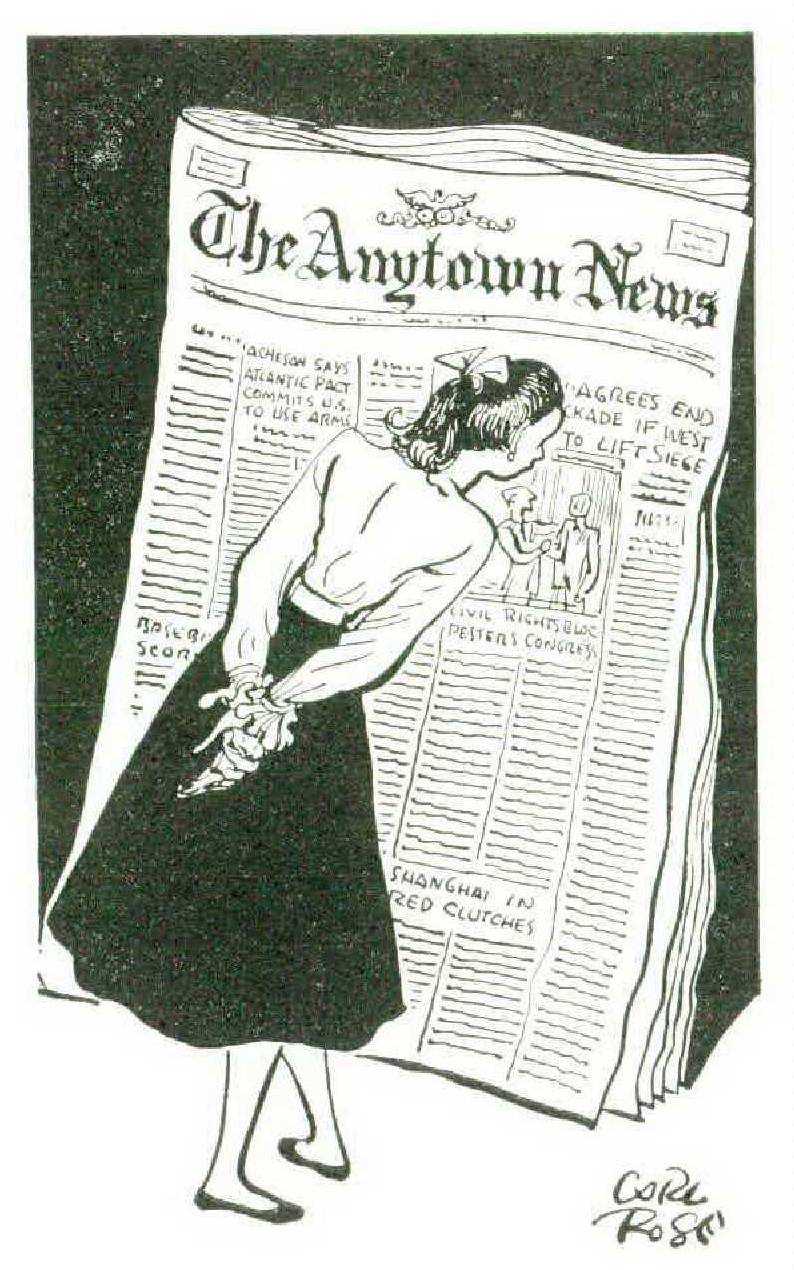
Women have their own peculiar way of reading, or not reading, newspapers. Sitting under a dryer or picking things up — between phone calls around the house, they happen upon a newspaper. Its date is not important—yesterday’s or last week’s or last month’s, it’s all the same. Everything in the paper is necessarily news.
The woman is astonished to find that all sorts of things have been going on in the world, some of them quite complicated. Of the lead story — from China or Lake Success or Moscow — she can make no sense whatever, since it seems to be mixed up with previous matters that she never heard of at all. Who is Lomakin? Why should the mayor be talking about the cost of snow removal? What is snow removal? They have to keep the streets clean anyhow, don’t they? Where is Java? Certainly nowhere near Holland — or is it ? Is that sale of yard goods still going on? What is the date of this paper anyhow? What date is today? Heavens, the twenty-fifth! Too bad.
Such a plunge into the middle of things would disconcert a man. He would feel out of touch. According to his habit of life, he would either brush up on what he had been missing or remain, by firm choice, happily out of touch. To wander in and out of a fragmented world would confuse him. It confuses the woman too, but here again she achieves the main purpose of the defenseless sex: the conversion of a weak point into a trap for her master. It’s not the wife who comes off as the defective in the contest which follows her casual skimming of an old Sunday Times. The husband is the one who is shown up — ignorant, insensate, and forgetful.
The wife does not need to lay any deep plan for using the gleanings of her half hour under the dryer. They simply pop into her head that evening at dinner.
“What is going on in Turkey?” she asks. Her air is that of an eager pupil, confident that a great authority will respond with the definitive report on Turkey, brought up to date.
The man is perplexed. He has seen no big story out of Turkey that day or for some time past. He tries to think. “Nothing special that I know of,” he replies.
“Nothing? Now really, isn’t that just like you!”
“Well, I didn’t see anything in the papers about Turkey.”
“Why have we sent battleships to Turkey?” the wife demands.
This jolts the husband. What new mess is in the making? Could something have started a war while he was on the way home? “Great, heavens,” he exclaims, “are we sending battleships to Turkey?”
“I’m surprised that you don’t know. I thought you always followed these things.”
“I certainly haven’t heard of our sending any battleships to Turkey. Where did you get it?”
“I read all about it today at Miss Butler’s while I was getting my hair done. It said something about the reserves. Do you mean to say that we are even sending our reserves to Turkey and that you haven’t heard about it?”
The husband puts down his coffee. Not a war, after all, but what about the battleships? He thinks furiously, cudgels his memory. Reserves . . . reserves — the word stirs a faint recollection. Vaguely to mind comes a minor item of some weeks back: two destroyers, perhaps three, taking naval reservists to the Mediterranean, a “good-will” cruise or some such thing.
“I seem to recall a story about a couple of our destroyers going to Turkey on a naval reserve cruise,” the husband begins.
“Ah, so you do know what I’m talking about,” says the wife.
“Well, you asked me about battleships.”
“What difference does that make?” demands the wife. “The point is that you did know that something was going on in Turkey and that when I asked you about it you just sat there and pretended you didn’t.”
“But I thought you meant today,” says the husband. “That destroyer business was a month ago.’
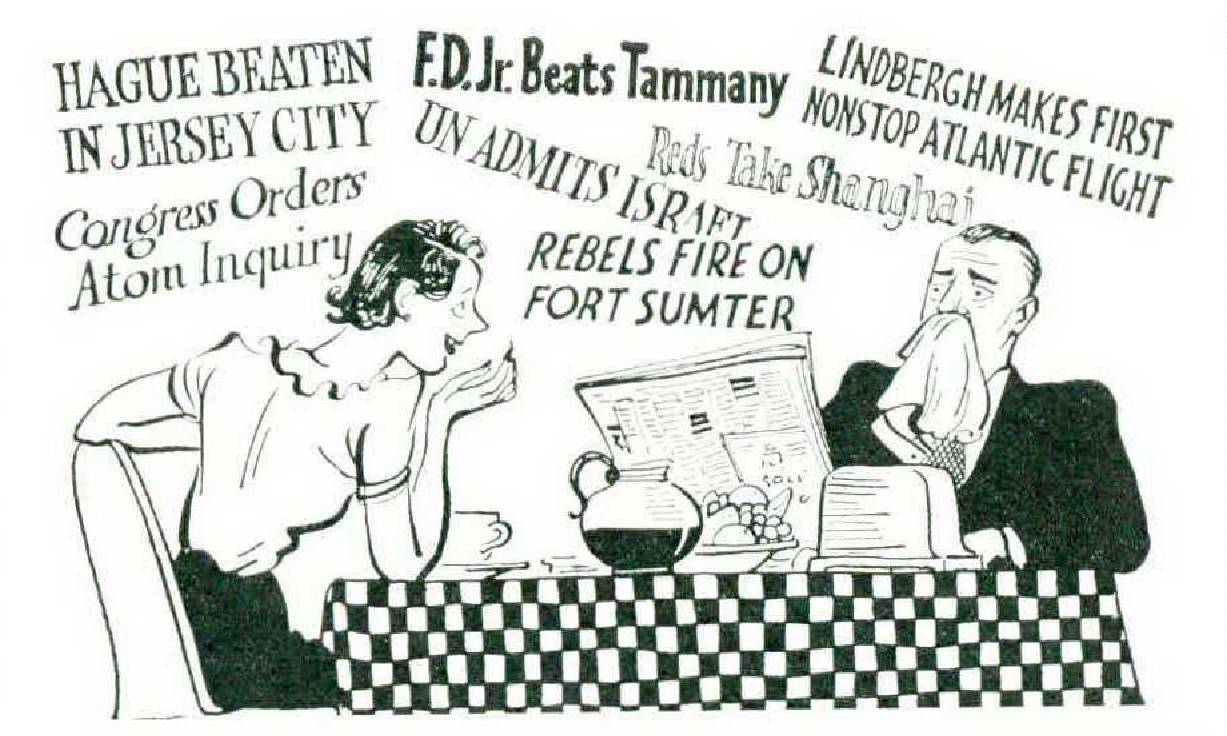
Now comes the crusher. “Well, if you knew it at the time,” the wife asserts, “you certainly ought to have told me about it.”
The wife has the situation well in hand by this time. Patiently, as if according a stubborn child one more chance, she says, “Well, toll me some more interesting things from the news tonight.
The husband realizes that he had better play up. He launches into a spirited account of a local censorship quarrel. A vice crusader has taken from the shelves of the public library a half-dozen novels, denounced them as obscene, and refuses to give them back to the library. He has no right to do this, the husband explains, and the library is taking it to court. This will interest the wife especially, he tells her, because she met the librarian last week at the Browns’ party and— But the wife’s attention seems to have turned elsewhere, He has lost his audience.
“What have you done,” the wife demands suddenly, “about that deposit for Tom’s summer camp? You know it was supposed to be mailed to Mr. Peters on the first of the month and here it is the fifteenth. If we’re not going to send him to camp, I think you ought at least to let Mr. Peters know, he’s been so helpful, etc.
A variation of the what’s-in-the-papers-tonight ? entrapment comes when the wife returns one afternoon from a lecture course that she is taking. The course is entitled “Our Government and What It Means to You,” and deals with the more elementary aspects of elections, public revenues, the courts, and so on. She has just heard the district attorney explain the successive stages of procedure against a criminal. She found him a terribly interesting speaker— rather attractive, too and she is full of the speech that night at dinner.
“I did so wish you had been with me at the lecture this afternoon,” the wife begins. I know you don’t like that sort of thing, but this one was simply fascinating. I learned things about our courts that I’ll bet even you didn’t know. Somehow, he made it all so simple, so clear ...”
“Good enough,”says the husband. Tell me about it. Who was giving the lecture.”
“It was either the attorney general or the district attorney — or whatever you call him,’ the wife replies. “I don’t quite remember his name but he gave us a wonderful talk.
“ Well, you should have noticed which he was,” says the husband. “The district attorney here. George Himmelfarber, is a pretty good guy, but the attorney general is a bad egg, a very bad egg — Jerome Sculpin. Was that who it was?”
“I have the program somewhere, if it makes any difference,”says the wife. “I don’t think it was either of them. Some name more like Switzer.”
“I don’t believe I know him,” the husband says.
“Well, you would if you went to more of these things,” says the wife. “You have no idea of what you miss. This one was simply fascinating.”
The wife unfolds the gist of the lecture as she remembers it: the wrongdoer is first arrested and arraigned yes, that was the word—arraigned, in the District Court; they either let him go or hold him for a higher court —of course, that is, if it’s something really serious; otherwise they may just fine him or send him to jail — assuming, of course, that he’s guilty; then the grand jury indicts him —if they haven’t let him go — and then he finally has his trial in what is called the Superior Court. “Did you know that?” she demands.
“ Know what ?” the husband asks.
“Why, that we have in this state a court called the Superior Court did you know that?” She is challenging him. He foolishly accepts.
“Well yes, I did,” the husband admits.
“Well I didn’t,” says the wife. “Are you sure you know about the Superior Court and what it does?”
“Of course I am,” says the husband stoutly.
Students of chess, military tactics, and the technique of cross-examination will see that the wife has achieved the classic situation of encirclement. That is where her Q-and-A has been leading ever since she started the conversation. All that remains is for her to pull the string, close the noose. She indulges herself in one more exchange with the loser just to savor the extra moment of victory.
“Do you mean to say,”she begins, silkily, that you have known all along about the Superior Court and the District Court and all that ?”
“ Certainly,” replies the husband. ”Why shouldn’t I?”
Again the crusher: “Well why on earth haven’t you told me about it ?”
“Why should I?” asks the husband. He can’t, help sounding as if he had preferred to keep his knowledge a dark masculine secret. He realizes this. “How should I know that you wanted to hear about the Superior Court ?’ he adds.
“That’s just it,” says the wife triumphantly. “You never tell me anything.”
Game! Set! Match!
CHARLES W. MORTON