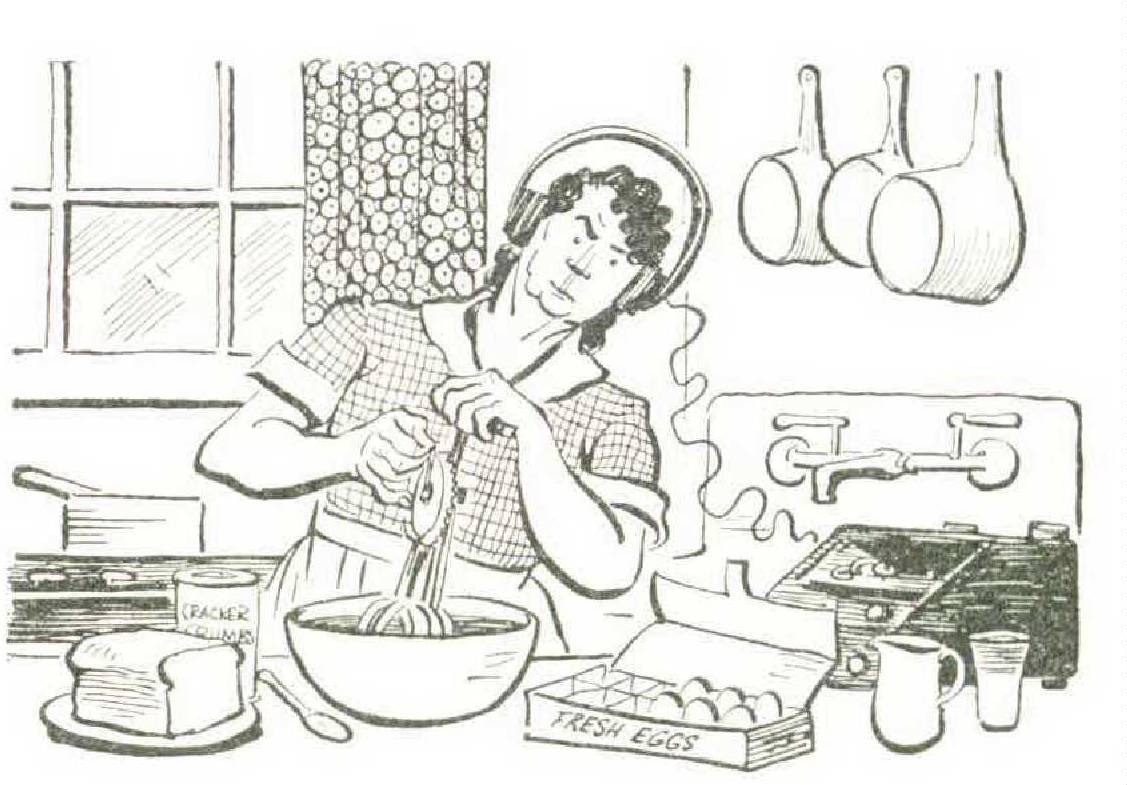
The Kitchen Problem
HERBERT COGGINS has written for the Atlantic on how to catch burglars (in a bag) and how to enjoy paying taxes. He lives in San Francisco.
COOKERY
by HERBERT COGGINS
THERE is no excuse for bad cooking. Considering the experience and tradition behind it, the preparation of food should be our most advanced skill. Instead, it’s run on the superstition that a cook is born, not made; and even the best chef will often admit that this or that dish didn’t turn out as planned.
We wouldn’t tolerate such a thing in other work. Iron foundries don’t turn over their furnaces to the instinctive expert whose metal formula is based on a little pinch of this and a little pinch of that. And the factory management which admitted that for some unknown reason the automobiles on then assembly line were not as they had hoped, would be inviting retirement.
I have contended that cooking can be just as exact as any other business. The laws of physics and chemistry are not suspended in the kitchen. The making of biscuits will some day be as accurate as the manufacture of corkscrews.
When I decided to straighten out the kitchen problem, my first idea was to compile a little manual describing the know-how of each task and then lay it out in proper sequence in the day’s work. Second thoughts were belter. Though we are a nation oversupplied with cookbooks, we lead the world in acid indigestion. My job was to enforce a small part of the things that we already know.

I rejected as absurd the thought that someone must stay home and supervise the work in the kitchen. It is as uneconomical as a factory with a superintendent beside each machinist. The worker has blueprints and patterns to guide him, and in an up-to-date plant the novice can soon compete with the experienced journeyman. Deviation from good work is almost impossible.
I would do the same for the kitchen. I would set a work pattern so accurate that perfect results would be certain. But I wouldn’t trust it to printed words to be mislaid or misinterpreted. My patterns would be spoken instructions. I would build my borne management system on sound records. I would leave no tolerance for lack of training or even low intelligence. For the person who understood English nay system would be automatic. Once started, each meal would have to be perfect.
I went at my task in my usual systematic manner. I read every good cookbook I could find. I culled the best recipes and organized them into thirty well-balanced menus that I felt would bear repealing. Then I engaged the best home cook I could find to come into our kitchen and serve the menus under my supervision. On the margin of each page I made notes of such changes as she advised and, like a musical score, I marked bars of rest to give time to complete each part of the task.
When we finished the course, I dictated the recipes into a recording instrument, took the records to the office dictaphone, and had the typist make copies. I edited them carefully and then, so that there would be no technical slip-up, I had them reinscribed by a professional announcer.
The afternoon I brought the compact little transcriber into the kitchen I could hardly wait to try my plan. I had phoned my wife to have all the makings of a meal ready for my coming. I borrowed an apron and pitched in with confidence. Hopeful as I had been, I was astonished at the efficacy of the system. Unaided, and with no experience, I turned out a most satisfying meal in a short time. The spoken routine practically forced me to do the right thing, and the whole work was so synchronized that the necessary dishes were all ready at the proper time. In a small way it was like a construction job where the various parts are gathered together and then suddenly assembled in beautiful perfection.
I had purposely started my system when we had no kitchen help. I wanted it tested by someone with no experience or cooking habits. So when Bella came to us she seemed just the person. She had a partial school education and no know ledge of cooking. But she had what I wanted most. She was careful and conscientious, and had the necessary lack of self-confidence to make her dependent on my system.
She worked out beautifully from the first. The fact that there were only two of us to cook for made it simple, and our housekeeping ran as smoothly as a conveyor belt. Each evening we laid out the records for the next day’s menus and the tew everyday instructions for tidying up our rather modest home. Breakfast was an especially successful meal, and through the routine the bacon and eggs and toast came off the stove so expeditiously that we had to speed up a little to be downstairs on time.
But convenient as was the method for us, it was even more of a boon to Bella. There was no fear of forgetting, no vexatious decisions about the time and temperature for baking, and no running about with an open cookbook.
We had not yet tested my plan with dinner guests but I had no hesitancy. For the first experiment we chose the day of the big foot ball game of the season. My wife naturally attended to the unusual things like arranging a few flowers and tidying up the living room. Also, as we were leaning, she took a surreptitious look at the dining-room table that Bella was setting up in advance.
The game turned out to be one-sided; but it was enjoyable and the brisk weather sharpened our appetites, which I had been pointing up a little by describing our perfect kitchen setup. The ribbing that I got from our four guests for my enthusiasm merely added zest to my anticipation.
When we reached the house, the lights were on, and when I opened the door we were greeted with the crackling of the tire that had been newly lit in accordance with instructions. The two couples and I paused in the hall to remove our things, but my wife naturally hurried to the kitchen. Through the door I could see that the dining table was most attractive, and we could hear Bella in the kitchen.
She had followed the menu laid out for her with her usual faithfulness. But there was one disturbing circumstance — our record menu had been planned for only two people.