This Month
Even a superstition must have a beginning. If the Chinese believe that powdered tiger claws tone up the system, it is safe to assume that they must have paid off for at least some Chinese, and who are we to scoff without having tried them? The primitive Ga of West Africa think they can cure disease by making the patient uncomfortable, yet that is precisely what many of our best hospitals do to the same end. The public thinks most educators are saps. Therefore, there is probably something to it. But is there?
It was at St. John’s College, so the legend goes, where the first class to complete the hundred-books curriculum stayed on, every last one of them — to teach at St. John’s College. This seems to sum up fairly well the main scheme of American education. All must be educated, on the outside chance that all might want to become teachers. But the educated person who chooses otherwise must demonstrate that his education has not turned him into a ninny.
No newspaperman suffers quite so pitifully among his fellows as the graduate of a School of Journalism. The business executive is forever blasting out the “nonsense” which his subordinates may or may not have learned at college. A man in a bank who displays the stigmata of an economics course would make the bonding company responsible for him distinctly uneasy. To be called a “professor” in a Hearst newspaper is not libel under the law, but it ought to be, for the word has abominable connotations when used by Hearst. To have been influenced by the professors is almost as bad as being one, yet college degrees are required of all, just like typhoid shots for people going to Dakar. In consequence, the college man of sufficient charm -an outstanding war record helps — can hook on somewhere as an office boy and begin to de-educate himself. It is harder for the girl graduate: she must first go to a secretarial school. After that, she may get a cushy job addressing envelopes.
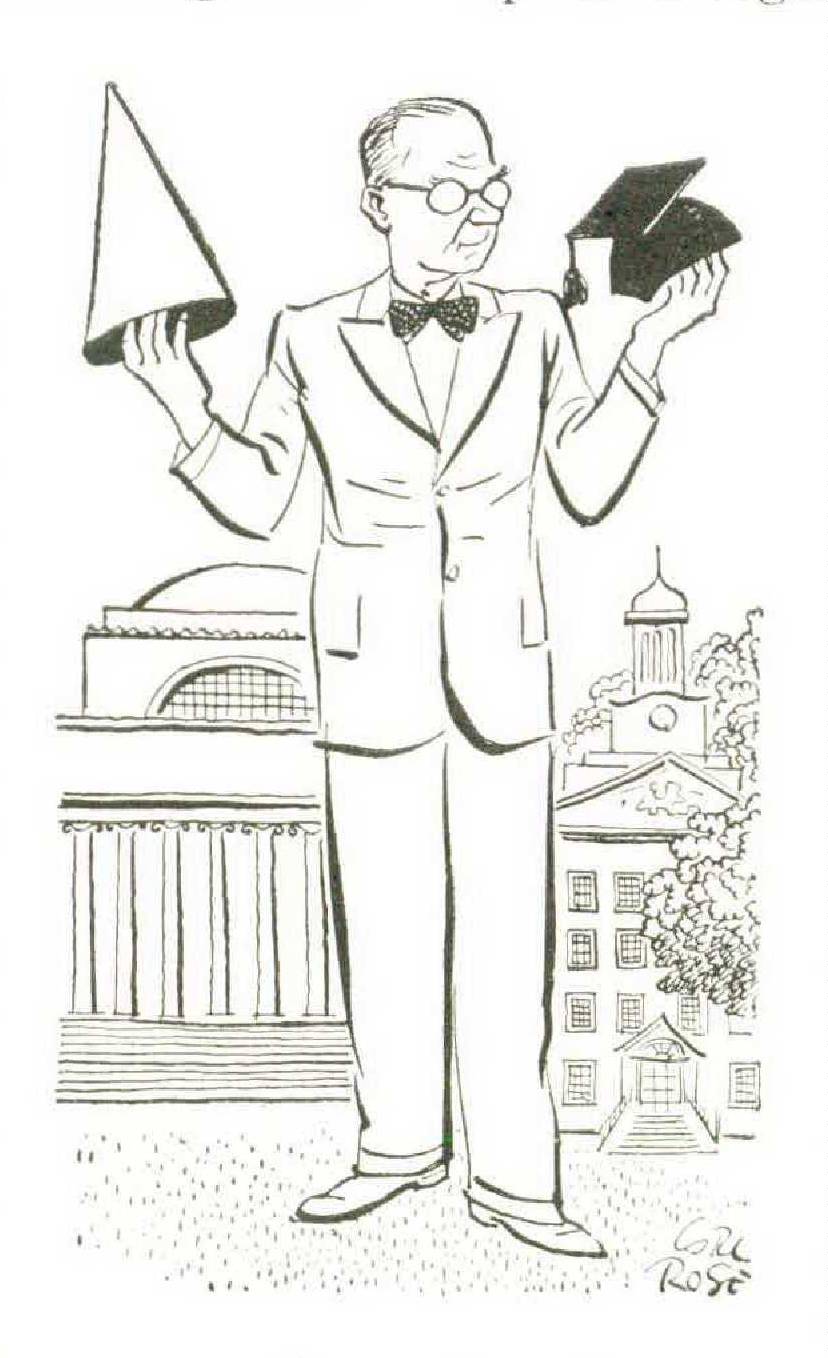
Our low esteem for the professors and their product comes simply from our failure to analyze these remarkable men and their way of life in the modern world. That we underestimate them is plain, as even a glance at the three main categories of college professors will show.
Consider the professor who actually teaches. This is the rarest type, because holding classes and lecturing, sometimes as early as 9 A.M., must be set up on a regular schedule. The teacher must be there, looking fairly presentable, whether he feels like it or not. He must be sufficiently acquainted with the textbook he is using (ideally, one written by himself in leaner days) to give assignments in it, but the rest of his output can be personal reminiscence, joke-telling, or rambling observations about his subject or life in general. Because his class is so big, he farms out the correcting of papers and interviews with students to his assistants or “section men.” He is thus obliged to do no reading, no writing, but he does have to show himself around the college on two or three days each week.
If the teaching professor’s work seems light by ordinary standards, that of the research man is even lighter. He avoids teaching and holding classes, and months can go by when no one ever catches a glimpse of him. He may be in Santa Fe taking the sun or lounging about at home or dozing in libraries, for all the college knows. To keep the authorities softened up, he appears at long intervals with a sheaf of notes, and reports that he is on the trail of Something Big.
If the college president tries to talk budget, the research man will go dreamy on him, play the absent-minded professor, and throw up a tactical screen ot the jargon of his specialty. Not even the president can be sure of what’s going on — and for that matter the president himself may be bluffing it. The research man is supposed to publish his findings eventually, but he can postpone the day as many times as he wishes: more research needed, Scholarship must be impeccable, budget too skimpy anyhow, working day and night . . .
The third of these academic types is the professor who publishes. He does nothing but write books and articles, and make speeches — at a stiff fee — to conventions and luncheon clubs. Often on the radio, he is now looking for a television sponsor. The college, which sees nothing of him, is proud of his achievements. His earnings in a bad year would run to as little as $30,000.
Each of these three types of college professor, in addition to two weeks at Christmas and a week at Easter, gets a three months vacation every summer. Their college salaries may be moderate, but it’s a solid connection, with rich pickings on the side for work as a “consultant” to baby food manufacturers, engineering firms, the State Department, etc.
Who is to say that such men are saps?
CHARLES W. MORTON