This Month
Men, especially fathers and bridegrooms, have long wondered why a perfectly normal wedding has to combine the more complex features of a street fair, the Sophomore Prom, and a three-alarm fire. Why, they muse, must there be crowds, traffic cops, waiters, canopies and carpets, and foodstuffs on so vast a scale? Is it really necessary to make over the house like a hotel preparing for an American Legion convention? If there are sandwiches, need creamed chicken follow? For a fifteen-minute ceremony, ought the family to have to float a bond issue? Won’t it be just as legal without an awning over the front walk?
The men troubled by such questions fail to realize the two main reasons for the big wedding: —
1. To amass for the bridal couple the greatest possible quantity of presents.
2. To create the impression of a union tantamount to a treaty between the Montagues and Capulets.
Preparations for a big wedding are much like those for the great jack-rabbit drives out West, with the whole countryside lined up as beaters.
The role of the beaters, for the purpose of the wedding, is filled by the bride’s mother, unassisted. She is equal to an army banging dishpans or a whole safari of Meru tribesmen. Instead of rabbit or rhino, she is rounding up wedding guests. (Wedding guest: anyone who receives an invitation to a wedding.)
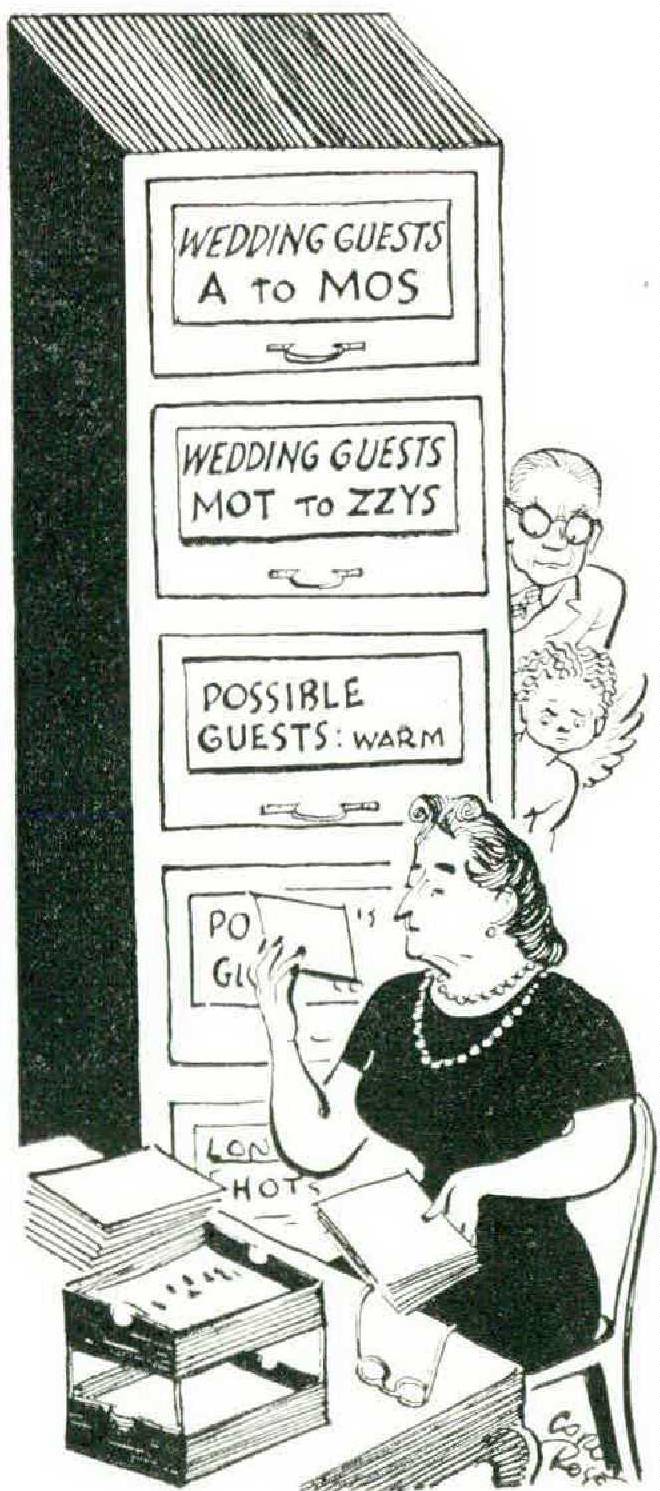
The Australian tracker has no keener eye than the bride’s mother. She can discern the spoor of a wedding guest from no more than a dislocated pebble, a fallen leaf, or a casual conversation with a stranger on a bathing beach. Ranging widely for fifteen or twenty years of search, she sweeps before her the greatest possible number of prospective wedding guests and ultimately confines them, some thousands by this time, in a stout card file. Here the weaklings and the unfit are culled out, and the others the live names — are herded into improvised categories, roughly according to tenderness, wealth, consanguinity, and quid pro quo.
The rejects are allowed to escape by means of an ingenious punch-card system and are never heard of again. But the live names, little dreaming what is in store for them, browse in the card file until the final stages of the unequal struggle. They mill around contentedly, with their checking accounts still in their natural state, budgets glossy and well cared for, and in some cases with even a few dollars of surplus adorning an exceptionally fine male specimen.
The names must be kept up to date. A change of residence means a new card, destruction of the old. Extra care is taken to keep track of summer homes and travel; one of the easiest alibis of the noncontributing, non-appearing guest is that he was away somewhere and not getting his mail. If an address is completely lost, the mother can hire a skip-trace company to track down the fugitive.
Under the term “guests” are usually grouped two widely different types, the socalled gift-bearing guest and the barren, or “public relations, guest. (Any mother of a bride would be glad to rope in a governor or a supreme court justice or the president of the First National Bank, even though he might donate nothing more than a china ashtray.)
The unremitting pursuit by brides’ mothers of the gift-bearing guests has greatly reduced their numbers and made the survivors exceedingly shy and wary. But the annual catch still lakes in at least once during the season, which usually begins in April and extends through June, most wellto-do adults in the population. Some are caught, banded, and released as many as half a dozen times in a single season.
The matter of addresses has come to exert a powerful influence on many seemingly unrelated conventions. The attitude that a young girl should not associate with persons to whom she has not been properly introduced, far from seeking to protect her against moral and physical damage, is merely based on the mother’s determination to get on the wedding list the full name and address of everyone whom the child meets. The bride’s mother cultivates college graduates for the same reasons — she can always look them up in an alumni directory.
The final triumph of the bride’s mother comes when she is ushered dow n the aisle to a forward pew at the wedding. No one wears a “gown ” any more, but that is what the bride’s mother is wearing. It’s a uniform, battle-dress. Her familiar costume has been shapeless tweeds or durable serge of modest hue. But now she has ransacked the spectrum to burst upon the assemblage sheathed in an orchid or chartreuse Gown of the most dashing high-style. None of her friends would have thoughl she had the prodigality to buy it or the nerve to wear it. But there she goes. . . . CHARLES W. MORTON