Guatemala
HERBERT CERWIN lives in Guatemala and has written extensively on Central America. His book These Are the Mexicans was published a little over a year ago.
TRAVEL
by HERBERT CERWIN
BACK in the sixteenth century a trip from Mexico City to Guatemala took from three weeks to a month. For those who try such a trip in their car today, the journey can prove as lengthy and arduous as it was four hundred years ago. Yet by air Guatemala is only hours away from any point in the United States, and by boat five to seven days, depending on the port of embarkation.
Guatemala can also be reached by train on a railroad line that starts from Veracruz, drops down into Tehuantepec isthmus, and ends at Suchiate. It is possible too, for those seeking adventure, to make the trip on muleback or on foot.
I have tried all these routes over a number of years, except on foot or muleback, and I can recommend only the air lanes and the sea. Anyone who at present attempts to drive his car from Mexico to Guatemala is flirting with trouble. The PanAmerican highway from Ixtepec south is a legend and a cow trail. Some have managed to get through, while others have merely learned to curse better. For those who do want their car I suggest putting the automobile on the train at Veracruz or Ixtepec on the Mexican side; even so, it’s a complicated business.
Go by boat or by air. There are now some excellent United Fruit freighters sailing out of Baltimore, Mobile, and occasionally Charleston. Most of them are new boats, each cabin with private bath. The fare one way is $138 and the average running time is seven days with a stopover in Havana. Since they are banana freighters, it is well to remember that bananas come first on the return trip, passengers last. Because of union regulations, meals are served at early hours: luncheon between 11.30 and 12.30 and dinner from 5.30 to 6.30, and you have to be there on the dot.
For more relaxed traveling there are the United Fruit cruise ships from New Orleans. Meals are later and some passengers dress for dinner. There are also swimming pools and sports. The cost one way runs from $150 to $240.
All these boats end up in Puerto Barrios. The best thing about this Atlantic port is that you don’t have to spend the night there if you come on the cruise ships (though if you come on a freighter you might). The special train that takes passengers from the boats to Guatemala City is faster than those on regular schedule, but still takes from ten to twelve hours across hot, tropical country. Recently, however, an airplane service has been installed which makes the flight in forty minutes.
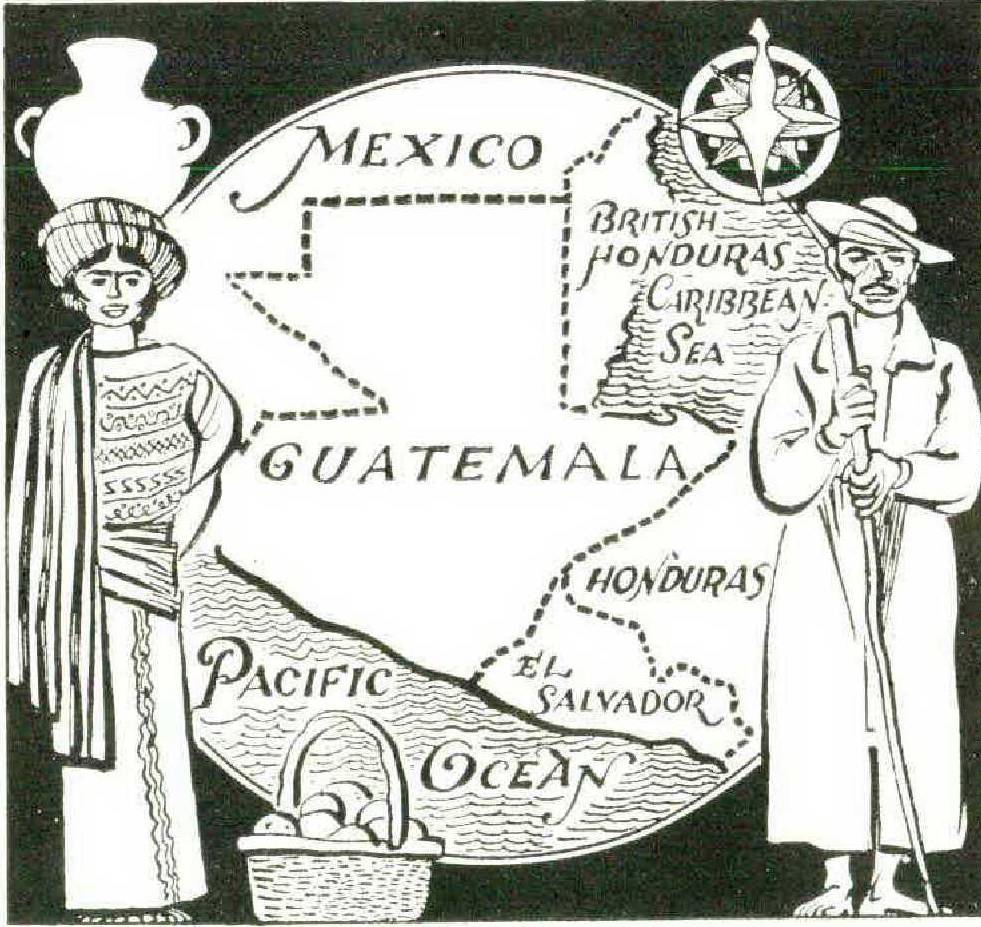
Boat travel from California ports to Guatemala’s Puerto San José on the Pacific side is still erratic, expensive, and not always to be relied upon. This should improve soon, as the Grace Line is now adding new freighters to its fleet.
By air there are three distinct routes, each offering certain attractions and advantages: the Miami-Havana and Guatemala flight, the New Orleans-Mérida (Mexico) trip, or the longer way around via Texas and Mexico City. Of the three, I prefer the Mérida flight simply because anyone who goes that way will get a chance to stop over and see the Mayan ruins at Chichen-Itza and at Uxmal in Mexico. These ruins, wonderful and majestic in themselves, are also a curtain raiser for Guatemala. The ancient temples and other buildings were constructed over fifteen hundred years ago by the Mayas, whose civilization is now believed to have originated in the interior of Guatemala.
The only other important ruins which are almost as accessible are those in Copán, just over the Guatemala border in Honduras. While the ChichenItza and Uxmal ruins can be reached by automobile from Merida, this is not true of Copan, and the trip there must be made by plane. During the tourist season there is usually a Sunday flight from Guatemala City to Copán with enough time to visit the ruins and return by evening.
Guatemala has not escaped the world-wide inflation but it’s still not too expensive. In Guatemala City, rates at hotels, including meals, run from $5 to $10 per day, and at pensiones from $3 to $6. They are about the same at Antigua, which was the first capital of Guatemala in the Spanish colonial period, and at Lake Atitlán, a volcanic lake set in the mountains. The Mayan Inn, at the Indian village of Chichicastenango is attractive and the food is good. I have heard tourists complain that, there’s not always hot water and that the food could be better. But knowing some of the difficulties the management of a hotel is up against, I am always amazed that they do have hot water most of the time, that the plumbing fixtures work, and that the food is mostly very good. The only other complaints I have heard come from the Quiché Indians, who never get over their astonishment at the behavior of some of our tourists. No one, I suppose, would ever think of taking photographs during Mass at St. Patrick’s Cathedral in New York; but many tourists seem to have no scruples about photographing Indians during their religious ceremonies.
Anyone who gets as far as Chichicastenango will make a mistake if he doesn’t go to the Friday market at San Francisco El Alto. This is one of the most interesting markets in Guatemala and the trip through the Quiché mountain country is worth the extra trouble and expense. If the road were a little better, I could well recommend the trip to Nebaj, a typical Indian village where they make some of the most interesting huipiles (women’s blouses) in Guatemala.
Tourists, of course, have heard a great deal about Guatemala weaving. Unfortunately, much bad weaving went to the clamoring United States market during the war. Good material, and not too expensive, is still available. But really fine pieces of weaving are now difficult to find and to buy; the Indians just are not making them as before. A fine ceremonial huipil will cost from $35 to $45 but there is lesser weaving available at from $3 to $10 or $15. Some of the better shops in Guatemala City, like Guatemala Handicraft or Dyer’s, charge no more than the city market; besides, they will tell you truthfully whether the colors are fast or not. A test which usually works to determine the fastness of the dye is to drop a few drops of lemon juice on the color in a fabric.
Guatemala claims it has a climate of “eternal spring.” I suppose this is based on the fact that it seldom really gets cold even in winter. This boast is largely true and almost any time is a good time to visit Guatemala. Of course there’s the rainy season, which starts the middle of May and continues until October; so, many people prefer to come between January and April. But then there is the dust from the Guatemala roads to swallow.
It is a good idea to bring some warm clothing. The early mornings and the nights can be chilly, particularly in Guatemala City and the mountain villages. There is very little sea bathing, but there is swimming at Lake Atitlán, and the tropical sun tans fast.
Don’t expect to eat Guatemala food unless you are staying with a private family, for hotels seldom serve it. But you can get a variety of tropical fruits in the markets and practically all of them are safe to eat. The native alcoholic drink is aguardiente. While it is as potent as tequila, it is inferior in quality. Hotel bars charge 75 cents for a Scotch highball and 60 cents for a Martini or an Old-fashioned. Canadian and American whiskeys can be purchased by the bottle in stores at prices which are much lower than in the united States. Excellent French and Spanish wines are available at reasonable prices.
Guatemala is in a better economic position than most Latin American countries principally because of its high-altitude coffee and its banana exports. Coffee and banana prices are the highest in history. The best coffee plantations— or Jincas, as they are called— are in Antigua and in the Cobán area, while the banana farms are in the hot, tropical lowlands. The United Fruit Company now allows tourists to visit some of its banana farms. But permission must be obtained first because there are no hotels, and accommodations in the company guest houses are limited. Coffee fincas are also interesting to see, especially during the picking season from November to early February.
There was a time when an American visiting Guatemala needed a passport, a visa, a dozen photographs, and on arrival had to register with the police and then get. an exit visa on departure. The Guatemala government is no longer so suspicious, particularly since it has discovered how many dollars tourists leave behind; now, only a tourist card with two photographs is required. The Guatemala currency unit, the quetzal, has the same value as a U.S. dollar, and most hotels and shops will accept greenbacks. Only the native sellers in the markets will refuse it. I once asked one of them why, and his explanation was quite logical: “It is not the money of the country.”