This Month
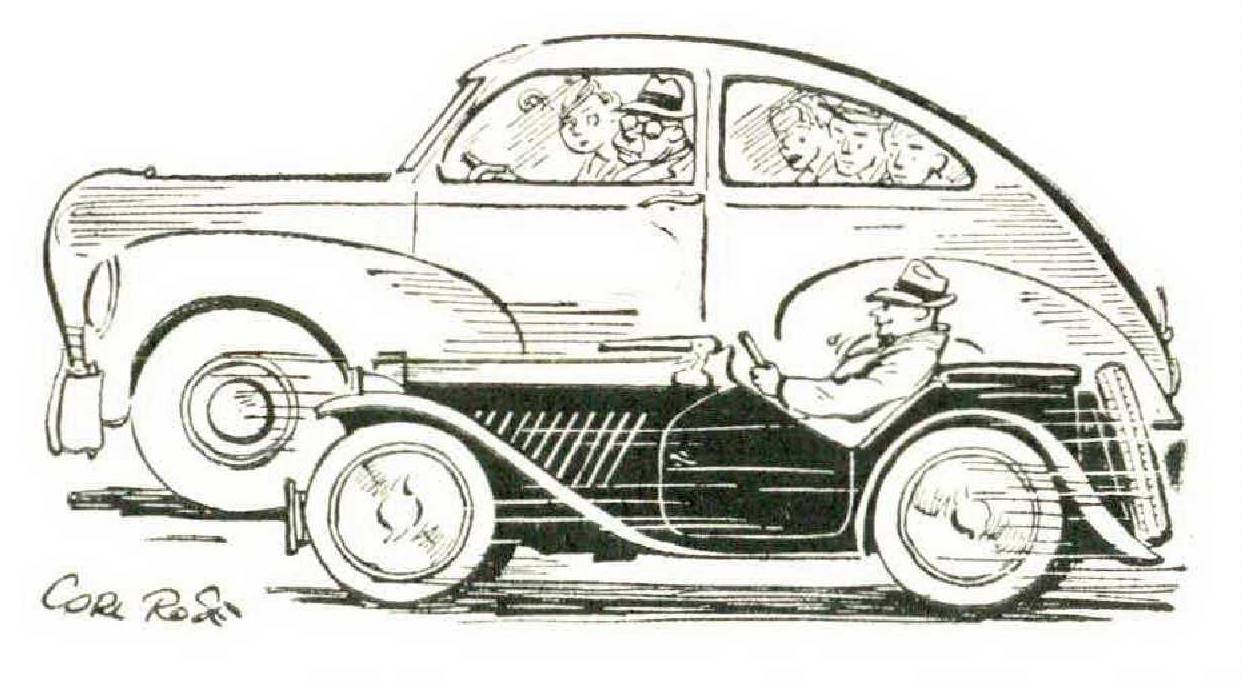
Whenever I see the proprietor of a British sports car pounding along an American superhighway, his situation fills me with sympathy, envy, and sorrow. The sympathy is for the protest vote which the driver has registered against the crushing uniformity of American cars; and also for the hard ride that Be is getting and the manifest shortcomings of his importation. The envy is for the depth of his purse, the raffish style of his car, and certain of its performance characteristics. The sorrow is for the unwillingness of our own automobile makers to offer anything of the kind.
Some of the operating advantages of the British sports car are described by John W. VAndercook (page 91). Its disadvantages are more complex. The British engine, for instance, is designed to save scarce and expensive gasoline; it must undergo a severe annual tax, graduated according to the area of its piston displacement. It must take the form, therefore, of an uncommonly small engine according to our standards, yet be capable, by means of efficient design and prodigious r.p.m., of enough horsepower to be interesting. Such an engine calls for more gear shifting than the American will accept and is often crotchety in slow traffic. The ear itself is made for narrow, twisting, hard-surfaced roads and relatively short distances. With its short wheel base, narrow gauge, stiff suspension, and low clearance it’s easy to handle on such a road, but only an enthusiast would endorse these qualities for American highway conditions.
The problem of the American designer is no less specific. He sets out to produce in large quantities an all-purpose car, dependable, powerful, and fast. Usually seating six persons, it must be comfortable both for the driver-owner if he is alone, and for the whole family with all its luggage. Its springing tries to serve equally well cargoes ranging anywhere from 125 pounds to ten or fifteen times that amount. This calls for a big engine and considerable bulk and weight in the car.
Just before the war the Germans were offering a standardized small high-performance roadster, a two-passenger car with a disappearing top. Fully equipped with a starter, lights, spare wheel, and accessories, the BMW Type 328, as it was known, had a total weight, ready to run, of 1530 pounds. Other features included a streamlined underbody, a small six-cylinder engine with three carburetors, and a four-speed transmission. Its acceleration figures were remarkable, the ear running up from a standstill to 50 miles an hour in less than six seconds. Its price, f.o.b. Hamburg, was some $2100. The same car was made under license in England and at a higher price by FrazerNash. Both versions were successful in many competitions and I believe the Type 328 established a Mount Washington record over here. For anything like its price, the BMW was probably the most brilliant performer of any “stock” ear of its day.
There is no use trying to argue a man out of the mystique which makes him want to own, more than anything else, a Saumur saddle or a set of chisels from Eskilstuna or a Lock hat or a Bugatti instead of its domestic counterpart. I once enraged the foreign sports car fancy in this country by writing in the British magazine Speed that a slightly converted Ford, at an extra cost of about $500, could outsprint and outrun most of the avowed sports models of English and Continental origin. My facts and figures were correct, but the rejoinders wore more in the field of metaphysics. (Note the distaste which Mr. Vandercook encountered for “hot rods” at Watkins Glen. My own crime was worse, since my Ford was not even a hot rod but only, so to speak, a warm rod.)
Between the hard-seated fanatic in his speed oar and the portly householder lounging with his family on the divans of Detroit, there might he a fair number of customers for still another type of automobile. I have in mind a standard American chassis with lower and more rigid springing, a shorter wheel base, and high-geared steering. Its engine would be the most powerful in the company’s line. Weight would be held at the minimum and all nonessentials omitted. The two-passenger body would be an aluminum skin on a wooden or light metal frame, with a manually operated disappearing top and a windshield that would fold flat. In that general direction and with trifling technical changes which would help the scheme along, almost any American maker could turn the assignment over to Raymond Loewy and come out with an interesting car for which some people would be glad to pay a premium. Among them, I am certain, would be a good many Continentals and Englishmen with a taste for the imported article.
CHARLES W. MORTON