The Saracen's Head
English artist and writer, OsBERT LANCASTER came down from Oxford in the early thirties and studied at the Slade School. Later he became the art critic of the Observer and a cartoonist for the Daily Express, and so embarked on the, writing and drawing which hare earned him a dual reputation. During the war he lived in Greece for eighteen months in a semiofficial capacity, and the notes and sketches he made, at that time have recently appeared in his new book, Classical Landscape with Figures. Now, in wholly different vein, he devotes himself to the adventures of William de Littlehampton. the reluctant Crusader.
by OSBERT LANCASTER
13
THE sun was blazing from a cloudless sky and had it not been for a slight sea breeze, just sufficient to fill the sails of the Santa Caterina Lachrymosa, the heat would have been intolerable. Stretched out in the shadow of the poop lay William, fanned by his faithful Negro slave Hercule, eating dates and observing with interest a flying fish that was careering from wave to wave.
Some six weeks had passed since the fall of Acre, and with the advance of summer the campaigning season had drawn to a close. Many of the Crusaders felt that although Jerusalem remained in the hands of the Infidel, enough had been accomplished to justify their departure. This feeling was shared by William who, moreover, considered that to stay longer would be to tempt Providence, for luck such as his surely could not continue indefinitely. On learning therefore that a large, fast ship was leaving shortly from Tyre for Marseilles, he had booked a passage to the latter port wilh the intention of continuing.his journey overland to the Channel.
They had now been some three days at sea, and alt hough the coast of Syria was far behind they had remained in sight of numerous small islands, one of which at this moment lay a couple of leagues to starboard. William was just inquiring of Hereulo what land it was when there came from the lookout the familiar erv, “A sail, a sail!”
The. reaction produced by this warning was very different from that which had occurred on board the St. Caradoc; the Santa Caterina Lachrymose was a far larger vessel, heavily armed, and thanks to her two hanks of oars, manned by well-whipped galley slaves, had a great turn of speed, and those who bothered to mount the poop to gaze in the direction indicated by the lookout did so from idle curiosity rather than apprehension. The sail in question turned out to be a small galley which sheered off as soon as she sighted their own ship, and William returned to his content plat ion of the flying fish.
At first the elusive creature seemed completely to have disappeared, but at length William discerned a gleam in the waves some few yards to port. What was his astonishment to realize, as he looked closer, that this was not his old acquaintance but a glass, bottle! His curiosity fully aroused by so unusual a sight (glass bottles were not then the commonplace articles they are today), he turned to Charlemagne, who lay panting by his side, saying, “Go on, then! Fetch it, boy!" Charlemagne, by no means loath to take a clip and eager to show off his prowess in the water, cleared the bulwark at one bound, swam rapidly towards the bottle, gripped it firmly between his teeth, and with some difficulty and a little assistance from a kindly sailor with a boathook, regained the deck.
On examining the bottle, which Charlemagne had laid obediently at his feet, William was interested to observe that it contained a small roll of parchment which, on extraction, proved to be covered in writing that he assumed to be Greek. Fortunately Hercule had been at one time in the Byzantine service and was well acquainted with the Greek tongue. Accordingly on his master’s bidding be translated the document as follows: —
If you he Christians in that great vessel take pity, I beg you, on a young maiden of gentle birth, cruelly kidnaped from her notive land, who is even now being carried away by Infidel pirates to slavery and a fate morse than death.
DESPINA PROTOPAPPADOPOULOS
On hearing this cry of anguish William was deeply distressed. He was most anxious to reach Marseilles with all possible speed and reluctant to suffer any delay, but he was now, he remembered, a knight and he had read a quite sufficient number of romances to realize that the rescue of maidens in distress was from henceforth to be one of his principal lines of business. He summoned the Master, explained to him the obligation under which he rested, and asked for the ship to be turned about in hot pursuit of the galley.
Almost at once the rhythm of the oars redoubled in speed as the whips cracked across the shoulders of the unfortunate galley slaves. At the same time, as if Providence approved of William’s unselfish decision, the breeze quickened and in a very short space it became clear that the Santa Caterina Lachrymosa was rapidly gaining on her quarry. This, it seemed, was as obvious aboard the galley as it was to William and his companions, for the pirates suddenly changed course and ran into the shallow waters in the lee of the small island, judging the larger vessel would be unable to follow.
However, terror made them careless, and a sudden reduction in speed, followed by a long rending sound, announced that they had hit a rock. The vessel almost at once began to founder and the pirates were observed to be diving overboard and swimming rapidly towards the shore. Then, just a split second before the galley sank, a small figure clad in white was seen to run up the deck and, with a gesture of infinite pathos, cast herself into the waves from that side of the ship opposite the Santa Cater in a Lachrymosa.
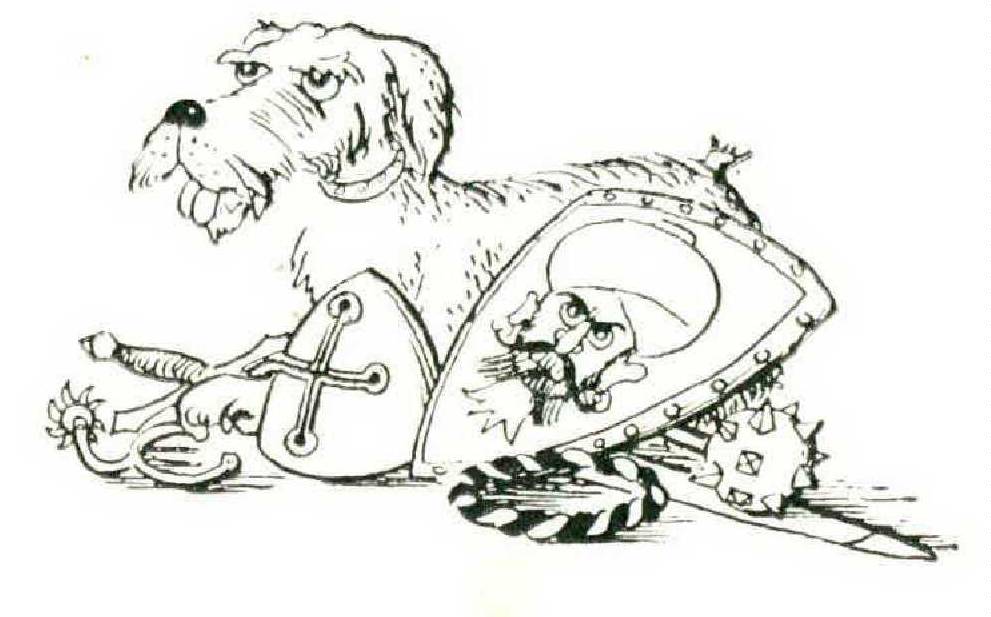
Once more William found himself in an intolerable dilemma. Their ship, it was obvious, could not safely get more closely inshore, there was no dinghy, and a brief inquiry made it clear that of the ship’s company only William and Leofric could swim. Much as he disliked that form of exercise, William saw clearly that he would have to plunge in, for to allow Leofric to get away with the credit alone would be unthinkable. Accordingly, drawing some comfort from the reflection that the Mediterranean was unlikely to prove so cold as the moat of Courantsdair, he jumped briskly over the side, calling upon Leofric to follow.
William’s efforts were fully rewarded for, by dint of quite extraordinary exertions, he reached the maiden’s side just as she was going down for the third time, and with the assistance of Leofric, and despite the well-meaning, but on the whole ineffective, efforts of Charlemange to be of use, succeeded in bringing her to the Santa Caterina Lachrymosa.
After the whole party had dried in the sun, the unfortunate maiden, who had been afforded such comforts as the ship could provide, was prevailed upon through the medium of Horcule to tell her story. She was, it appeared, the only daughter of Constantine Protopappadopoulos, Lord of the island of Kolynos. She had, but two days previously, been playing blindman’s buff with her girl friends on the seashore close to hor home, when a band of corsairs suddenly sprang out from behind a rock. She, unfortunately, had been “he,”and assuming the screams of her companions, who had fled on the first sight of the intruders, to be all part of the game, had run blindfold into the arms of her captors.
Deeply moved by this touching recital, as were all the ship’s company, William saw clearly that, there was nothing for it but to turn aside to Kolynos, which the Master assured him was but a day’s sail to starboard, and restore the unfortunate girl to the arms of her father.
14
EARLY next morning a cry from aloft informed William that they were in sight of the island, and natural curiosity to see the home of the beautiful Despina prompted him to go at once to the poop.
The view which met his eyes was quite unexpectedly rewarding; there rose up from the sea, about two leagues ahead, a great mountain whose sides seemed to drop almost perpendicularly to the waters edge. To the east, however, there jutted out a short arm of comparatively flat land, fringed on one side with a long strip of sandy beach backed by palms, figs, and olives, and on the other by numerous buildings in a most refined style of architecture, facing a considerable harbor enclosed by a fortified mole of wellconstructed masonry. On the very top of the mountain there appeared a great castle of apparently miraculous construction, connected with the town below by a long flight of steps curling and backing up the mountain side, protected at intervals by castellated gateways and formidable curtain walls.
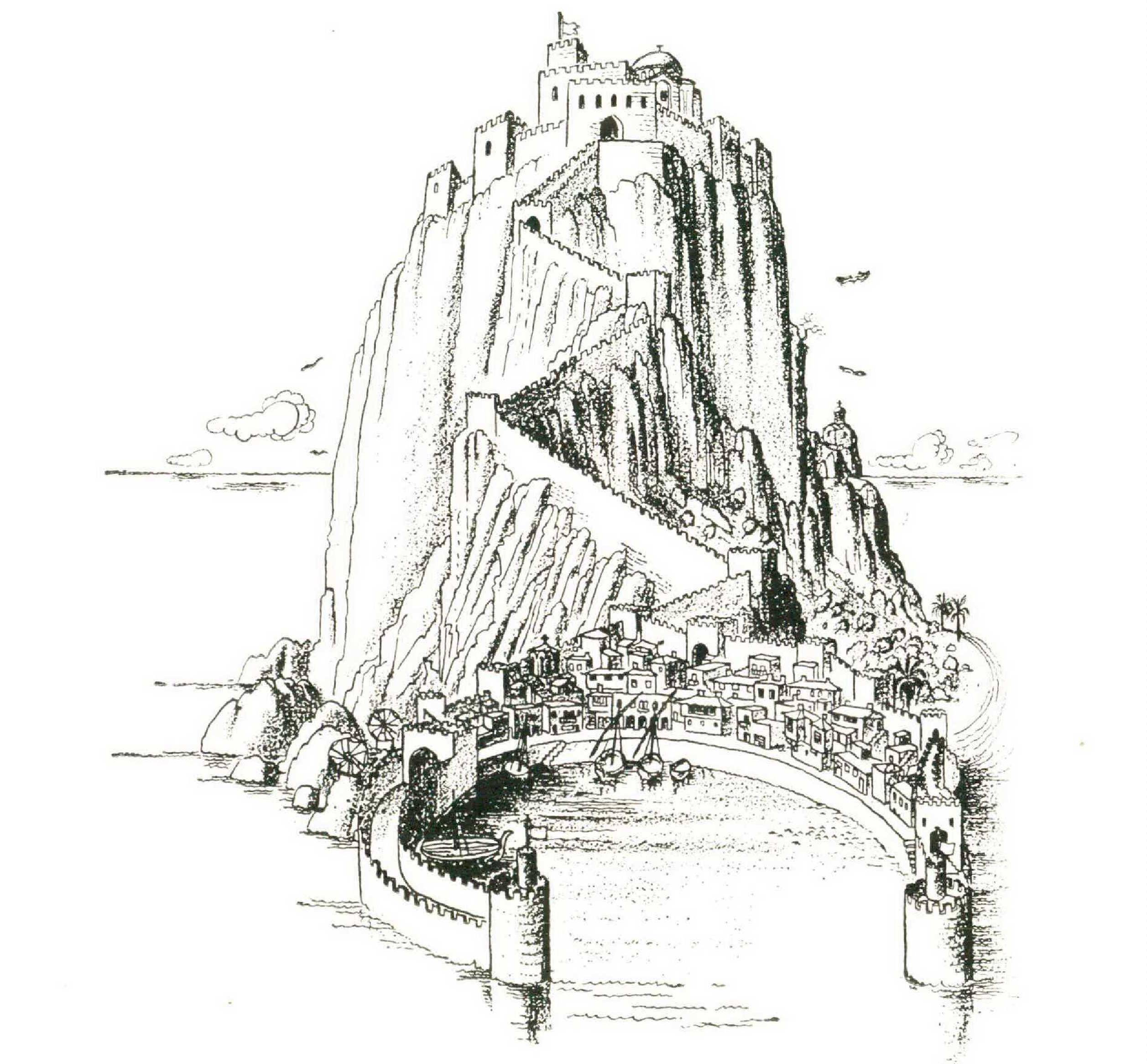
However, the air of gaiety and charm which the town possessed when seen from a distance proved on closer view to be largely illusory. All the shops along the sea front were shut, the ships in the harbor had their flags at half mast, and from the domed church behind the houses came the sound of gloomy chanting. Despite the bright color of many of the buildings, the sparkling waters of the harbor, and the brilliant sunlight in which the whole scene was bathed, an indescribable air of depression hung a bout the entire place.
At first the waterside appeared to he completely deserted but at length, just after they had lowered the gangplank, a solitary customs official, of infinitely depressed appearance, sauntered gloomily towards them and as William, courteously giving his arm to Miss Protopappadopoulos, appeared at the side, asked in hollow tones to see their passports.
As William was quite unacquainted with the Greek tongue it was his fair companion who replied, and at the sound of her voice the official condescended to raise his eyes from the ground for the first time. Instantly his face was transfigured, his eyes almost popped from their sockets, a radiant but incredulous smile lightened his countenance, and falling on his knees he covered Despina’s hands with kisses.
Almost at once further figures, attracted by the sounds of the customs official’s rejoicing, appeared from the neighboring houses, and as the news of their lady’s return spread like wildfire through the town the whole atmosphere completely changed. Shutters were taken down from the shops, the sound of chaining stopped abruptly, to be succeeded by the ringing of church bells, and from every street and alley radiant Greeks poured onto the quayside to swell the vast crowd by which William and Despina were already surrounded.
So overexcited were the loyal and affectionate townspeople that there is no saying when William and Despina would have been disentangled had they been left to their own devices, but it was not long before the crowd fell back to make way for a distinguished group of newcomers rapidly approaching down the hill from the direction of the castle.
At the head of the little procession was a nobleman of refined and venerable appearance, clad in a style far richer than that affected by the upper classes of society in England. William at once assumed him to be the Lord of Kolynos — an assumption that was almost immediately confirmed by the old man’s enfolding Despina in his arms while the tears coursed down their cheeks.
After some minutes during which relief and joy bereft both parent and child of speech, Despina, talking at great speed, explained to her father the circumstances of her rescue and led him up to the slightly embarrassed William. In excellent French, of which the fluency was only slightly impaired by strong emotion, the good old man expressed at length his gratitude, admiration, and wonder. He finally concluded his speech, the length of which was agreeably enlivened by a wealth of gesture, by insisting that William and his page should immediately accompany him to his castle, while the rest of the ship’s company were to be entertained at the public charge by the delighted citizens.
The palace of the Lord of Kolynos, for castle was too austere a term to describe so magnificent a dwelling, quite overwhelmed William by the convenience of its arrangements and the luxury of its furnishing. The walls were adorned with exquisite views of noble buildings and with elegantly designed landscapes all carried out in the most beautiful mosaic. In one room Adam and Eve were seen in the Garden of Eden surrounded by every known species of flower and shrub and by beautifully rendered animals of an unquestionable docility. In another the great Achilles was riding at speed round the walls of Troy, dragging behind him the body of Hector, and observed with deep emotion by Priam and Helen clearly distinguishable on the battlements above.
The floors of the innumerable apartments were all inlaid with marble and covered, in some cases, by magnificent carpets of Oriental workmanship: and through open doorways one caught sight of cool loggias laid out with potted shrubs and refreshed In ingeniously designed fountains. It was all, William felt, very unlike Courantsdair.
15
SUCH were the comforts and wonders of Kolynos that William, despite his anxiety to gel home as quickly as possible, could hardly bear to put an end to his stay beneath Constantine Protopappadopoulos’s hospitable roof. In particular he acquired a great fondness for Turkish baths, with which the castle was bountifully supplied, and of which he had previously never so much as heard.
However, at the end of a week, despite the sincere and voluble protests of both Despina and her father, he firmly announced that the wind being favorable he must depart at sunrise the next day. When the Lord of Kolynos saw that nothing he could say would shake the determination of his guest, he reluctantly consented to his departure, announcing at the same time that there would take place that night a farewell banquet which all the ship’s company, together with the most distinguished residents of the island, were without fail to attend.
To catalogue the innumerable dishes which were set before William, or to describe their exquisite flavor or the refined manner of their preparation, is a task beyond my powers. I can only tell you that the great feast in El Babooni’s stronghold seemed in retrospect to have been little better than a provincial beanfeast, and in comparison with the elegance and subtlety of this menu to have been characterized solely by an ostentatious and vulgar profusion. However, even the most ingenious of repasts must sometime eonte to an end, and at length, when the last fruits had been removed, the glasses finally recharged, the Lord of Kolynos rose to take leave of his guest in a speech which William expected to be long, but little guessed would have so dramatic a close.
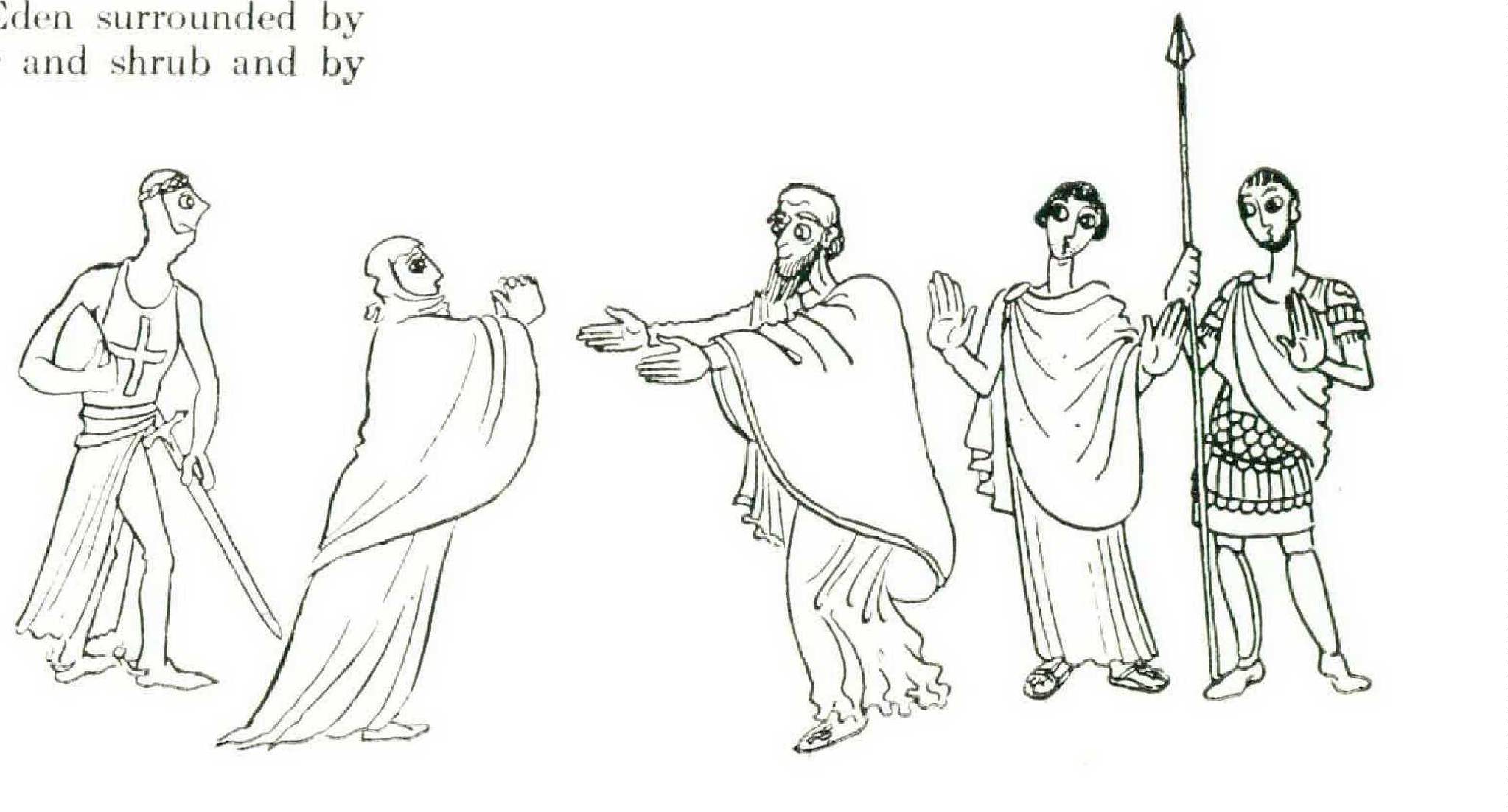
“Loyal subjects and distinguished guests,” said Constantine Protopappadopoulos, “we are met together this evening to bid farewell to one who by his valor and resource has laid the whole island, and particularly its ruler, under an obligation which can never properly be discharged. Of the circumstances and occasion of his coming among us you are all fully aware, and there is no need therefore for me to enlarge upon them, even had I the fluency and the descriptive powers properly to do so.”
Nevertheless for the next twenty minutes the good old man proceeded to describe in detail every aspect of his daughter’s plight and her miraculous delivery, adding several exciting incidents such as an underwater light with the leader of the pirates and a breathless pursuit by man-eating sharks, of which William, to tell the truth, had very little clear recollection.
“And now, my friends,” continued their host, “how best may we recompense this heroic and incomparable young man? I confess I have spent long and sleepless nights in debating just this question and only now have I found an answer which, however painful it may be to me personally, I am convinced provides the only solution.”
At this point in the speech there came into the host’s voice a note of deep emotion, and he paused to cast a glance of inexpressible tenderness towards his only child.
“Old as I am, my eyesight is still good, and I have not failed to notice, these last few days, the warmth and affection in the glances which my beloved daughter has freely bestowed upon our young visitor. He for his part, with that gentlemanly reserve which so distinguishes the gallant race from which he springs, has done his best to conceal his true feelings beneath a mask of stoical indifference. But I was not deceived! My daughter is, as you well know, the light of my life and the apple of my eye, but nevertheless, deeply and long as I shall miss her and here I think I am speaking not only for myself but for all loyal Kolynotes my dear Despina’s happiness must always be my first consideration.
“Take her, dear boy, take her,” he cried, turning to William with the tears coursing down his cheeks, “and may she ever prove as loyal a wife as she has been dutiful a daughter.”
Poor William was too embarrassed to speak and was, moreover, very much afraid that he was going to have hiccups. What on earth would his mother say if he were to come back with a foreign bride? Whatever was he going to do about his cousin Gertrude, whom his mother had long ago decided he should marry? Then, as the memory of Gertrude’s weather-beaten features and huntin’ voice came to him afresh and as he looked across the table at Despina, whose beauty had indeed made a deep, if unconscious, impression, his mind was suddenly made up. Rising to his feet he crossed the hall and took the lovely heiress’s hands in his own.
16
THE sun was low above the West Downs and, although it still wanted two days till the harvest was in, there was already a feeling of approaching autumn in the air. A faint mist was gathering in the meadows below the castle of Courantsdair, mingling with the wood smoke rising from the village hidden from sight in the valley. In the bailey, across which the shadow of the great keep was slowly extending, a large hay wain was being unloaded alongside the stables, the castle cat was stretching in that corner of the gatehouse which still retained the sun, and a row of ducklings went quacking in the wake of the gatehouse keeper’s daughter carrying a pot of mash to the pigsty. High above this peaceful scene in a sheltered corner of the battlements, the Dame de Courantsdair was watering her potted plants.
Nearly a year had gone by since William’s doparture for the Crusade and during all that time no word had reached Courantsdair. Local rumor had it that Sir Willibald do Wandsworth had been slain, but no details had as yet come to his neighbors.
The Dame, although she would have died rather than admit it, was growing nervous, and her youngest daughter Gwendolen, William’s favorite sister, made no effort to conceal her anxiety and was even now on the topmost turret of the keep scanning the road to the sea. This lookout she had recently made her daily charge at this hour of the evening, but was today observing every detail of the distant scene with a more than usual absorption. For Abbot Slapjack, who had arrived late at the castle the previous evening, had announced the presence of a large vessel from foreign parts lying out in the roads, and the fond girl hoped against hope that a messenger might be aboard bringing tidings of her beloved brother. The Abbot himself, not a sentimental type, attached little importance to his own news, and was comfortably installed in the Dame’s solar composing his sermon for the forthcoming Harvest Festival.
The Dame had just emptied her watering can and was preparing to go indoors when a shrill scream from aloft drew her attention to her daughter, who was pointing with wild excitement towards the coast road. Almost despite herself the formidable matron east a glance in the same direction, and as she did so the sharp reprimand which Gwendolen was about to receive on the rudeness of “point ing” died on her lips.
Coming over the crest of the hill, just before where the road sank once more from sight to the village below, was an impressive procession.
First came a gigantic Negro, superbly mounted, carrying a large banner with an unfamiliar device, closely followed by a snub-nosed youth that Gwendolen, whose eyesight was sharper than her mother’s, was hysterically certain was Leofric. Then came a closed litter borne on the backs of two mules alongside which rode a handsome youth on a gray mare (the Dame for some time remained unconvinced it was really her son), at whose heels there gamboled a large, tailless hound of familiar ugliness. Behind were visible two men-at-arms and a long string of servants and pack animals.
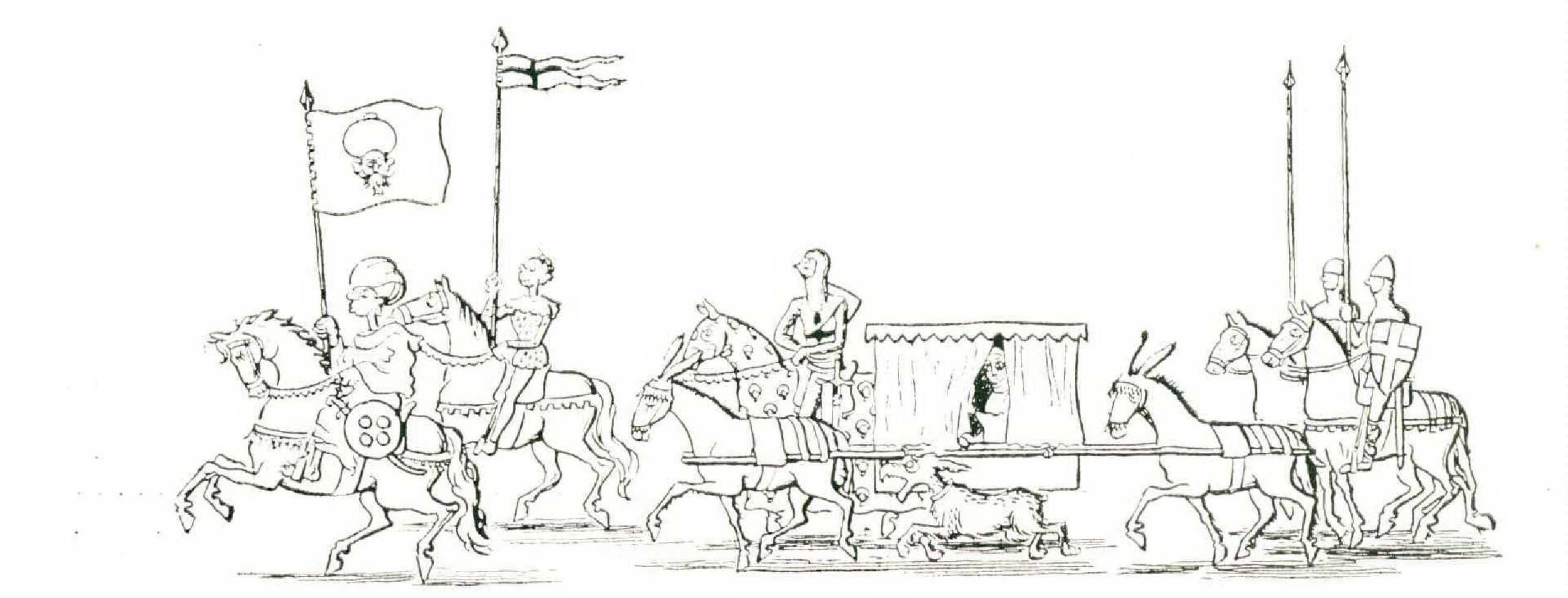
By the time the tail of the procession had passed over the brow of the hill, the Negro and Leofric were already clattering over the drawbridge into the outer bailey, and a sound of cheering from the village announced that the loyal villeins had recognized their returning lord. The scene which now took place in the courtyard was indescribably affecting. The gatehouse keeper, the gatehouse keeper’s wife, the gatehouse keeper’s daughter, and the gatehouse keeper’s dog made no effort to conceal their emotion, and the behavior of Gwendolen and her six sisters was hardly more restrained. Only the Dame maintained her usual well-bred, unruffled calm, but even on that stern and dignified countenance a close observer might have noticed, if the truth were told, a faint tremor at the corner of the determined mouth, a hint of dampness in the eagle eye.
Sir William, for his part, was deeply moved by the warmth of his reception and embraced his sisters with a genuine affection and his mother with a respectful tenderness. Nevertheless those who knew him best might possibly have detected a slight shade of nervousness in his manner. This, however, completely vanished on his overhearing one of his sisters remark with an engaging innocence how sorry poor Gertrude would be to miss this homecoming, and how ill she had timed her visit to her aunt the Abbess. Thereupon his brow cleared and with a firm determined step he advanced to the closed litter, which had already aroused the keenest speculation among the bystanders, and drawing back the curtains assisted Despina to alight, saying in loud, unshaken tones as he did so, “Mother, I wish to present to you the Lady do Littlehampton.”
The stunned silence whiclugreeted this announcement was finally broken by the astounded Dame.
“But, but — Gertrude? ” she said.
“She can go into a nunnery,” Sir William easily replied, adding a little unkindly, “she was everlastingly saying she felt she had a call to the religious life. And now,” he continued quickly before anyone had time to discuss the point, “we will go in and tidy. Then in half an hour all will repair to the chapel, where Abbot Slapjack, whom I am delighted to see here today, will celebrate our nuptials.”
Noticing the look of consternation which came over his mother’s face at this announcement, Sir William made haste to explain that as the previous ceremony had been conducted according to the rites of the Greek Orthodox Church, he had thought it as well to repeat them on his return.
“After that,” he went on, “there will be a wedding feast in the great hall, which some of my people here,” indicating with a casual wave of his hand the long retinue of servants, “will take steps to prepare while we are in the chapel.” So saying, he took Despina by the hand, whom, after she had made a deep curtsey to the Dame, he led into the castle.
The wedding ceremony, conducted by the Abbot with all his usual mastery, was simple but touching. The bride, in an exquisite white gown of a material which was quite unfamiliar to the ladies of Courantsdair and which they were interested to learn was called silk, looked ravishing. The bridegroom, whose beautiful golden spurs attracted much attention, seemed to have acquired a new confidence and dignity. And it was generally agreed that for once no fault could be found even with the behavior of Leofric.
It was a late hour, indeed, before anyone in the castle retired to bed that night. Over and over again William was forced to recount every detail of his journey and adventures, which he did with a becoming modesty and, all things considered, remarkable accuracy. On only one point did he in any way diverge from the strictest truth. In explaining the loss of poor Charlemagne’s tail he gave the company to understand that this had occurred in the gallant action beneath the walls of Acre. At long last, after he had described for the fifteenth time his overthrow of El Babooni, had recounted word for word his interview with his sovereign, and had distributed the last of the costly and exotic gifts with which he had come laden from Kolynos, he rose, bidding his mother and sisters a fond good night, took Despina by the hand, and gave the signal for a general departure to bed.
17
IN the years which followed the events recounted in this story the respect and affection in which SitWilliam and his lady were held by all who knew them steadily increased, and the castle of Courantsdair, in which its owner had effected many improvements — glass in the windows, Persian rugs on the floors, rich frescoes on the walls, and many other luxuries which, although common enough in the East, were totally unfamiliar in Sussex — became famous throughout the length and breadth of the land for its hospitality and high standard of living.
The Dame in the course of time was gathered to her fathers at the ripe age of eighty-eight; her unmarried daughters remained single, with the exception of Gwendolen, who married Leofric less than a year after William’s return; and Gertrude in due course succeeded her aunt as Abbess of a neighboring convent, where her filthy temper and unnatural strictness made life intolerable for all the nuns. Charlemagne lived to a ripe old age, much respected by all the dogs of the neighborhood and the terror of every puppy for miles around. Hercule in due course married the gatehouse keeper’s daughter, and their union was blessed with nine children, three white, three black, and three piebald.
Today more than seven centuries have passed since all these things took place, and small trace now remains of any of the scenes in this tale. The ruins of the castle of Courantsdair were long conspicuous, but were finally sold by the father of the present Lord Littlehampton some years ago in order to pay death duties, and the site is now covered by the Chateau Housing Estate. Today the only remaining indication of that once formidable pile is to be found in Nos. 18 to 25 Acacia Road, which, having been rather hastily erected on the site of the old moat, are quite exceptionally damp in winter.
In the little village church of Currants the beautiful tomb of William and Despina, in the early Gothic style, is still preserved alongside that of Sir Dagobert although rather overshadowed by the white marble resting place (adorned with sixteen cherubs, a life-size statue of the deceased in a full-bottom wig, and allegorical figures of Faith, Hope, and Charity) of his eighteenth-century descendant, Admiral of the Blue, Sir Marmaduke Littleharnpton.
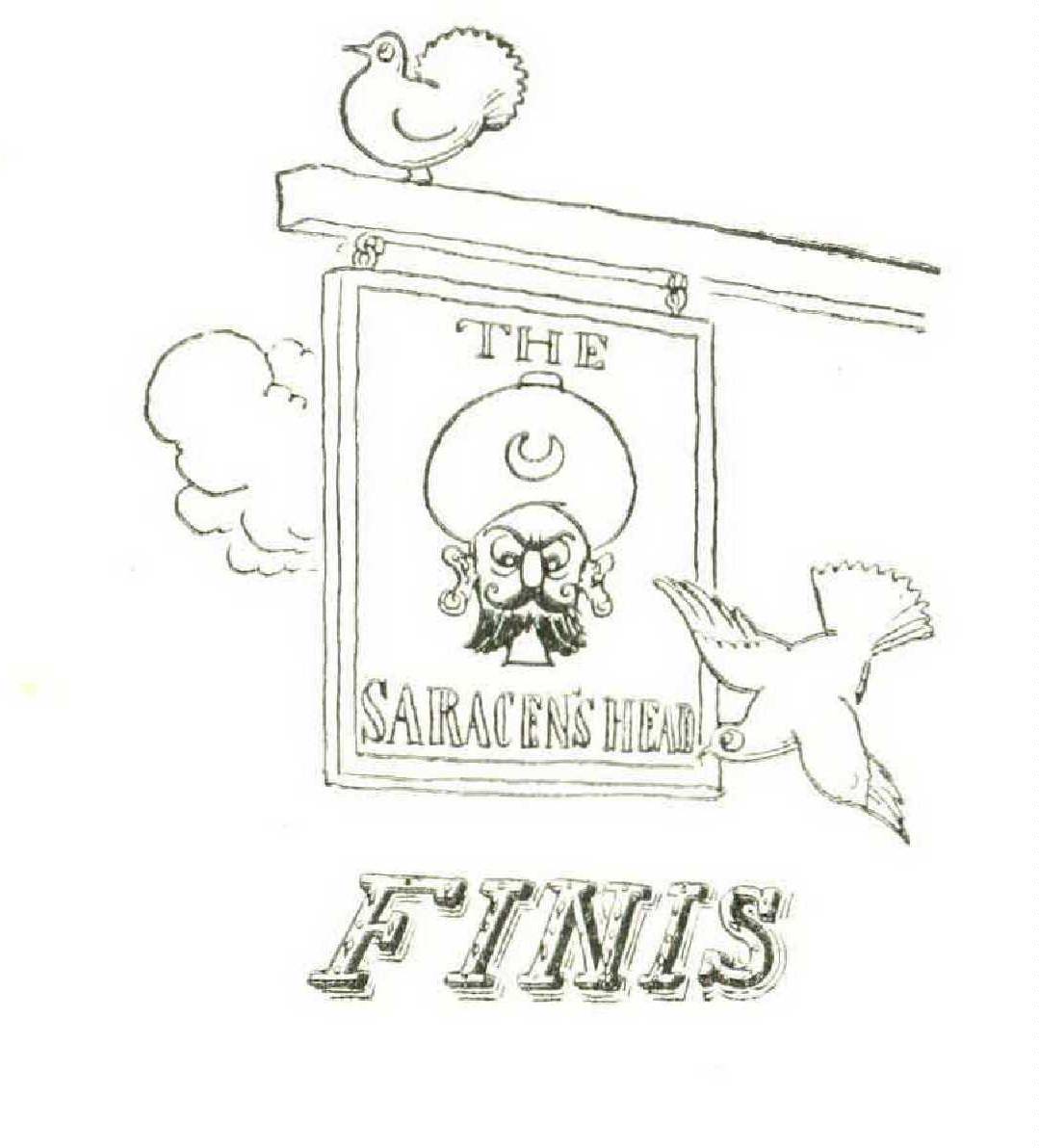
Of the village which William knew as a boy no trace at all remains. Nevertheless, if you look up above the door of the ancient inn (almost completely modernized in recent years) that long ago replaced The Blue Boar which occupied the site in the time of Sir Dagobert, you will still see, weatherbeaten but recognizable, creaking rustily beneath the eaves, the proud sign of The Saracen’s Head.