Three Frosted Drinks
by. Q. DE GOUT
IN the ordinary run of summer sociability, the frosted drink—a julep or planters’ punch — is a rare thing indeed. By all odds the best-looking of hot-weather drinks, the julep or punch is also leisurely, delicate, and phenomenally cold. It even sounds attractive on a muggy evening with the rattle of its finely crushed ice. Its fragrance is of fresh mint or fresh limes with faint overtones of bourbon or Jamaica.
On specifications, then, the perfectly frosted drink for nine o’clock of a July evening is all right. It is not hard to achieve, the ingredients are simple enough, and the cost is no more than its equivalent in cocktails or highballs. But it remains an infrequent pleasure, outshone by its inferiors, even in times of tropical heat.
On the basis of most of the recipes for frosting drinks, I do not wonder that the householder shies away from them. The more casual instructions in the handbooks would not produce a frost, and the more complex make too much work of it. Like a collapsed soufflé or the bisque that curdles, the julep that does not frost is a fiasco. But made with any regard for its essentials, the thing has to frost, it can’t help frosting. The essentials: —
Glasses. — The thinner the glass the quicker and better the frost. Serve the glass on a saucer, for fingering it will spoil the frost. Kentuckians notwithstanding, a straw or sipper is the comfortable way to drink a julep or any other drink made with crushed ice.
Ice.—Ideally, the ice is crushed to about pea size, and most of the gadgets for this purpose turn out a satisfactory product. Large lumps of ice impede frosting, and a piece the size of half an ice cube will prove to be a nuisance. Frosted drinks require two or three times as big an ice supply as highballs.
Liquor. — The enemy of frost is dilution, and one can be sure of the best all-round result in any case by using 100 proof bourbon for juleps and 90 proof Jamaica or Demerara rum for punches. Before the war, 114 proof rum was available, but it appears to have gone off the market, and the highpowered 151 proof type is too heavy to use by itself. Combinations of the 90 and 151 proof rums are worth experiment, and three parts 90 proof Demerara joined with one part 151 Jamaica make an impeccable punch.
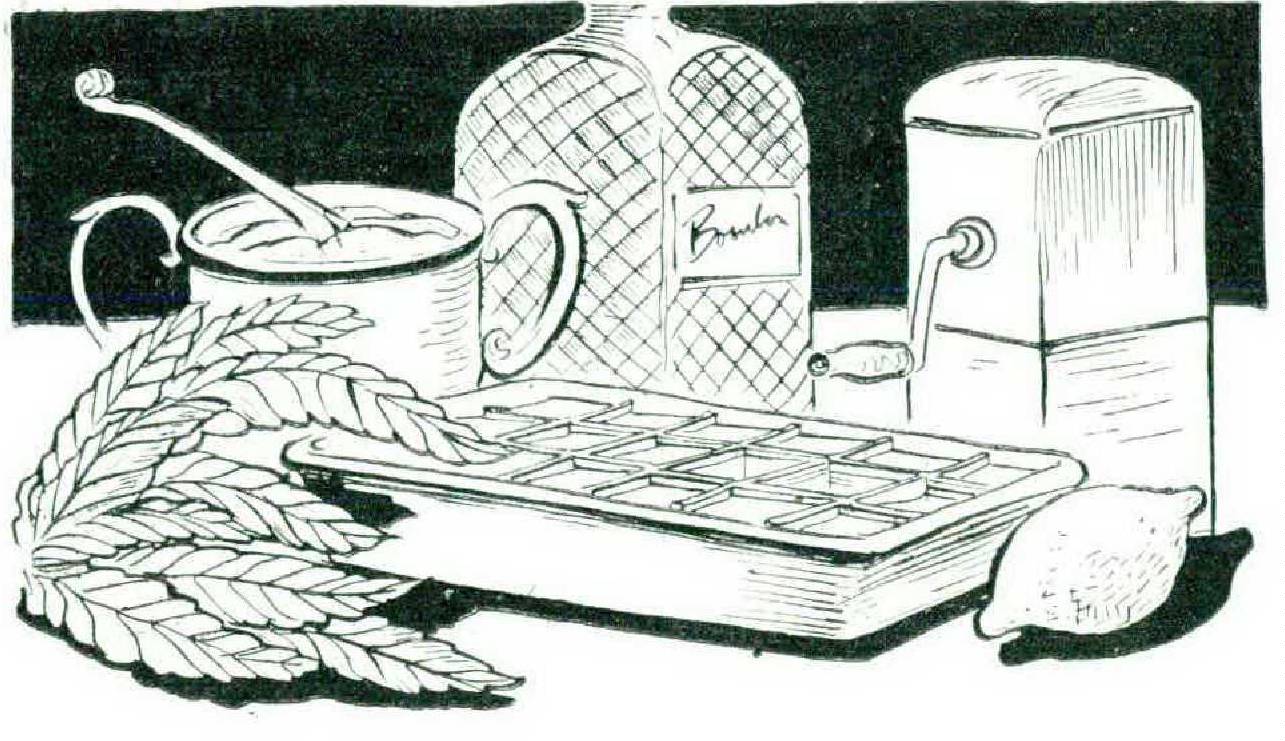
Mint.The small, bright green leaves of spearmint are preferable to other varieties.
Sweetening. — Rather than become involved with sugar syrups and their water content, which tends to dilute the drink, I use granulated sugarin the proportion of one scant teaspoonful to a glass for juleps.
The argument as to whether or not the mint should be “bruised” is still heard from time to time, usually from people who have no idea of what they are talking about. The issue is one of taste versus bouquet. For those who like the taste of mint in a julep, the leaves must indeed he “bruised” or muddled or macerated. The non-bruise school uses its mint only for olfactory and visual purposes, by topping the glass with a thick bunch of sprigs, and one burrows through these without a straw for a potion that is substantially nothing but plain whiskey sweetened. There is no sense in putting mint leaves in a julep and not bruising them, if one expects to impart any significant flavor of mint to the drink.
It is this same issue which causes some experts to disdain the straw. If you make the drink for mint taste and bruise the mint, you would naturally use a straw to avoid showering yourself with crushed ice. If the mint is to be sniffed rather than tasted, the straw is useless.
The prime necessity in making a drink frost and stay that way is to keep the glass tightly packed with crushed ice from bottom to brim. There should be no floating ice area at the top,-the ice is even bulging slightly above the glass when it is first issued. Packing the glass is easy enough, the drink comes out at the correct bulk and strength, and no subsequent stirring is needed, if one proceeds as follows: —
Fill the glass with ice to about the halfway mark, tamp it lightly with a spoon or glass rod, pour in a splash of liquor and tamp the ice again. More ice, more liquor, more tamping, to the three-quarter mark. Repeat for the final quarter. For this packing and pouring method, then, here are three summer recipes:-
Mint julep. — Muddle a dozen or fifteen mint leaves with sugar and a tablespoon of ice in bottom of the glass; add a little ice and stir till sugar is dissolved; pack the glass and pour in the 100 proof bourbon as above; at the three-quarter mark decorate with two or three good sprigs of mint and complete packing and pouring. The final touch on this drink is a spoonful of ice tapped in on top.
Frosted sour.-Use the julep recipe with bourbon, substituting two tablespoons of lemon juice for the mint.
Frosted punch. — Ditto, with two tablespoons of fresh lime juice (lemon will do, but limes are better) and Jamaica or Demerara rum instead of bourbon.
A hot-weather drink that will not frost but is reasonably to be included in this presentation is iced coffee, provided one has sufficiently powerful drip coffee as a base. To that end I suggest a rereading of “Strong Coffee” in the June, 1945, Atlantic. Chill the finished beverage in a jar or milk bottle in the refrigerator and serve it, three parts coffee to one part whipping cream, sugar to suit, in tall glasses with ice cubes. Pouring hot coffee on ice does nothing but ruin the drink.