This Month
Advice to the well-digging Chairman of the American Institute of Physics (page 87): enjoy your well, drink freely, and don’t build a house there.
A summer cottage at the edge of the sea. with plenty of privacy and no near neighbors, ought to be a boon to the city dweller. As he sizes up its simple furnishings, aware that most of his waking hours will be spent on a beach or tennis court or lounging in the sun, the cottage promises an easement of all that has burdened him in town. Shorts and sneakers, a nap when he feels like it, pickup meals with a minimum of fuss, the dawdling over breakfast coffee, and bed around ten of an evening — these are the costless yet profound satisfactions of seashore life which the cottage offers. No doorbell, no dinner parties, no forays into the week-end traffie. He will have nothing to do with or-for — anybody, in his cottage life, except those of his own choice. He feels almost guilty in the selfishness of the prospect.
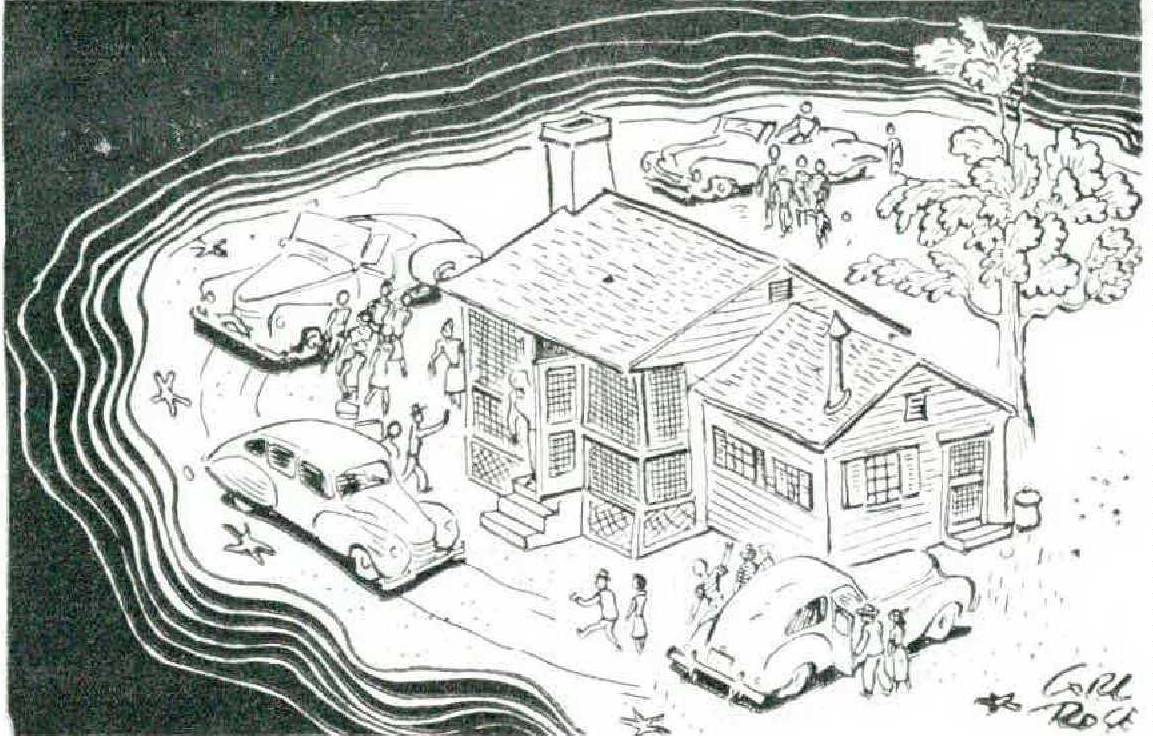
Nonsense. Unless the cottage is located on Easter Island or unless the summer resident, Doakes, is living under an assumed name, his dream of idle pleasure is wrecked even before he has relearned the oil stove and its ways. In about the same numbers as those visiting the Statue of Liberty or Radio City on a fine day, guests of all kinds begin dropping in on him at all hours.
Aside from certain predatory characteristics, the guests are perfectly normal people, healthy and with powerful appetites and just as tired as Doakes of town life and household chores. Some of them are friends of his. Some of them he has even invited. But most of the guests come simply because word has spread, like the grapevine of the underworld or the mysterious pulsation which speeds news through the wilds of Africa, that Doakes is now open until Labor Day, there for the taking and at their senrvice. Short of working without pay in the field of organized public welfare, Doakes could sweat no more altruistically for people in general than he will in his pleasure-dome by the sea.
Doakes has no defenses against visitors simply because he is trying to spend his holidays in genuine idleness. If he were conducting bird walks or running a charter boat, he could at least plead engagements. But his basic plan for a sunny noon places him under an awning in a long chair, a frosted drink (page 86) within reach, a light lunch and nap next on the docket. He is doing nothing, going nowhere and looks it, when the first carload of visitors pulls up.
Doakes tells himself it’s a mistake, wrong road, lost the way. But no, a spokesman, vaguely familiar to Doakes, approaches him and hails him by name. The spokesman is either the man who thought up the party or one skilled in negotiations for the uninvited. His opening is brisk: “We just thought we’d come down and have a swim and picnic, what with all the room you have around here. I don’t want you to do anything. Don’t take any trouble for us. We don’t need a thing.”
It is all put in such a way that Doakes is being asked only for the loan of his ocean and a few rocks. Thus he is unable to reply, “Unless you and your party leave these premises forthwith, I shall have you ejected by the police.” He is, in fact, like the luckless character in the mystery story, whose misadventures run to book length because he decided not to call in the police.
“I’ve got some people here from Wilkes-Barre who want very much to meet you anyhow,” the spokesman goes on, “and my wife’s uncle and aunt came along — they’re staying with us. I can’t tell you how much the kids have been looking forward to this.”
Within the next hour, Doakes has served a couple of rounds of frosted drinks, ginger ale for the children, taken the visitors and their beach bags to various bedrooms to change, and made up their deficiency of towels. The spokesman borrows Doakes’s dressing gown; he’s afraid of sunburn. Off they go to the beach while Doakes washes up the glasses and collects cigarette stubs, gum wrappers, and debris from his terrace.
He is through just as the beach party returns. They are all ravenous after their swim, and to save time fiddling with a fire outside on the rocks, would Doakes mind if they boiled up a few lobsters on his stove? It begins to look showery. Probably the wise thing would be to go ahead with the meal in the cottage and give up the picnic plan. Eh, Doakes?
Doakes is allowed to join the feast, but the visitors hadn’t counted on an extra “guest ” and he comes off rather leanly with a couple of lobster claws and a dot of potato salad. “Anyone want coffee?” the spokesman demands, and sure enough, they all do. Thanks a lot, Doakes.
By the end of the meal, it’s raining steadily. The visitors sit with Doakes for a while in his living room. The children are fractious; bored with Doakes’s poker chips and record albums, they begin pelting each other with pieces of the Monopoly game. Eventually, the visitors manage to let Doakes see that he is not proving himself any great shakes as a host. Even his weather is a disappointment. Back to town, the spokesman suggests. They pack up in a hurry and depart.
A careful reading of Walden will show that all Thoreau was trying for was a guest-proof base. “Two knives and forks, three plates, one cup, one spoon ” — that was the most Thoreau had to risk in dishwashing. As to food and refreshment, he’d stand for one guest, “But if twenty came and sat in my house, there was nothing said about dinner.”
Unless Doakes seeks to become a virtuoso of inhospitality, he will get out of the cottage game and bone up on Hotels and Resorts. Those long rows of rocking chairs on the veranda of the Cliff House may be just the thing after all. C. W. M.