The Sinking of the Well
Distinguished for his teaching, research, and wartime work in the field of optics, GEORGE R. HARRISON is Dean of Science at Massachusetts Institute of Technology and Chairman of the American Institute of Physics.
by GEORGE R. HARRISON
SEVERAL years ago my family and I, while roaming on the northern or less sophisticated side of Cape Cod, came upon a gentle slope that looked out over the bay in so interesting a fashion that we decided here would be the place for the summer home we hoped to build when the war was over. At the top, broad wind-swept pines stood hardly twice as high as my head, and under these the needles were clean and cool; while lower down, the wild cranberry spread a smooth carpet among the beach-plum bushes and barberries. Here we would put in a well, so that water would be immediately available when the time for building arrived, and in the meantime we could pump our tin cups full and picnic on our own domain.
Once the papers had been passed and the hillside was securely ours, I inquired at the nearest Cape Cod village as to the possibility of a well. Mr. Billingsley. the plumber, proved elusive for our first three visits, and after that evasive. Finally, by dint of great cunning, we got his promise to sink the well “right after Christmas.”
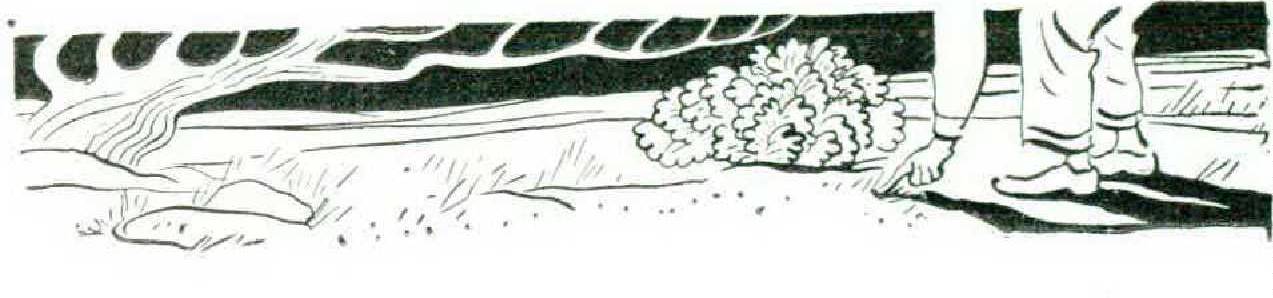
But Christmas passed, and all the months of snow; and when June brought the bayberry blossoms again and we went down to pump gushing water from our lot, there was still no well in sight.
It was our distant neighbor Mr. Purvis who eventually resolved the situation. He had sunk his own well with the aid of a brother-in-law, and he honored me by supposing that if he could do this, perhaps I could also. To be sure,
I had no readily available brother-in-law, but I had David, my sixteen-year-old son.
According to the Handbook of Plumbing, which, though slated for the past twenty years to be thrown out, now proved itself to be a jewel of the fairest water, wells can be dug, bored, or driven.
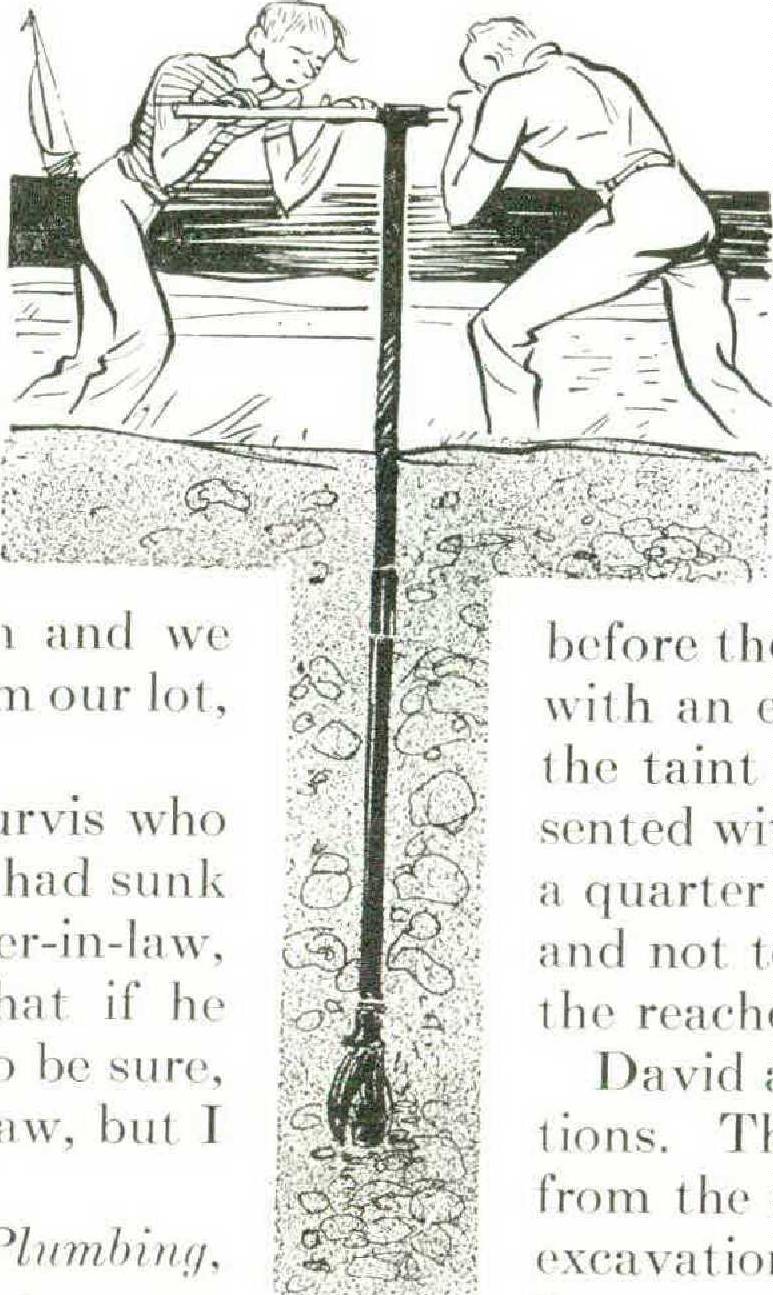
Digging was out of the question, I could tell from experiences in clearing the walk after a six-inch fall of snow. Boring rigs, it developed, are complicated structures which require large engines for their transportation, and even larger ones for their operation. But if between the bayberry bush that marked the spot where we decided the well should be, and the clear stream that we envisioned as coursing far below, there lay only sand and clay, and no gravel, granite boulders, or other massive glacial debris, it might be possible to bore a well by hand with an elongated post-hole digger. Or one could, said the book, screw a rigid pointed strainer to the end of a piece of pipe and, by well-directed blows of a heavy sledge, force this “well-point" into the earth.
All through the winter I laid my plans. The water probably lay not more than thirty feet beneath the surface, for wells on either side not half a mile away contained water that had been struck at that depth. In the basement at home I assembled and checked over all the necessary tools, and provided for every contingency except the fatal ones of striking a rock or reaching salt water instead of fresh.
On a Saturday early in July all was to be ready, and we would have the entire day to sink our well. According to my calculations this should take not more than five hours, which left seven hours for rest, recreation, and unforeseen emergencies. Yet I knew in my heart that no matter how carefully I planned, the well would take much longer than seven hours or even twelve, and that the setting sun Would see me driving homeward well-less and with an aching back.
There was only a faint glow in the east when we made a last check of our load. Grub hoe, shovels, well-point, pipe — everything was there. It was still early morning when we pulled up at a Cape neighbor’s and started filling an old oil drum with water to be used in priming the pump when the well was ready to produce. Fifty gallons should be enough. I assured our friends that this was only a loan; before the day had passed it would be replaced with an equal quantity of water untouched by the taint of professional plumbing. I was presented with an empty bottle and the promise of a quart or if I could return it filled with potable and not too saline fluid obtained from beneath the reaches of our “sandpile.”
David and I were soon at the scene of operations. The roots of bushes which we pulled from the dry sand at the planned point of the excavation seemed discouraged: and never had I seen a spot which showed less likelihood of slaking thirst. But we inserted the post-hole digger, took a dozen tentative turns on the handle, and pulled it up. Our well was eight inches deep.
Soon we found that ten turns were sufficient to fill the curved maw of the digger, then eight, then seven. We were proceeding with efficiency and dispatch. Turn, turn, turn — then up to dump the load: do it again, and another foot of depth is added. The sand seemed to come cleaner and cleaner, but on the next insertion we heard a sound which sent a quiver up my spinal cord. The borer would not turn. We had struck a rock.
I looked at David, and David looked at me. Was this, then, to be a barren spot, predestined to eternal aridity? I hauled up the digger, emptied the small handful of sand it contained, and banged it back into the hole. David gave it a great heave, and it moved! Turn, turn, turn again, both holding our breaths, and it came up full. Before half an hour had elapsed we had pushed the hole down as far as two added lengths of pipe would take us -sixteen feet —and the sand grew yellower and more compact as we proceeded. Eventually the sand became intermingled with clay, and the clay was definitely wet!
Then progress began to be slower — we found that we were even losing ground. The handle would be turned its seven times and would go down its eight inches, and the load would be painfully raised and dumped, but when the borer had fallen again to the bottom of the hole, the handle would be higher than it had been before. This, I came to realize later, was a good sign, for the clay was now so wet that it would not stand alone, and the lower sides of the hole were collapsing faster than we could remove the debris.
Now I was glad that I had provided for both a driven and a bored well. We joisted out the digger and assembled enough lengths of two-inch pipe to
lower the well-point to the bottom of the hole. Then we screwed a cap on the topmost pipe, and backed up the station wagon so that its tail gate would serve as a platform on which to stand. David took a well-aimed blow at the cap with a sledge hammer. I expected to see the pipe drop a foot into the ground. Instead the cap shattered, and the top of the pipe was so bent that another cap could not be screwed on.
Fortunately we had enough pipe, so the top length was replaced and covered with another cap. Again David aimed the blow; again the sledge descended, and again the cap shattered. This time the pipe remained undamaged, but we had no more caps. Ten minutes elapsed while we contemplated our defeat. Then I cut a stubby branch from a pine, trimmed it to a plug, and hammered it into the top of the pipe. Soon regular gentle blows from the sledge were forcing the pipe slowly down, down, down. Forty blows by me, and the top of the pipe would be three inches closer to the ground. Eighty blows by David, and it would be down six inches more. So we took turns, forty and eighty, father and son, until we had gone down five feet with the sledge and it was necessary to screw on another length of pipe.
The sun by now was very high; we had been some four hours at the well, and I knew that the hardest work was still ahead. To justify a few extra minutes of rest I said, “Let’s man the pump.” and before inserting a new plug into the added length of pipe we screwed the little red hand-pump into place. In addition to the fifty-gallon drum of water, we had brought a sprinkling can full, and this I poured into the pump, pushing the handle vigorously as I poured. Nothing happened.
Then suddenly there was a catch; no more water would go in, and a few
strokes later a flood of creamy liquid came pouring from the spout of the pump. With loud shouts we pumped energetically by turns, and there was no slackening of the smooth and viscid flow. Gradually,however, the clay was washed out of the wellpoint, and by the end of an hour of pumping the water emerging was definitely limpid. As David pumped I measured the flow with a bucket: six gallons a minute of sweet and clear water. Darwin, Golumbus, and Einstein were our companions in the joys of discovery.
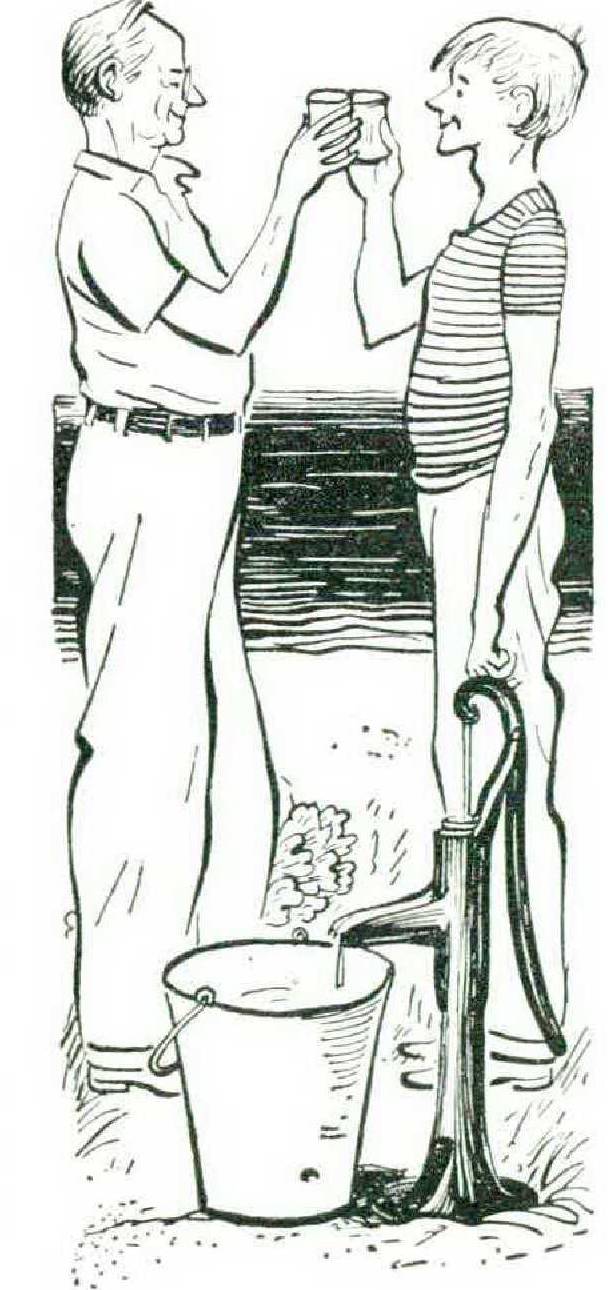
The more we pumped, the clearer came the water, and there was no lessening in the flow. Late in the afternoon my wife and daughters, returning from an excursion of their own, came to see how we were progressing. When we saw them in the distance we assumed the proper disconsolate attitudes. How did it go? The pipe broke. Oh, too bad. Then David pumping violently, and the gushing stream, and the delighted ejaculations of surprise and congratulation.
Later we dug down a few feet around the well, so that it could be capped and covered for the winter, and found the stone we had struck. It was about the size of a golf ball, and had obligingly permitted itself to be pushed aside. Not two inches from it we found a boulder bigger than my head.
The fifty gallons of water we returned gratefully and untouched to the friends who had provided it, and we presented them, using appropriate ceremony, with their bottle filled with nectar. The well now lies snug beneath the sand, secure after several bleak winters and foggy springs. When summer came again, and the sun was hot on the dunes, I pumped from it a cooling draught. Then I looked with pride at the well that David and I had sunk, and I said to myself, “I am a successful man.”