Snakes for the Squeamish
Author of the recent best-seller The Big Sky, A. B, GUTHRIE. JR., is a Lexington, Kentucky, newspaperman.
by A. B. GUTHRIE, JR.
WE CALLED the king snake Dr. Ditmars. Only one of the seventeen other reptiles once to be found in our house ever acquired a name. His was Dr. Funkhouser, after the authority who had identified him for us as a milk snake or cowsucker. The others — the hog-nosed viper, the indigo or gopher snake, the ringneck, the assorted grass and water snakes — we never got around to naming; their addition to our reptile house left little time for idle occupation with individuals.
Besides, other and unreckoned responsibilities kept increasing, until at last we found ourselves the tenders not only of the reptiles but of (1) one white rat, (2) ten inbred and highly nervous mice, and (3) one incredibly warty and lethargic toad.
They all came to be in our house as a result of the fascinated interest of our son, when he was six, in the excellent plates in Dr. Raymond L. Ditmars’s Snakes of the World. The pictures of the king cobra, the Gaboon viper, the reticulated python, and all the rest engrossed him at once and at length. Let my wife or me sit down and he crawled into our laps, lugging the book with him. He pestered startled and sometimes uneasy guests with his insistence on joint scrutiny. He asked questions that, would have stumped Dr. Ditmars himself.
His interest seemed good to my wife and me. We encouraged him. We thought he might slide easily from boyhood hobby into adult, profession, like Naturalist Ditmars himself.
As a consequence, when Nonny came into the house one day, clasping in one fat list the small milk snake later called Dr. Funkhouser, my wife stifled her screams and got a box. We put the reptile in it and fed it earthworms and congratulated ourselves on our bold exercise of child guidance.
Reading of the mild and friendly nature of the common or chain king, we had one sent from Florida that fall. Dr. Ditmars was mild, all right, and friendly, I suppose, though a snake’s capacity for manifestation is limited. After he became used to us, he seemed to welcome the opportunity of winding his cool cylinder about a warm, bare forearm, from which the alert head stood out, spearing a nervous tongue into the universe.
With early spring, we began to worry lest Dr. Ditmars was hungry. The reptile books said that as his winter torpor wore off he should have a live meal — a mouse or a small rat or another snake. And now our troubles began. Though mice heretofore had specked the pantry shelving and rummaged in the Wheaties, we could not find a one. Our clever little copper cages — $1.19 each — which we had been assured would catch mice alive, corroded in basement and pantry. Despairing of them, we tried oldstyle spring traps, thinking to snatch from them still warm and possibly acceptable, if dead, sustenance. The bait molded on the triggers.
So, in desperation, we got Mousie, the white rat, from the University of Kentucky Physiology Department. He was a sleek creature, a mouse-size suckling with pink eyes and silky fur and inquiring whiskers.
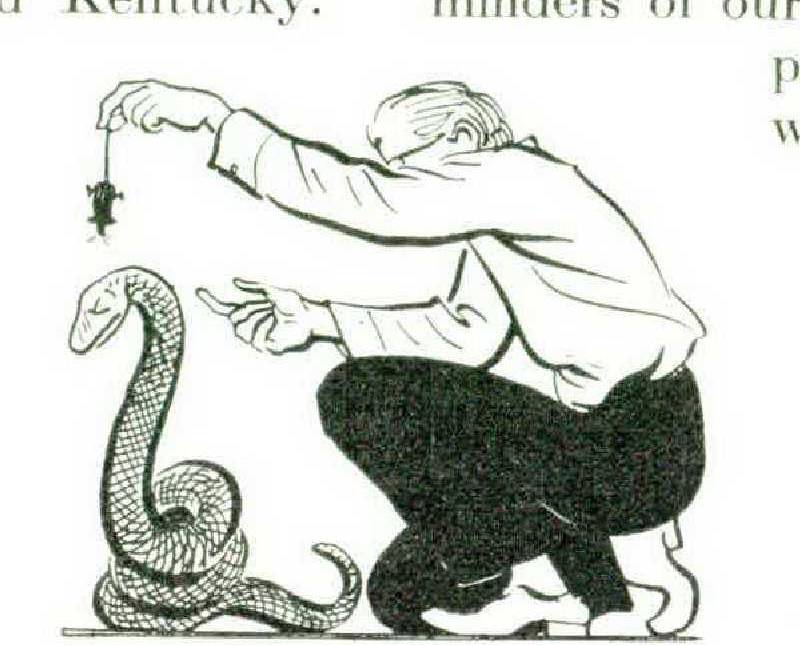
We offered Mousie to Dr. Ditmars once. Rather, I did, against the eloquent, if half-spoken opposition of wife and son. The snake drew back, hissing, as I introduced him and then squirmed forward and poked his nose gingerly at the white puff and flung himself back and glided forward again while a fine tremor agitated the helpless suckling.
Unequal to the spectacle, I joined the family in the kitchen and we stood there while the clock tolled off the forty-five dragging minutes that the reptile books allow for a snake to prove its hunger, and then we all ran for the cage, and I believe we cheered, for there was Mousie, still alive. Suckled thereafter on a medicine dropper, he thrived on the formula compounded for our eight-week-old baby.
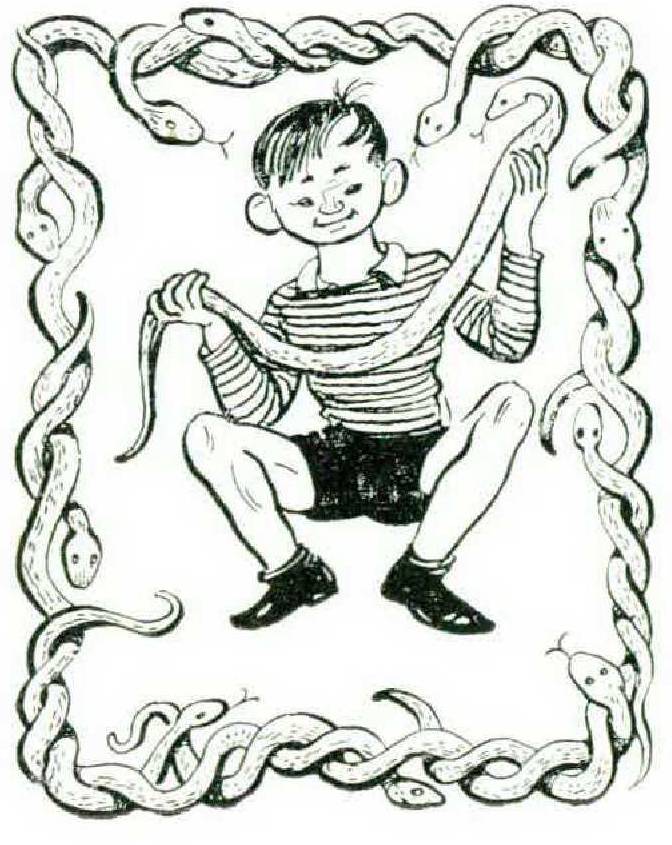
We should have known better then, but Nonny insisted on more snakes, and my wife and I remained in the throes of enthusiasm for child guidance, and so we acquired the hog-nosed viper and the gopher snake and the ringneck, and a dozen or more assorted reptiles that Nonny kept bringing in from the fields.
We learned a good deal about snakes. The king and the gopher quickly became friendly, or at any rate accustomed to us. To the last, though, the little cowsucker would coil and vibrate his tail and strike savagely but harmlessly at our hands. Until he lost his fear of us, the toothless viper would swell his neck, cobra-like, and feint at us. That threat failing, he would flop over on his back and play dead. He gave himself away if we righted him, for he always turned back over.
Shedding was a process always interesting and wonderful. We watched as the skin faded and coarsened and the eyes dulled and the sight finally was lost behind a milky cap. One day the old garment would tear, and beneath it we could see the fine, new, colorful sheath. At that point we usually helped, drawing the shedding skin away carefully. Nonny always was delighted when we got a snake peeled out, for then, he said, it was just as if the pet were brand-new.
We might have continued our studies but for the nutrition problem. The situation was acute before the indigo and the viper arrived. Afterwards it was harrowing. I had ordered a small indigo. The one sent us was not an inch under five feet. A constrictor, he was thick and muscular, obviously a heavy eater. As we pulled foot after foot of his handsome, lustrous, purple-black body out of the mailing box, I thought despairingly that nothing less than a shoat would satisfy him. He was a calm and gentle creature, with amber eyes and the habit of hissing softly when we handled him.
The instructions said he fed on gophers or rats or mice, of which last-named he would require quite a number. And, of course, they had to be live gophers and live rats and live mice. To the best of my knowledge, no gopher ever inhabited Kentucky. Later, I was to wonder whether a mouse had. We never tried for rats, feeling that an encounter between rat and snake would be too suggestive of the Roman arena for our household. As for the hog-nosed viper, his tastes were different. His meat was frogs and toads, live frogs and toads.
No one who has not awakened morning after morning knowing he ought to have a live mouse by night, no one who has not driven himself out into the barren grass to look for a toad, can know the burden that settled on our house. We trapped and we searched and we searched and we trapped. We kicked through the fields and set cages in garage and tool house and offered boys ten cents for each mouse or toad delivered alive.
The results were meager. We caught a mouse or two, but always in spring traps that killed them. One was still warm, however, and we managed to get the king snake to take it by agitating it slyly with a stick. Out shopping, my wife snatched a half-dead rodent from a grocery cat. We got one toad, too, a pensive and virtually stationary amphibian which cried so piteously as it started down the viper’s eager gullet that we hurriedly rescued it.
At last we wired to Florida: “Ship immediately, two dozen mice, one dozen toads.”
The mice arrived a few days later, twenty-four of the most peculiar rodents ever assembled. Some had ticks and some had twitches and some ran crazily in circles. Some were brown, some were black, some were white, and some were parti-colored. You had only to look at them to know they were at the wrong end of a long line of inbreeders and miscegenators. One and all, they won such a lender concern from Nonny that we got only fourteen of them to the snakes, and those only by stealth.
It took the toads much longer to arrive, but up the walk, at last, came the expressman.
“Lady,” he said to my wife, holding the parcel away from him, “this here box is for you, but I don’t think you want it.”
He added: “It like to stunk me off the truck all morning. Something’s mighty dead in here.”
Our enthusiasm had run out to the last reluctant drop by now — my wife’s and mine, that is. Nonny was eager as ever, except that a proposed trip to Montana had given him another and more immediate interest.
Eventually, we decided to give the king and the gopher to the University Zoology Department. The white rat went back to Physiology. Dr. Funkhouser, the hognose, the ringneck, and the garters were turned loose. The last fantastic mouse sickened and died. The toad we set out in the grass and he faded imperceptibly into the yonder. For reminders of our project we have the empty cages, plus the following enduring bits of wisdom from our observations: —
1. Once you can bring yourself to lay hand on a snake, any extravagant fear of it is likely to disappear.
2. There is nothing like a snake in the house to keep callers from interfering with your homework.
3. It is hard to catch a mouse alive.