Oldest Inhabitants
John W. VANDERCOOK is widely known as an author, world traveler, and radio commentator.
TRAVEL
by JOHN VANDERCOOK
THE habitation of Achille Beynac, a Frenchman by nationality, a small farmer by vocation, overlooks the valley of a good-tempered little river called the Vézère in the Department, of the Dordogne. As the famille Beynac is proudly aware, theirs is no usual dwelling place. It is the oldest in the world.
More pretentious households are ready — frequently too ready—to offer documentary proof their particular piece of property has been in continuous use for generations. It is difficult to take such people seriously. For much more substantial testimony than any faded deed or charter is at hand — indeed, no farther away than an easy sloptoss from the kitchen door—to establish beyond all quibble the Beynac demense has been suitable and pleasant for man’s needs, just as it is today, for between one hundred and twenty-five thousand and two hundred and fifty thousand years. Among the district’s few hundred shopkeepers and peasants — whose knowledge of the remote past is as extensive as are the minutiae of baseball among American elevatormen — that perhaps not inconsiderable difference is the subject of much discussion. The exact truth may never be established. Local opinion, however, understandably favors the higher figure.
A quarter of a million years, like a quarter of a million francs, are clearly more satisfactory than is merely half that sum.
The house is of unpretentious, neatly whitewashed masonry. Part of its roof is tiled, and conventional enough. The rest, for convenience, is formed of the jut of one of the low chalk cliffs that typify the region.
The cottage itself, fucked snugly under that vast, protecting shelter, stands some forty feet above the level of the fields, so to reach it one must climb a flight of wooden steps. To the left the gentle river, bordered by willows and flanked by growing crops green under the usual sun, winds out of sight. To the right is the drowsy, red-roofed, white village of Les Eyzies. Off to the northward, far enough away to concern only the adventurous, is Périgueux. And somewhere to the west is Bergerac. The view from the economically small windows of the Beynac homestead is as peaceful as any in all of France.
It is a view which has undergone some monstrous changes. And always, truly always, since spines began to straighten and thumbs, with such tremendous consequence, grew long enough to touch the tips of fingers, human eyes have watched them.
Not far from the back door, under the shadow of the cliff, inquisitive, excited visitors from the pitiably nouveau world outside have dug a deep trench. The sides of that trench, cut like the slash of a giant sword through time made visible, index the unimaginably ancient story.
Down at the very bottom there is earth. Void and calm as it waited while the planet spun and ihe rhythm of the sun marked endless ages, and ihere was none to hear the soughing of the wind or the river’s whispering. Up the exposed sides, mere inches, life begins. Abruptly. Man had come. That overhang of limestone, even then, gave protection from the rain.
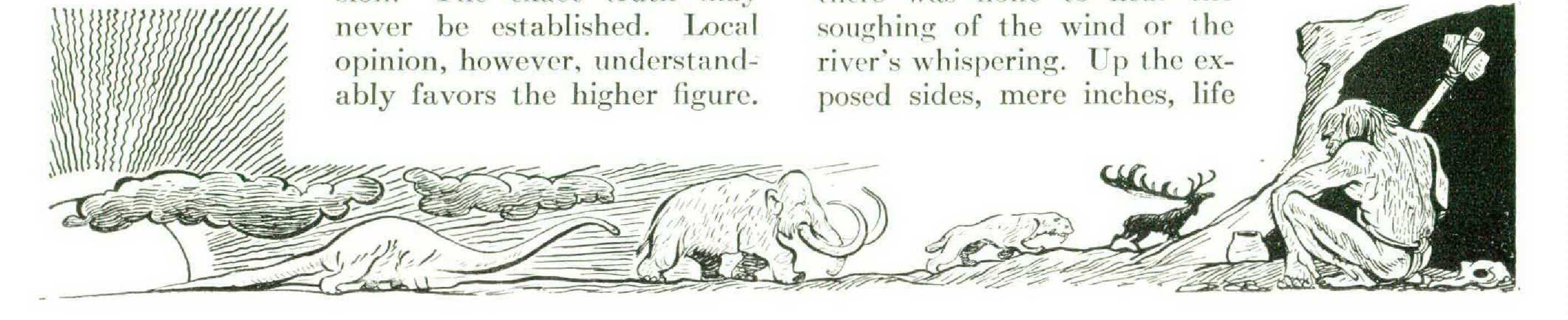
None, at first, was needed from the cold. Dawn-beings — Chelleans they call them now — with what must have been heavy casualties, then hunted hippopotami, swaying elephants with beady eyes, and tigers, here in this same valley. There was no winter, which was as well. For those first anicêtres, as the inhabitants of Les Eyzies familiarly speak of them, who devoured the bloody meat of their animal antagonists on the beynac property had not yet discovered fire. The detritus of bones and of roughly shaped flint instruments left behind from some forty thousand years of Chellean banqueting are dusty white in color.
It grew colder. The tigers and the hippopotami went south. Down from the stormy summit of the globe the ice was spreading, with the majestic sloth of wisdom. But man stayed on. Bison and reindeer added their bones to the unmistakable litter under the shelter’s shadow. The level of the floor, as anyone can plainly see, was rising. The profusion of flint tools assumed variety and art.
At last the waters of the Vézère grew still. The ever wintry rains puttered, and were caught in steely-blue enchantment where they fell for thrice the time that has galloped by between the rise of Ur and the fall of Nagasaki. Bear, boar, woolly mammoth, and the strangely stubborn tribe of Man were the only creatures who remained.
Halfway up the walls of that revealing trench there is a vivid change. The layers of bones broken for their marrow are all blackened. Stimulated by the fierceness of the Time of Ice, man had discovered fire. His brain was growing. His hands were more agile. Though when the pale sun shone he and his strong women still lived, slept, got their kind, and cooked the prey they had dragged there under the cover of the ancient cliff, other, perhaps cleverer neighbors a few miles away found deeper caves and the courage to penetrate their darkness.
Fire gave light. By that light in the new-found privacy far under the hills they made a new discovery. Alone among all living things, men could, if they chose, create. Life need not be, as it had seemed so long, mere uniform destruction.
In the innermost recess of a low-ceiled, narrow cavern called the Grotto of Combarelles, just outside Les Eyzies, you can, if you are fanciful, recapture the very instant of that discovery.
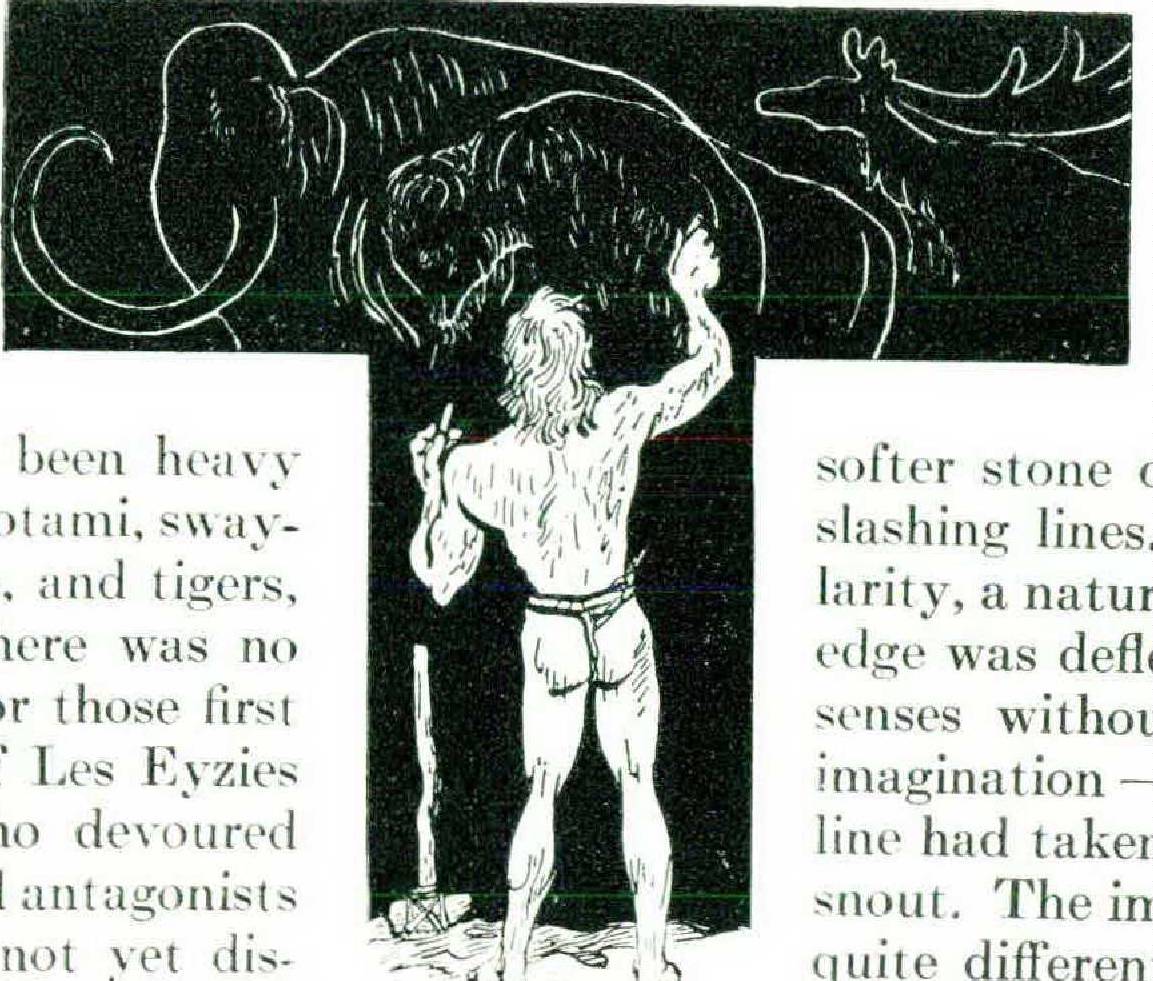
There is a small ledge of rock on which, twenty, thirty thousand years ago, sat men of a newer race. They wore tall now. Their jaws no longer jutted as had those of their predecessors. While the storms raged unheard outside, in the dim glow of little fires they struck useful shape into the unyielding flint just as men always had. The chips still lie there on the floor. As the instruments took shape, the sharpness of their edges were tried in the softer stone of the cave wall, in careless, slashing lines. Here, there was an irregularity, a natural protuberance. The cutting edge was deflected. The toolmaker — one senses without too much forcing of the imagination — saw that by chance the cut line had taken on a likeness to a reindeer’s snout, The image pleased him. With finer, quite different strokes he completed with deliberation what hazard had begun.
His work was emulated. When the race of artists vanished the grotto’s walls were left covered with such engravings. In a still deeper cave near-by, the Font de Gaume, are the triumphantly strong and beautiful earth-red and carbon-black paintings of mammoth, of deer, of horses, and of bison which have become famous through the world. They loom there damply in the enormous silence just as they were left eons, eons past.
There are a dozen such “sites.” The names of half the divisions and subdivisions of prehistory now in universal use are taken from farms, hills, cliffs within a circle of half a dozen miles.
Some years ago the name of the “Hôtel de la Gare,” the best in town, was changed. It is now the “Hotel of the Cro-Magnon and of the Railway Station. And with reason. For it was in process of enlarging the woodshed by the common local practice of digging farther back into the soft lime of the abutting hillside that the five skeletons, of two adult men, an old man, a woman, and a child, were found to which visiting men of science attached the label of Cro-Magnon. It is possibly a shade discouraging for the inhabitants of the valley to realize the brains of that quintet were more capacious than are their own. But it is pleasant at least to have such measurable confirmation of what has been so long suspected: that the Intellect developed first in France.
In times like these to have so much past behind one is comforting. Folk of the Dordogne Department rest upon that past as upon a cushion. Not even Germans are as bad as glaciers. And they go away much sooner. Les Eyzies, one observes, has survived them both.
The Beynac family are of a neat and cleanly habit. The little farmhouse under the cliff is spotless and the ground around the revealing trench is swept with twig brooms. But the occupant of such a property clearly has a duty to Tomorrow.
From time to time, with a hint of ceremony, M. Beynac tosses from his kitchen door, after long service, the blunted blade of a rusty axe, or an old screwdriver that has lost its handle. In these things there is a tradition to be followed. It would be a pity for the Present to leave no trace.
M. Beynac, however, faces that possibility with a certain philosophic melancholy. The works of man, he knows — for in Les Eyzies one is an amateur of Man—grow ever less durable. The flints he left are immortal. The tools that next he made of bronze last through millennia. There is even such a thing as truly ancient iron.
But steel? M. Beynac shrugs. Steel is done for in less than that tick of time we count a century.
It would be ironic, would it not, for savants of some future age to conclude that history ended in Les Eyzies when the painters of the caves followed the reindeer north?