Be Your Own Architect!
EDWIN BATEMAN MORRIS was formerly associated with the Office of the Supervising Architect in the Federal government.
by EDWIN B . MORRIS
FOR those who contemplate building a house and wish to feel the joy of individual expression which comes to one from drawing out the house plan and actually seeing it before him as the child of his own brain, a hint or two on methods of procedure may not be amiss. The first thing one needs is a pencil (with a rubber on it); also a rule and a piece of letter-size paper — preferably two pieces held together by Scotch tape.
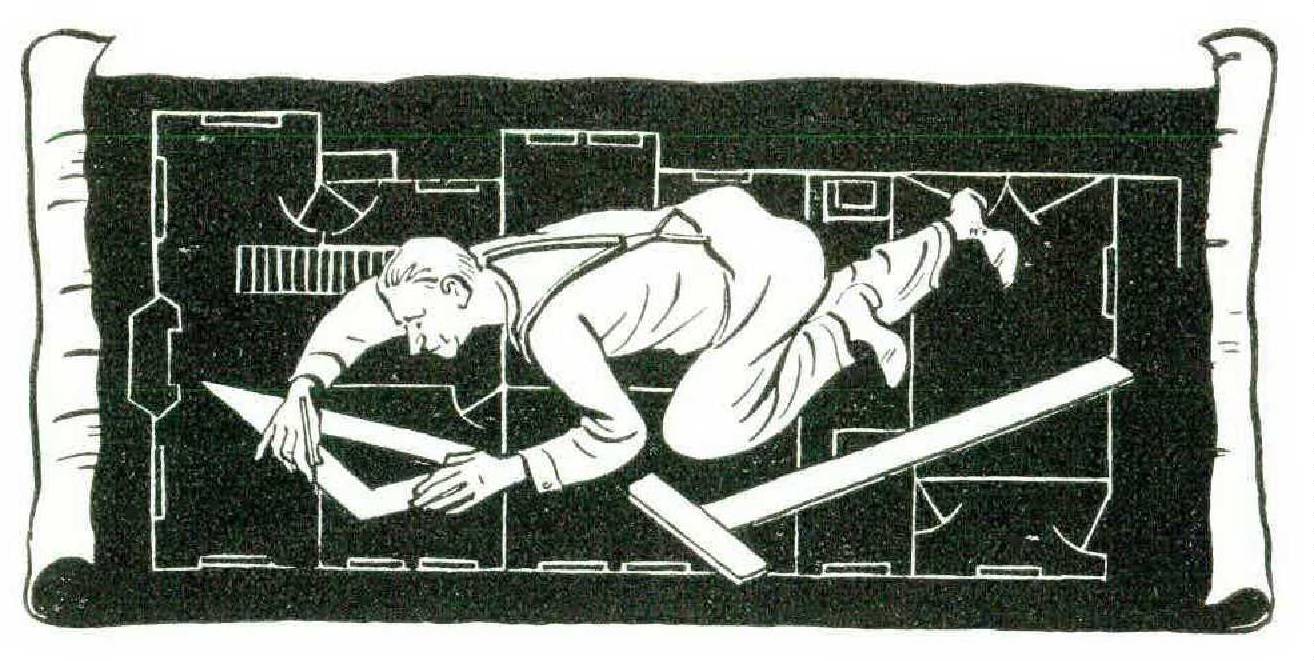
Clear a space on a more or less convenient table, reasonably free from jarring and shaking. Housecreative effort begins with the living room. Therefore, assuming a crouching position, with ruler in right hand, measure your present living room, using index finger of left hand to mark each successive laying down of the ruler. If you run into a piano or davenport, finish the reading on a line parallel to your first try. Then, barring mistakes in counting, you have figures showing the size of the room.
Lay out a rectangle on the paper to represent the living room in the new house, making it twice as large as your present one. It is convenient to let one inch on the ruler represent four feet. Many persons get confused while making hasty computations, with the result that one side of a room becomes a different length from the opposite side, thus causing a vague sense of unreality.
Not that exact right angles in this preliminary thinking are essential. A certain freedom is allowable. Walls and partitions, for instance, may be represented by a single line, as if they had no substance, since creative impulse must not be broken by too great attention to detail.
It is customary for the lay thinker to represent windows and doors in a room as if laid down on the floor. This is wise and sensible if the delineator can keep his head. But if the multiplicity of lines of different representation values perplexes him, causing him to lose the distinction between the frail fantasy of vertical elements reclining horizontally and the stern meaningfulness of lines indicating partitions, he is on the way to minor obfuscation or even hopeless confusion. A window reposing on the floor may become surprisingly alive with plumbing fixtures and show facilities for shower-taking in an embarrassingly public location.
For the stair-hall, lay off an oblong adjoining the living room, about six feet wide, and in it draw a sort of keyboard, about the size of a coffee table, to represent stairs. These may not get you to the upper floor in the space indicated, but they act as a memorandum, tending to prevent the classic error of a house with no facility for reaching bedroom spaces above.
Then the crux — what to do on the other side of this stair-hall! Instinct, a sort of atavistic impulse, is for a dining room (a space, more or less obsolete, where, as the name implies, meals are served, at a table surrounded by chairs in lieu of the more orthodox counter and stools): but this gives way to the wiser decision to place a garage in this location, on the theory that transportation transcends refection, if I know what I mean.
To the rear of the living room draw rectangles to represent coat closet, lavatory, and kitchen. Delineation of walls and partitions, having substance, by lines having none has now brought about a hopeless relationship between exterior size and net interior space, so that you are perhaps using area that may not exist. But this must not be allowed to discourage over-all thinking.
Proceed boldly, drawing in stove, refrigerator, and cupboards of sizes that appear reasonable. In an available space indicate counter and stools. Cramped conditions may make draftsmanship show a saucer-wide counter, and stools roughly three or four inches across, an alarming prospect. But that is a matter for further study.
Moisten the pencil before drawing all lines, so that they will be distinct, being careful not to put the rubber end in your mouth, as this by smudge potency may eventually destroy any remaining appearance of clarity or draftsmanship.
Architects are curiously prejudiced in the matter of having the stairway in the same general position at first and second floors — holding, narrowly perhaps, that it is unwise for the steps to move any great distance to right or left halfway up. Minutiae of this sort can be consolidated in the clarifying three-dimensional space that will exist when the house is being built. On the second floor, therefore, the stairs should be located — allowing at least as much space as for a grandfather’s clock — in a simplifying place, relying upon natural causes to bring head and foot into smooth juxtaposition.
By careful simplification one can thus in a surprisingly short time lay out a full house plan which can be turned over to an architect (or a builder) with brief instructions to build the house along the lines indicated, thus reducing conferences and eliminating time-consuming discussion.