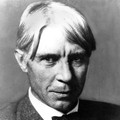
Abraham Lincoln
by CARL SANDBURG
1
THE range of the personality of Abraham Lincoln ran far, identifying itself with the tumults and follies of mankind, keeping touch with multitudes and solitudes. The free-going and friendly companion is there and the man of the cloister, of the lonely corner of thought, prayer, and speculation. The man of public affairs, before a living audience announcing decisions, is there, and the solitary inquirer weaving his abstractions related to human freedom and responsibility.
Perhaps no other American held so definitely in himself both those elements — the genius of the Tragic, the spirit of the Comic. The fate of man, his burdens andcrosses, the pity of circumstance, the extent of tragedy in human life, these stood forth in word shadows of the Lincoln utterance, as testamentary as the utter melancholy of his face in repose. And in contrast he came to be known nevertheless as the first authentic humorist to occupy the Executive Mansion in Washington, his gift of laughter and his flair for the funny being taken as a national belonging.
Though we sometimes meet the expression “a Lincolnian style,” it has no strict meaning; Lincoln had many styles. It has been computed that his printed speeches and writings number 1,078,365 words. One may range through this record of utterance and find a wider variety of styles than in any other American statesman or orator. And perhaps no author of books has written and vocalized in such a diversity of speech tones directed at all manner and condition of men.
Three short pieces from his pen are kept as immemorial possessions of the American people, each keyed to a high tragic note. These are the Letter to Mrs. Bixby, the Gettysburg Address, the Second Inaugural.
The War Department records showed a Boston woman to have lost five sons in combat actions. The number was less than five, as later research revealed. But Lincoln spoke through her to all families that had lost a boy or man in the war. “Weak and fruitless must be any words of mine which should attempt to beguile you from the grief of a loss so overwhelming,” he wrote. “But I cannot refrain from tendering to you the consolation that may be found in the thanks of the Republic they died to save.” He poised his quill pen for the final sentence of the letter, he on whose initiative, action, and responsibility the war had begun and had been carried on for nearly four years, and he wrote: “I pray that our Heavenly Father may assuage the anguish of your bereavement and leave you only the cherished memory of the loved and lost, and the solemn pride that must be yours to have laid so costly a sacrifice upon the altar of freedom.”
In a photographer’s studio eleven days before delivering the speech at Gettysburg, Lincoln had held in his hands the lengthy address of Edward Everett, the designated orator of the day, the printed two-hour discourse covering nearly two sides of a one-sheet supplement of a Boston newspaper. To a young newspaper correspondent from California, Lincoln said his own speech at Gettysburg would bo “short, short, short,” as it proved to be, ten sentences spoken in less than five minutes. In its implicative qualities, it stands among the supreme utterances of democratic peoples of the world. “A new nation, conceived in liberty, and dedicated to the proposition that all men are created equal.” For the perpetuation of this men were dying on battlefields, he said. And having so died, they would be forgotten men and their deaths of no use unless the living dedicated themselves to the unfinished work for which the dead had given “the last full measure of devotion.”
Virtually the Gettysburg Address is one of the great American poems, having its use and acceptation far beyond American shores. It curiously incarnates the claims, assurances, and pretenses of republican institutions, of democratic procedure, of the rule of the people, and directly implies that popular government can come into being and can then perish from the earth.” How he would have defined “a new birth of freedom,” at length, must be sought elsewhere in the body of his utterance. No accusations, no recriminations, no lash of invective, not even a mild outspoken reproach of the enemy. Some have detected in haunting echoes of the Gettysburg Address a quiet summons to those of the South reluctant to let go of national unity: Come back into the old Union of States and let us make of it what those Virginians, Washington and Jefferson, envisioned. Apart from its immediate historic setting it is a timeless psalm in the name of those who fight and do in behalf of great human causes rather than talk, in a belief that men can “highly resolve” themselves and can mutually “dedicate” their lives to a cause, in a posture of oath-taking that “these dead shall not have died in vain.”
As one may delve endlessly into the restless implications of the Gettysburg Address, so also one may ponder the Second Inaugural and the intricate derivations to be made from it. A cry for merciless and further war, so some took it, while others read it as a benediction, a prayer, and a fathomless hope set to music. How did the war begin? He would try to tell it in two sentences, one long and one short: “Both parties deprecated war; but one of them would make war rather than let the nation survive; and the other would accept war rather than let it perish. And the war came.” The peculiar sobriety of judgments pronounced on both of the warring sections of the country has had wide discussion and keeps a permanent value: “Neither party expected for the war the magnitude or the duration which it has already attained. Neither anticipated that the cause of the conflict might cease with, or even before, the conflict itself should cease. Each looked for an easier triumph, and a result less fundamental and astounding. Both read the same Bible, and pray to the same God; and each invokes His aid against the other. It may seem strange that any men should dare to ask a just God’s assistance in wringing their bread from the sweat of other men’s faces; but let us judge not, that we be not judged. The prayers of both could not be answered — that of neither has been answered fully.” In like pitch and key was the often quoted sentence of the First Inaugural four years earlier: “Suppose you go to war. You cannot fight always; and when, after much loss on both sides, and no gain on either, you cease fighling, the identical old questions as to terms of intercourse are again upon you.”
2
THE Bixby Letter, the Gettysburg Address, the Second Inaugural, these were widely reprinted and went to increasingly large readerships as decades passed. Yet there was another utterance of Lincoln that did not come to any immense audience until the Second World War. This consists of passages from the President’s Message to Congress, December 1, 1862. In his Message, Lincoln was using to the limit his powers of persuasion to get the Congress to enact legislation enabling “compensated emancipation,” the Federal government to buy the slaves and set them free. Also in this Message he presented the cause of national unity in new phases. “A nation may be said to consist of its territory, its people, and its laws. The territory is the only part which is of certain durability. ‘One generation passeth away, and another generation cometh, but the earth abideth forever.’ It is of the first importance to duly consider and estimate this ever enduring part. . . . Our national strife springs not from our permanent part, not from the land we inhabit. . . . Our strife pertains to ourselves — to the passing generations of men; and it can without convulsion be hushed forever with the passing of one generation.”
Then, having presented his plan for compensated emancipation, he appealed for united action as between Congress and Executive. “We can succeed only by concert. It is not ‘Can any of us imagine better?’ but, ‘Can we all do better?’ Object whatsoever is possible, still the question occurs, ‘Can we do better ?’” Then came his pleadings wherein it is seen that he was sensitively aware of how momentous was the hour and of the need for each man to make his personal record such that it would stand the scrutiny of remote generations, urging: “The dogmas of the quiet past are inadequate to the stormy present. The occasion is piled high with difficulty, and we must rise with the occasion. As our case is new, so we must think anew and act anew. We must disenthrall ourselves, and then we shall save our country.”
There have been long-time students of Lincoln who place among his sublime passages the one that closed this 1862 Message: “Fellow citizens, we cannot escape history. We of this Congress and this administration will be remembered in spite of ourselves. No personal significance or insignificance can spare one or another of us. The fiery trial through which we pass will light us down, in honor or dishonor, to the latest generation. . . . We shall nobly save or meanly lose the last, best hope of earth. Other means may succeed; this could not fail. The way is plain, peaceful, generous, just — a way which, if followed, the world will forever applaud, and God must forever bless.”
That the Congress paid little heed, that it balked at the legislation suggested, that it had a low or indifferent opinion of Lincoln’s language and persuasions, is part of the record. That the Congress, save for a remnant of two or three members, had any dim vision that possibly eighty years later, in another national crisis of world scope, there would be global circulation of sentences from this Message of Lincoln, there is little or no indication. A grim fighting insistence was found in such lines as “The fiery trial through which we pass will light us down, in honor or dishonor, to the latest generation.”
Lincoln, it would seem, practiced his mind in private, rehearsed by himself the method of the abstruse, lofty, cogent reasoning he would apply to the materials of public discussion. Among memoranda written about the time of the debates with Stephen A. Douglas is the following piece of dialectic: “If A can prove, however conclusively, that he may, of right, enslave B, why may not B snatch the same argument, and prove equally that he may enslave A? You say A is white, and B is black. It is color, then: the lighter, having the right to enslave the darker? Take care. By this rule, you are to be slave to the first man you meet with a fairer skin than your own. You do not mean color exactly? You mean the whites are intellectually the superiors of the blacks, and therefore have the right to enslave them? Take care again. By this rule, you are to be slave to the first man you meet, with an intellect superior to your own. But, say you, it is a question of interest: and if you can make it to your interest, you have the right to enslave another? Very well. And if he can make it his interest, he has the right to enslave you.”
The ancient cry, “Against stupidity even the gods struggle unavailing,” had a manner of paraphrase from Lincoln before a Midwest audience: “If a man will stand up, and assert, and repeat, and reassert, that two and two do not make four, I know nothing in the power of argument that can stop him. I think I can answer the judge so long as he sticks to the premises; but when he flies from them, I cannot work an argument into the consistency of a maternal gag, and actually close his mouth with it.”
The tragic note, the fateful event at hand or to come, the screen of mist and cloud behind which Providence wrought His designs, the drama of man in shadowy and portentous deeds, this enters in the Bixby Letter, the Gettysburg Address, the Second Inaugural, and other instances given in the foregoing. Of another color are Lincoln’s many forensic passages where his purpose is the achievement of inexorable and unanswerable logic. The most celebrated example of his style in this field is his letter in the summer of 1862 to a New York antislavery editor who continuously attacked Lincoln as slow, indecisive, and vacillating in emancipation policy. In clarity and as a definition of political and military aims in the t urmoil of civil war, the letter has curious dignity and the self-possession that cheers adherents.
The editor had addressed a vehemently critical letter to Lincoln, and without sending a copy to him, had published it in his newspaper. Lincoln’s reply began, “If there be in it any statements or assumptions of fact which I may know to be erroneous, I do not, now and here, controvert them. If there be in it any inferences which I believe to be falsely drawn, I do not, now and here, argue against them. If there be perceptible in it an impatient and dictatorial tone, I waive it in deference to an old friend whose heart I have always supposed to be right.”
Of his policy he would not leave anyone in doubt, wrote the President, as he proceeded: “I would save the Union. I would save it the shortest way under the Constitution. ... If there be those who would not save the Union unless they could at the same time save slavery, I do not agree with them. If there be those who would not save the Union unless they could at the same time destroy slavery, I do not agree with them. . . . If I could save the Union without freeing any slave, I would do it, and if I could save it by freeing all the slaves, I would do it; and if I could save it by freeing some and leaving others alone, I would also do that.”
Equally fateful, and as widely known and discussed at the time of its delivery, was the “House Divided” Speech of 1858. This was the preliminary to the seven debates with Senator Douglas that year, from which Lincoln emerged a national figure, and the Cooper Union Speech of February, I860, which dramatized Lincoln as a possible Presidential candidate. Out of the tumult and troubled horizons of that year of ‘58 came the tall Illinoisan with his relentless “If we could first know where we are, and whither we are tending, we could better judge what to do, and how to do it.” The slavery agitation would not cease, he declared as his opinion, until a crisis should have been reached and passed. He quoted, “‘A house divided against itself cannot stand,’” and proceeded, “I believe this government cannot endure permanently, half slave and half free. I do not expect the Union to be dissolved — I do not expect the house to fall — but I do expect it will cease to be divided. It will become all one thing, or all the other.”
By plain reasoning to reduce the opponent’s position to absurdity was often Lincoln’s aim and method as writer and speaker. Into grim fantasy could he carry it, as in 1856, when he sketched a cultural apparatus arrayed and a climate of opinion generated toward the Chattel Slave: —
“All the powers of earth seem rapidly combining against him. Mammon is after him, ambition follows, philosophy follows, and the theology of the day is fast joining the cry. They have him in his prison house; they have searched his person, and left no prying instrument with him. One after another they have closed the heavy iron doors upon him; and now they have him, as it were, bolted in with a lock of a hundred keys, which can never be unlocked without the concurrence of every key — the keys in the hands of a hundred different men, and they scattered to a hundred different and distant places; and they stand musing as to what invention, in all the dominions of mind and matter, can be produced to make the impossibility of his escape more complete than it is.”
3
THUS we have considered, or touched in degree, the brooding and speaking figure of Lincoln in the human Tragedy. How he moved and spoke as part of the human Comedy became vivid mouth-tomouth folklore while he was alive, and his quips and drolleries went beyond his own country and began the process by which he was internationally adopted by the Family of Man.
A paradox was seen. Year by year came the stream of photographs reporting the face of the Chief Magistrate in the Executive Mansion. Camera craft had developed. The carte de visite was more than a vogue. Millions came to know the Lincoln face as though they had seen it in life. There it was, gaunt, fissured, melancholy, tragedy scrawled over it as on no other that had moved with authority among the doors and rooms of the Execut ive Mansion. “A Hoosier Michelangelo,” wrote Walt Whitman. And yet this man was the source and wellspring of a current of folklore and humor that widened and grew, that still exists and has its periodic accretions of newly found authentic material and its apocryphal and gratuitous contributions.
Of ten-cent books in paper covers published in the latter half of Lincoln’s administration, one was titled Old Abe’s Joker and another Old Abe’s Jokes—Fresh from Abraham’s Bosom. It could be taken as part of a trend in American literature. The horselaugh school of American humor had come into its own with its pre-eminent pen names of Orpheus C. Kerr (Robert H. Newell), Artemus Ward (Charles Farrar Browne), and Petroleum Vesuvius Nasby (David Ross Locke), vulgarians all, with their pot shots at pomposity, and a meat axe for frauds, hypocrites, and snobs. Friends and compatriots of the President, they supported him and his cause with their satire and jibes. It was a country and a people warmly receptive of these jesters, whose persiflage often carried a razor edge, that gave its response and understanding to the byplay and humor that came to be known as “Lincoln stories.”
Several facets had the Lincoln humor. His generation and his kinfolk had their storytellers who could “spin a yarn” to pass the time and to brighten the pioneer corners where they lived. He could tell a story for the sake of merriment, a medicine to his bones. Or again he would use a story as illustration of an argument or point of view, or as fable and allegory. Or again what he was saying could be veiled in a delicate irony. And there were phrasings and pithy utterances that came to be known as “Lincoln sayings,” such as, “You can fool all of the people some of the time and some of the people all of the time, but you cannot fool all of the people all of the time.” Or, “It is best not to swap horses while crossing the river.” And, “Broken eggs cannot be mended”; “Bad promises are better broken than kept”; “We shall sooner have the fowl by hatching the egg than smashing it”; “A jury too frequently has at least one member more ready to hang the panel than the traitor”; “No man knows so well where the shoe pinches as he who wears it.”
Of the authenticated stories that Lincoln used for illustration, one seemed to have been reported by callers and visitors more than any other. Often his duties required him to be furtive and secretive beyond what he liked in political affairs. And he would tell of the Irishman in the State of Maine, where the sale of alcoholic liquor was prohibited. Having asked a druggist for a glass of lemonade and having the glass as ordered set before him, the Irishman whispered, “And now, can ye pour in just a drop of the creeter unbeknownst to me?” In a discussion of his use or misuse of Constitutional prerogative Lincoln said, “Like the Irishman, I have to do some things unbeknownst to myself.”
To make a point, Lincoln could mention, in passing, the two gentlemen who met and fought themselves out of their overcoats into each other’s. To the query of an old neighbor from back home, “How does it feel to be President of the United States?” he could answer, “You have heard about the man tarred and feathered and ridden out of town on a rail? A man in the crowd asked him how he liked it, and his reply was that if it wasn’t for the honor of the thing, he would much rather walk.” One verbose man had the rating, “He can compress the most words into the smallest ideas of any man I ever met.” A rural orator from the Southwest “mounted the rostrum, threw back his head, shined his eyes, and left the consequences to God.”
The Lincoln vocabulary ranged from the plainest of street vernacular to hoary and archaic AngloSaxon terms. The enemy had “turned tail and run,” he told a crowd on the White House lawn in 1865, to the dismay of various purists. And again he would trust to be understood in the ancient form of the noun “burthen” or the verbs “holden” and “disenthrall.” His influence on the styles of other speakers and writers is incalculable. His use of the gift of laughter has been better emulated than the depths of his desire to mislead no man by act or word. This latter lay at the root of his counsel to the Congress in the 1862 Message: —
“In times like the present, men should utter nothing for which they would not willingly be responsible through time and in eternity.”
Human solidarity, unity of action and feeling, may rise from a leadership knowing somewhat of both soil and seed, knowing of whatever dynamics Lincoln believed he could see at interplay among men and political states and civil factions when, in 1862, he wrote to a New Orleans man: —
“I shall do nothing in malice. What I deal with is too vast for malicious dealing.”