This Month
We had the good fortune some years ago to take to dinner the author of a musical comedy. His show was to open a pre-New York tryout that night and the man was in a great state of jitters. We have never regretted walking out, at 9.45 P.M., on the show, which subsequently was a sellout for two years, and we have always been grateful to the author for telling us about Gordon Kahn (page 95). It seemed to cheer him up to remember Kahn.
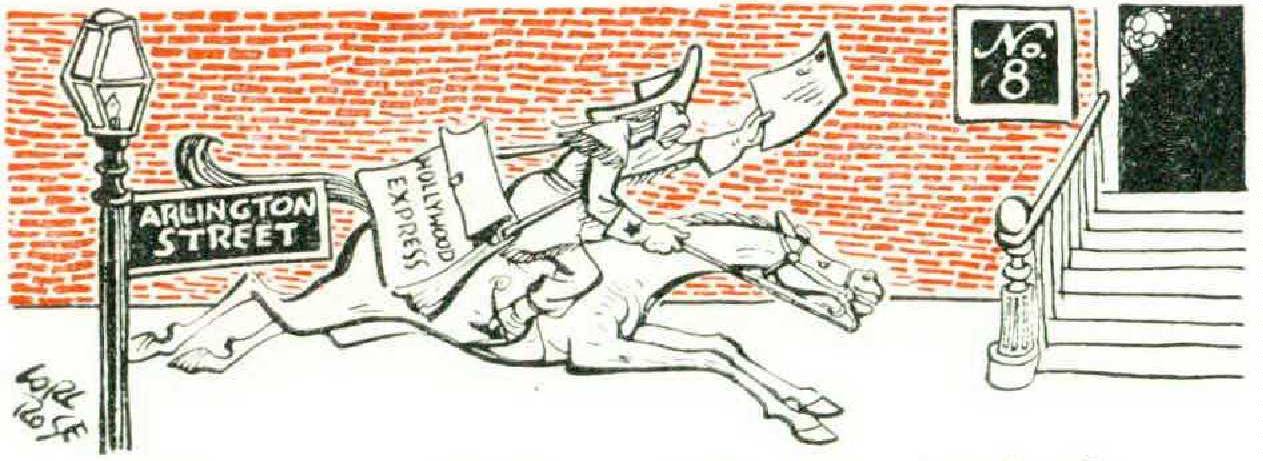
Kahn, our guest said, was the greatest conversationalist he had ever met. Author of numberless screen plays, Kahn could become a stylized screen character, any character, along effectively and make perfectly good sense as the Lone Ranger. He could make himself sound like a movie district attorney, sinful financier, Colonel de la Légion Étrangére. Shifting gears he would become Lord Greystoke chatting with his simian followers, or faithful Tonto, he of the meaningful grunts.
The musical comedy author was doing a fair job of it himself, impersonating Gordon Kahn. It was a merry meal. We wrote to Kahn the very next day and he has been the Atlantic’s Hollywood correspondent ever since. We have yet to hear his voice, but his letters are the most richly allusive of all that reach our desk.
Kahn is likely to begin with some such line as: “A native boy has just run up the hill bearing your message in a cleft stick.’ The rest of the letter goes on to explain the delay in his next piece for the Atlantic. A rare disease, nothing serious but enough to have held up production, is usually the cause. In recent months Kahn has convalesced — so his letters have asserted — from a touch of the African rinderpest, the Plague of Justinian, just plain distemper, St. Anthony’s Fire, “a streptococcus in the pharynx,” a fever picked up from “a toxic porringer" in a San Francisco hotel. Only one of these maladies warranted the services of what Kahn calls “my leech,” and most of them, we judge, are no more than Kahn’s way of saying “the pressure of other duties” or, at the very worst, the vapors. We mention all this only to account to our readers for his occasional absence from these pages.
There is nothing to match foreign travel as a source of agreeable illusions. After a pleasure jaunt in another land, the glamour seems to predominate, the frustrations of the trip itself to fade and disappear. Years later, a tour of almost any place is recalled in terms of its best meal or its most charming scene, never for lesser rewards. The returned traveler is bound to be complacent in what he has done, dwelling more on his triumphs than his unwisdom. The traveler is thus one to be envied if not for his trip, at least for his misconception of it.
The riskiest illusion of the traveler strikes him while the trip is still going on. It stems from the broad circumstance that most foreign countries have their own national currency, some of them at a handsome discount from the dollar. On getting foreign money at about half price, the visitor quickly begins to rationalize all his expenditures as bargains. What with the discount and import duties, the 40-cent cigar would cost him twice that at home, he reasons. Where in New York could one stand the whole café orchestra to the drinks for a mere $4.115? Soon the traveler is grandly telling newsboys to keep the change; his scale of outlay becomes pegged to a high style in which a morning paper costs him a quarter and his tips to cab drivers often exceed the fares. It takes him only a day or two to convince himself that the local currency has no value whatever and that he has plenty of it. He becomes a sort of one-man UNRRA mission, an expensive frame of mind.
When he gets home, the traveler will talk mostly of how cheap everything was.
The most reassuring daydream from a trip abroad is gained by the discovery of the place where the traveler can retire in his old age on nothing a year. All tourists set out with the vague idea of happening upon it — the all-expense refuge where one lives abundantly for $5 a week, boissons compris. (Five dollars a week equals two hundred and sixty dollars a year equals twenty-six hundred dollars for ten years . . .) Great tidings of such import kept trickling across the Atlantic, before the war, from every hamlet of Europe. Griffin Harry gives us the first hint that air castles are nearing a state of decontrol, when he reports lodgings, all found, in western Eire at $6 to $10 a week.
C. W. M.