Young Hunger
FOOD
By M. F. K. FISHER
IT is very hard for people who have passed the age of, say, fifty to remember with any charity the hunger of their own puberty and adolescence when they are dealing with the young human animals who may be frolicking about them. Too often I have seen good people helpless with exasperation and real anger upon finding in the morning that cupboards and iceboxes have been stripped of their supplies by two or three youths — or even one — who apparently could have eaten four times their planned share at the dinner table the night before.
Such avidity is revolting, once past. But I can recall its intensity still; I am not yet too far from it to understand its ferocious demands when I set; a fifteen-year-old boy wince and whiten at the prospect of waiting politely a few more hours for food, when his guts are howling for meat-breadcandy-fruit-cheese-milkmilkmilk — ANYTHING IN THE WORLD TO EAT.
I can still remember my almost insane desperation when I was about eighteen and was staying overnight with my comparatively aged godparents. I had come home alone from France in a bad continuous storm and was literally concave with solitude and hunger. The one night on the train seemed even rougher than those on board ship, and by the time I reached my godparents’ home I was almost lightheaded.
I got there just in time for lunch. It is clear as ice in my mind: a little cup of very weak chicken broth, one salted cracker, one-half piece of thinly sliced toast, and then, ah then, a whole waffle, crisp and brown and with a piece of beautiful butter melting in its middle which the maid deftly cut into four sections! One section she put on my godmother’s plate. The next two, after a nod of approval from her mistress, she put on mine. My godfather ate the fourth.
There was a tiny pot of honey, and I dutifully put a dab of it on my piggish portion, and we all nibbled away and drank one cup apiece of tea with lemon. Both my godparents left part of their waffles.
It was simply that they were old and sedentary and quite out of the habit of eating amply with younger people: a good thing for them, but pure hell for me. I did not have the sense to explain to them how starved I was—which I would not hesitate to do now. Instead 1 prowled around my bedroom while the house slumbered through its afternoon siesta, wondering if I dare sneak to the strange kitchen for something, anything, to eat, find knowing I would rather die than meet the silent, stern maid or my nice, gentle little hostess.
Later we walked slowly down to the village, and I was thinking sensuously of double malted icecream sodas at the corner drugstore, but there was no possibility of such heaven. When we got back to the quiet house, the maid brought my godfather a tall glass of exquisitely rich milk, with a handful of dried fruit on the saucer under it, because he had been ill; but as we sat and watched him unwillingly down it, his wife said softly that it was such a short time until dinner that she was sure I did not want to spoil my appetite, and I agreed with her because I was young and shy.
When I dressed, I noticed that the front of my pelvic basin jutted out like two bricks under my skirt: I looked like a scarecrow.
Dinner was very long, but all I can remember is that it had, as pièce de résistance, half of the tiny chicken previously boiled for broth at luncheon, which my godmother carved carefully so that we should each have a bit of the breast and I, as guest, should have the leg, after a snippet had been sliced from it for her husband, who liked dark meat too.
There were hot biscuits, yes, the smallest I have ever seen, two apiece under a napkin on a silver dish. Because of them we had no dessert: it would be too rich, my godmother said.
We drank little cups of decaffeinized coffee on the screened porch in the hot Midwestern night, and when I went up to my room I saw that the maid had left a large glass of rich malted milk beside my poor godfather’s bed.
My train would leave before five in the morning, and I slept little and unhappily, dreaming of the breakfast I would order on it. Of course when I finally saw it all before me, twinkling on the Pullman silver dishes, I could eat very little, from too much hunger and a sense of outrage.
I felt that my hosts had been indescribably rude to me, and selfish and conceited and stupid. Now I know that they were none of these things. They had simply forgotten about any but their own dwindling and cautious needs for nourishment. They had forgotten about being hungry, being young, being . . .
In an essay by Max Beerbohm about hosts and guests, the tyrants and the tyrannized, there is a story of what happened to him once when he was a schoolboy and someone sent him a hamper that held, not the usual collection of marmalade, sardines, and potted tongue, but twelve whole sausage-rolls.
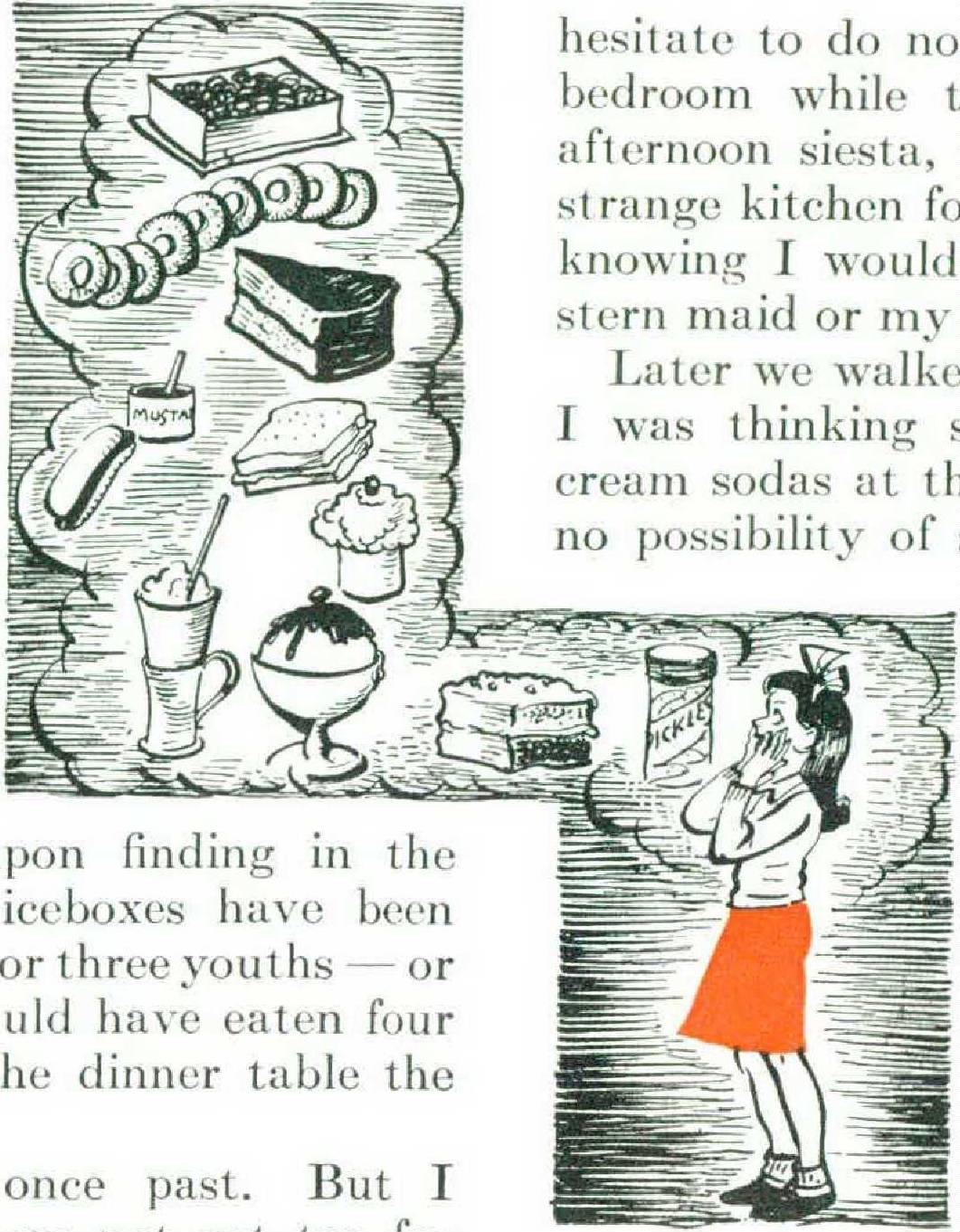
“Of sausage-rolls I was particularly fond,”he says. He could have dominated all his friends with them, of course, but “I carried the box up to my cubicle, and, having eaten two of the sausage-rolls, said nothing that day about the other ten, nor anything about them when, three days later, I had eaten them all— all, up there, alone.”
What strange secret memories such a tale evokes! Is there a grown-up person anywhere who cannot remember some such shameful, almost insane act of greediness of his childhood? In recollection his scalp will prickle, and his palms will sweat, at the thought of the murderous risk he may have run from his outraged companions.
When I was about sixteen, we were allowed one bar of chocolate a day, which we were supposed to eat sometime between the sale of them at the little school bookstore at 4.30 and the seven o’clock dinner gong. I felt an almost unbearable hunger for them — not for one, but for three or four or five at a time, so that I should have enough, for once, in my yawning stomach.
I hid my own purchases for several days, no mean trick in a school where every drawer and cupboard was inspected, openly and snoopingly too, at least twice a week. I cannot remember now how I managed it, with such lack of privacy and my own almost insurmountable hunger every afternoon, but by Saturday I had probably ten chocolate bars — my own and a few I had bribed my friends who were trying to lose weight to buy for me.
I did not sign up for any of the usual week-end debauchery such as a walk to the village drugstore for a well-chaperoned double butterscotch and pecan sundae. Instead I lay languidly on my bed, trying to look as if I had a headache and pretending to read a very fancy book called, I think, Martin Pippin in the Apple Orchard, until the halls quieted.
Then I arranged all my own and my roommate’s pillows in a voluptuous pile, placed so that I could see whether a silent housemotherly foot stood outside the swaying monk’s-cloth curtain that served as a door (to cut down our libidinous chitchat, the school board believed), and I put my hoard of Hersheys discreetly under a fold of the bedspread.
I unwrapped their rich brown covers and their tinfoil as silently as any prisoner chipping his way through a granite wall, and lay there breaking off the rather warm, rubbery, delicious pieces and feeling them melt down my gullet, and reading the lush symbolism of the book; and all the time I was hot and almost panting with the fear that people would suddenly walk in and see me there. And the strange thing is that nothing would have happened if they had!
It is true that I had more than my allotted share of candy, but that was not a crime. And my friends, full of their Saturday delights, would not have wanted ordinary chocolate. And anyway I had much more than I could eat, and was basically what Beerbohm calls, somewhat scornfully, “a host" and not “a guest": I loved to entertain people and dominate them with my generosity.
Then why was I breathless and nervous all during that solitary and not particularly enjoyable orgy? I suppose there is a Freudian explanation for it, or some other kind. Certainly the experience does not make me sound very attractive to myself. Even the certainty of being in good company is no real solace.