This Month
A recent attempt to eliminate horseflies from a Massachusetts beach prompted a comic artist hereabouts to predict that the campaign was bound to fail. There would be too many protests, he said, from horsefly lovers. It seemed to us a fine example of the kind of problem which always pops up in any dealings with a fairly large number of people. The scheme may look like an airtight benefaction; at the worst, it seems harmless. Yet there will always be some unexpected specialist to discover in it the most sinister consequences ever plotted against mankind. He will write a Letter about it.

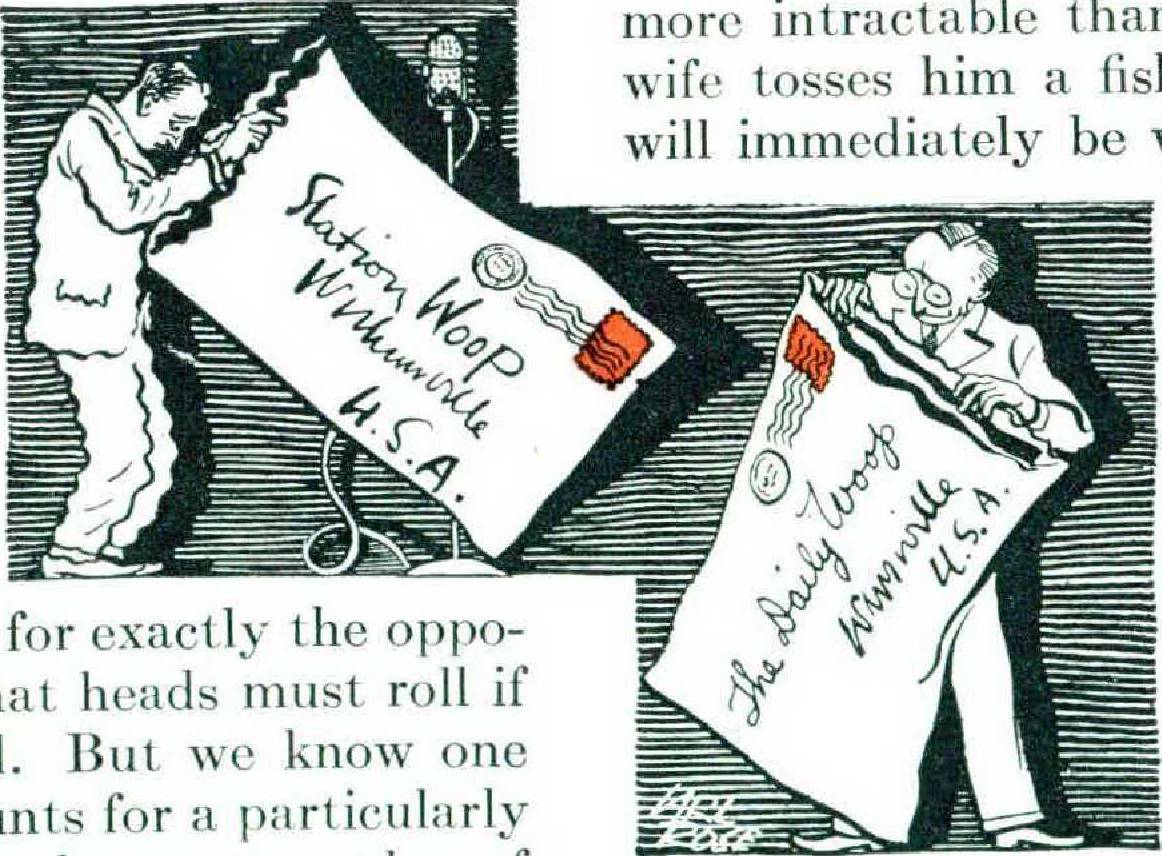
Our author Frances Eisenberg (page 139) reports on how the inner councils of radio networks react to the constant possibility of getting a Letter. One gathers that they take these things rather seriously in radio. Newspapers take Letters just as seriously, of course, but sometimes for exactly the opposite reason. Radio may feel that heads must roll if even a single squawk is heard. But we know one newspaper publisher who accounts for a particularly idiotic columnist in his pages by the great number of denunciatory letters provoked by the column. The letters show, he says, that people are reading the column. This makes him very happy, although the amount of paper thus wasted by his columnist and the correspondents in the course of a year is obviously enormous.
Without too much stretching, M. F. K. Fisher’s views on the youthful appetite (page 134) could apply equally well to adults. We can only guess at how many of the world’s ills are caused by poor timing in regard to food, quite apart from its quality and quantity. Gromyko often sounds to us like a man who tries to make his major decisions before breakfast instead of waiting, as he should, until the coffee has taken hold.
The final fifteen minutes before dinner are another risky period for any householder, a breeding point for small arguments which sometimes lead to divorce and crimes of violence. Just as she keeps a first-aid kit, a lire extinguisher, and a sewing basket for other emergencies, so will the competent housekeeper stand ready to quench any flare-ups on the part of her husband by the prompt application of food. At such times, even though he may seem headed for apoplexy or a cell in Murderers Row, the man is no more intractable than a veteran circus seal: if his wife tosses him a fish or a bit of round steak, he will immediately be waving his flippers and beaming on her. Such is the stubbornness, alas, of some women that they scorn this simple aid to the relationship and let the mean old thing suffer until dinnertime.
The easiest solution, once the officiating parson’s last pronouncement is made, is that both parties shall seek a detached understanding of breakfast and dinner hazards. Nothing of any kind would be broached until after breakfast, and dinner would be moving toward the table the moment the man’s first footfall was heard on the front steps. The hunger of age fifteen is no more exorbitant, in our experience, than the 6.00 P.M. gnawings which convert even the most fatuous husband and father into the enemy of the home. Waiting for his dinner, the man loses selfcontrol, dignity, and his own sense of position. If he takes to strong drink or evenings out, by way of selfprotection, his dilatory wife has only herself to blame.
C. W. M.