Letter From a Horse
RADIO
By FRANCES EISENBERG
SOME of the people in the department were surprised when we got a letter from a horse. But it was a valuable experience to us all for two reasons. First, it shows what an important force radio has become. And second, it illustrates how careful you have to be about what goes out over the air; if you aren’t, careful, somebody is going to get offended.
One of the aims of our company is to please each and every one of our listeners. No matter how lowly their station in life, we welcome the opinions of our audience. And right here I want to say that we read this letter from a horse with as much interest as we should read a letter from the President of the United States. Also, if it were not for the fact that the envelope had no return address, we should have sent our usual Form 415 thanking the writer for her comments. After all, this is a democracy and everybody who writes to us gets the same courteous reply. We don’t care who you are. A listener is a listener, whether he eats off the finest china or out of a feed bag. At least that’s the way we feel.
Everything that goes on the air passes through our department first. We read every word. That’s why the programs you hear over our network are so clean and inoffensive. We take out everything that might annoy somebody. For instance, a lot of listeners disapprove of sex; so we remove it wherever we find it. Again, suppose a lawyer should turn on his radio and hear some character in a script described as a shyster, or a doctor hear somebody called a quack. Naturally lawyers and doctors would resent these insults to their professions. So we take things like that out.
It’s a very ticklish job. You have to keep remembering that the radio audience is made up of the whole American public, which contains Protestants, Catholics, Daughters of the Revolution, members of the CIO, people who live in penthouses and people who live in shacks, Democrats and Republicans, Northerners and Southerners — and we try not to forget any of them. It’s not easy, but it’s our job. We want to keep everybody happy, with their radios turned on. Yet, in spite of all we can do, once in a while some group we didn’t know about makes itself heard.
It doesn’t happen often, but it does happen. For instance, this horse. Somehow we had overlooked that particular portion of our listening audience.
It happened that Miss Ellis read this particular script — “The Story Book Lady,” a four o’clock sustaining show for kids, which dramatizes children s books and fairy tales. 1 remember Miss Ellis looked up from it with a doubtful expression. Can a man be cruel to a horse on the air?" she asked.
The girls develop an instinct for trouble spots after they have been with us awhile. Sometimes they have a feeling that there is something offensive in a script, even though they don’t know exactly whom it will offend or why. It’s just something you acquire when you work in Continuity Acceptance — a kind of sixth sense. Miss Ellis has this sense developed to a stronger degree than any of the other girls, but she lacks the courage to make decisions.
“It’s a dramatization of Black Beauty,” she said. “I remember that a man did beat the horse in the book, but I wonder if we should let him do it on the air.”
All the girls stopped reading and considered. “I don’t see why not,”Miss Olson said after a moment. “There’s no doubt that people are cruel to animals in real life sometimes. I knew a—”
Miss Olson is new to our department. She can’t seem to realize that it s not what people do in real life that’s important, but what our listeners want to hear.
“It’s the villain that does it,” Miss Ellis explained. “If it’s the villain that does it, I think it’s all right as long as the script ends on a happy note,” somebody else ventured.
“I guess I’ll pass it then,” Miss Ellis said. “I don’t feel right about it somehow, but I guess nobody will mind. He only gives him a whack or two.” So she O.K.’d the script and sent it through, and nobody thought any more about the incident.
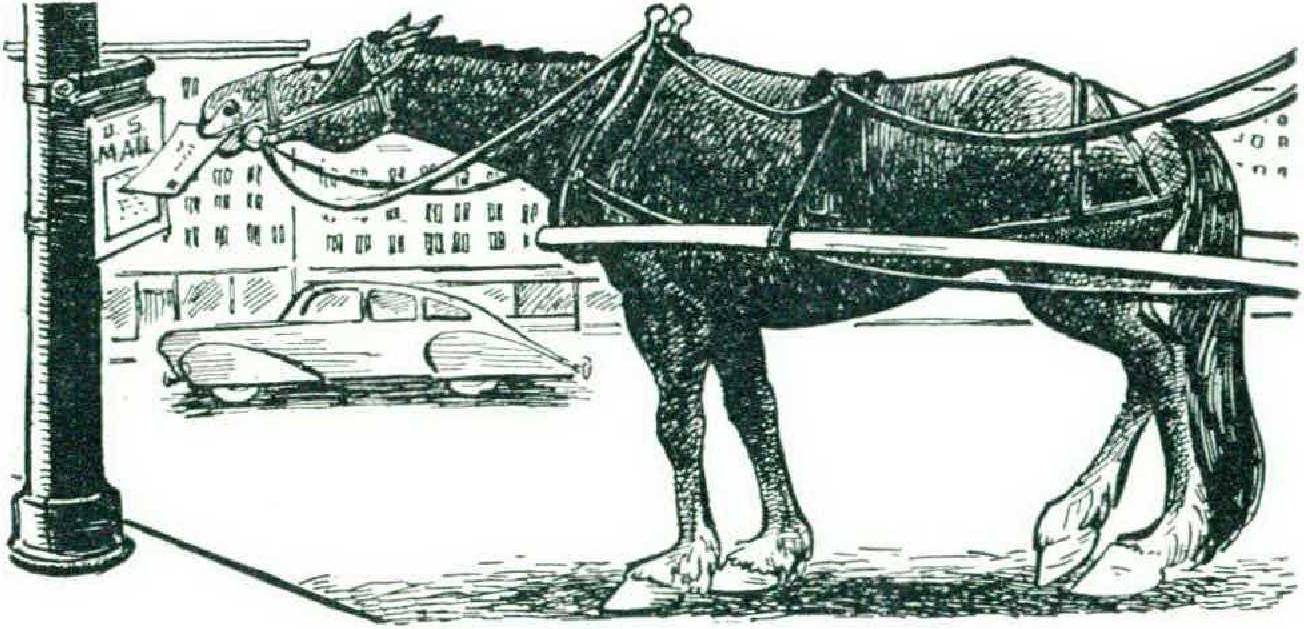
It was two days later, Thursday morning, that I opened the mail, and there was the letter. The address was typewritten, partly in capitals. When I opened the envelope, a few grains of oats fell out. The letter read as follows: —
DEAR STORY BOOK LADY: —
For your information I am and have been for five years connected with a delivery wagon of the C. H. Shultz Bakery and proud of it. It is a humble position, but it keeps Oats and Hay in our mouths and I don’t see anything to be Ashamed of in honest Labor. Yesterday I was waiting in front of a Grocery Store for my employer to finish a delivery and happened to overhear a radio in a taxicab across the Street. It was your program the adventures of a horse named Black Beauty and all the troubles he went through. And frankly I am Astonished that you would let such things go on the air. Is this your idea of what a young Horse ought to hear? I am the mother of two and spend my life working my hoofs to the bone to provide for them and keep them away from anything Sordid. My youngest is very Sensitive and if he had heard your Program he would have cried himself to sleep for a week. Is it right to play on the Sympathies of young horses like that? Surely there is enough Unhappiness in real life without having it on the Air to upset our minds. So why don’t you show the Cheerful side.
Yours truly
The signature was somewhat blurred.
I took the letter with the rest of the morning mail to Miss Hart, the editor, who read it and called in Miss Ellis for a conference. Miss Ellis was disturbed because she had let something go by that had given a listener offense. She explained that she had questioned the script herself and had also asked the other girls, and none of them had seen anything objectionable. It was true that the horse went through a lot of harrowing experiences, but they were no worse than the things a lot of characters in the afternoon kid shows went through.
“Look at Arizona Pete,” Miss Ellis said. “Last week he and his horse Lightning both fell over a cliff and lay there without food or water for two days.”
“Yes, and some horse is going to write in objecting to it,”Miss Hart said. “We’re overlooking the minority groups. We’re relaxing too much. We’ve got to make vigilance our watchword.”
So she dictated a memorandum to the staff, advising the greatest care in passing any script that might annoy our horse audience.
And since then the girls have been very careful. Only yesterday Miss Ellis deleted the phrase “mare’s nest” from a script, and on the change slip she wrote as the reason: “This expression is used in a derogatory sense and might be considered disparaging by any of our audience who are horses.”