Here in the Studio..
RADIO
By EDWIN O’CONNOR
IF RADIO had accomplished nothing else during the quarter century of its existence, it would have gained the respect and admiration of allied entertainment media solely on the strength of its bold and realistic treatment of its public. The theater, the motion picture, and the ballet, forever aware of the connection between the box office and life itself, have customarily handled their audiences with gloves of purest kid. It remained for radio to strike out and demonstrate that one really excellent way of winning and holding a vast, sympathetic, and eventually profitable audience was to treat that audience as if it did not exist.
Back in the days when radio was content to abide by the maxims of tradition, the radio set was considered a satisfactory link between the listener and the broadcasting studio. Radio, in other words, appealed only to the ear. Now, after twenty-five years of growth, it appeals to the eye. The progress has been swift and rewarding. Beginning with those days of uneasy experiment when the listener first was to be baffled by waves of inexplicable laughter from the studio, only later to be informed that Eddie Cantor had just come on stage all dressed up as a little girl, there have been rapid strides in the direction of complete unintelligibility to the listener. And with several of its most highly regarded programs, the broadcasting industry has sternly reminded the listening public of their fall from grace and of their replacement by the smaller but more directly responsive group known as the studio audience.
At present the wooing of the studio audience is being carried on chiefly by comedy quiz programs— that is, those audience-participation shows which have as their goal the human laugh. Pre-eminent among these is “Truth or Consequences,” whose twin discoveries, made some six years ago, are to presentday radio what the discovery of the artificial snowflake was to the modern motion picture. The first of these discoveries was that a substantial portion of the country’s adult population is interested in playing
idiot on a coast-to-coast basis. The second was that material which had heretofore been considered the exclusive property of Olsen and Johnson and similar manipulators of purely visual humor is in reality ripe for radio. Accordingly “Truth or Consequences” went on the air: a program which could be fully savored only by those directly witnessing it; a program which drew its substance from those beholders who were willing to be halfdrowned, spattered with egg yolks, or suspended upside down from the ceiling. Today, in radio, such doings are known as “having fun and all who participate in the high jinks are referred to as “swell sports.
The principle which activates “Truth or Consequences” also bubbles within People Are Funny,”a program of more recent birth, but one which differs from its predecessor in age only. Both programs are nourished by a series of ingenious and hearty stunts, which go on from week to week, and of which the following are fair samples: —
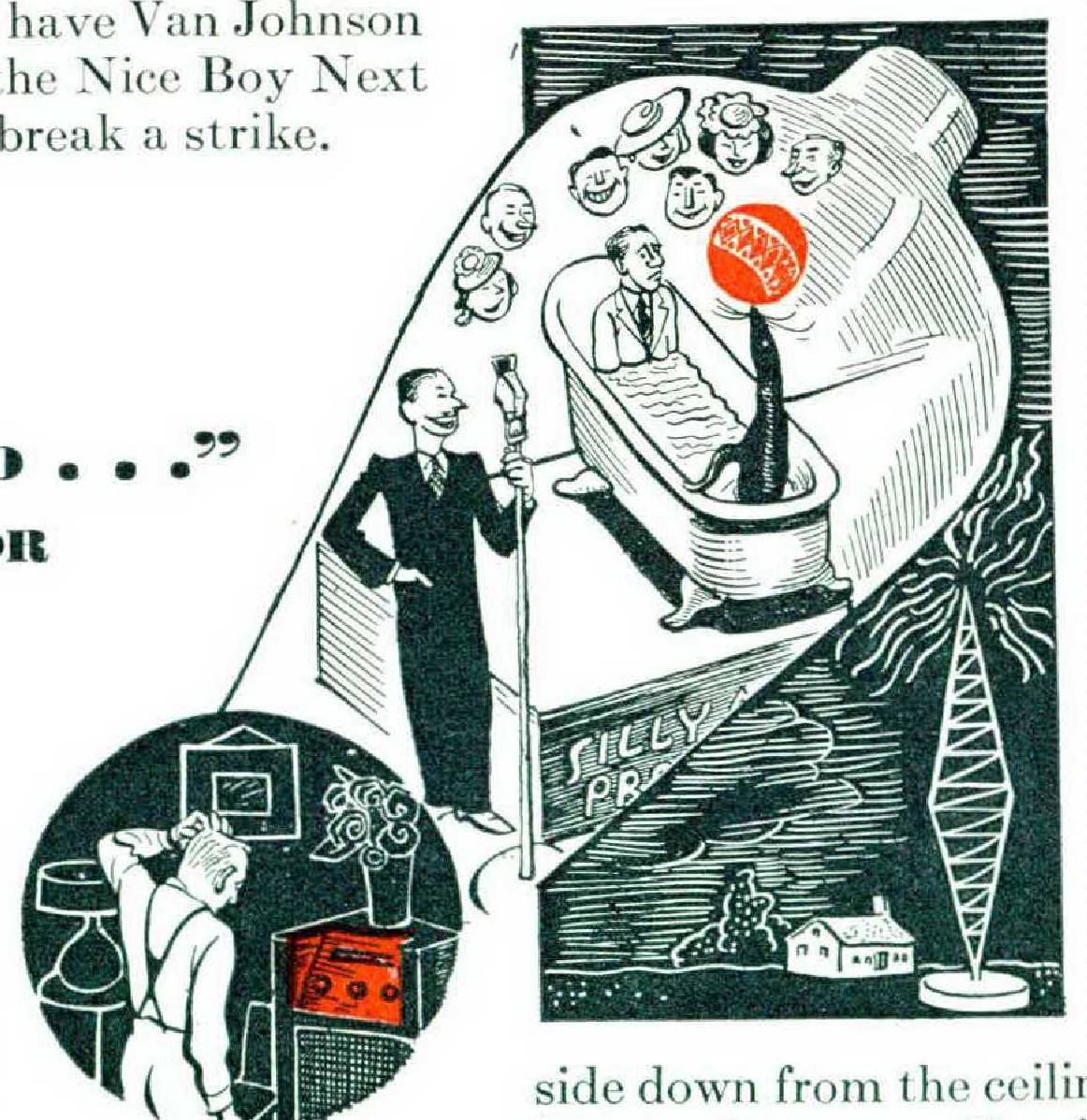
1. There is a double bed on the stage. A blindfolded man is prompted to crawl into it, believing that the other half of the bed is occupied by his wife. When the blindfold is removed, the man sees that he is really in bed with a live seal. Response from the studio audience: bedlam.
2. A man has a pie thrown into his face. The pie may be custard; or it may be lemon, pineapple, or chocolate meringue. Response from the studio audience: more bedlam.
3. A man sings a sentimental song while simultaneously gobbling a banana. Studio response: as before — especially if the banana is pushed into the man’s face before he finishes his song.
Cut of the same cloth, though with a few trappings which are properly its own, is the program “Detect and Collect.” Here there is a reliance upon a valuable piece of stage property called “the big magic curtain.” From time to time during the evening, this big magic curtain is raised, much as though it were a big non-magic curtain, and there behind it is the yeast of the show. Up to this point, the studio audience has not come into its own. Despite every effort of the master of ceremonies, it has been decorous, even noiseless; it is when the curtain is raised to reveal a whole stageful of cats that the madness begins. Before the evening is over, those in the studio will be entertained by visions of a stuffed grizzly bear; a brand-new “pin-stripe” suit, with the “stripes” made entirely of safety pins; one hundred and fifty “giant-size” piggy banks; and a just plain “life-size” caricature of one of the contestants.
Here is all this fun going on; and the radio audience, composed of some few million people who, for one reason or another, were unable to get down to the studio that night, is still standing by, patient if unenlightened. A few clues to the mystery have been distributed by the master of ceremonies in a running explanation, much in the manner of a man in Miami dispatching a “Wish you were here” postcard to an underprivileged friend spending the winter in Bangor, Maine. The success of this explanation depends to a large extent upon the behavior of those in the studio audience. If, instead of panting quietly in their seats and waiting for the next balloon to go up, they recall the hilarities so recently witnessed, they find it difficult to contain themselves, and accordingly they out-howl the master of ceremonies with shouts of reminiscent mirth.
These three programs are broadcast during the evening hours, but this does not mean that due deference is not paid the studio audience at other times. With an intrepidity rarely found in radio, several programs have dared to brave the formidable competition of the soap operas, and are now doing a successful business with the studio audience in the broad light of day.
Each of these shows has its own particular visual trappings. “ Breakfast in Hollywood,” oddly enough, features a man who tries on ladies hats! The response from direct witnesses is nothing short of tremendous. “Queen for a Day” has a figurative horn of plenty, which is forever emptying into some fortunate woman’s lap. On this program, a single pair of nylon stockings, elevated reverently before the studio audience, provokes a succession of admiring sighs, such as have not been heard since the golden days when Rudolph Valentino was stalking Agnes Ayres around a tent. “Queen for a Day,” however, taking no chances, does not stop at nylons. It also presents, in dazzling sequence, furs, dresses, perfumes, jewelry, flowers, shoes, and — for a surefire laugh — a girdle! This is the show that has brought Christmas to America on a five-day-week basis, and for those who can get down to the studio to see Santa, it’s fine.
Perhaps the explanation of all this lies, buried and mute, in the fact that three of the five programs just mentioned have already been translated into motion pictures, where indeed their particular qualifications might seem to have placed them in the beginning. It may be that these programs are whistling and marking time, waiting for television to reveal them in their true glory. Since television, as a popular medium, seems to be yet a distance away, this does not do the radio listener of the present day any great amount of good.
The reaction of the radio audience to these programs is worth noting, since the repudiation of a primary audience by an entertainment medium is news. A few listeners, keenly aware of social niceties, have abandoned their radios altogether, holding that listening to them, now, would constitute eavesdropping. This is a minority movement, however. On the whole, the attitude has been one of becoming docility, and the majority of listeners remain at their posts, just as prehistoric woman, beaten but loyally adhesive, stuck by the mate who had flogged her.
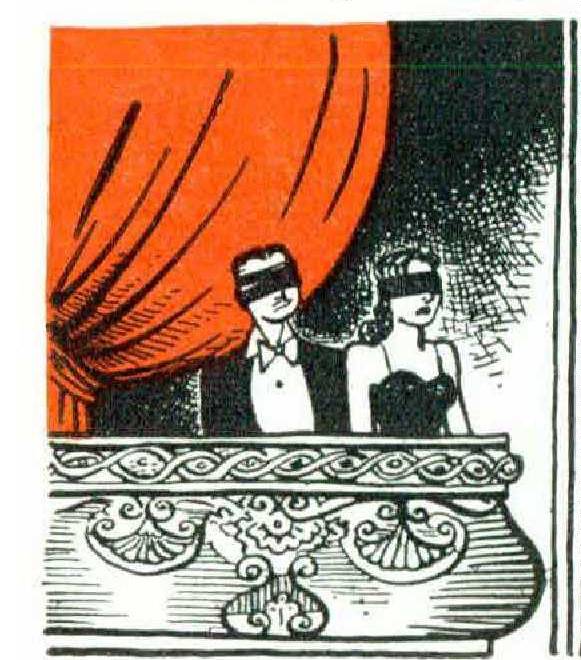
Since radio has been so successful with this radical technique of presentation, I suggest that other art forms adopt it in the near future. I propose, specifically, that on the night when the Theatre Guild presents its next major stage attraction, the entire dramatic action take place behind closed curtains, for the exclusive benefit of the stagehands. This would place the cash customers, who might be able to hear but most certainly would not be able to see, in much the same position that the radio audience is in today.
And, in place of the radio master of ceremonies, who from time to time doles out occasional bits of information, I suggest that the theater might that night use Lawrence Langner, co-director of the Guild. Whenever anything particularly uproarious took place behind the curtains, he could emerge from the wings, with an oral footnote for the orchestra seats. It might seem strange at first, but you never can tell: it might — catch on.