This Month
We can hardly expect the tipping nuisance to disappear overnight as a consequence of Clyde Brion Davis’s objections, which open up on the next page. But tipping is still on the increase, having already extended to such once proud journeymen of hire as Pullman conductors, hotel clerks, real-estate agents, garage mechanics, and house painters. Unless Clyde Davis is able to reverse the trend, we may yet be pressing quarters on subway guards, meter readers, and anesthetists. Husbands and wives will exchange gratuities, authors fling coppers to obsequious editors. It’s later than we think.
The presence of Mr. Davis in Accent on Living gives us a chance to say something to the 160,000 Atlantic readers about his book The Great American Novel. Perhaps, at one stroke, we can diminish tipping in the United States and put into the mail to Mr. Davis’s publisher (Rinehart) 160,000 orders for the book. (Whoever has already bought the book should add at least one extra copy for lending.)
Ironical writing, even in short forms, is scarce enough. Sustained successfully throughout a fulllength novel, it is all but nonexistent. When one has counted off Zuleika Dobson, Cakes and Ale, and The Late George Apley from present-day authors, the Davis book seems almost the only candidate to complete the quartet. Its main character, a newspaperman who is telling the story, has the same genius for error as Thackeray’s Barry Lyndon; but whereas Lyndon is a scoundrel, the Davis character is the arch-sap, mistaken in all that he thinks and does, yet resolute in his wrongheadedness every inch of the way. The Atlantic of April, 1942, published a single chapter of this genre, “Portrait of a Professor,” by Oscar Lewis, a brilliant unstuffing of an academic shirt, but few writers, sad to say, seem to try the ironical vein. We have no knowledge of the sales of The Great American Novel since it was first published in 1938, but the book will deserve a reading for a good many years to come. It is, incidentally, the most convincing novel about a newspaperman which we have ever read.
Our thanks go to Herbert Coggins (page 128) for carrying out in print, with his burglar trap, a notion which must occur at one time or another to every householder. The burglarious events in our own experience have inspired in us not so much a sense of property loss as rage at the intrusion.
Robert Benchley once described a recurring daydream, a courtroom scene in which, striving against the most formidable cross-examiner of them all, the witness Benchley, unruffled but inexorable, would dazzle and destroy his adversary with a series of epigrammatic replies which even the court itself could not help admiring. There must be a bit of this yearning for success in a classic situation in our friend Coggins.
If Mr. Coggins prefers to catch them in a bag instead of cowing his burglars by sheer force of personality, or perhaps with a .30-40 held negligently in readiness (and at a safe distance), well and good. Opening the bag of a morning would naturally be interesting. We find here, in addition, the primitive satisfaction of the hunter as well as the defender of the castle, the same high purpose with which we would snare the skunk in the henhouse or the mouse in the pantry. It seems to us that Mr. Coggins has come to grips with the very fundamentals of civilization.
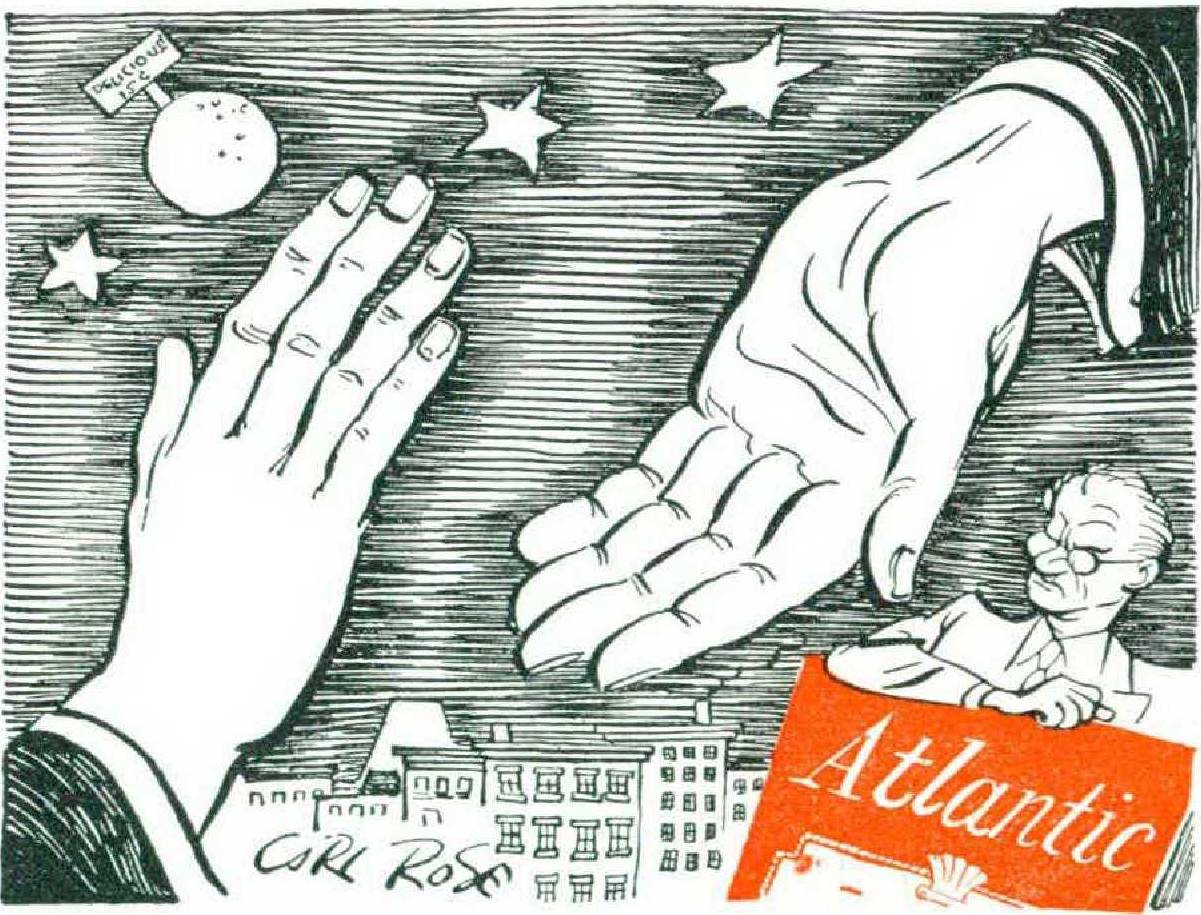
Having decided long ago never to stand in line for anything, under any circumstance, we should like to distribute reprints of Howard Hayes’s “Moon Cheese” (page 129) to all line-ups of freeborn Americans, whether for nylons, soap flakes, butter, or bread. Standing in line is a cut below accepting tips. No quid can be worth that particular quo. Better bare legs or marmalade than the shuffling docility of the queue, the shameful confession of what one is willing to put up with in the pursuit of the unplentiful. When the nylon salesmen are again ringing our doorbells and bonded bourbon is $30 a case, let us reread “Moon Cheese” and recall the fleeting eminence gained by those who finally stood in line long enough.
C. W. M.